






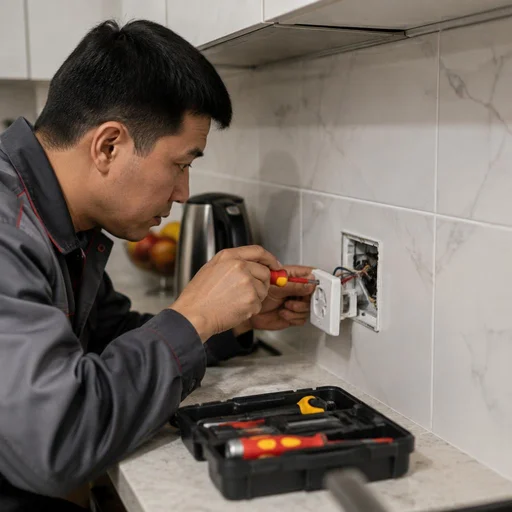
When an urgent electrician call is needed: signs of an emergency in an apartment
An emergency in the wiring almost always gives a signal in advance — sparking, smell, clicking in the panel. Let's break down which signs mean that an urgent call to a technician is needed, rather than a DIY repair.
Signs of a short circuit and a broken circuit
- Click in the panel: a sharp pop followed by the lights going out indicates a breakdown between phase and neutral in the cable or socket.
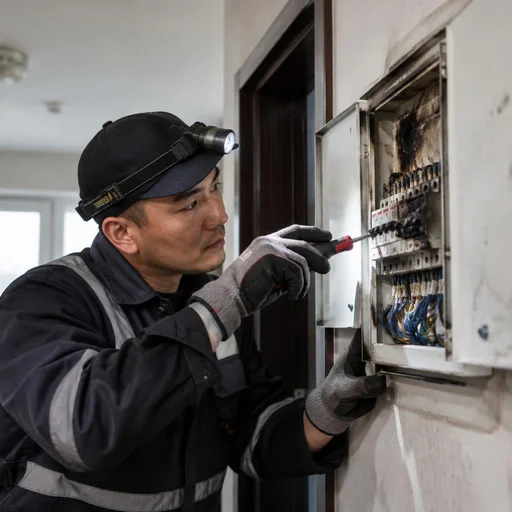
- Smell of burnt insulation: a pungent smell of burnt plastic near a socket or panel is a sure companion of a short circuit.
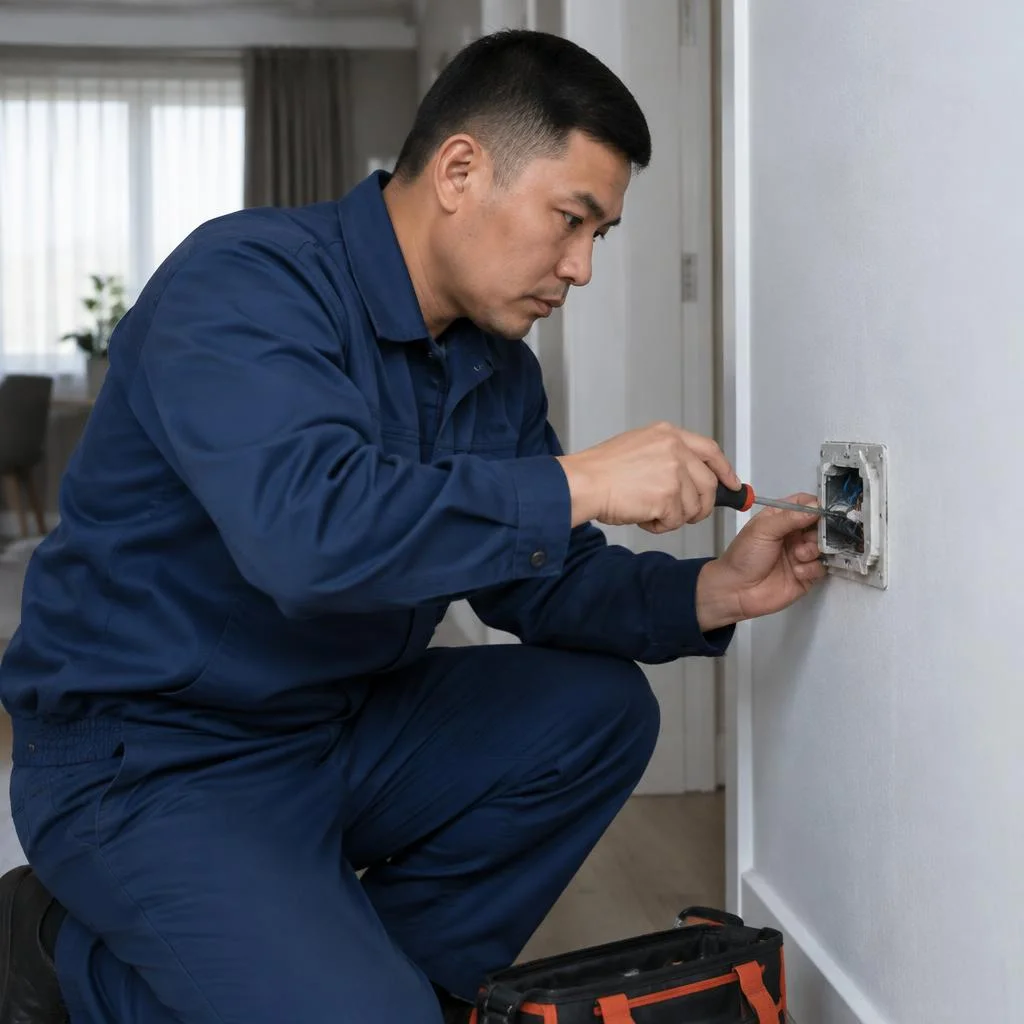
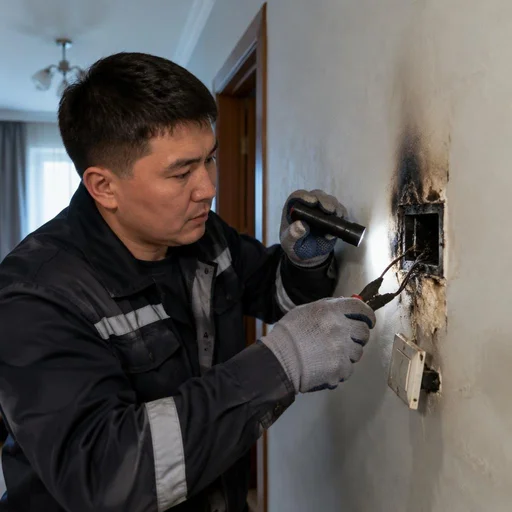
- Darkening of the socket: melted plastic and black scorch marks around the slots indicate overheating of the contact under load.
- The breaker does not hold the load: the protection trips again after each reset — a damaged section remains on the line.
- Sockets in one group are dead: some points work, some don't — a sign of a broken circuit or a burnt twist in the junction box.
What to do right now: the order of actions before the technician arrives
- De-energize the apartment: turn off the main switch or the two-pole breaker at the input — this is the first action in any emergency.
- Do not touch the panel with wet hands: moisture on your fingers and the metal panel turns an inspection into an electric shock.
- Do not reset the tripped breaker again: each reset supplies voltage to the damaged section.
- Move flammable items away from the socket: move curtains, paper and furniture away from the source of the smell and heat.
- Call a technician: a round-the-clock 24/7 visit covers nighttime emergencies, when DIY repair is especially dangerous.
Why urgent calls happen more often in Bishkek's old housing stock
In Bishkek's older buildings, aluminum wiring and weak breakers are not designed for modern loads — an air conditioner, boiler, or microwave overloads the line. In the Alamedin-1, Vostok-5 and Dzhal microdistricts, old blocks run on 2.5 mm² aluminum with 16 A breakers, whereas a single 2 kW boiler draws almost the entire capacity of a group, and a washing machine adds another 2.2 kW. Over time, aluminum loses its ductility and oxidizes at the twists — the contact heats up even without exceeding the power, so a preventive check of the electrical panel is more informative than replacing a single breaker. Residents of such buildings should invite a technician to inspect the panel once every couple of years, before the first signs of an emergency.
Eco-Service Emergency Electrician: What an Emergency Call-Out Includes and How Diagnostics Are Performed
An emergency call-out is not about "replacing a circuit breaker" — it's about finding the cause. We show how a technician locates a break and a short circuit and what diagnostics include before work begins.
How a Technician Locates a Circuit Break Without Chasing Walls
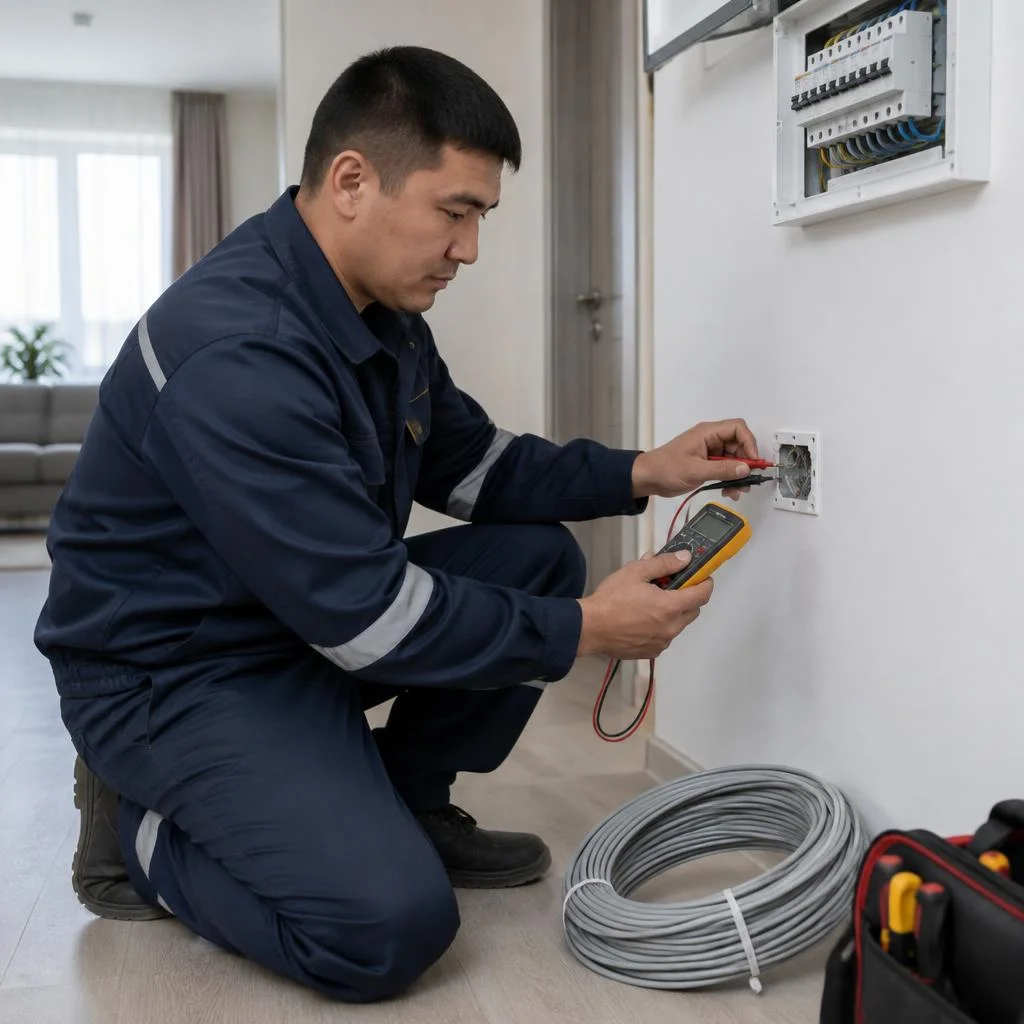
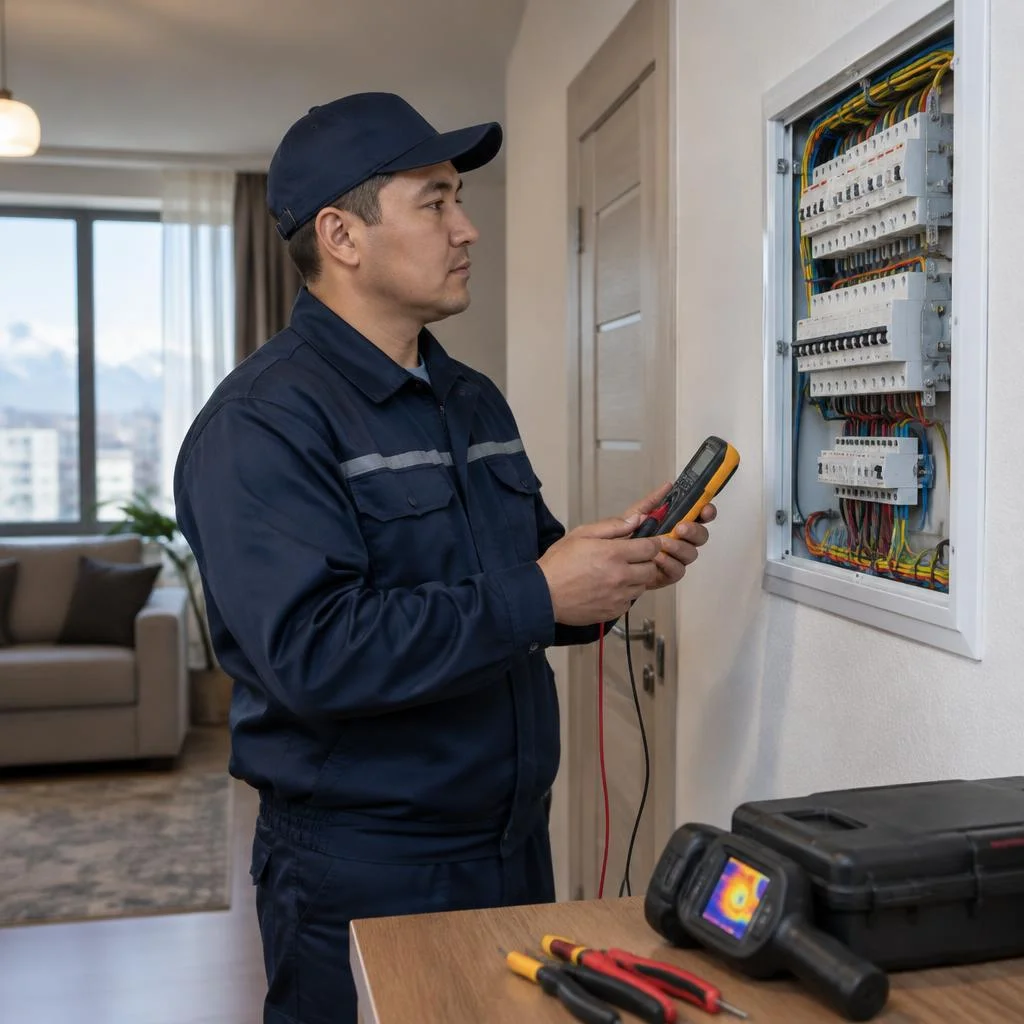
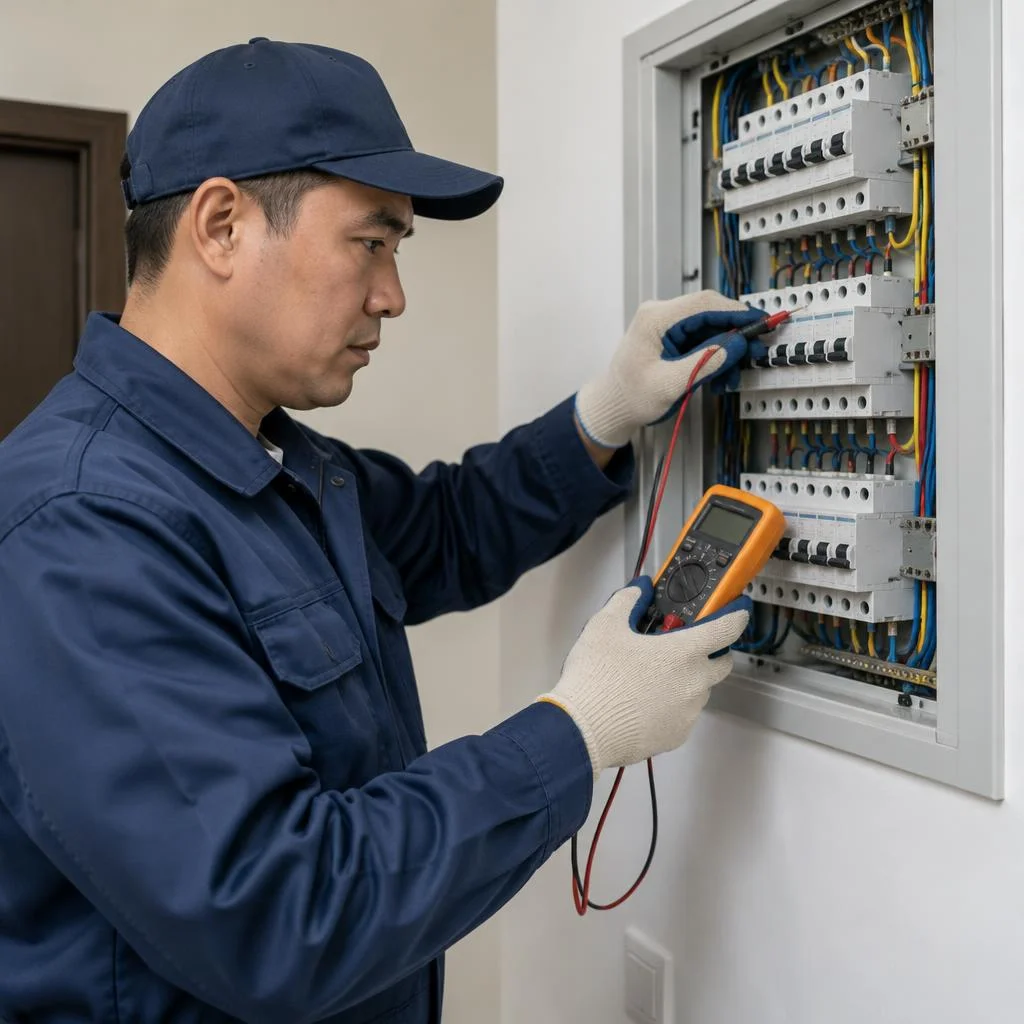
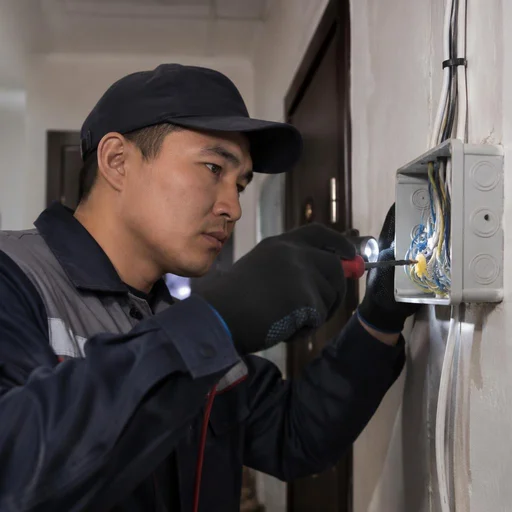
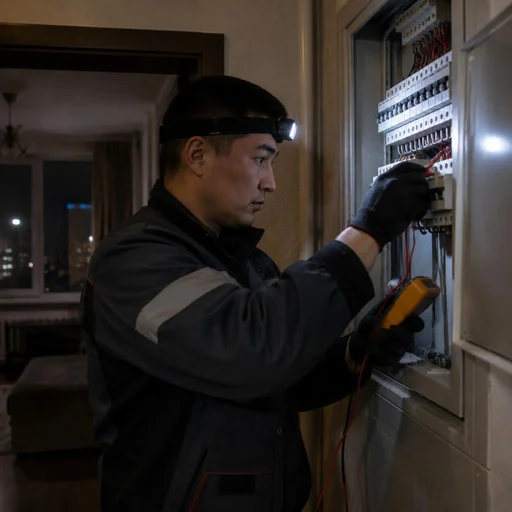
A specialist locates a circuit break using a multimeter and a cable tracer, section by section — from the panel to the outlets — without opening walls until the damaged section is confirmed. First, the lines from the junction box are tested for continuity: the device shows on which segment contact is lost, and only after that does the technician pick up the hammer drill. A cable tracer helps follow the cable in the wall without opening it — using the electromagnetic field, it determines the path of the conductor under plaster and concrete, which is especially valuable in panel buildings. Finding a break without wall chasing saves the finish: opening is done only on the confirmed segment, not "just in case" across the entire room, and after repair it's enough to fill and sand one section. This is precisely the stage that private handymen most often skip — they immediately open the wall and then can't explain where exactly the break was. In our practice, a client shows three opened sections, and the cause remains unfound.
Short Circuit Diagnostics and Inspection of the Panel with Circuit Breakers
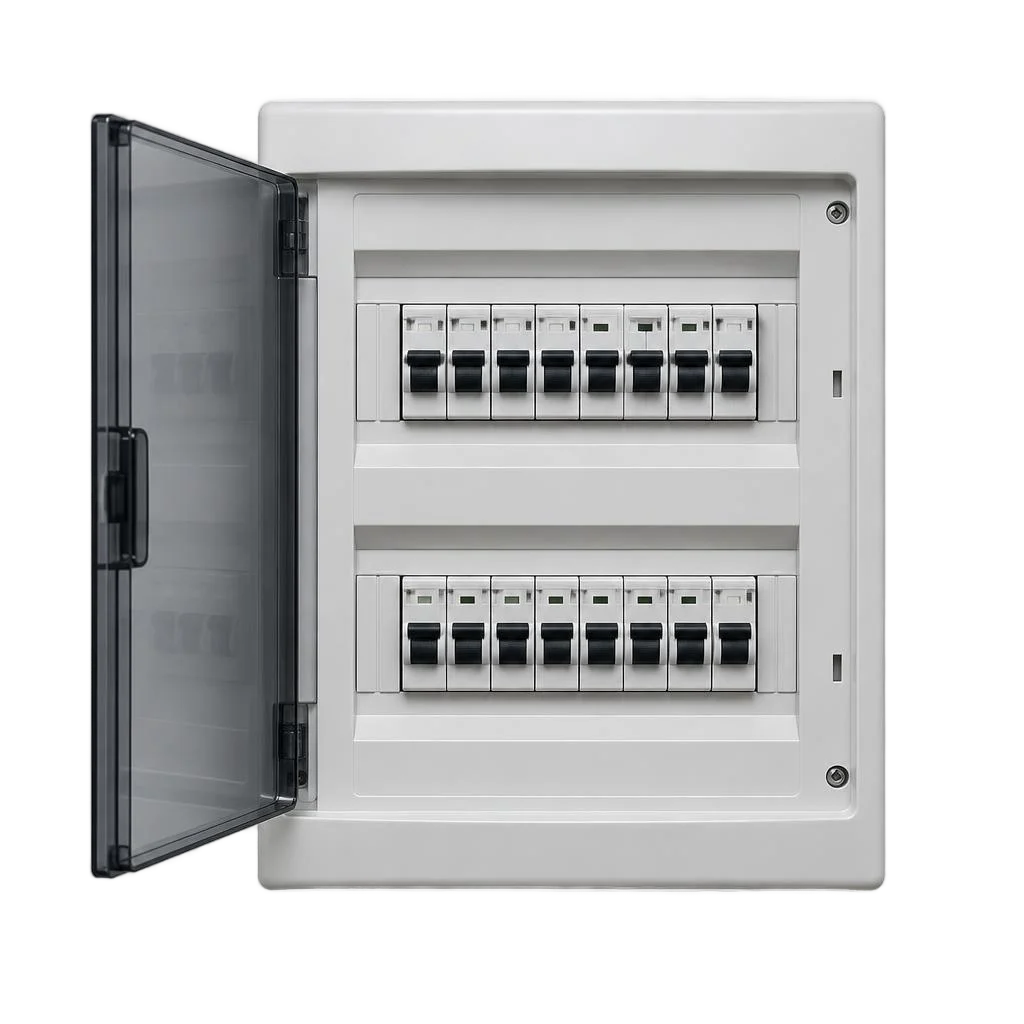
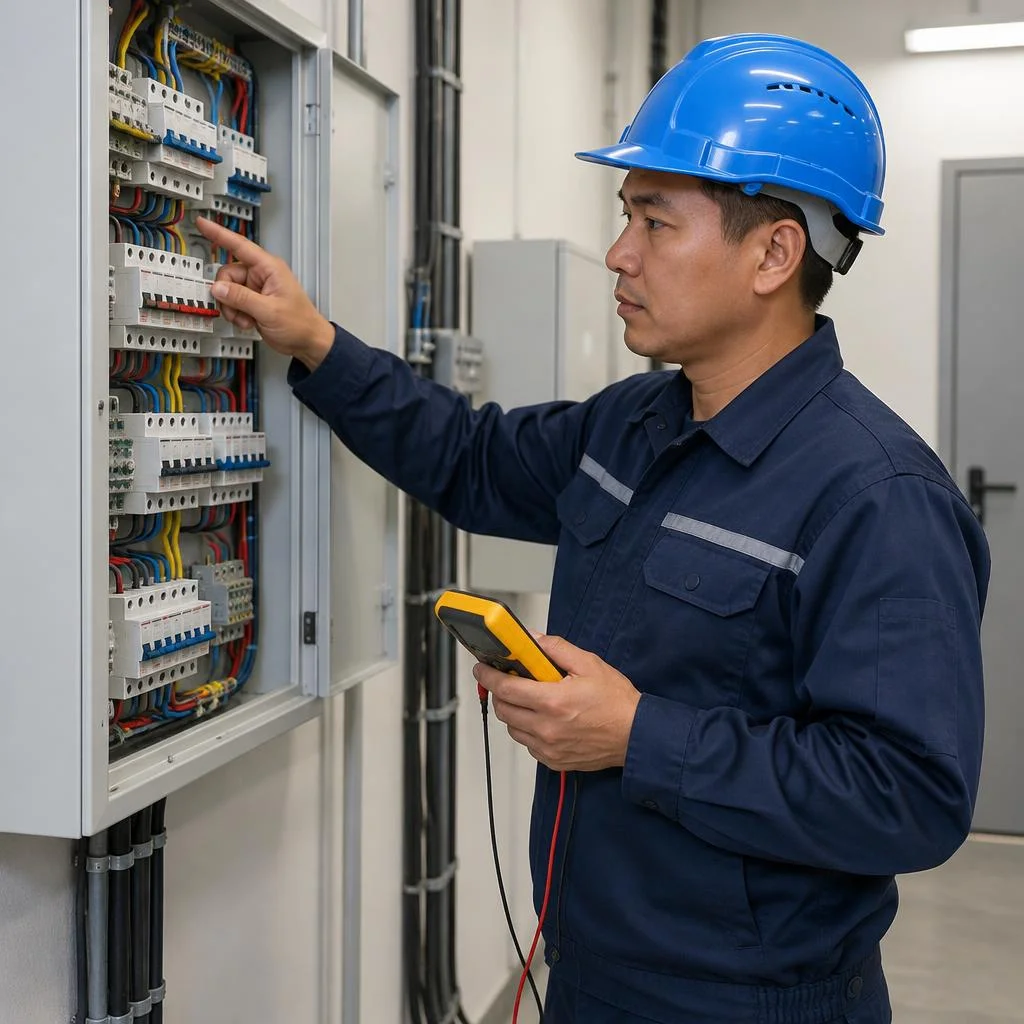
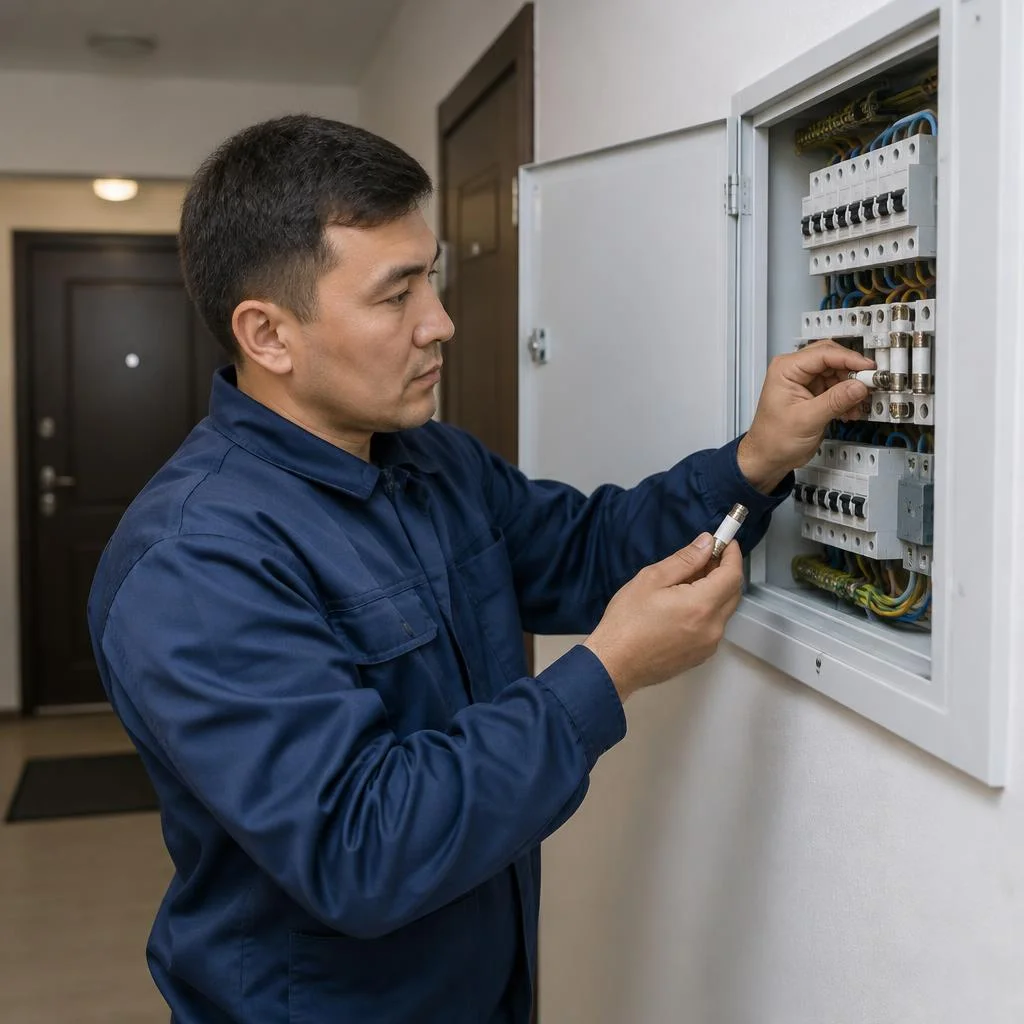
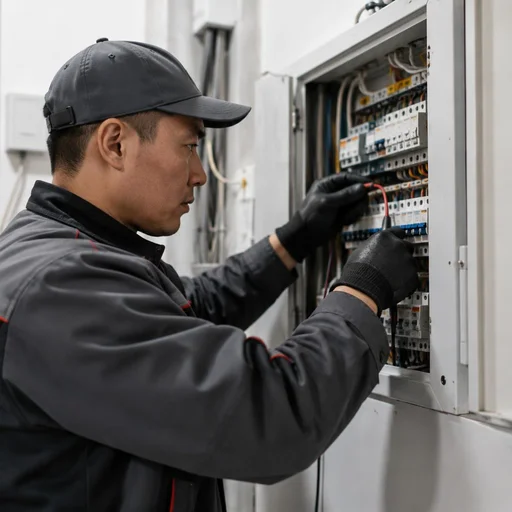
We check the panel and circuit breakers under load: with a tester, we measure insulation resistance, assess contact heating and the condition of the RCD, in order to separate a burnt-out breaker from line damage. A megohmmeter shows the insulation resistance of each line — if it's below the norm, the cause is not in the breaker but in the cable or in the appliance itself. The technician switches off the groups one by one and applies load: this way, the short circuit search is localized to a specific branch, not the entire apartment. Terminal heating is checked separately — a loose contact heats up and melts the breaker body, causing the protection to trip repeatedly even after replacement. Checking with a multimeter on your own only shows the presence of voltage — it does not detect contact overheating and leakage, which cause the breaker to trip repeatedly. If after resetting the lever the power goes out again, it's not worth searching further on your own: the cause is in the line, and without a device it can't be found.
Restoring Apartment Power and Eliminating Sparking
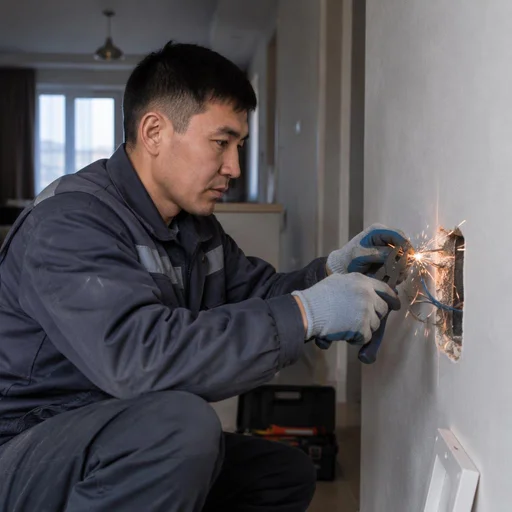
The technician restores the apartment's power after eliminating the cause and separately eliminates wiring sparking — re-tightening loose terminals, replacing burnt sections and tightening contacts in outlets. The procedure is as follows: first, the damaged group is found and disconnected, then each outlet on that branch is checked, and only then is voltage applied through a working breaker. Sparking in an outlet is often related not to the outlet itself but to a loose contact in the mounting box or a twist behind it — replacing the faceplate without eliminating the cause does not solve the problem. In Khrushchyovkas and Stalinkas of Bishkek, aluminum twists are found: they oxidize, heat up and spark under the load from a kettle or heater. The technician installs terminal blocks or solders the connection — this is more reliable than a twist and does not require replacing the entire line. Power is restored only after each group has been tested for continuity and checked under load.
The Smell of Burnt Insulation and Saving Wiring After Flooding
The technician eliminates the smell of burnt insulation by finding the overheated section, and saves wiring after flooding: testing lines for continuity, drying and replacing damaged segments before applying voltage. The smell almost always comes from a specific place — a junction box, an outlet assembly or a terminal block in the panel — so first the technician goes through all connections and looks for darkened insulation and melted plastic. After flooding, you can't just dry the walls and turn on the breaker — water in the mounting boxes and junction boxes causes leakage, which the RCD registers as a fault. Lines are tested for continuity with a megohmmeter: if the insulation resistance has dropped, the damaged segment is replaced, not dried with a hairdryer. In our practice, after leaks from neighbors, the outlets in the kitchen and bathroom are most often affected — moisture lingers there the longest. Applying voltage to such a line before complete drying and testing is not allowed: it's a direct path to a repeated short circuit.
Emergency electrician call-out: how the visit works and what the technician brings
An urgent call-out differs from a scheduled one in that the decision is made in minutes. We break down how the visit works, what the technician brings, and why qualifications matter more than speed.
24/7 round-the-clock call-outs and in-person drop-off at the service center
We accept requests around the clock: at night, the call-out follows the same procedure as during the day, and devices are accepted in person at the service center. The dispatcher records the address, the nature of the emergency, and the number of floors in the building — this data is used to assign a technician with the required certification and tools for the specific type of network. In Bishkek, requests are accepted both in new buildings on the Southern Highway and in the old housing stock in the center, where aluminum wiring with loose contacts is more common. A night call-out does not mean a "standby technician on call" — the same staff technician works the shift as during the day, so the quality of diagnostics does not depend on the time of day.
What the technician brings on an urgent call-out
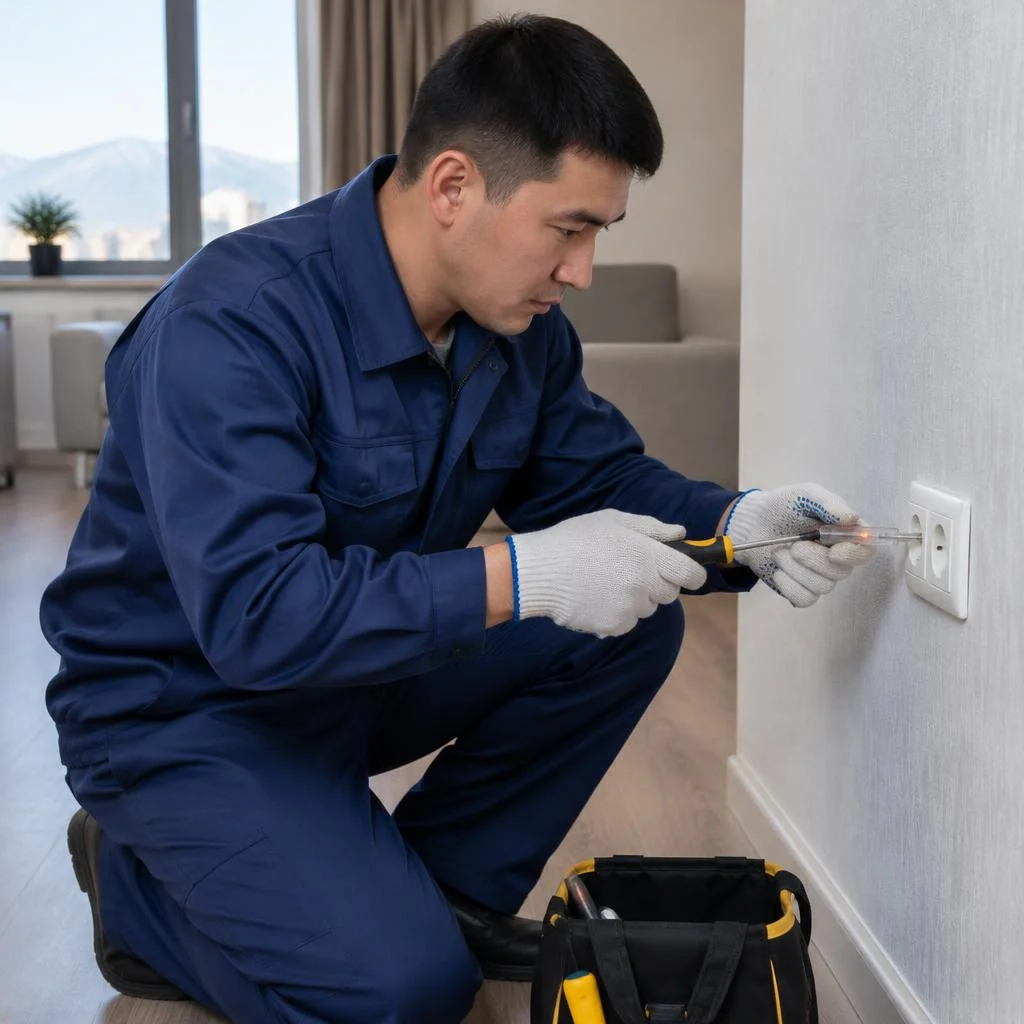
- Multimeter and voltage tester screwdriver: checking voltage at the input, sockets, and panel terminals before any work with wiring begins.
- Cable locator: finds the route of concealed wiring in the wall without opening it up — needed when a break or short circuit is hidden under plaster.
- Insulation tester: measures the insulation resistance of conductors, detects current leakage to the enclosure and hidden cable damage.
- Set of circuit breakers and fuses: replacement of a burnt-out breaker and fuse in the panel is done immediately if the rating matches the design.
- Consumables for sockets and switches: terminals, mounting boxes, insulation, ferrules — to restore the unit in a single visit.
- Cable lugs and zip ties: redoing twisted connections in the junction box when the cause of the emergency is an oxidized contact.
Why a qualified technician is more reliable than a private individual
We work under a contract with a 2-year warranty: the technician is a staff employee with relevant qualifications, not a one-off contractor from an ad. A staff electrician has electrical safety certification, a set of calibrated instruments, and accountability to the service — if the same issue recurs, the same specialist who handled the property investigates the call-out. A certified emergency electrician starts by measuring the insulation resistance of the entire line, not just by replacing a burnt-out part, so they find the hidden cause rather than the symptom. A private individual does not provide a written warranty and often does not have an insulation tester — they replace the visible unit, while the cause of the emergency may remain in the line. Based on our experience, every third repeat request after a "technician from Lalafo" is related to exactly this: the breaker is new, but the twisted connection in the box keeps heating up.
What is recorded in the contract before work begins
- Address and scope of work: the list of units the technician will check and replace at the property.
- Warranty period: 2 years on completed work and installed components.
- Procedure for a second visit: if the cause is in concealed wiring, the scope of the next visit is agreed upon before signing.
- Liability of the parties: who is responsible for the condition of finishes and furniture in the work area.
- Contractor details: a legal entity, not a phone number — the warranty certificate is issued based on it.
Electrician emergency service: repair of panels, sockets and switches
Urgent on-site repair is not just "fix it here and now." We show which units the technician repairs on-site and how to distinguish an emergency repair from a planned replacement.
Urgent repair of a socket and switch
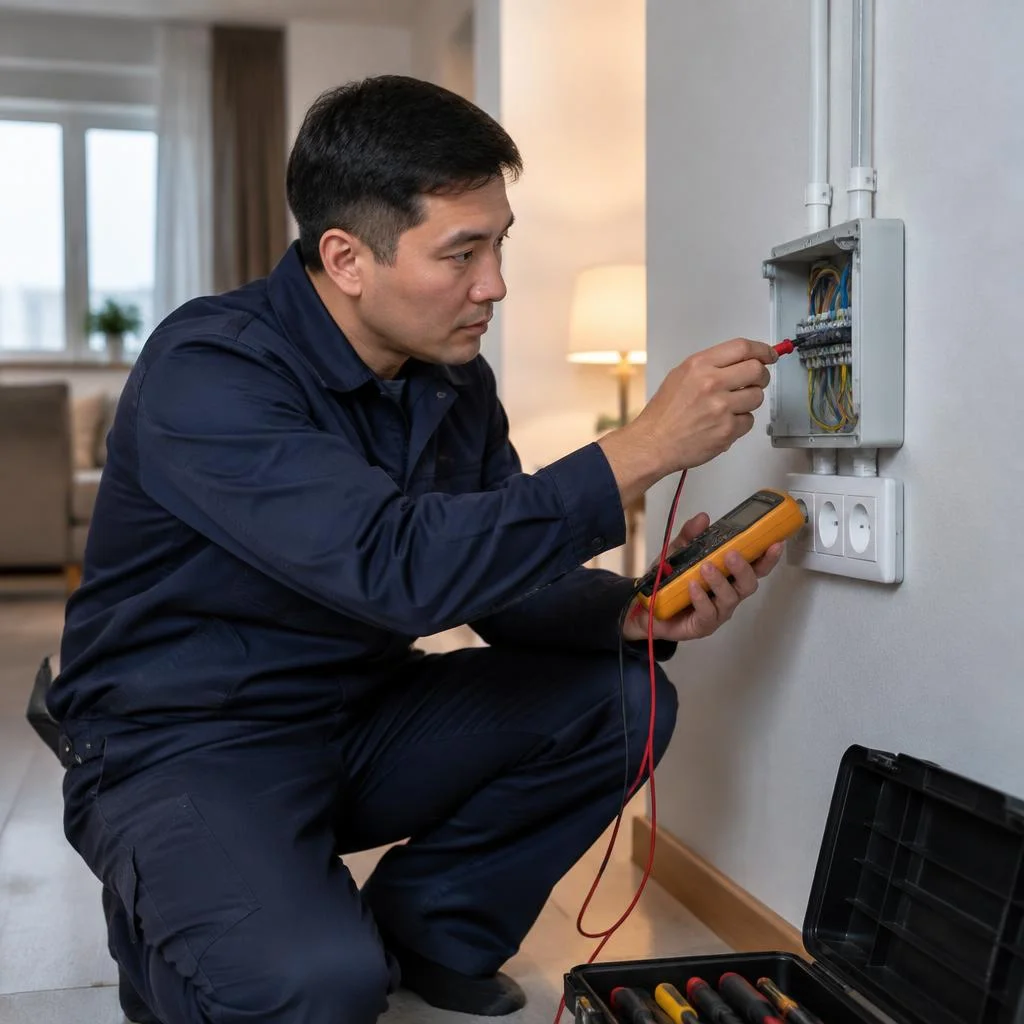
We perform such socket and switch repairs on site: we replace burnt terminals, restore contact, and if necessary install a new point in place of the damaged one. Most often the technician is called out for a socket sparking under load — a kettle, heater, washing machine — as well as for a switch that clicks but does not close the circuit or gets warm under your finger. In Khrushchyovkas and Stalinkas in central Bishkek — on Kievskaya, Toktogula, Frunze streets — 2.5 mm² aluminum wiring loses contact at the twists after 15-20 years, and it is the joint that burns, not the socket itself. If a socket gets hot under load, the problem is often in the cross-section of the supply cable, not in the socket itself — replacing the point without checking the line will lead to repeated heating.
Replacing a burnt-out circuit breaker and fuse in the panel
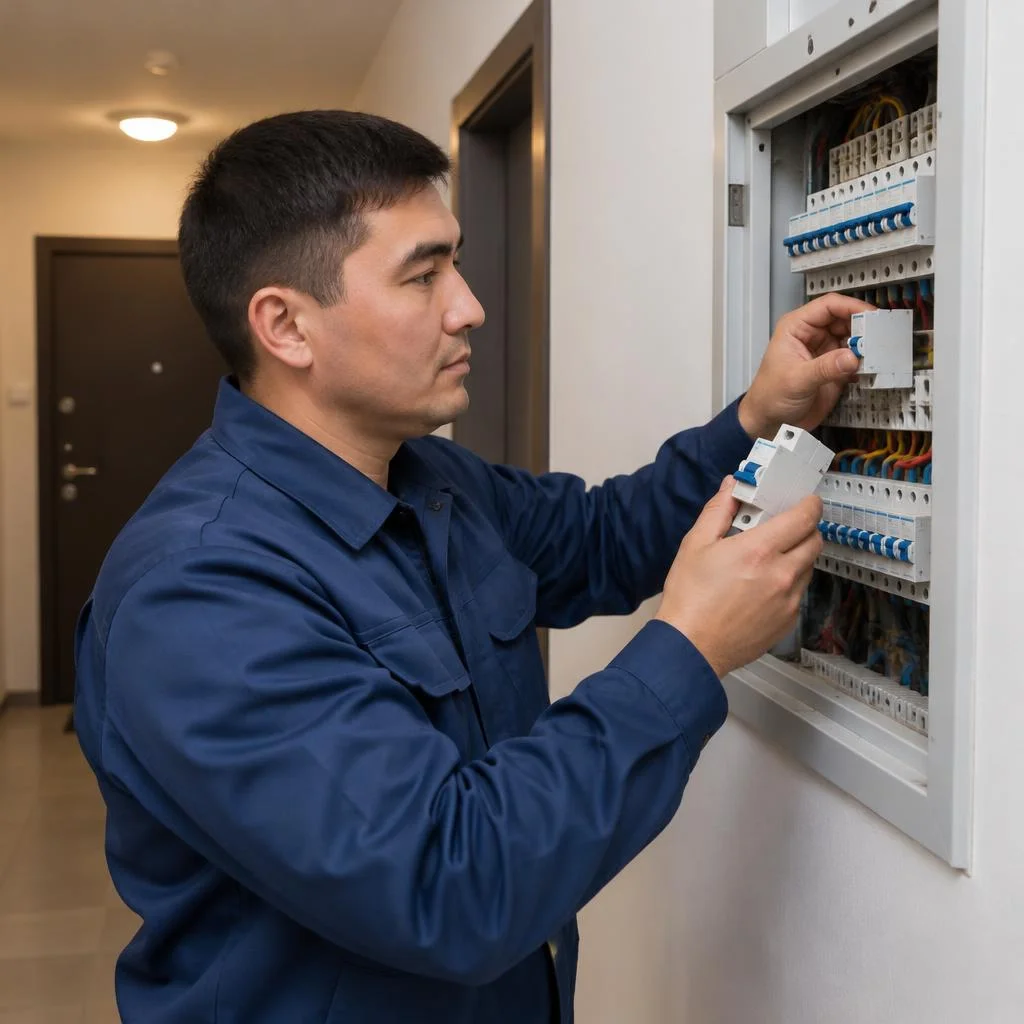
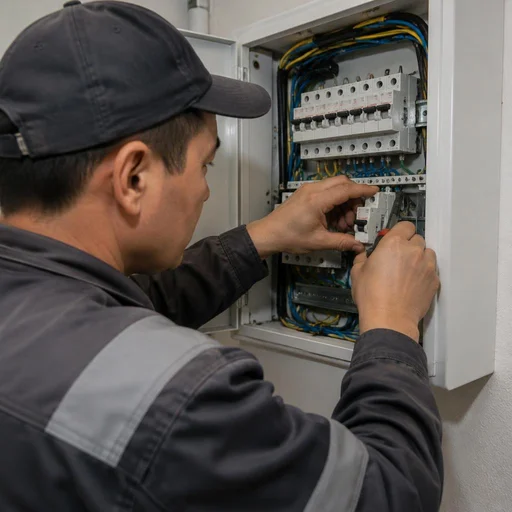
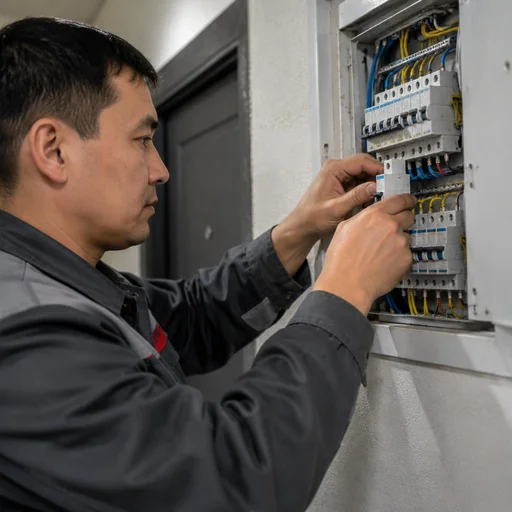
We replace a burnt-out circuit breaker and fuse in the panel, after first checking the line: a new breaker is installed only after confirming that the protection tripped due to overload, not due to a short circuit. On-site, the technician removes the panel cover, checks the incoming voltage of 220/380 V with a multimeter, tests the outgoing groups for continuity, and inspects the terminals for melting — on old panels in series 1-464 buildings in Jalal and Asanbay, the contact is so loose that the breaker trips without any real overload. When replacing a fuse in the panel, the rating is set strictly according to the cable cross-section: 16 A for a 2.5 mm² line, 10 A for 1.5 mm². A breaker with an inflated rating "stops tripping," but it also stops protecting — the wiring heats up inside the wall, and the next emergency could end in a fire.
Comparison of emergency work: what is resolved on-site and what requires a second visit
| Work | What is done on-site | Is a second visit needed |
|---|---|---|
| Locating a circuit break | Section-by-section diagnostics | No |
| Replacing a burnt-out circuit breaker | Replacement + line check | No |
| Emergency socket repair | Contact restoration | No |
| Replacing a fuse in the panel | Selecting the rating and replacement | No |
| Replacing the electrical wiring in a room | Marking and preparation | Yes |
| Installing concealed wiring | Chasing walls for cable | Yes |
| Saving wiring after flooding | Continuity testing and drying | Yes |
The exact boundary is determined by the technician after diagnostics: promising "we'll do it in an hour" before that is a sign of an unprofessional approach. Planned work such as chasing walls for cable or replacing the electrical wiring in a room requires a second visit with materials and tools, while an emergency call-out handles the initial restoration of power in a single visit.
Calling an emergency electrician: warranty, payment and liability
An urgent call-out is also a matter of trust: who is responsible for the result, how the warranty is recorded and how to pay for the work. Let's break down the service terms and the division of responsibility.
2-year warranty and a contract for urgent work
We draw up a contract and a warranty certificate for electrical installation work — the 2-year warranty covers replacement of circuit breakers, repair of sockets, and restoration of wiring. The call-out is carried out by a qualified technician with electrical safety clearance, not an outside contractor: the same specialist who performed the diagnostics signs the acceptance report. The warranty certificate records exactly which section was repaired: in the event of a repeat fault, the technician sees the work history and doesn't waste time diagnosing a line that has already been checked. If a person decides to call an electrician again for the same line within two years, the call-out under the warranty case is arranged without payment for the work. Keep the certificate together with the contract — if you move or sell the apartment, it confirms which sections of the wiring have already been put in order.
Payment via MBANK and O!Деньги
You can pay for an urgent call-out at Eco-Service via MBANK and O!Деньги — the transfer goes through immediately after acceptance of the work, and the receipt stays in the app. The technician also accepts cash, but cashless payment is more convenient for a night call-out: you don't need to look for change or keep money at home. The amount depends on the list of work — finding a break, replacing a circuit breaker or repairing a socket are counted as separate items, and the technician states the total before starting the repair. Cashless payment leaves a trace in the payment history — this is convenient if the work needs to be confirmed for a management company or landlord. Keep the electronic receipt: together with the warranty certificate, it settles the issue of confirming expenses in case of disagreements with the landlord.
Who is responsible for the wiring in a rented apartment
As a general rule, concealed wiring and the distribution board are the owner's area of responsibility, while a socket or switch damaged due to improper use is the tenant's. Wear of the line, old aluminium in the walls, a circuit breaker tripped by overload — these are repairs at the owner's expense, because the resident does not affect the condition of concealed utilities. A socket burnt out from an overloaded extension lead, a switch torn out by the roots, a point flooded with water — these are consequences of use, and the tenant bears the costs. A dispute is resolved more easily if the technician records in the report exactly what failed: wear of the line or mechanical damage to the point. Before calling, agree with the landlord who pays for the call-out — written confirmation in a messenger will remove any ambiguity when settling up.
Emergency electricians: wiring replacement and post-accident prevention
After an accident, it's important not just to restore power, but to understand whether the wiring needs replacing. We break down when local repair is enough and when planned replacement and prevention are needed.
When replacing the wiring in one room is enough, and when the whole apartment needs it
Eco-Service replaces the electrical wiring in a room for local line damage, but recommends apartment-wide wiring replacement if aluminum is laid throughout all the rooms and the breakers trip regularly. A sign of partial replacement is damage localized to one zone: an overheated outlet, a charred section behind a cabinet, a melted twist in a junction box. A full replacement is needed when the conductor cross-section can't handle the load from a boiler, washing machine and heaters: in Bishkek's panel nine-story buildings (Asanbay, Kok-Zhar, Djal microdistricts), 2.5 mm² aluminum lines carry a total of up to 3.5 kW, while a modern apartment consumes 6-8 kW. Partial replacement in one room doesn't remove the load from the shared line — if the panel is still on aluminum, the accident can repeat in the neighboring room.
Hidden wiring or open cable routing: what to choose
Eco-Service installs hidden wiring with wall chasing for the cable if renovation is underway, and routes the cable in an open way if the walls can't be touched. Wall chasing for the cable gives a smooth surface without overlays, but requires a wall chaser with a vacuum and subsequent plastering — in a panel building the groove depth is limited to 20 mm, otherwise the rebar is exposed and load-bearing capacity drops. Open cable routing in a cable duct or corrugated conduit takes 3-4 times less time and leaves no construction debris: in a rental apartment in Djal or an office on Kievskaya, this solves the issue in one day. Open routing in a cable duct is more maintainable: in an accident, the section is replaced without opening the wall, which is important for rental apartments and offices.
Preventive inspection of the electrical panel after an accident
Eco-Service performs a preventive inspection of the electrical panel after an accident: it measures insulation resistance, checks contact heating and the condition of the RCD to rule out repeated tripping. A megohmmeter shows the line's insulation resistance — the norm is from 0.5 MΩ; at 0.2-0.3 MΩ the insulation is already broken down, and the breaker will trip under load. A thermal imager detects overheating of terminals: a 15-20 °C difference between adjacent breakers indicates a loose contact that will melt the housing within 2-3 months. Inspection of the panel and breakers includes testing the RCD with the button and measuring the trip time — the norm is up to 300 ms at rated leakage current. It makes sense to do prevention once a year before the heating season: it's in winter that the load on the wiring is at its maximum due to heaters, and calling an emergency electrician costs more than a planned inspection.
Conclusion
An emergency service electrician solves not only the immediate power problem, but also prevents more serious consequences. Below are brief takeaways that will help you navigate the first minutes of an accident and afterward.
Key takeaways
- De-energize the apartment first: switch off the main breaker and don't hold a tripped lever — re-energizing under load increases the risk of fire before the technician arrives.
- Clicking, the smell of burnt insulation, darkened outlets are a signal for diagnostics: replacing the visible component without finding the cause leaves hidden damage in the wall.
- Finding a break without wall chasing preserves the finish: only the confirmed section is opened, not the entire run from the panel to the room.
- Local wiring replacement in a room helps with a pinpoint damage: with an aluminum line throughout the apartment, a full replacement is more reliable.
- Inspecting the panel once a year reduces the risk of a repeat accident during the heating season, when the load on the network is at its maximum.