








Why lightning protection is needed in Bishkek and when it is indispensable
In the foothills around the capital of Kyrgyzstan, thunderstorm activity is higher than the average for the Chuy Valley, and dense development and metal roofs make a direct strike a realistic scenario. We explain when it is impossible to do without a protection system.
Does a private house need lightning protection
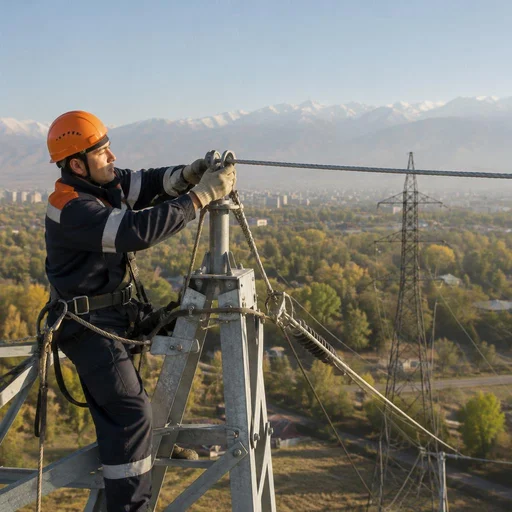
In Bishkek and the foothill areas, the number of thunderstorm hours per year exceeds the average for the region, so a private house with a metal roof, an antenna or a tall tree nearby falls into the zone of risk of a direct strike. The climate reference point is data from Kyrgyzhydromet: for the foothills of Ala-Archa and the Alamedin Gorge, 30-40 thunderstorm hours per season are recorded versus 20-25 on the plain, and a metal roof with an area of 80 m² or more acts as a natural air terminal. Houses in the residential areas of Kok-Zhar, Kalys-Ordo and Ak-Ordo are especially vulnerable, where tall poplars and power transmission line supports stand nearby. Installing lightning protection is the request we most often receive from owners of precisely such plots, and it also settles the main question: to protect the roof or wait for a strike. Even if neighboring houses have stood without protection for decades, this does not cancel out the statistics — a single discharge takes out the wiring, the boiler and the electronics for an amount comparable to the cost of the entire system.
Lightning protection standards in Kyrgyzstan and categories of facilities
- Category I: explosion- and fire-hazardous workshops, fuel and lubricant warehouses, gas stations — facilities with permanent occupancy; protection zone of type A with a reliability of 0.999.
- Category II: residential and public buildings above 25 m, schools, hospitals, server rooms with round-the-clock operation of equipment; protection reliability 0.99.
- Category III: private houses, cottages, low-rise outbuildings; a simplified zone with a reliability of 0.9 is permitted.
- Basis: СО 153-34.21.122-2003 and the international standard IEC 62305 define the zone calculation, the choice of down conductors and the requirements for grounding.
- Category upgrade: a gas boiler room or server room on the plot moves the facility into a stricter group and changes the scheme already at the design stage.
What happens if there is no lightning protection: real consequences
- Roof fire: a discharge into a wooden rafter system or combustible insulation leads to a fire within minutes.
- Electronics failure: a voltage surge burns out an inverter boiler, router, video surveillance and smart home controllers.
- Damage to wiring: the insulation inside the chases melts, which requires opening the walls and completely replacing the cable.
- Insurance denial: companies in Kyrgyzstan more often refuse to pay out if the facility was subject to being equipped with protection under the standards but in fact did not have it.
- Installing the system costs less than dealing with the consequences of a single strike, so the payback calculation is done before work begins, not after an accident.
Types of lightning arresters: rod, cable, mesh, mast
The type of lightning arrester is selected based on the roof shape, building height and the presence of protruding elements. We break down the four main options and show which object each of them suits.
Rod lightning arrester: when it covers the whole house
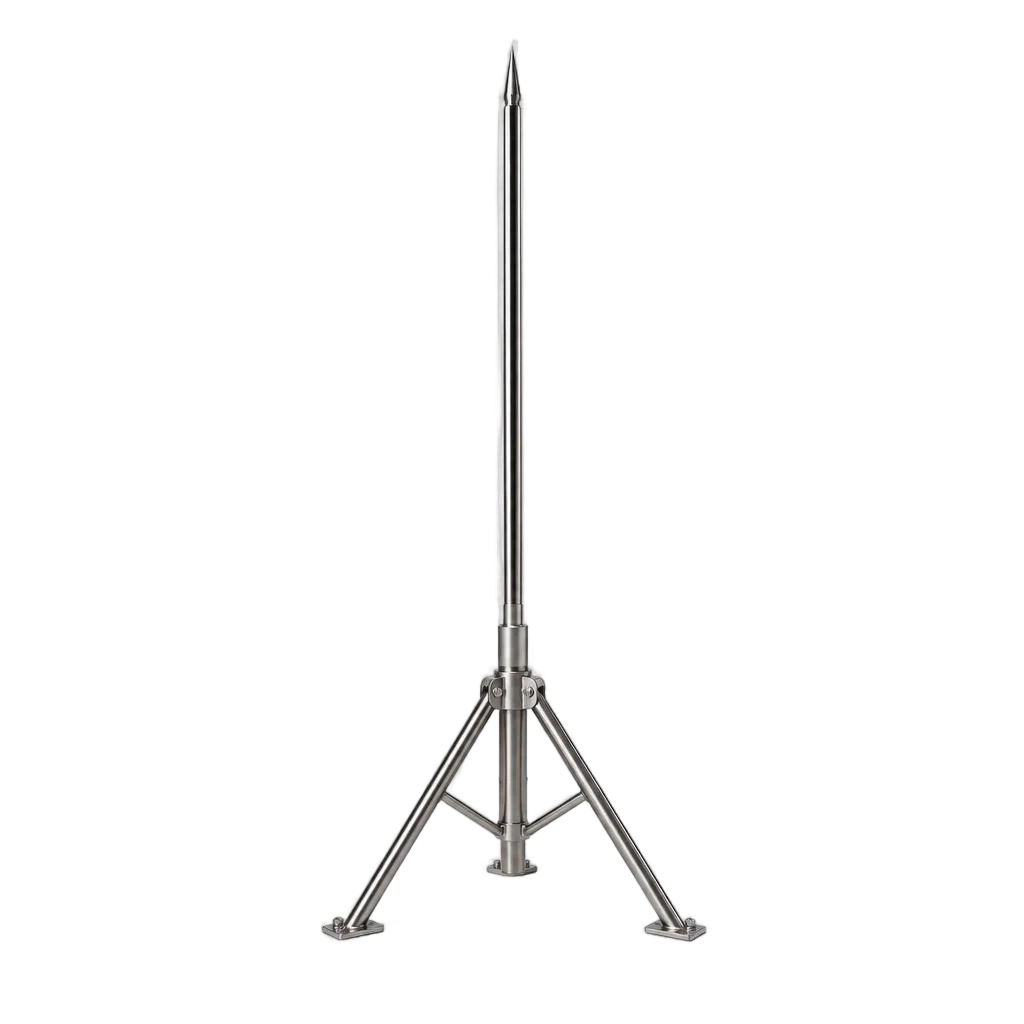
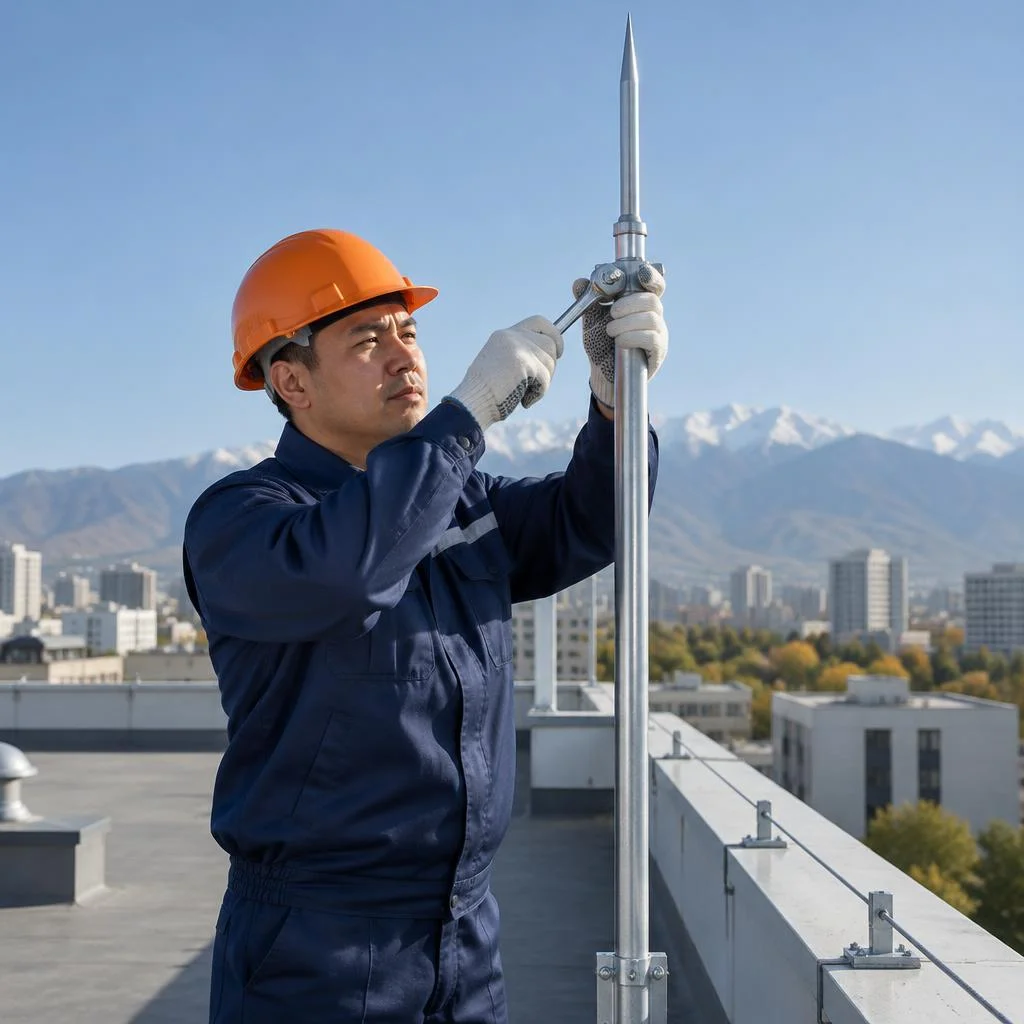
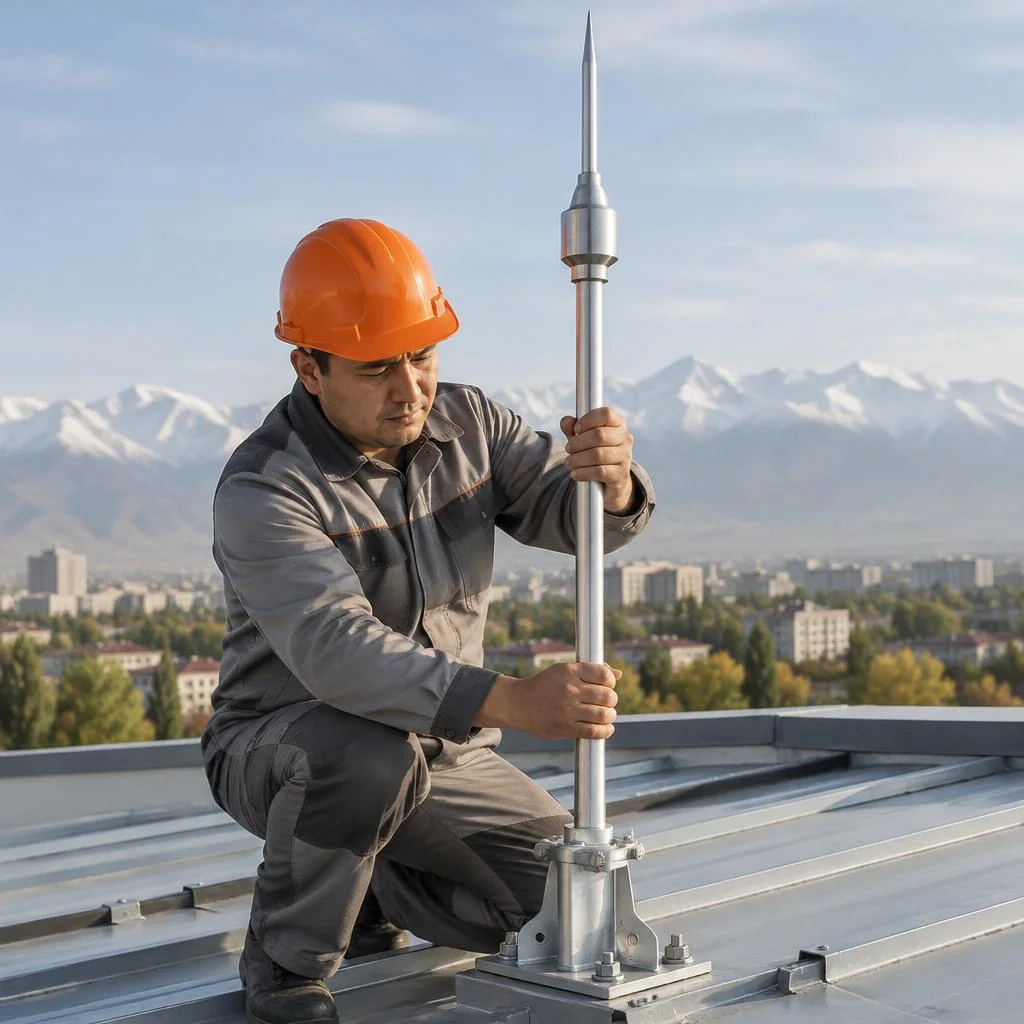
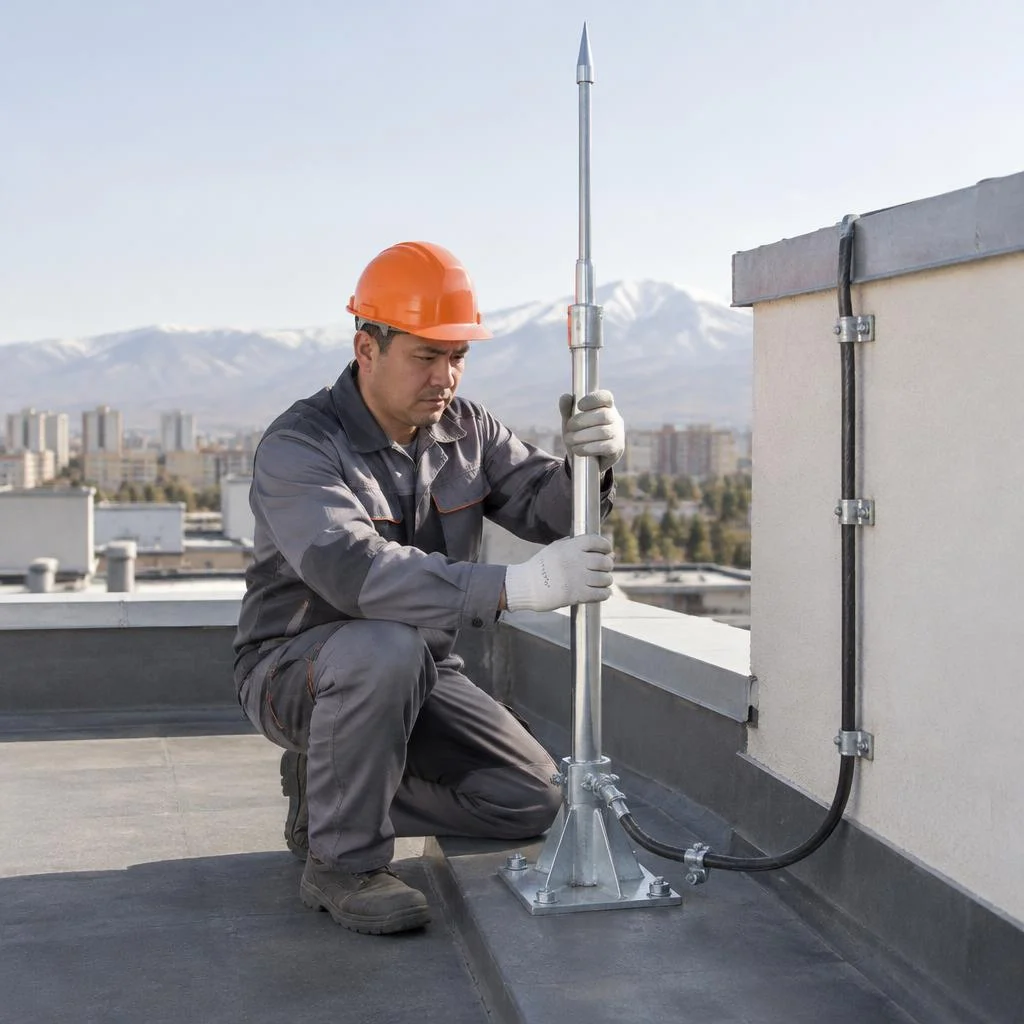
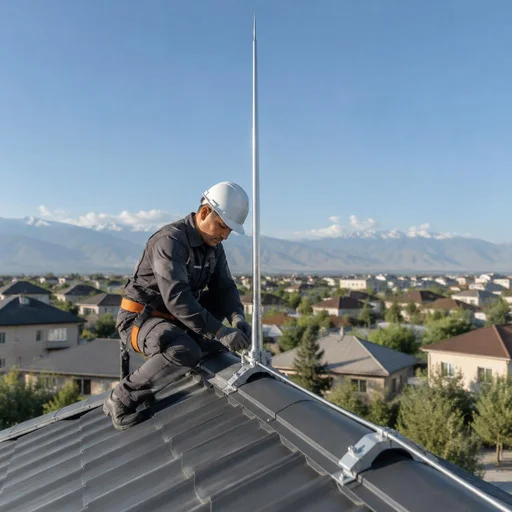
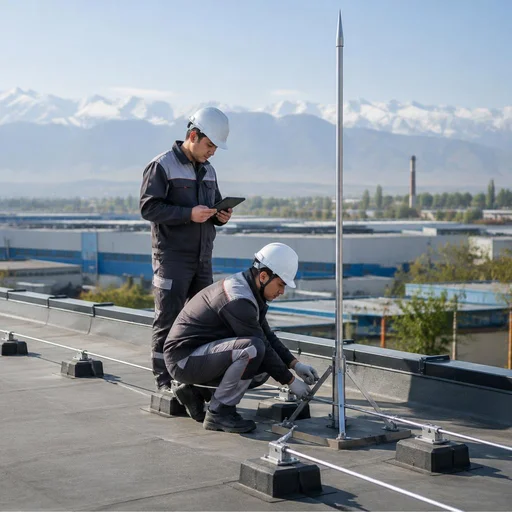
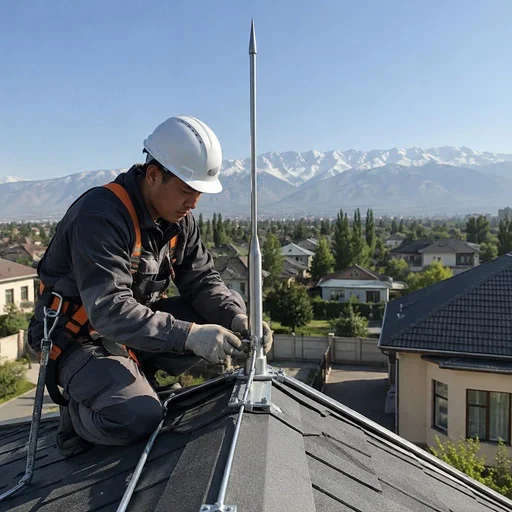
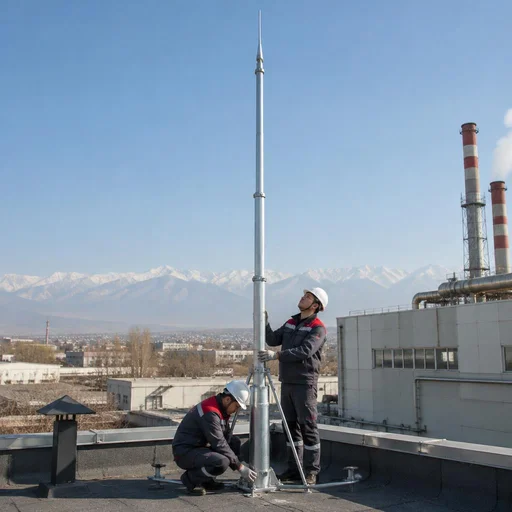
We install a rod lightning arrester on pitched roofs of private houses: a single rod with a 45° protection angle covers a compact building entirely. On objects with an area of up to 100-120 m² and a height of up to 10-12 meters, such an arrester made of steel or aluminum with a diameter of 8-10 mm covers the entire roof and the adjacent zone without additional elements. We fasten it on the ridge or at the highest point of the slope, connect it to the down conductor via a clamp and lead it out to the grounding loop. If the house is elongated or has an extension, a single rod is not enough — the protection zone narrows, and we add a second arrester or switch to a cable scheme. Before installation, check the roof shape in plan: a length-to-width ratio greater than 2:1 is a signal to provide two points rather than one.
Cable and mesh lightning arrester for extended and flat roofs
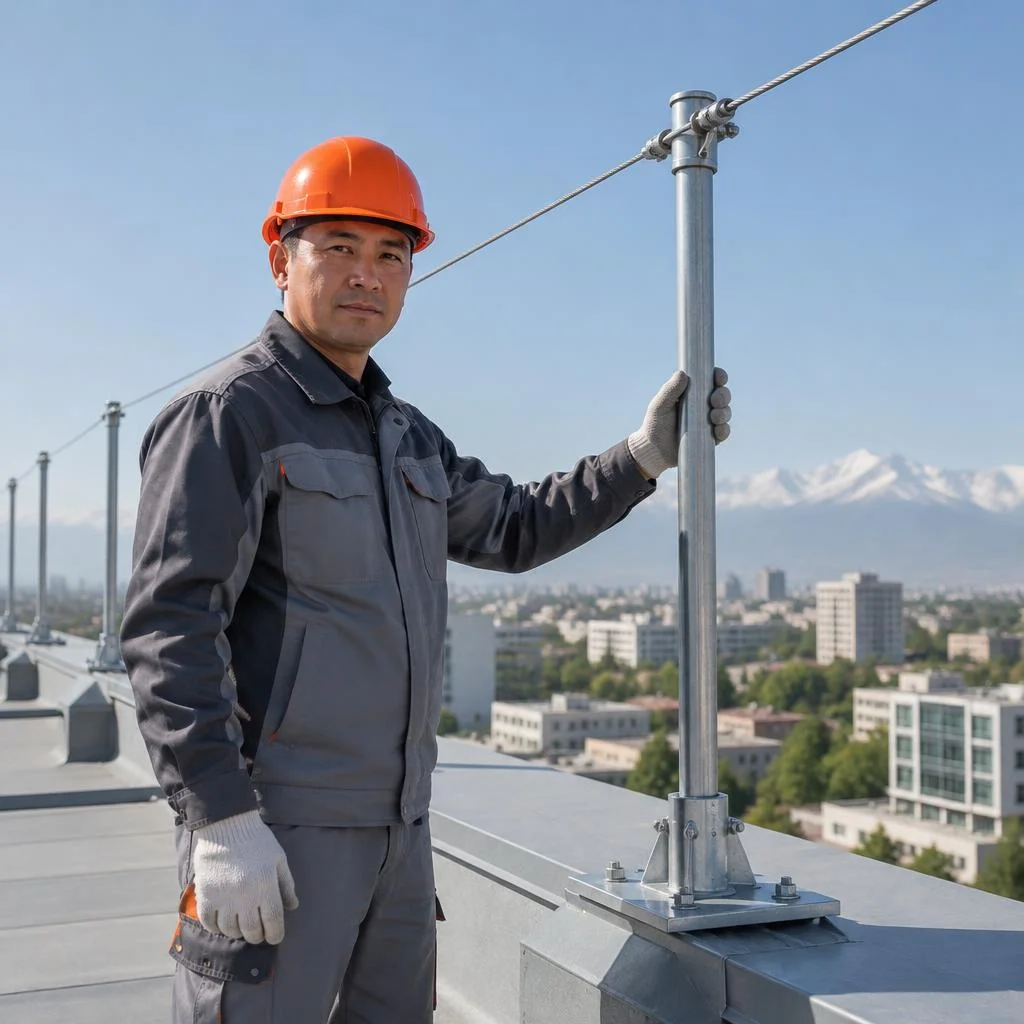
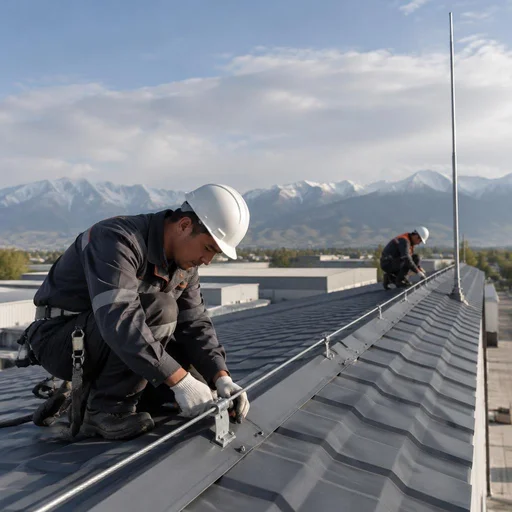
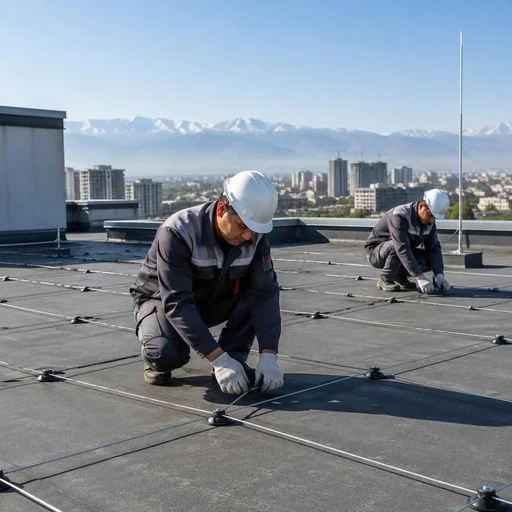
For long slopes we stretch a cable lightning arrester along the ridge, and for flat roofs we install a mesh with a spacing calculated for the object's category. A cable with a diameter of 8 mm made of galvanized steel is fastened to holders every 1-1.5 meters along the entire length of the ridge — on houses with a length of 20 meters or more this is cheaper and simpler than building a line of five or six rods. A mesh arrester made of 8 mm rod is laid in cells of 5×5 or 10×10 meters depending on the lightning protection class: for category III, 15×15 is sufficient; for I-II the spacing is reduced. The mesh requires more fasteners and welding points, so on small houses it loses to the rod in terms of labor costs, but on a flat roof it provides uniform protection without "dead" zones. When ordering, immediately clarify the object's category for the installation of a lightning arrester on a flat roof — the cell spacing and material consumption directly depend on it.
Lightning mast and free-standing lightning arrester
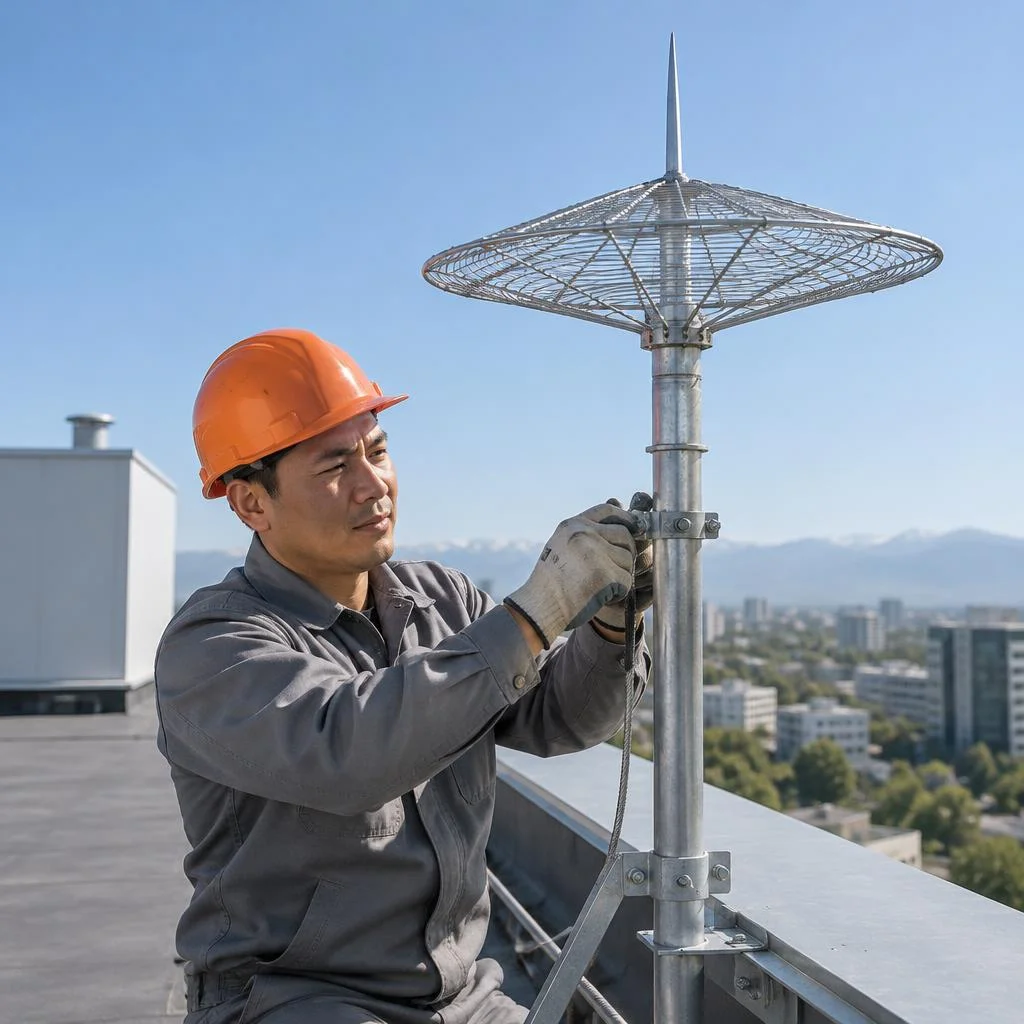
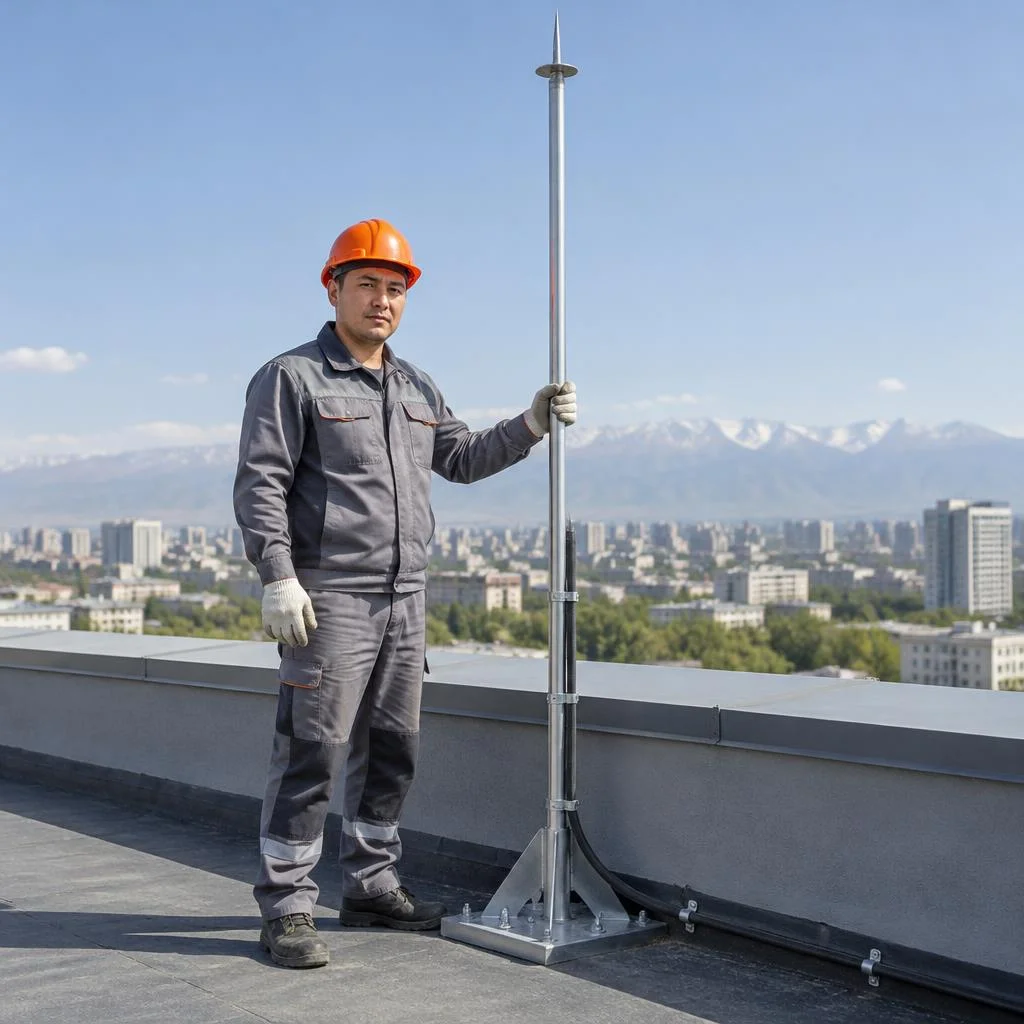
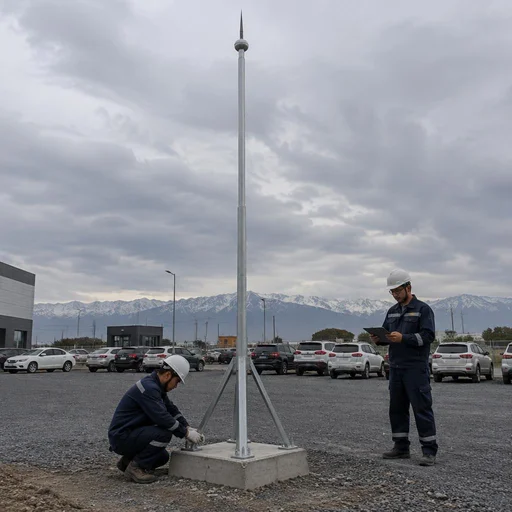
When the arrester cannot be fastened to the roof or the object has a complex shape, we install a lightning mast or a free-standing lightning arrester on its own foundation. A mast with a height of 6-15 meters is assembled from steel pipes with guy wires and rests on a concrete base or an anchor group; a free-standing lightning arrester is the same rod, but moved 3-5 meters away from the building and connected to its own ground electrode. This scheme is used on objects with historic roofing, membrane covering, explosive zones and where installation on the roof is prohibited by operating regulations. A free-standing structure is more expensive to install, but it eliminates the risk of damaging the roofing pie and simplifies maintenance — everything is visible and accessible from the ground. If the object is guarded or the roof is under the contractor's warranty, choose the remote option: it does not affect the covering and does not void the warranty. In requests, clients often write briefly — lightning arrester installation, and by the object's address we immediately determine whether a mast is needed or a 3-5 meter offset is enough.
Comparison of lightning arrester options by object type
| Object type | Recommended arrester | Installation feature | Protection category |
|---|---|---|---|
| Compact private house, pitched roof | Rod | One rod, 45° protection angle | III-IV |
| Elongated building, long ridge | Cable | Tension along the ridge, holder spacing 1-1.5 m | II-III |
| Flat roof, industrial object | Mesh | Mesh spacing 5×5 or 10×10 m | I-II |
| Complex shape, roof must not be touched | Mast / free-standing | Own foundation, 3-5 m offset | I-III |
In 8 out of 10 private houses a rod is enough; cable and mesh are for extended or flat roofs, and a mast is for objects where the roof must not be touched.
How a lightning protection system is designed and calculated
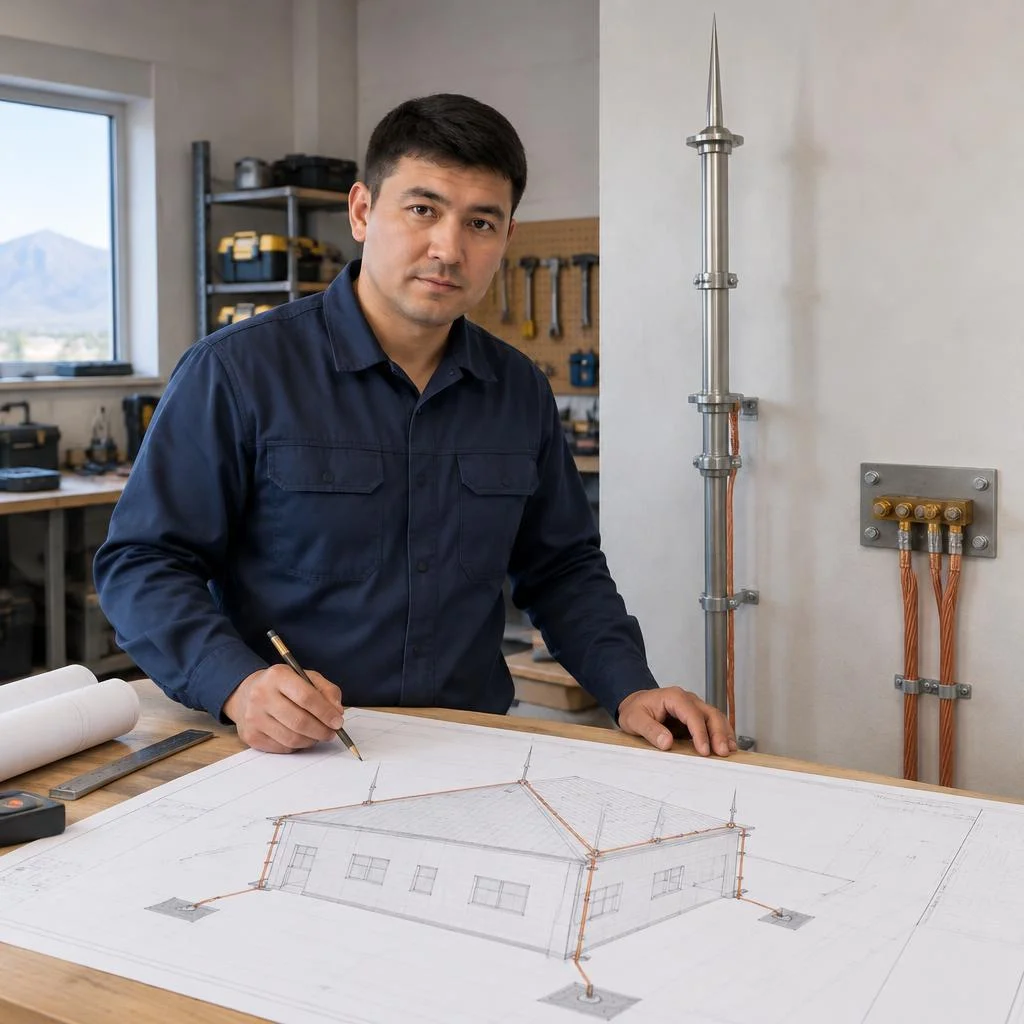
Before installation, the system goes through design and calculation — from the protection zone to the grounding resistance. Skipping this stage produces "paper lightning protection": there's a rod on the roof, but the protection doesn't work.
Calculation of the protection zone and selection of the category
We calculate the protection zone based on the height of the lightning rod and the dimensions of the building, and we take the category from Kyrgyzstan's regulations, taking into account the purpose of the facility. The basis is SO 153-34.21.122-2003: for a private house, category III is sufficient; for a facility with gas equipment or a server room — II; for explosive zones — I. We select the height of the rod so that the protection cone covers not only the ridge, but also the roof corners, the chimney, antennas, and dormer windows — these are precisely the points that take a strike during a diagonal discharge. For a complex roof with valleys and height differences, we calculate each zone separately, otherwise an uncovered sector remains at the junction of the slopes. In search queries, clients often write briefly — "gromootvod installation" — and this query usually hides precisely the calculation of the protection zone, not just a rod on the ridge. Another frequent query is "Lightning protection installation": behind it stands the same stage, only with an emphasis on the final installation, which is why we always start with the calculation, not with purchasing the rod. A mistake at this stage is underestimating the height of the rod "by eye": visually the rod is there, but the corner part of the house remains outside the protection zone, and the strike lands precisely there.
Calculation of grounding resistance for Bishkek soil
We measure the soil resistivity on the site and select the configuration of the ground electrode so that the impulse resistance falls within the standard for the chosen category. In foothill areas (Alamedin district, Kok-Zhar, the vicinity of Kara-Zhygach), the soil is rocky with layers of crushed stone — here a single 3-meter rod gives a resistance several times above the norm, and increasing the length barely helps. In such cases, we install a deep ground electrode or modular rod grounding, while in clayey and loamy soils in the floodplain of Ala-Archa and Alamedin, a classic loop made of angle steel is sufficient. The resistance calculation is performed by an Eco-Service engineer based on measurement results, not on tabular data for "average soil." On the rocky soil of the foothills, a single rod does not meet the standard, which is why a deep ground electrode saves days of work compared to attempts to drive the rod a couple more meters.
Audit and certification of existing lightning protection
- Visual inspection: the condition of the lightning rod, holders, fasteners, and welded seams — corrosion and cracks at the weld point are immediately visible.
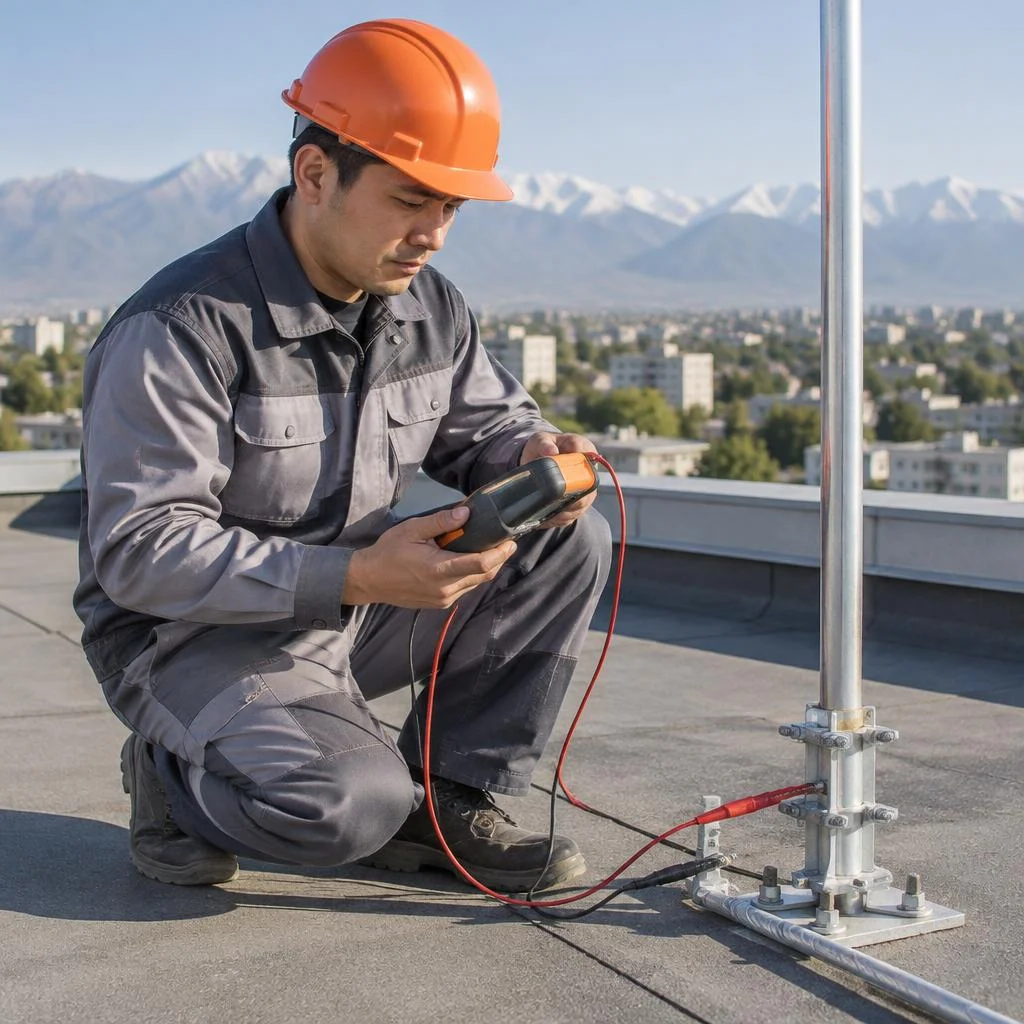
- Grounding resistance measurement: with an M-416 device or an equivalent at three points; the result is compared with the standard for the facility's category.
- Checking the down conductors: continuity of the circuit from the rod to the ground electrode, absence of twists, reliability of the connecting clamps on the facade.
- Issuing the certificate: we record the diagram, measurement results, date, and the person responsible — the document is kept by the owner.
- Verification against the current category: if the purpose of the facility has changed, the lightning protection certificate from Eco-Service is reissued to meet the new requirements.
Grounding and down conductors: the heart of the system
The lightning rod only receives the strike — the down conductors and the ground electrode must carry the discharge to the ground. It is precisely on this node that savings are most often made, and it is precisely here that the system loses its functionality.
Grounding of a lightning rod: loop, deep-driven and modular options
The grounding of a lightning rod is installed in three ways: a classic loop made of angle steel, a deep-driven ground electrode, and a modular rod system — the choice is dictated by the soil and the required impulse resistance. In Bishkek, the upper layers are often loess-like loams with a resistivity of 80-150 Ohm·m, while at a depth of 6-12 meters there are more moist gravel deposits. A loop made of 50×50 mm angle steel driven 2.5-3 meters along the perimeter provides the standardized 10 Ohms, but requires a free area of 6 to 12 m². A deep-driven ground electrode made of a copper-bonded rod goes down 9-12 meters and achieves the same parameters on a patch of one and a half by one and a half meters. Modular rod grounding is assembled from 1.5-meter sections and maintains stable resistance both in the dry season and after frosts. In areas of dense development in residential massifs such as Ak-Ordo or Kok-Zhar, where there are a couple of meters to the neighbor's fence, the modular option is more compact and more predictable seasonally — that is the one we recommend.
Laying the down conductor: facade, roof, chase
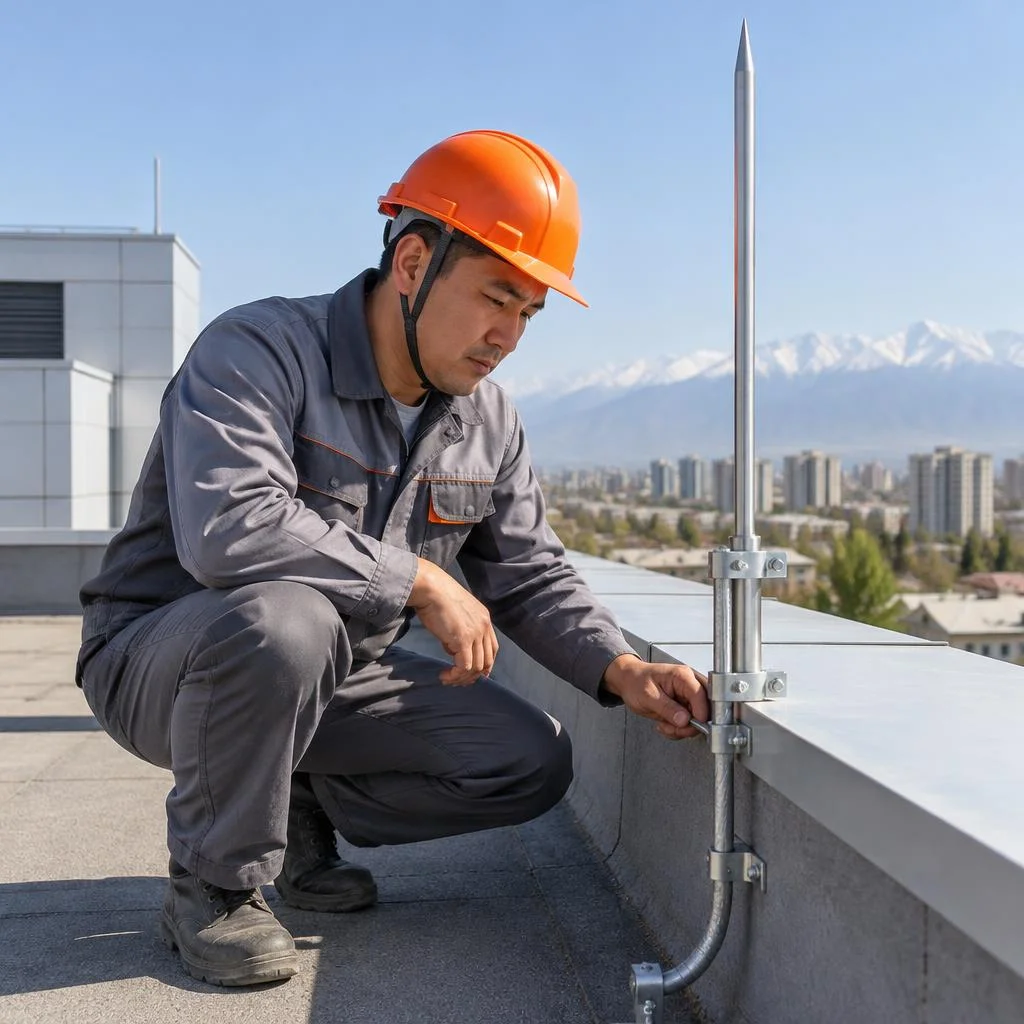
We run the down conductor along the facade, along the roof, or hide it in a chase — the route is chosen based on aesthetics, the length of the current path, and the wall material. The installation of lightning protection at sites with dense development almost always comes down to precisely this stage: along the facade, 25×4 mm flat steel or 8-10 mm diameter round steel is fastened to holders with a spacing of 600-1000 mm, and on plaster this is an open line that is visible. Along the roof, the down conductor is laid under the roofing or along the slope toward the drain — this makes the route shorter, but requires sealing of the penetrations. In a chase 20-25 mm deep and 15 mm wide, the flat strip is hidden, and afterward it is filled in with plaster or cladding — an option for houses made of brick and aerated concrete, where load-bearing structures cannot be chased all the way through. Every extra bend of the down conductor increases inductance and the risk of sparkover to adjacent utilities, so the route is kept as straight as possible, even if it costs a little more in fasteners. At sites with metal siding, we separately check whether the cladding forms a parasitic loop.
Connections and welding: why twisted joints are unacceptable
- Welding in the ground: all underground connections are lap-welded, the seam is cleaned and coated with bitumen mastic — this is the only node that cannot be rechecked later.
- Clamps on the facade: for inspectable nodes we install galvanized clamps with a spring washer so that the connection can be inspected and tightened.
- Holders and fasteners: holder spacing of 600-1000 mm on the facade and 500-800 mm on the roof, with fasteners selected for the base material.
- What is not allowed: twisted joints, ordinary hose clamps, butt welding without overlap, connecting aluminum to copper without a bimetallic spacer.
Lightning protection installation: stages, seasonality, work on a finished house
Lightning protection is installed both during the construction phase and on a finished house. Below are the turnkey work stages, the specifics of retrofitting, and seasonal restrictions on burying the ground electrode.
Turnkey lightning protection installation stages
- Route marking: we lay out the path of the air terminal, down conductors and ground electrode along the roof and facade, taking into account corners, overhangs and the drainage system.
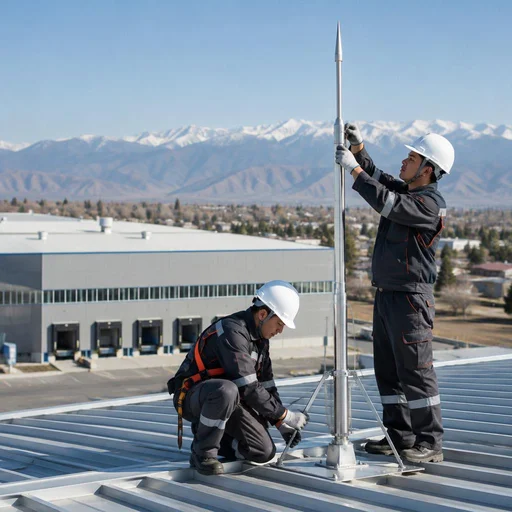
- Air terminal installation: we install a rod, cable, mesh or mast on the roof, or a free-standing lightning rod next to the building.
- Down conductor routing: we run the descent along the facade, roof or in a chase with a fastening spacing that prevents detachment under wind load.
- Grounding installation: we assemble the loop, deep or modular-pin ground electrode and connect it to the down conductor by welding or clamps.
- Handover with testing: we measure the impulse resistance and issue the system passport. We take the final measurement after rain and in dry soil — if the reading "fluctuates", we correct the ground electrode immediately, not after the first thunderstorm season.
Installation on a finished house and in winter
On a finished house we route the down conductors along the facade without opening up the finish, and in winter we install the above-ground part and the grounding in thawed soil, or postpone the burial until the thaw. Retrofitting does not require dismantling the roof: we place fasteners into the rafters through the finish coating, and run the descent along the ventilated facade or plaster with a spacing that withstands wind loads in Bishkek. Winter installation of the roof part is even more convenient — there is no risk of damaging a fresh roof, but we do not bury the ground electrode in frozen soil: it breaks the tools and does not provide the required contact. If the site is handed over in winter, we close off the above-ground part and move the burial to spring, and record the unfinished stage in the passport.
Lightning rod installation in a private house: what the work includes
Our lightning rod installation in a private house includes the design, air terminal, down conductors, grounding, fasteners and handover with a passport — the customer does not need to buy components separately. If the house is already connected to the electrical grid, we immediately check where the existing grounding goes: sometimes it can be used as part of the loop, and sometimes it does not meet the resistance requirements. Installing a lightning rod in a private house on a site with existing electrical wiring always begins with this check — otherwise the new loop and the old grounding will work against each other. And installing a lightning rod on a house without electrical wiring follows the standard scheme from scratch, without tying into existing networks.
Electronics protection, maintenance and 2-year warranty
Lightning protection does not end with the air terminal: electronics are protected by surge protective devices (SPDs), and the system itself needs periodic checks. Below — about protecting sensitive equipment, the maintenance schedule and the terms of the two-year warranty.
SPDs: why electronics need separate protection
We install SPDs at the house's service entrance and before sensitive equipment: they suppress secondary impulses that travel through the network even during a distant discharge. In Bishkek's private sector — Verkhny Ala-Archa, Kok-Zhar, Mayevka — an impulse is induced on the overhead line and reaches the boiler, pump and server rack, bypassing the air terminal. We select the arrester by protection level: for the main distribution board — Class I with a 25 kA impulse current, for low-voltage and video surveillance lines — Class II or III. We install modular DIN-rail devices with a wear indicator so the cartridge can be replaced after it operates. Lightning protection without SPDs protects the building but not the electronics: without an arrester, the induced impulse burns out the control boards of the boiler and inverter. Check whether an SPD is installed in your panel before the start of the thunderstorm season — it is cheaper than replacing a heating controller.
Maintenance and periodic system checks
- Inspection of connections: check the welded joints, clamps and bolted contacts on the air terminal and down conductor — a loose contact causes sparking.
- Measurement of grounding resistance: take a measurement with an M-416 or MRU-200 device — a rise in resistance above the norm signals corrosion of the electrode.
- Checking the fasteners: after winds and hail, inspect the holders on the roof and facade — a torn-off fastener leaves the down conductor hanging.
- SPD inspection: replace the arrester cartridge if the indicator shows it has operated or is worn.
2-year warranty and support after handover
Eco-Service gives a 2-year warranty on lightning protection installation: it covers welded connections, fasteners and the operation of the ground electrode, provided the operating conditions are observed. After handover of the facility, we provide a passport with the down conductor diagram, grounding points and a resistance measurement report — it is convenient for planning annual checks. In the passport we record the actual configuration, not a standard design: the price of lightning protection installation depends on the type of air terminal, the length of the down conductors and the depth of the ground electrode. Clients often search for "lightning rod installation price" — and end up here, so let me clarify: the estimate is made up of the same components plus the cost of the mast or free-standing support. The warranty is void if the system was modified by a third-party contractor or if extraneous lines were connected to the down conductor — coordinate any modifications before starting them.
Conclusion
We have gathered the main things that determine the result: without calculation and proper grounding, even an expensive air terminal remains a useless element on the roof.
Key takeaways
- Calculate before buying: lightning protection begins with determining the protection zone and the category of the facility, not with purchasing a rod or mast.
- The roof shape decides: a rod air terminal covers compact houses, while catenary and mesh systems cover extended and flat roofs.
- Grounding is the foundation: down conductors carry the discharge to the ground, and underground connections are made by welding, not twisting.
- Electronics separately: voltage surges are suppressed by SPDs, and the entire system is checked once a year before the thunderstorm season.
- The document as proof: the lightning protection passport records the diagram and parameters — without it, it is difficult to confirm compliance with the norms.