








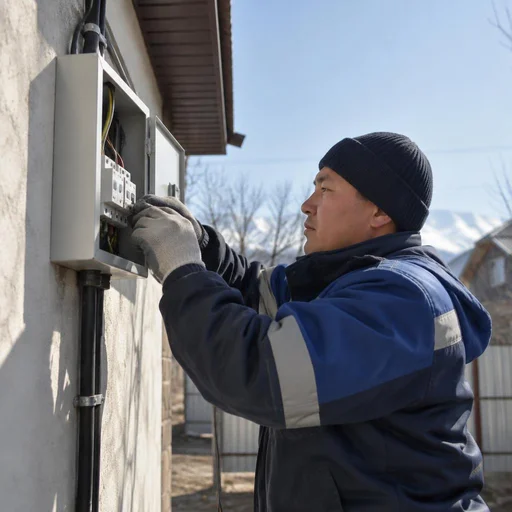
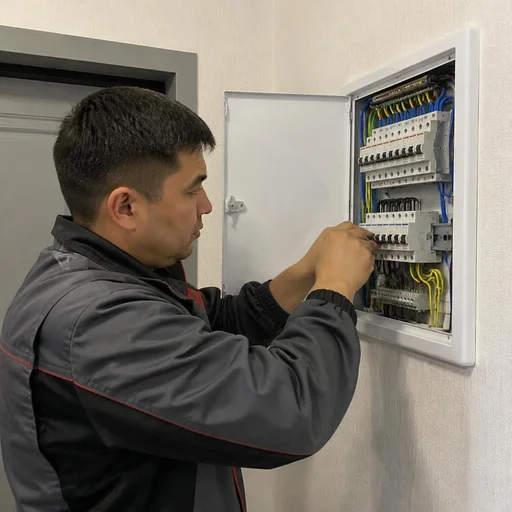
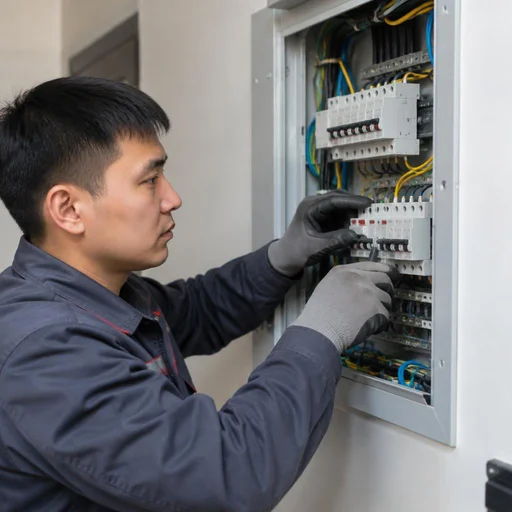
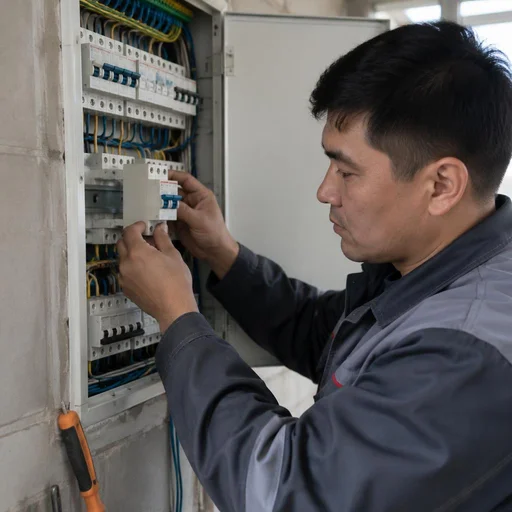
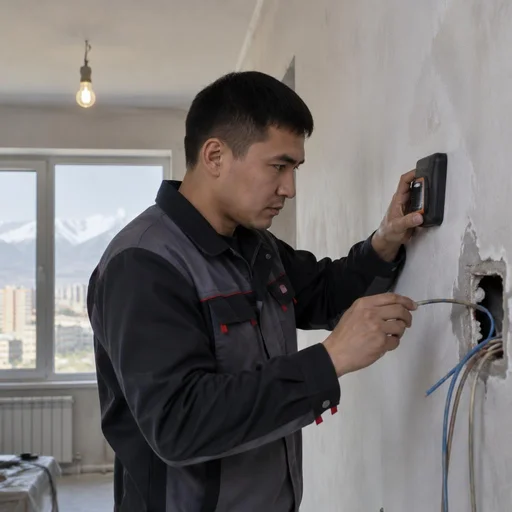
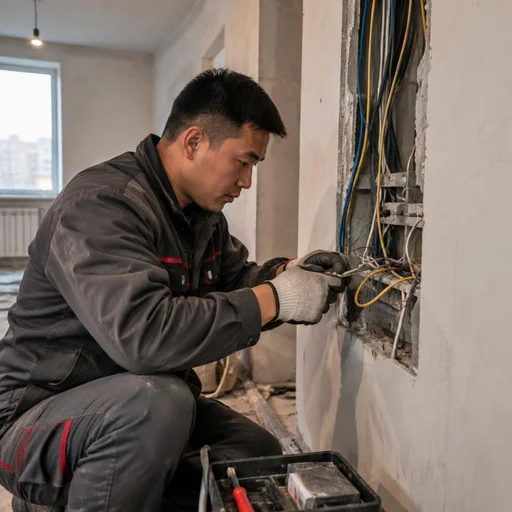
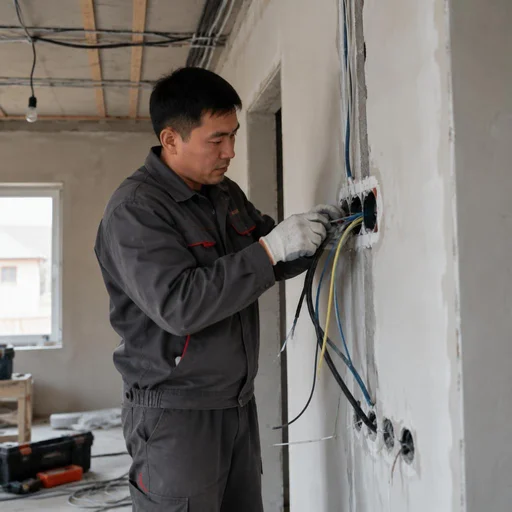
When old wiring in Bishkek becomes dangerous
A quarter of the city's housing stock consists of panel and brick buildings from the 1960s–1990s, where the lines were run for a lamp, a refrigerator and a TV. Today a washing machine, air conditioner, induction cooker and boiler have been added to those same circuits — and the aluminum in the walls gives out first.
Signs that it's time to replace the wiring
- A warm plug and socket: after 10–15 minutes of an appliance running, the plastic heats up — the contact is burning, and one more load cycle is all that stands between it and a fire.
- The smell of burnt insulation: a characteristic "fishy" odor from under a socket box or junction box indicates overheating of the conductor under the screw.
- Lights flickering when something is switched on: if the chandelier dims the moment the washing machine or pump starts, the line is overloaded for its cross-section.
- The breaker trips for no reason: tripping on the same circuit repeats more than once a week — the insulation is losing its resistance.
- Traces of soot and melted plastic: dark deposits on a socket, switch or breaker in the panel are a direct signal that it's not the point that needs replacing, but the line.
- The line is more than 30 years old: the aluminum in buildings from the 1960s–1990s has served its standard service life and isn't designed for today's household load.
Why aluminum wiring in panel and khrushchyovka buildings is dangerous
Aluminum oxidizes at the contacts, loses cross-section under the screw and heats up in junction boxes — these are precisely the points that cause most fires in the capital's old housing stock. The oxide film builds up over 2–3 years, resistance grows, and with it the temperature: under a load of 3–4 kW, a terminal in a box heats up to 90–120 °C. In the panel buildings of the Asanbay, Vostok-5 and Dzhal microdistricts, the line is often cast into the floor slab, and the only way to reach it is by cutting a channel. The khrushchyovkas on Toktogula and Kievskaya had it run as open twists under the plaster — such connections oxidize fastest of all. In panel buildings the weak link isn't the socket but the hidden line to the panel, so "just replacing the socket" doesn't solve the problem.
When a partial replacement is enough and when a full one is needed
You can partially update the wiring in one room, in the kitchen or on the line for a specific appliance, and fully throughout the entire apartment if the cable in the walls is aluminum and more than 30 years old. In new buildings with copper and a proper cross-section, local work is enough: run a separate line to the boiler, air conditioner or cooktop from the panel. In panel and khrushchyovka buildings with aluminum, the partial option is justified only if the new line runs entirely from the panel. Through Eco-Service you can order line testing before deciding — the technician measures insulation resistance and the load on each circuit, after which it's clear whether the existing line can handle it or needs replacing. Twisting a copper section together with an aluminum one in a wall means guaranteed heating within 1–2 years, so we don't make such a joint. In search, clients often type it briefly: wiring replacement Bishkek — and the technician immediately understands which apartment and what scope of work is meant.
What is included in a turnkey wiring replacement
For us, turnkey means a full cycle: from dismantling the old cable and chasing routes to assembling the panel, continuity testing and labeling the finished lines. Let's break down what exactly is included in the work and what is considered a separate service.
Stages of work: from dismantling to line continuity testing
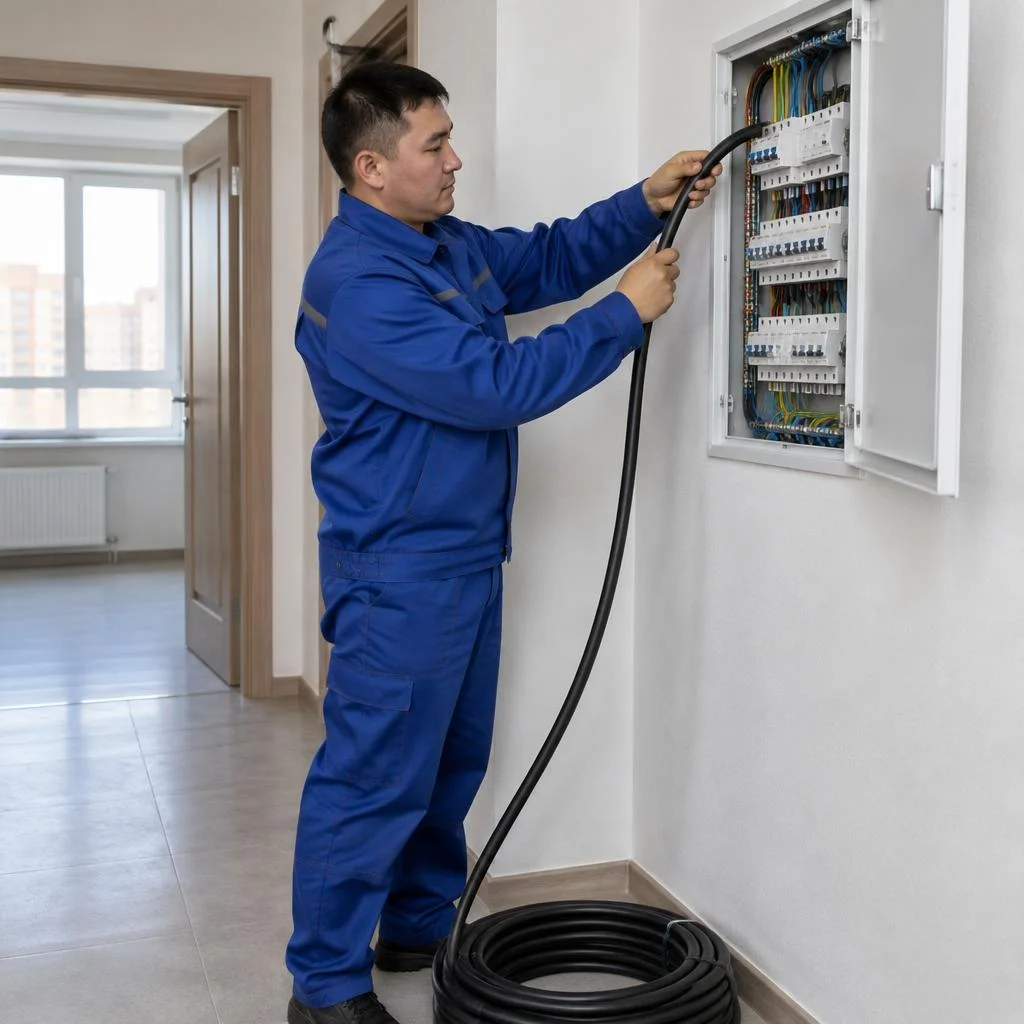
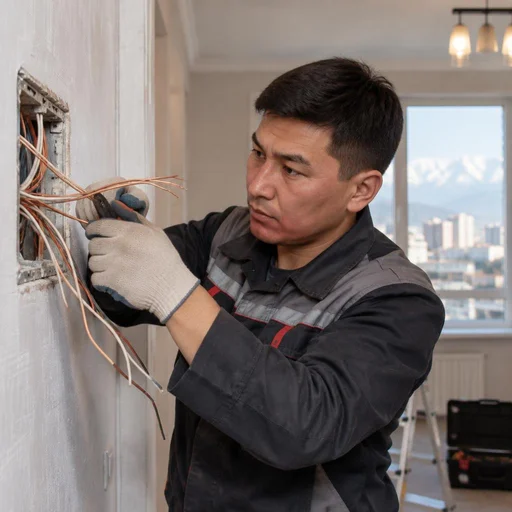
- Dismantling: we remove the old cable and aluminum twists, pull out outdated back boxes, and clear the chases of wire remnants.
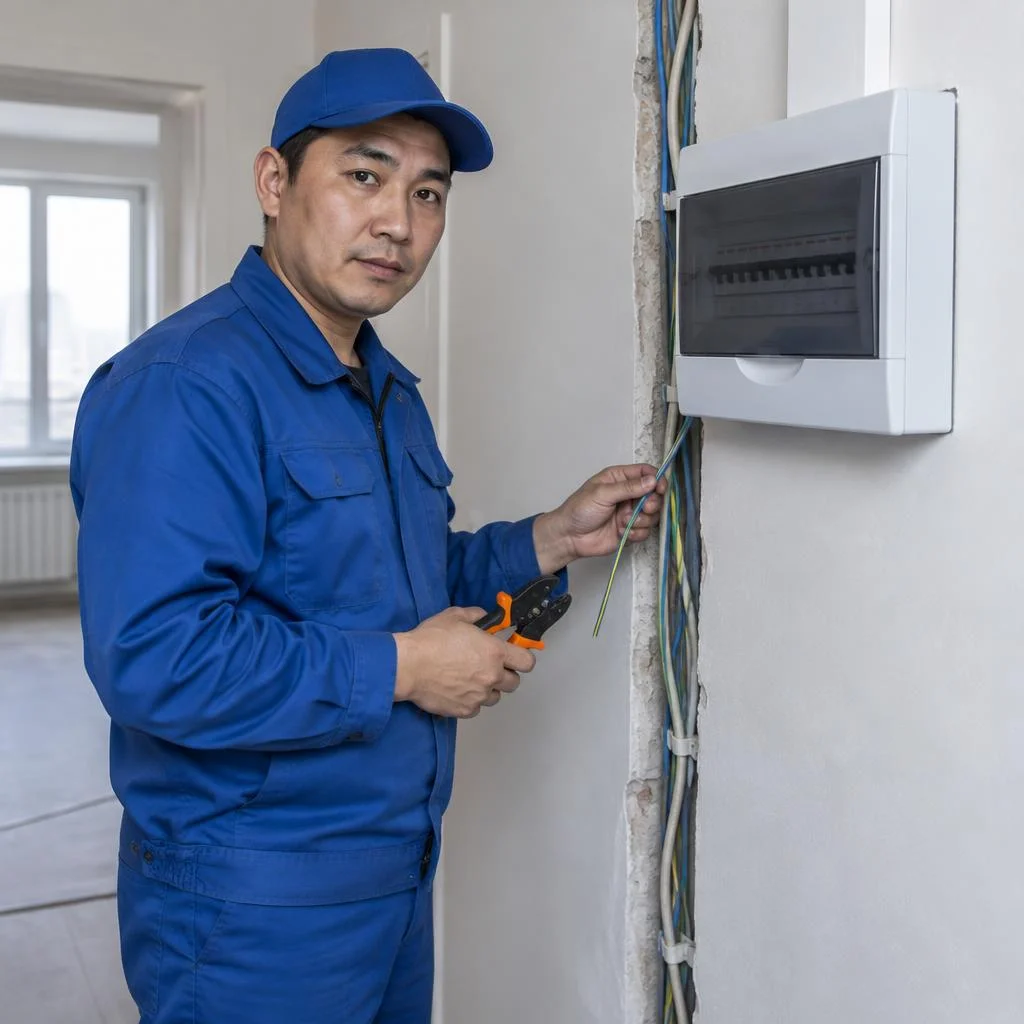
- Chasing: we cut routes for sockets, switches and mains, observing the depth for plaster and the turning radii.
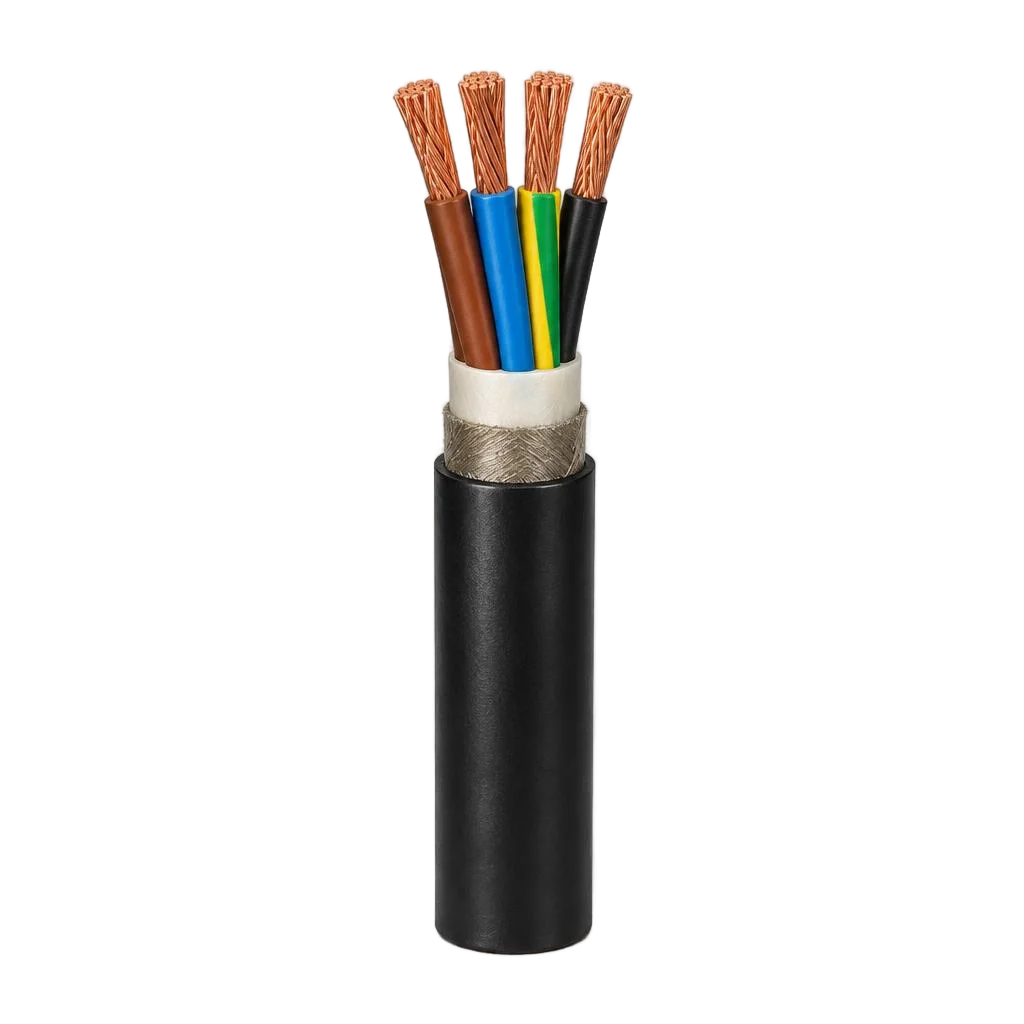
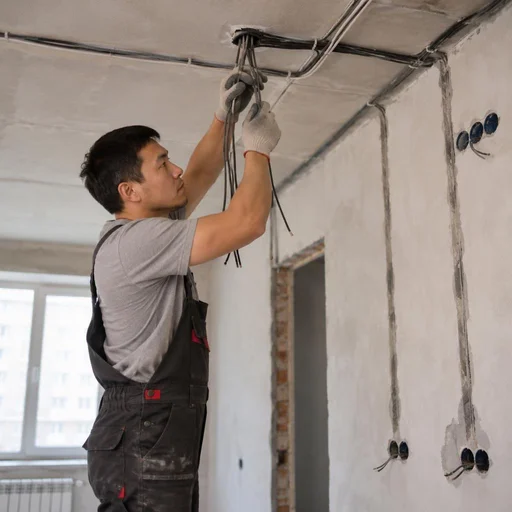
- Laying: we run VVGng-LS cable into the chase or corrugated conduit, separating power lines and low-voltage lines to avoid interference.
- Back boxes: we mount the boxes level, setting the depth flush with the future finish.
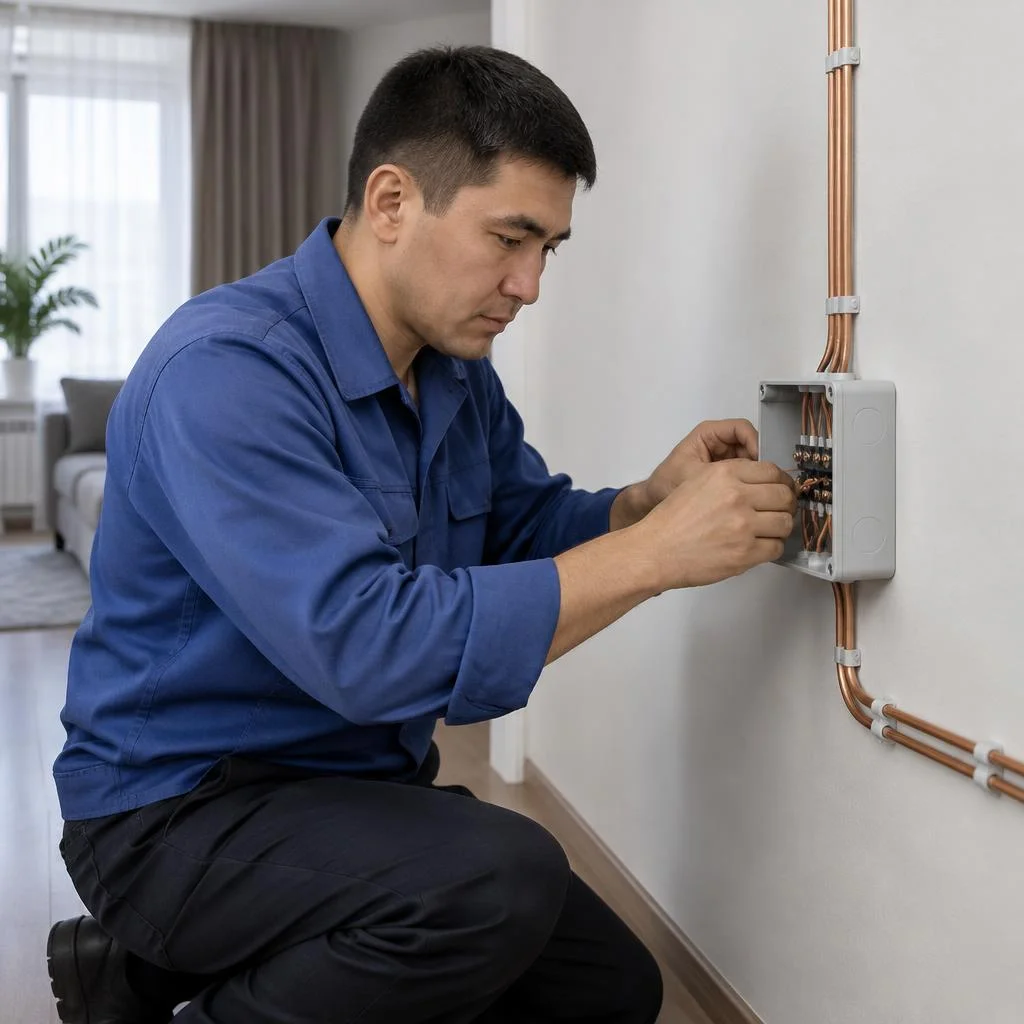
- Junction boxes: we connect the wires with terminal blocks or soldering, insulate and lay in a reserve for maintenance.
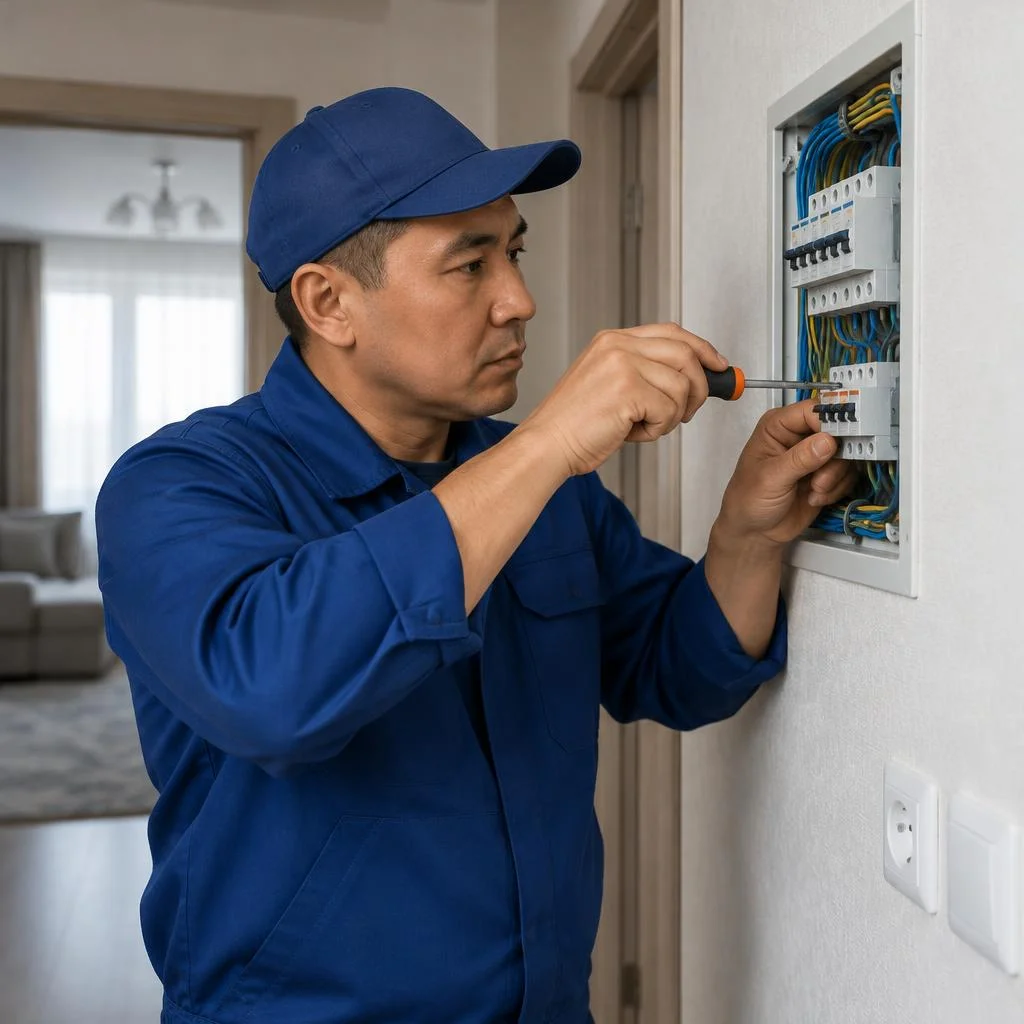
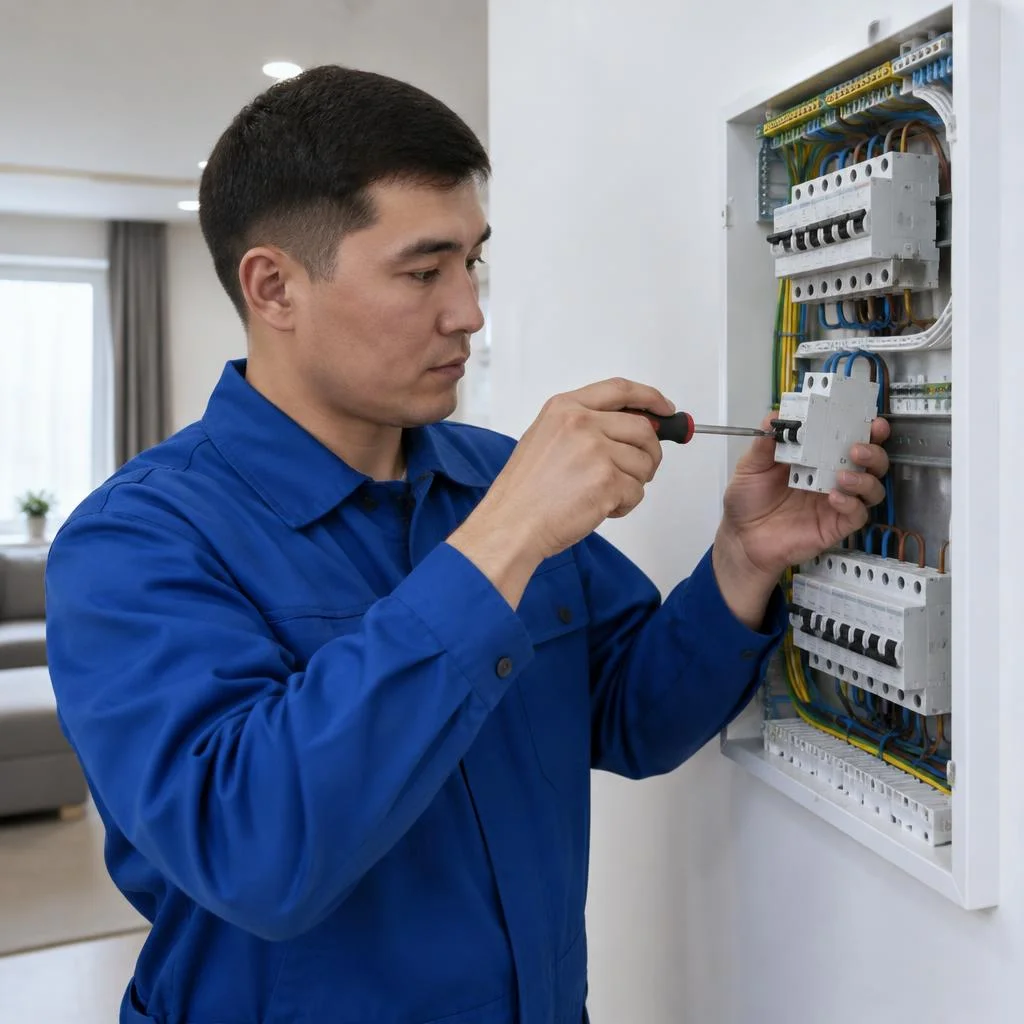
- Panel: we assemble the circuit breakers and RCDs by groups, labeling each module for its own line.
- Continuity testing and labeling: we check each line with a tester, apply labeling to the cable and in the panel.
What is included in replacing the wiring in an apartment, and what is separate
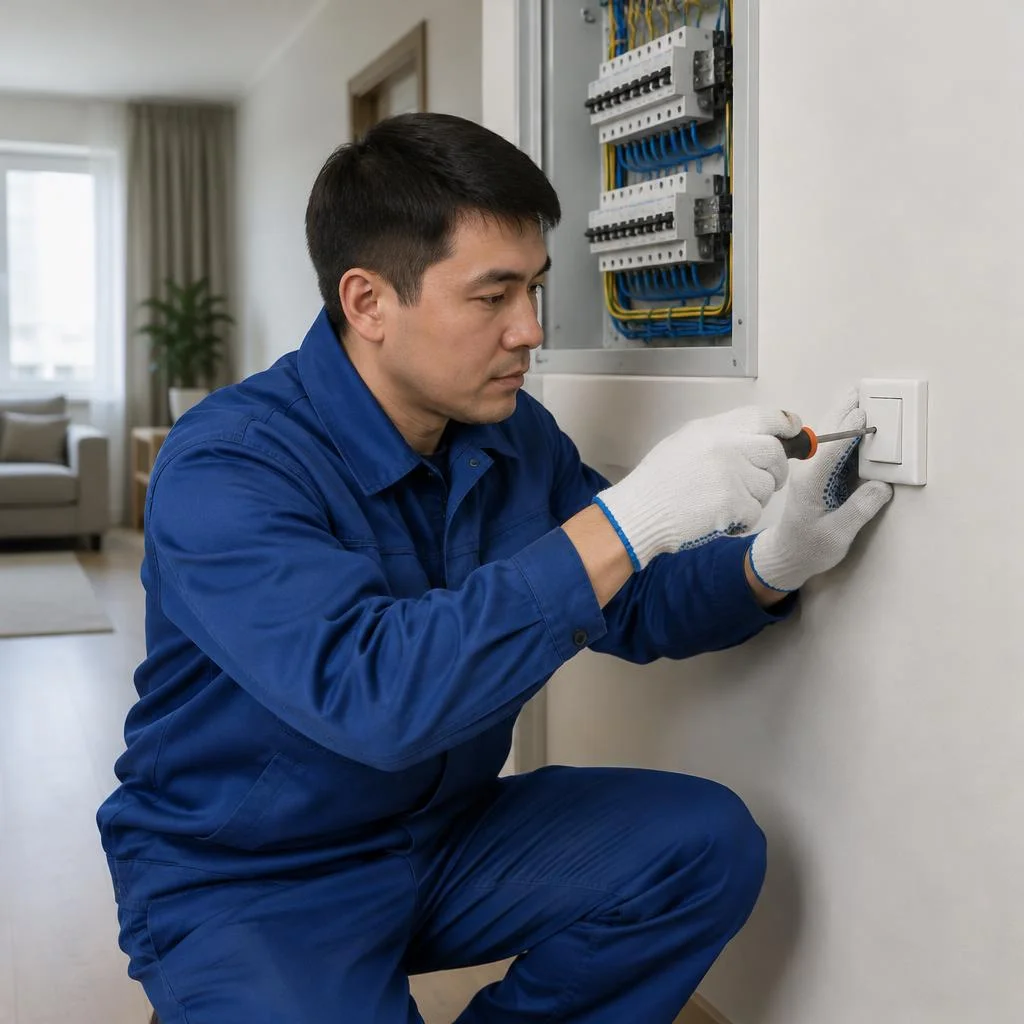
The basic replacement of wiring in an apartment includes distribution across the rooms, installation of points and assembly of the panel; replacement of the incoming cable from the floor panel and replacement of the distribution panel are considered separate works. We run the distribution along the ceiling and walls with outlets for each socket, switch and light fixture, including the kitchen with a separate line for the stove and boiler. We assemble the panel with circuit breakers for each group and RCDs for wet zones; we run the incoming cable from the floor panel to the apartment panel only if the cross-section is insufficient or the insulation is worn. The incoming cable is not always replaced: if it is copper and the cross-section matches the apartment's load, it is left in place — that is more honest than selling extra scope of work. A frequent question is the price of replacing wiring in an apartment: the total depends on the square footage, the number of points and the method of laying, so we calculate the estimate after an inspection. The full cycle of turnkey wiring replacement in Bishkek is performed by Eco-Service.
Methods of laying: chase, corrugated conduit, cable duct
| Method | Where we use it | Plus | Minus |
|---|---|---|---|
| Chase | Major renovation, hidden distribution | The cable is not visible, protected by plaster | Dusty, wall repair needed |
| Corrugated conduit | Ceiling, drywall, utility rooms | Fast, the cable is protected from mechanical damage | Visible without a suspended ceiling |
| Cable duct | Cosmetic renovation, open distribution | No dust, access to the line at any time | Takes up space, suffers from UV |
We select the method of laying according to the type of renovation: if the walls are already prepared for the finish, chasing will cost more than cosmetic work, and in a panel building with floor slabs it is sometimes more advantageous to run the line along the ceiling in corrugated conduit. Cable duct wins on speed and cleanliness, but loses on aesthetics and protection: in corrugated conduit and a chase the cable is protected from mechanical damage and UV, in a duct it is not. At Eco-Service, cable is laid using all three methods and the option is selected according to the condition of the walls.
Aluminum or copper: why we replace it and what we install
Copper displaced aluminum in apartment wiring not because of fashion: it handles a greater load with a smaller cross-section and does not degrade the contact over time. Let's break down which cable we install by default and how we connect the conductors.
Why we replace aluminum with copper wiring
We abandon aluminum in favor of copper because it withstands 1.5-2 times the load at the same cross-section, does not oxidize at the contacts, and lasts 30-40 years versus 15-20 for aluminum. In practice, the difference shows up in the kitchen: a 2.5 mm² aluminum line heats up under a kettle and microwave, while a copper one of the same cross-section handles them with ease. Copper's resistivity is 40% lower, so over a length of 30 meters the voltage drop is noticeably smaller — and in Bishkek panel buildings, from the distribution board to the far room it's exactly 25-35 meters. Clients often phrase the task in their own words: wiring replacement in a house in Bishkek — and from such a request we immediately understand that the riser and the entire wiring will need to be replaced. It's not just about the metal: aluminum "creeps" under a screw clamp, so the contact weakens on its own — even a carefully tightened socket requires re-tightening after a year.
VVGng-LS cable and cross-section for the load
| Line | Cross-section | What it powers |
|---|---|---|
| Lighting | 1.5 mm² | Chandeliers, spotlights, wall sconces |
| Socket group | 2.5 mm² | Sockets in rooms, kitchen, hallway |
| Power line | 4 mm² | Stove, boiler, washing machine |
| Apartment input | 6 mm² | From the floor board to the apartment board |
We install VVGng-LS cable: flame-retardant, with low smoke emission. Undersizing the cross-section "with a downward margin" is more dangerous than oversizing: the breaker protects the cable, not the socket, and with a thin conductor it won't trip before the cable starts heating up in the wall.
Connections: terminal blocks, soldering, twisting
We connect wires in junction boxes with terminal blocks and ferrules, not by twisting: twisting copper with aluminum in a wall is the most common cause of heating and line failure. Wago 222 and 773 series terminal blocks handle up to 32 A and are designed for copper conductors of 1.5-4 mm²; we use ferrule crimping where a rigid, permanent connection under load is needed — for example, at the input. Soldering provides the best contact in terms of resistance, but it is rarely used in a wall: when heated, the solder softens, and the connection can no longer be checked without removing the wallpaper. Even a proper terminal block requires access: if the box is walled up solid without a service opening, any connection becomes unserviceable — we keep them accessible.
Rewiring in an apartment, private house and panel building: how the work differs
The same service in an apartment, private house and panel building is calculated differently: access to the routes, the wall material and the volume of lines determine how much time the work will take and which installation technology is suitable.
Rewiring in an apartment: new build and resale
Installation in a new build is wiring for finishing work, while in a resale it is the complete removal of the old cable and wall chasing. In a new build, the routes are marked out on bare walls before plastering: the cable in corrugated conduit is laid in prepared channels, and the outlet points are checked against the furniture layout plan. In a resale, the old junction boxes are opened first, the lines are tested for continuity and the aluminium is pulled out of the chases — on concrete walls this takes longer than on gypsum board or brick. The cross-section is selected according to the load: 2.5 mm² for socket circuits, 1.5 mm² for lighting. Clients often search for apartment rewiring Bishkek — and land here, although these are two different scenarios. The work in the apartment is carried out by Eco-Service after testing the lines for continuity. In a resale, you should not chase load-bearing walls to their full depth: a cable in corrugated conduit under a layer of plaster or in a cable duct is safer for the structure and can be approved without a project.
Rewiring in a private house: service entry, panel, grounding
- Service entry: Installation in a house in Bishkek begins with a new service cable from the pole to the panel; we select the cross-section according to the total load.
- Panel: we assemble a distribution panel with circuit breakers for each line and RCDs for the wet-zone circuits.
- Grounding: we install a ground loop made of angle bars or rods with measurement of the spreading resistance.
- Lines throughout the house: we run cable in corrugated conduit or cable duct through the rooms, kitchen, boiler room and outbuildings.
- Continuity testing: we label each line in the panel and check it for breaks and short circuits.
Panel buildings and Khrushchyovkas: concealed wiring in the slabs
In panel buildings and Khrushchyovkas in Bishkek, the wiring is often cast into the floor slabs, so we run new lines on the surface — in corrugated conduit under the ceiling or in a cable duct, without chasing the load-bearing structures. The old cast-in line cannot always be removed: it is de-energised and left in the wall, while the new one is run along a separate route — this is safer than hammering into the slab. In Khrushchyovkas, an additional difficulty is the low ceilings and thin partitions: a cable duct along the wall saves height, and back boxes are installed in gypsum board partitions without impact tools. New lines in panel buildings are run by Eco-Service with preliminary testing of the old aluminium for residual voltage — in buildings with errors in the risers, the phase sometimes reaches the slab body.
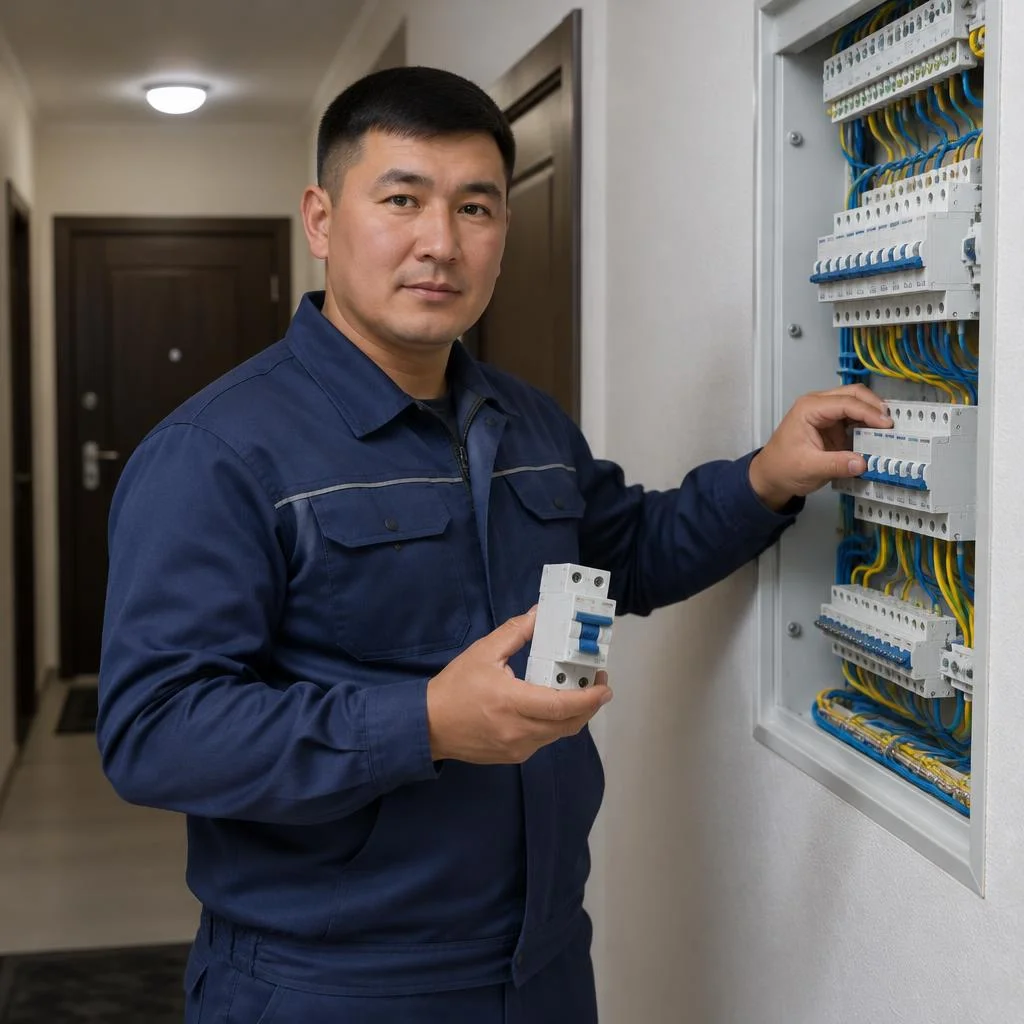
Panel, Circuit Breakers and RCDs: How We Build Protection
The panel is the heart of the new wiring: it determines whether the cable will burn out under overload and whether the line will trip on leakage. We select ratings based on the actual load of the apartment or house, not on the principle of "the more powerful, the more reliable."
Circuit Breakers: Ratings for Each Line
| Line | Breaker | Cable Cross-Section |
|---|---|---|
| Lighting | C10 | 1.5 mm² |
| Socket Groups | C16 | 2.5 mm² |
| Stove, Water Heater | C25 | 4–6 mm² |
| Main Feed Cable | C32–C40 | 6–10 mm² |
A breaker protects the cable, not the appliances: if you install a C25 on a 2.5 mm² line, under overload the wire will burn out before the protection trips — that's why at Eco-Service the rating is selected strictly according to the cross-section. In a kitchen with a stove and water heater, there are usually 4–6 separate lines; in a one-bedroom apartment, 5–7. The tripping current of the C-characteristic withstands the inrush surges of pumps and refrigerator compressors without unnecessarily disconnecting the line.
30 mA RCD: Leakage Protection and a Grounding Prerequisite
We install 30 mA RCDs on wet zones and socket groups: they disconnect the line on leakage that a person can already feel but that a current breaker doesn't yet detect. The 30 mA threshold is the boundary beyond which alternating current is dangerous to the heart, and tripping occurs within 25–40 milliseconds. In the bathroom, kitchen, and garage, the device is mandatory, especially if a washing machine or water heater sits on a damp floor. An RCD without grounding works incompletely: if the appliance body becomes live, it will only trip when a person touches the body — with grounding, disconnection occurs earlier, before contact. The "Test" button once a month confirms that the mechanism hasn't stuck.
Assembling the Distribution Panel
- Main Breaker: installed first after the meter, cuts power to the entire apartment in case of an emergency or repairs.
- RCDs and RCBOs: grouped by zone — wet areas separate from lighting.
- Line Labeling: each one is labeled — "kitchen sockets," "bedroom light" — so you can de-energize the needed zone in seconds.
- Connection Inspection: terminal tightening with a torque wrench, repeated under load.
- Spare Modules: 20–30% free slots for future groups — air conditioner, EV charger, underfloor heating.
Timelines, a 2-year warranty, and how the work is accepted
We give timelines after inspecting the site, the warranty is valid for 2 years on electrical installation work, and after handover the client keeps the wiring diagram and documents. Below is how this works in practice.
Timelines for replacing wiring in an apartment and a house
The timelines in the table are a guideline after inspection: in Bishkek, work in a panel building without wall chasing goes faster than in older housing with concrete walls, where the old cable is removed and the finish is restored. Eco-Service gives the exact schedule after inspecting the site, because access to the routes matters more than square footage. Most often, requests mention "wiring replacement in Bishkek" — and from that the technician immediately understands: a site visit is needed, an assessment of the condition of the old cable and panel, not a phone consultation. The timeline is affected by the wall material: chasing brick takes longer than gypsum board, and in older buildings, removal of aluminum lines is added. If you need a compressed schedule, say so during the inspection — some work can be done in parallel across risers and groups.
2-year warranty: what it covers
We provide a 2-year warranty on all electrical installation work: laying lines, assembling the panel, installing circuit breakers and RCDs, installing outlets — with a visit for warranty claims. In the documents we record the line diagram and breaker ratings so the client knows the load limits for each group. In our practice, most warranty claims are not installation defects, but connecting powerful appliances bypassing the design line: a washing machine on a lighting group, a heater on a 16 A outlet line. The warranty does not cover damage from unauthorized intervention or overload beyond the design — that is why the diagram and ratings are handed over. Before connecting a new appliance, check the diagram: if the power exceeds the breaker rating, a separate line is needed, not installing a breaker with a higher rating.
Acceptance of work: continuity testing, labeling, documents
- Line continuity testing: we check each group with a multimeter — phase, neutral, grounding are in place, there is no short circuit.
- Labeling in the panel: we label the breakers by zone — kitchen, bedroom, outlets, lights, so shutdown is quick.
- Wiring diagram: we hand over a plan of the lines with ratings and cable cross-sections, including hidden routes in the chase.
- Report and warranty card: we record the scope of work, handover date, and the terms of the 2-year warranty for the client.
- Demonstration: we show how the RCD works and explain what to do when the protection trips.
Conclusion
We have gathered the main things to keep in mind before replacing wiring: from assessing the condition of aluminum to the documents after acceptance. Below are brief conclusions for each key stage.
Main conclusions
- Aluminum from the 1960s–1990s: aluminum wiring in panel buildings and Khrushchyovkas has served its standard service life and is not designed for modern loads — a boiler, induction cooktop, air conditioner, and several household appliances at the same time.
- Full or partial: a full installation is justified when the aluminum is more than 30 years old or heats up at connection points; partial — only one line from the panel, without touching the others.
- Copper and VVGng-LS: the basic standard is copper cable with a cross-section suited to the design load of the line and non-flammable insulation; twists in junction boxes are unacceptable.
- Panel, breakers, and RCD: breakers are selected separately for each line, a 30 mA RCD is installed on groups with moisture, but it only trips correctly with working grounding.
- Acceptance of work: you should keep the continuity test and line labeling, the wiring diagram, and the report — without them, further diagnostics turns into a blind search.