








What a grease trap is and why it needs servicing
A grease trap retains fats and sludge before the effluent enters the sewer. Without regular servicing it stops working: the sections overflow, grease passes into the pipes, and odour appears.
How a grease trap is designed and which components get contaminated first
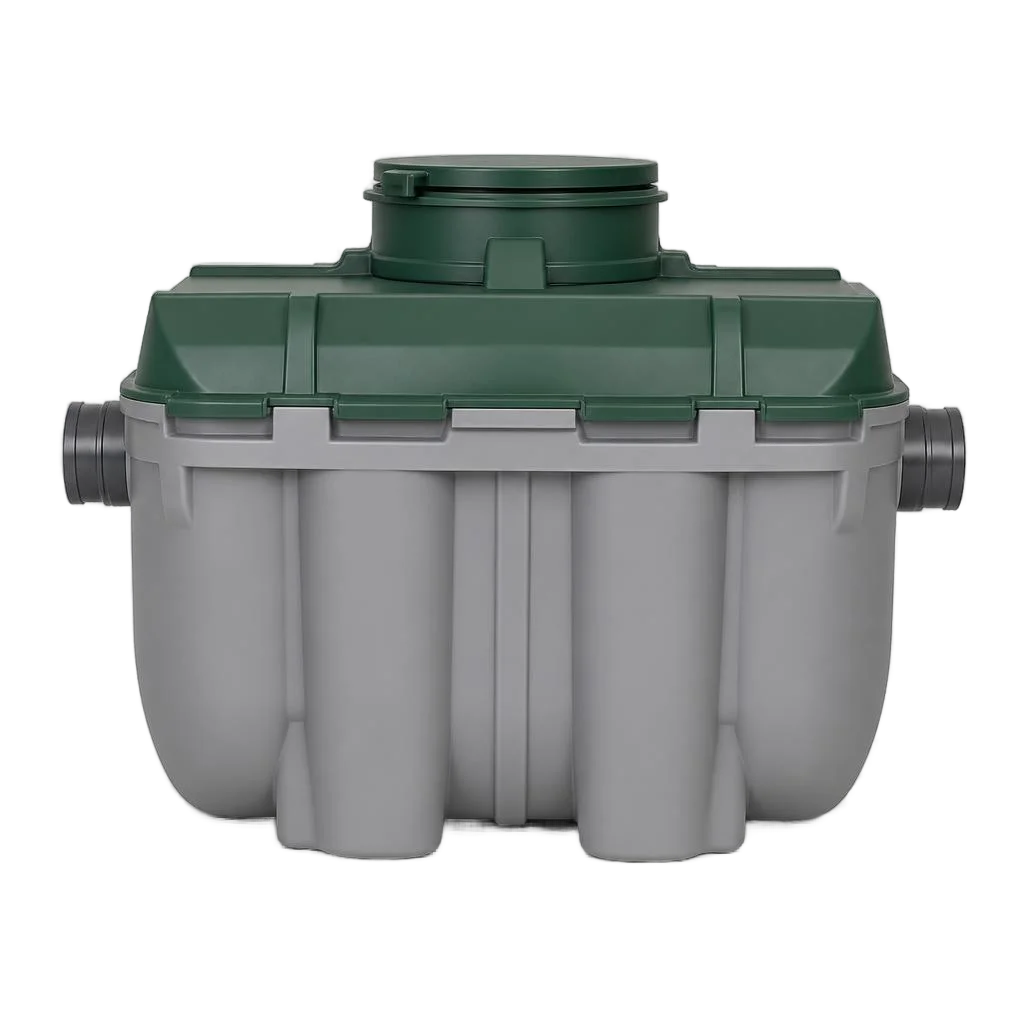
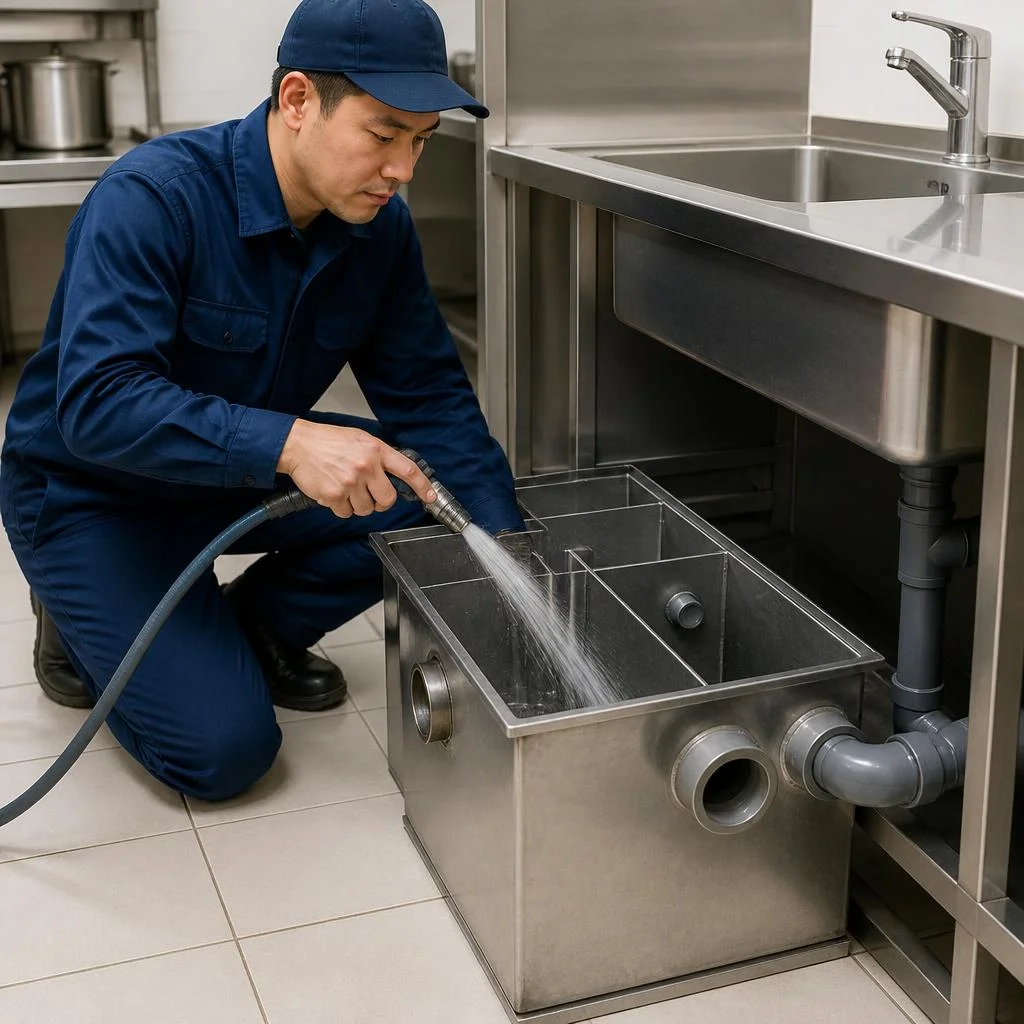
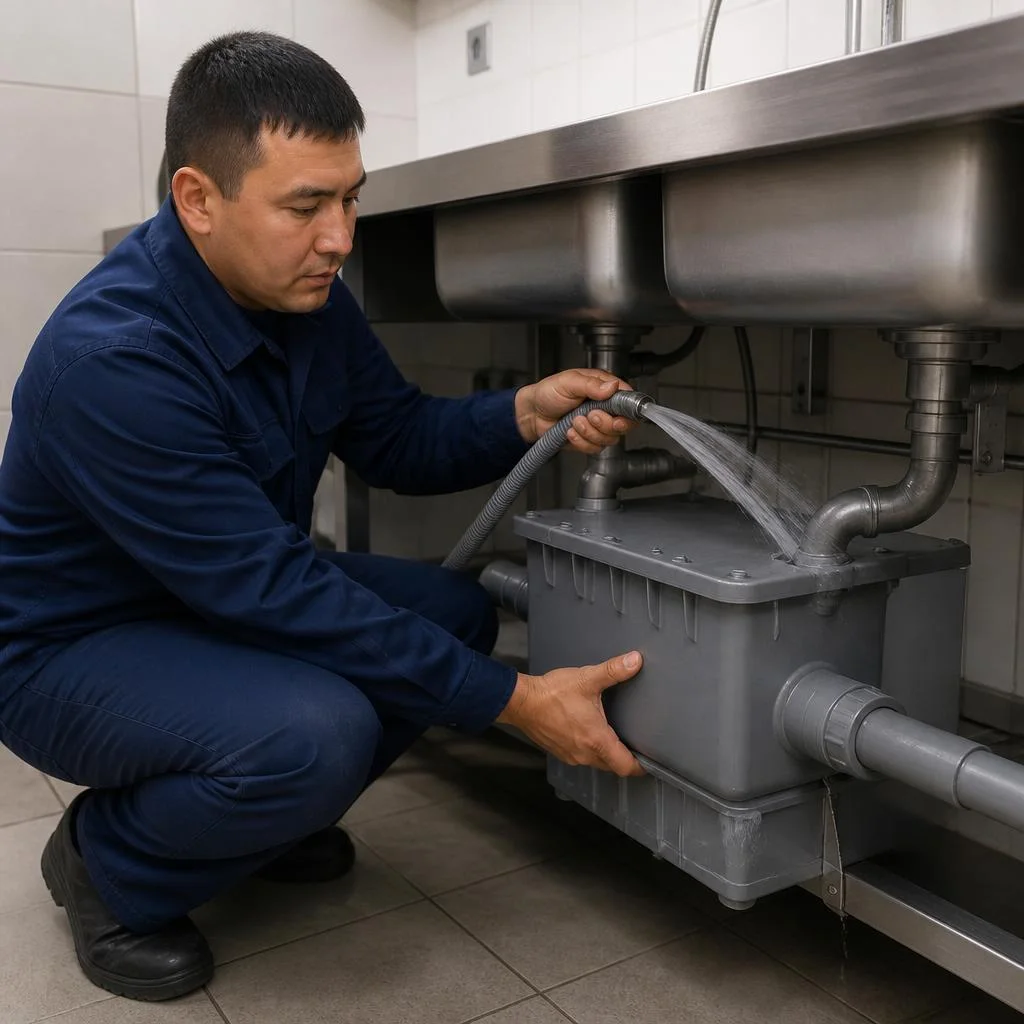
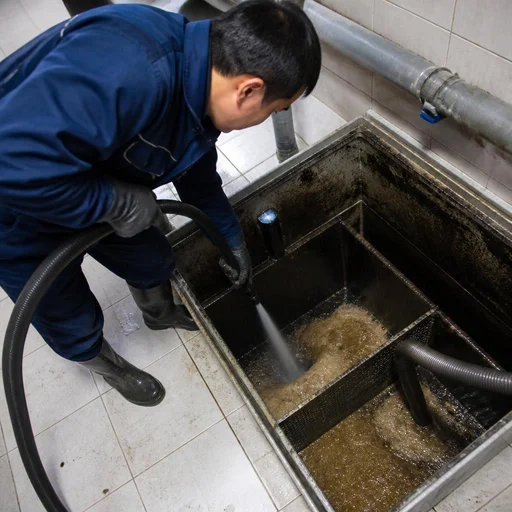
A grease trap separates the flow of wastewater into three fractions — grease floats up, sludge settles, and the treated water leaves for the sewer through the outlet pipe. Inside the body there are internal baffles: they damp the flow velocity so that the grease has time to rise to the surface and the heavy particles sink to the bottom. The inlet pipe receives the effluent from the sink, the outlet pipe discharges the clarified water, and the overflow channel connects the sections and prevents them from overflowing over the edge. The internal baffles and the inlet pipe clog fastest — they are the first to stop retaining grease, and that is when odour appears even before the sections overflow. During an inspection, check the baffles and the inlet first: if the layer of grease waste on them is thicker than a finger, servicing is already needed, even when the water drains normally.
What happens if the grease trap is not cleaned
- Odour from the sink: the grease crust in the sections rots, and the smell of sewage drifts into the kitchen even with the ventilation running.
- Slow drainage: the water drains more and more slowly, a layer of water stands in the sink — the outlet pipe is partially clogged with grease.
- Gurgling in the pipe: air breaks through the narrowed overflow channel, and the sound of draining changes before the odour appears.
- Grease in the sewer: the overflowing sections stop retaining the fraction, and deposits build up on the walls of the drain line.
- Blockage and a call-out for the emergency crew: the pipe becomes completely clogged, the kitchen shuts down, and clearing it costs more than scheduled servicing.
Who is responsible for cleaning — the tenant or the landlord
By default, responsibility for maintaining the grease trap lies with the tenant — the one who operates the equipment and discharges effluent into it. In Bishkek, most cafés and restaurants rent premises together with a ready-made kitchen, and the grease trap is already installed in the sink at the time the contract is signed. If this clause is not stipulated in the lease agreement, during a SanPiN KR inspection the fine will be issued to the tenant, even if the equipment belongs to the owner of the premises. In our practice, a dispute more often arises when the tenant changes: the new lessee receives an overflowing grease trap and does not understand who pays for the pumping out. Clients often phrase the request as "grease trap cleaning" — and from that wording it is immediately clear that the person needs a scheduled visit, not a one-off pipe clearing. Before signing the contract, record the condition of the sections in a report with photos — this removes disagreements both with the owner and during an inspection.
Regulations: how often grease trap cleaning is needed
The frequency depends on the kitchen's throughput and the volume of grease: there is no universal figure, but there are working guidelines by type of facility. Below is the schedule used to build maintenance at facilities in Bishkek.
Frequency by type of HoReCa facility
| Type of facility | Throughput | Recommended frequency |
|---|---|---|
| Coffee shop, bakery | up to 100 checks per day | once every 4-6 weeks |
| Canteen, cafe | 100-300 checks per day | once every 2-4 weeks |
| Restaurant, food court | 300-600 checks per day | once every 1-2 weeks |
| Delivery kitchen | 600+ checks per day | once every 7-10 days |
| Food production | continuous cycle | once every 5-7 days |
If a facility operates delivery through Namba Food or Glovo, the load on the kitchen increases during peak hours — the frequency shifts toward the minimum interval. At Eco-Service, the schedule for such kitchens is recalculated based on the actual grease consumption over the first week.
SanPiN KR standards and fines for an uncleaned grease trap
SanPiN KR requires keeping the grease trap clean and confirming maintenance with documents — during an inspection, the absence of reports is treated as a violation. The inspector looks not at the staff's words but at the paperwork: a maintenance contract, a completed work report, a grease waste disposal report, and the schedule according to which the facility was actually serviced. The fine is issued to the legal entity, and for a repeat violation within a year — with suspension of the outlet's operations until it is remedied. In search, clients often type it briefly: grease trap cleaning — and through such a query they end up with a contractor who handles the entire package of documents. The completed work report and the disposal report are not a formality: without them, the facility cannot confirm that the grease was not discharged into the sewer. Therefore, the maintenance schedule should be kept together with the sanitary documents, and not in the contractor's folder.
Signs that the grease trap needs urgent cleaning
- Smell from the sink: a persistent putrid odor lingers for more than a day even after rinsing the sink.
- Slow drainage: water drains noticeably longer than a week ago, with the same kitchen operating mode.
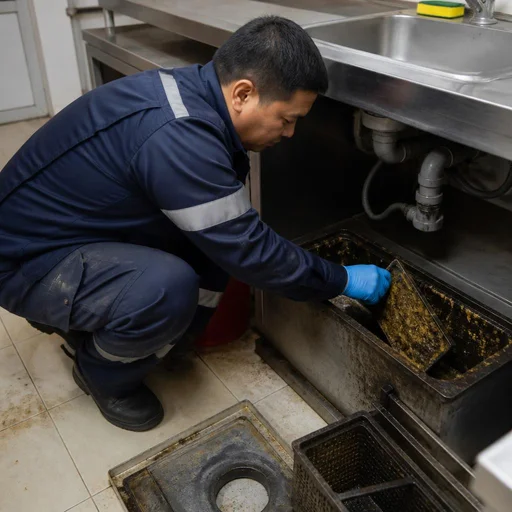
- Grease crust: a dense layer of grease a finger thick or more is visible on the surface of the first chamber.
- Seepage under the body: oily traces appear on the floor around the grease trap.
- Signals from neighbors: complaints about odor from the basement or from the shared sewer. If at least one of these signs appears, an urgent visit costs less than hydrodynamic cleaning of the drain line after an accident. At Eco-Service, a separate visit slot is kept for such cases — grease trap cleaning in Bishkek can be done on the day of request, and scheduled maintenance according to the plan removes the risk of an accident before it happens.
Cleaning technologies: manual, pressure, steam
The method is selected based on the type of contamination and the material of the housing — there is no universal approach. A combination of mechanical, hydrodynamic and steam treatment gives a better result than any of them individually.
Manual method
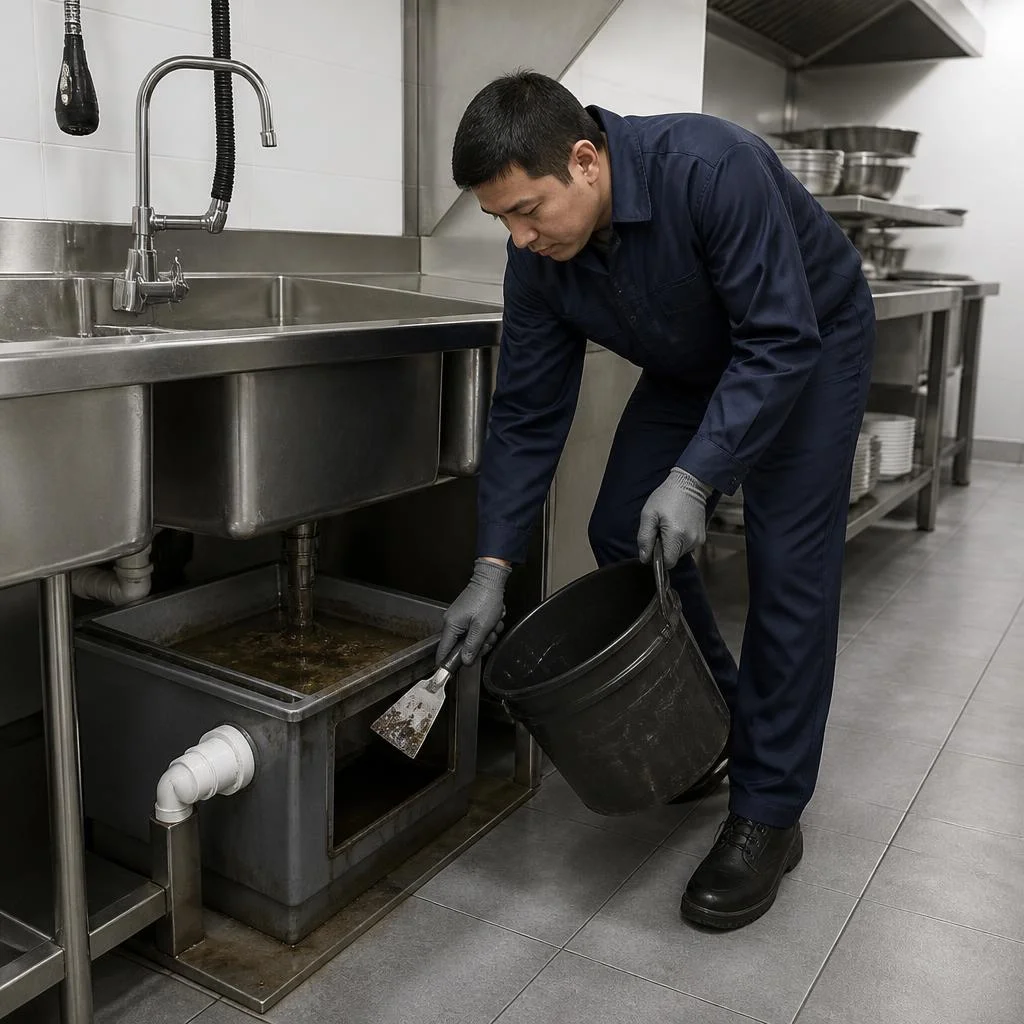
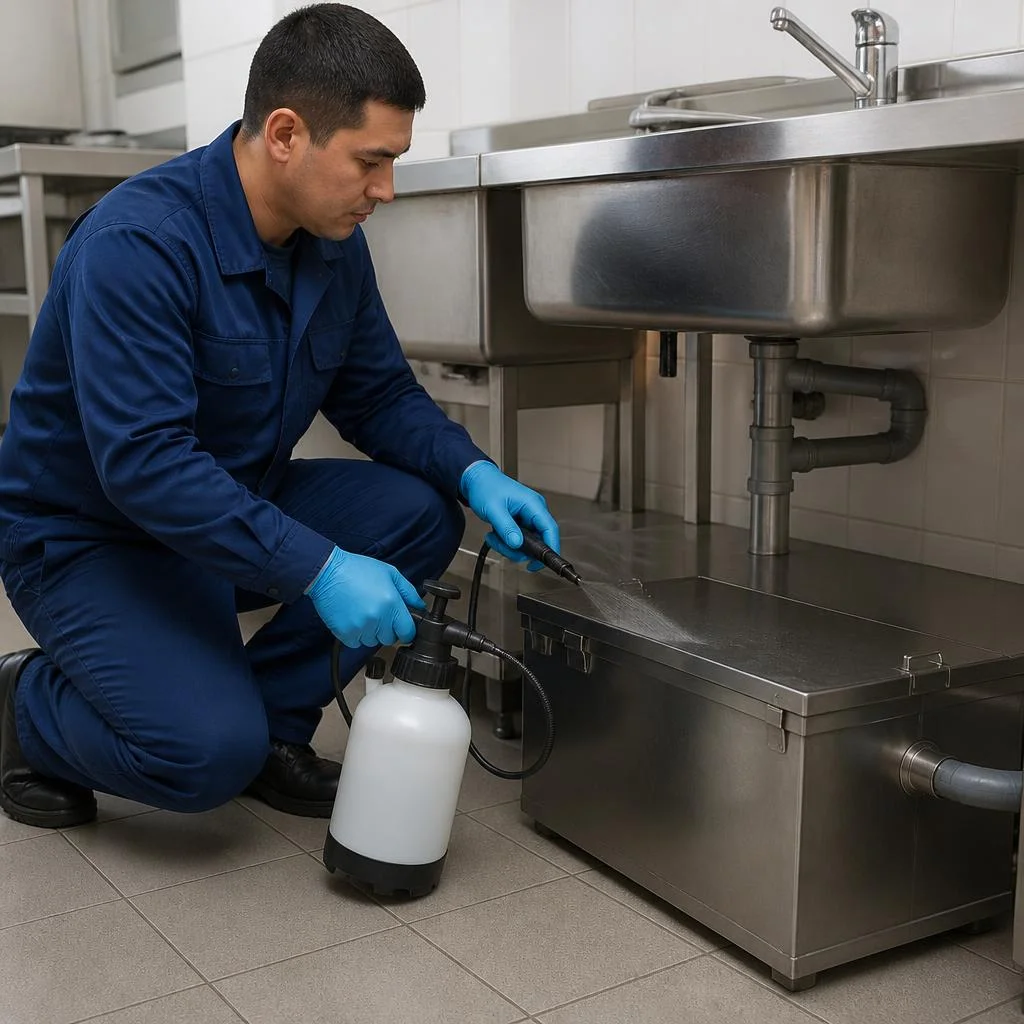
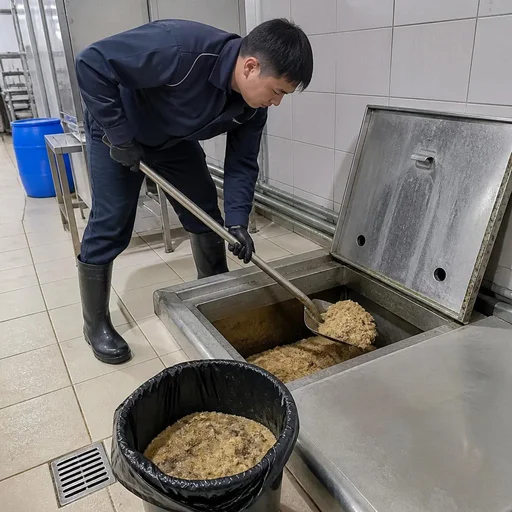
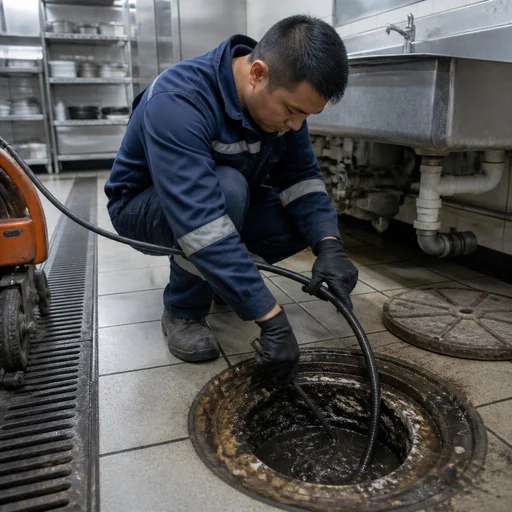
The manual method is the basic one: a specialist removes the lid, removes the grease crust and sediment from the bottom, washes the baffles and nozzles. At HoReCa facilities in Bishkek — from coffee shops to canteens in Osh and Jalal-Abad — this method covers up to 70% of the tasks under the maintenance schedule every 2-4 weeks, as long as the deposits have not compacted. On small under-sink models with a volume of up to 40 liters, disassembly takes 40-60 minutes: the grease trap lid is removed, the top grease layer is scooped out, the internal baffles are gone over with a scraper, and the sections are washed with warm water and a degreaser. We apply this method first at all facilities — it shows the condition of the sections before equipment is connected. The manual method is indispensable for plastic housings and small under-sink models, where a high-pressure unit deforms the walls, and manual grease trap cleaning remains the only safe option for such housings.
Pressure and steam treatment: when to use which method
| Method | What it removes | Where it is used |
|---|---|---|
| Manual cleaning | Grease crust, bottom sediment, deposits on baffles | Plastic housings, small under-sink models |
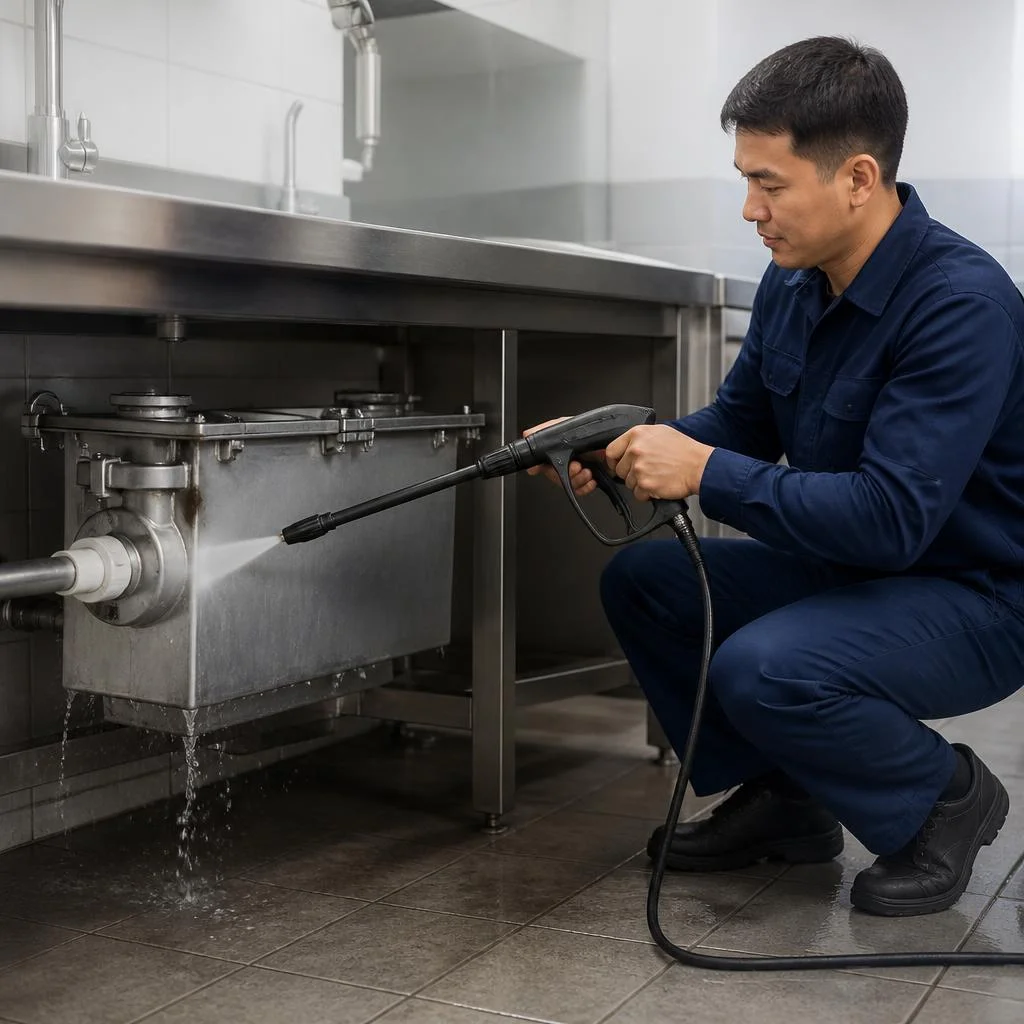
| Pressure cleaning | Dense hardened grease from walls and corners | Steel housings from 100 l, nozzles |
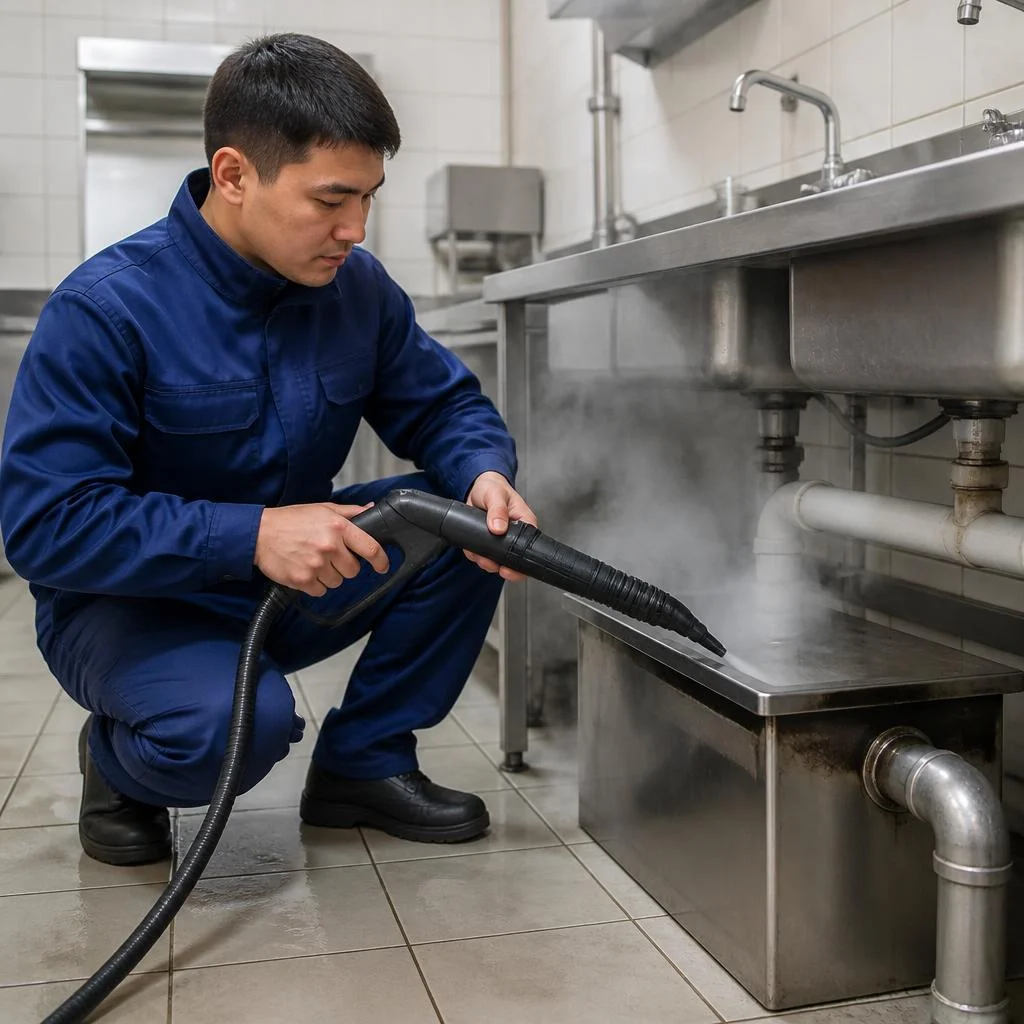
| Steam cleaning | Grease film, odor, bacterial deposits | Ventilation outlet, baffles |
| Hydrodynamic cleaning | Blockages in the drain line and overflow channel | Pipelines after the grease trap |
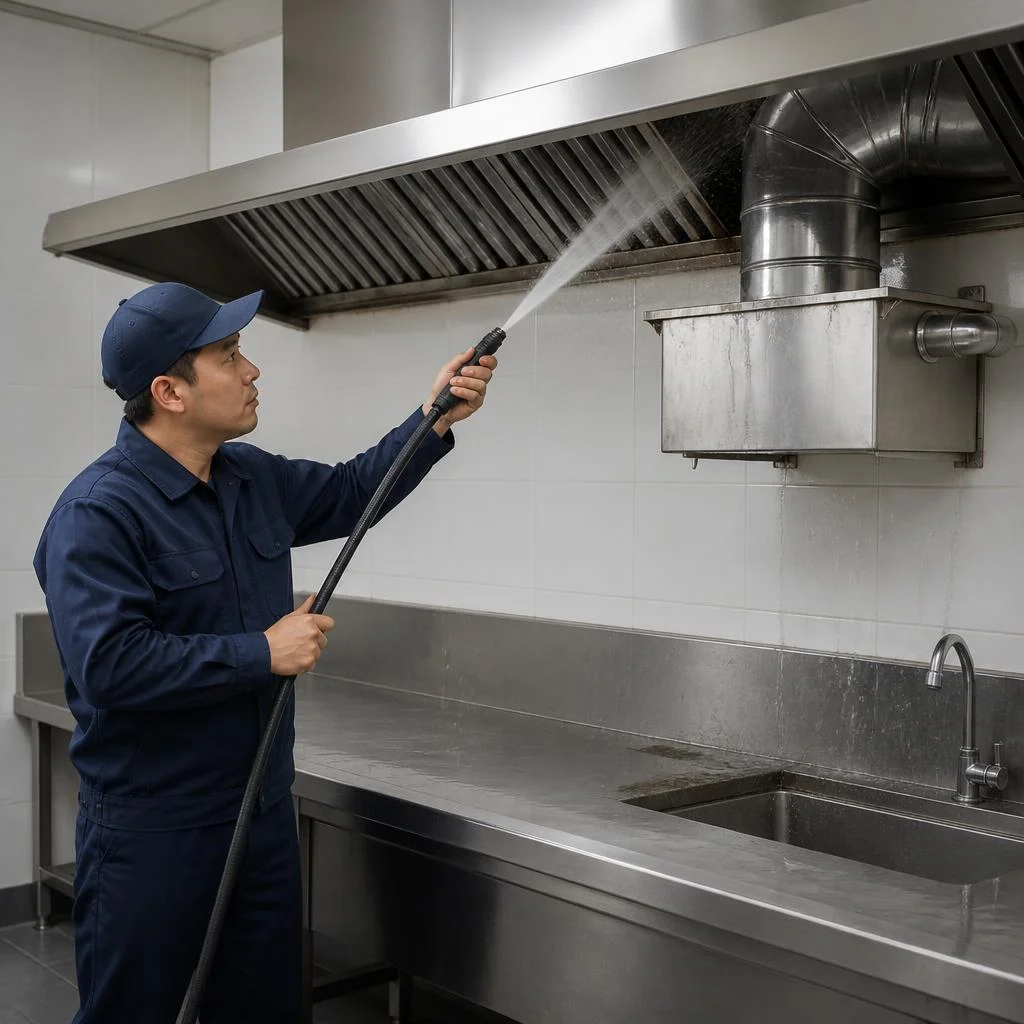
A high-pressure unit operates at 100-150 bar and washes off a grease layer of up to 5 mm in a single pass; a steam generator supplies steam at 140-160 °C and softens deposits in corners without residual moisture. Steam treatment is effective on the ventilation outlet — grease accumulates there that is not washed off by water and becomes a source of odor in the kitchen.
Sanitary treatment: when it is mandatory
Sanitary treatment is mandatory for facilities working with finished products — after mechanical cleaning, surfaces are treated with a sanitary compound. This refers to confectionery and culinary workshops, canteens at schools and hospitals, where the grease trap is located next to the food contact zone: the sanitary requirements of the Kyrgyz Republic impose increased standards on such facilities for the microbiological cleanliness of equipment. Mechanical cleaning removes visible grease but does not destroy the bacterial film on the internal baffles and in the corners of the housing — disinfection addresses precisely this layer, and the compound is applied after washing and held according to the manufacturer's instructions. We carry out disinfection together with full grease trap servicing — this way the treatment covers all sections, not just the visible part of the housing.
Pumping Out Fat and Sediment: How the Contents of the Sections Are Removed
Pumping out is a separate stage of maintenance: fat and sediment are removed in different ways because they are in different layers and require different equipment.
Pumping Out the Fat Mass from the Sections
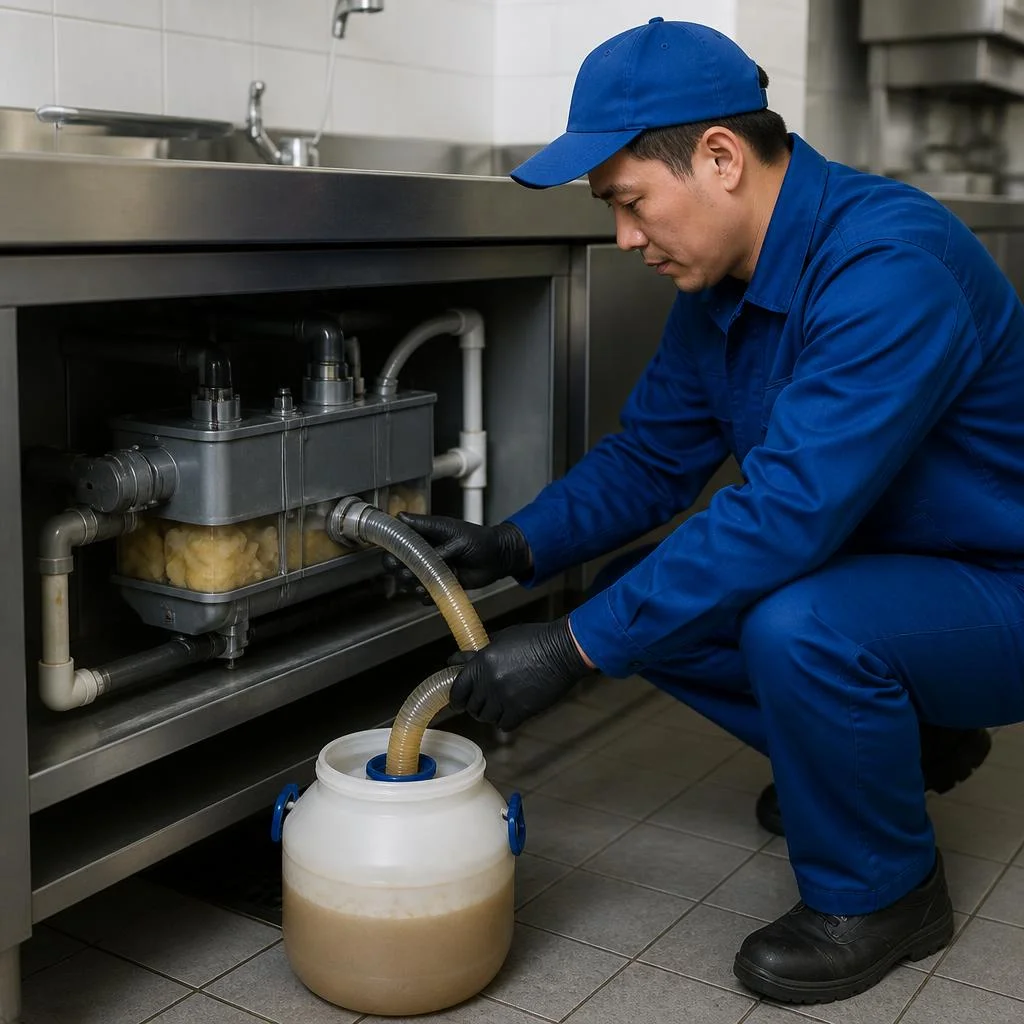
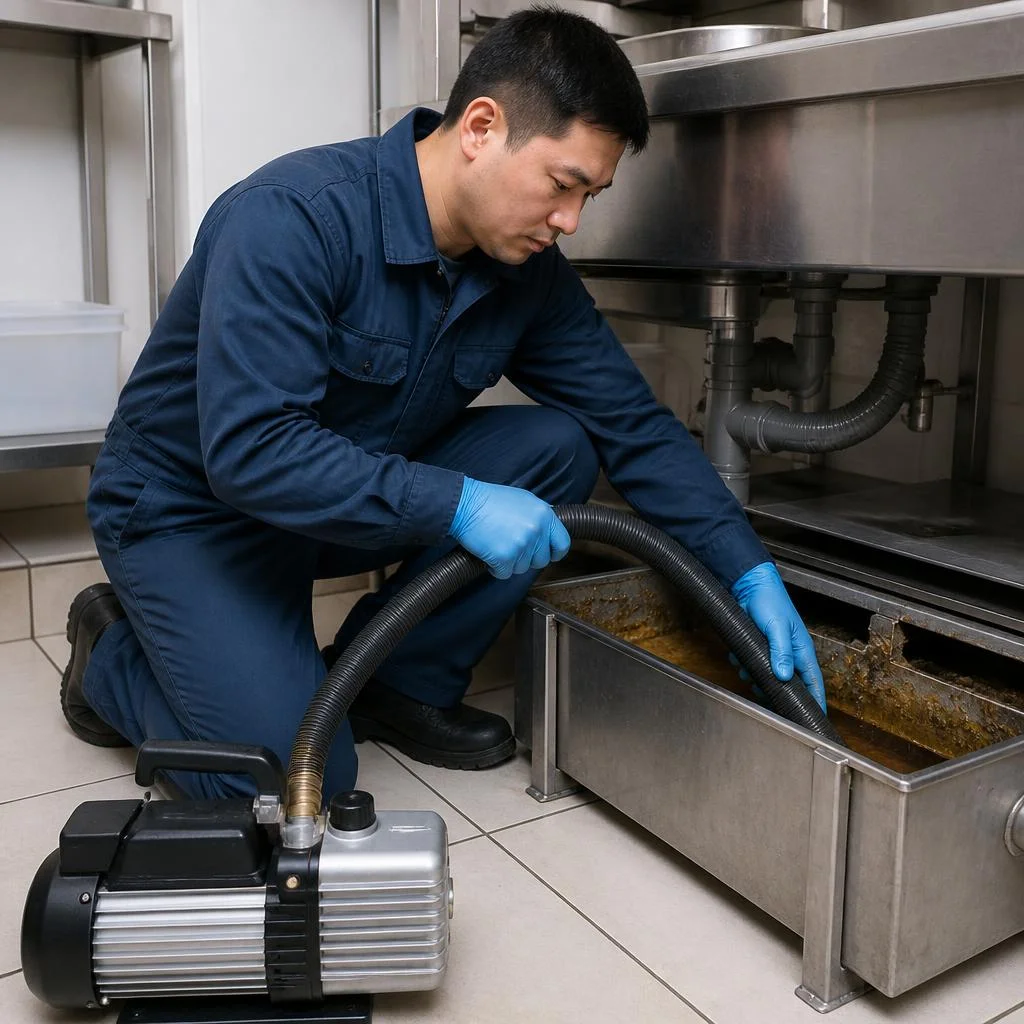
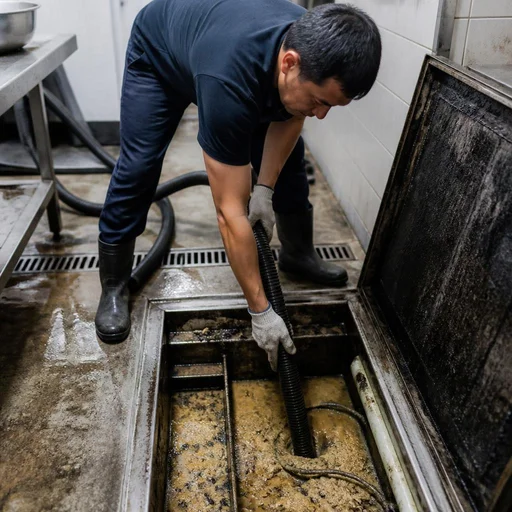
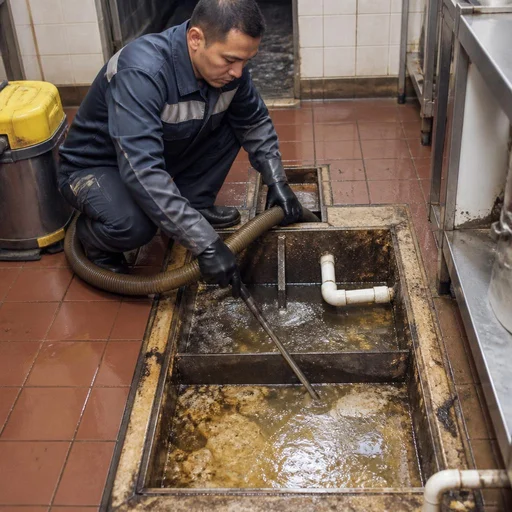
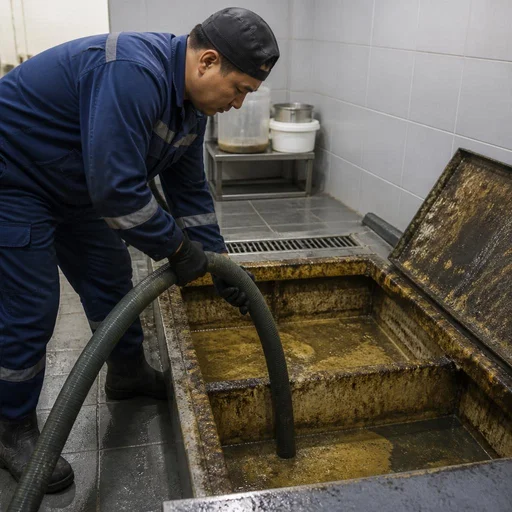
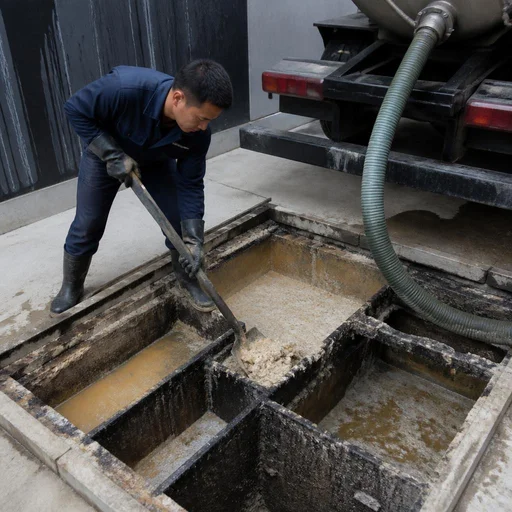
Pumping fat out of a grease trap is performed with vacuum equipment: the fat mass is collected from the surface of the sections and hauled away in sealed containers. The unit takes up the congealed and semi-liquid layer through a hose with a wide nozzle, without splashing the contents onto the walls of the housing. At HoReCa facilities in Bishkek with two or three sections, 60 to 200 liters of mass are pumped out in a single visit — the volume depends on the area of the fat surface and the temperature of the effluent. We work on a schedule before the shift opens so as not to stop the kitchen during peak hours. Fat must not be poured into the sewer even partially — it congeals in the pipes and leads to hydrodynamic cleaning of the entire drain line.
Pumping Out Sediment from the Bottom
Pumping out sediment from the bottom removes the dense fraction that settles under the water and does not rise together with the fat. It is a mixture of food particles, coffee grounds, starch, and detergents — it lies below the water level, right at the bottom of the section. A separate nozzle and a more powerful pump are used for it: the viscous mass cannot be drawn out with the same hose as the surface fat. In Bishkek kitchens with intensive frying, sediment accumulates in a layer of 5-15 centimeters over 4-6 weeks. In requests, clients often write briefly — grease trap pumping — meaning specifically the bottom layer that accumulates over months. If the sediment is not removed, it compacts and blocks the outlet pipe — then water drains slowly even with a clean surface.
Hauling Away and Disposal of Fat Waste
Hauling away and disposal of fat waste are carried out under a contract: the waste is transported to a licensed facility, and a disposal certificate is issued to the facility. The collected mass and bottom sediment are transported in closed containers — open barrels in residential neighborhoods are prohibited, because fat oxidizes and gives off an odor within just a few hours. We arrange one-time hauling or regular servicing with a fixed schedule — at a single address, with a single package of documents for the entire period. The disposal certificate protects the facility during an inspection — it confirms that the fat was not poured into the sewer or dumped in an unauthorized location.
Flushing of components and cleaning of lines
Flushing of components and cleaning of lines is work with the internal elements on which the throughput capacity of the grease trap depends. Let's break down which components are flushed separately and why each of them clogs according to its own scenario.
Flushing of inlet/outlet pipes and baffles
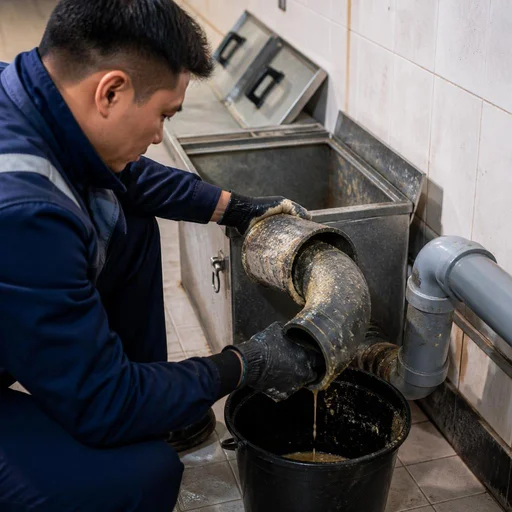
Flushing the inlet and outlet pipes restores throughput capacity: grease deposits on the walls, narrowing the passage and slowing drainage. The internal baffles in the sections accumulate buildup along their entire height, and without flushing them the flow bypasses the working settling zone — grease stops separating and is carried further into the sewer. At sites with intensive frying, the pipes become overgrown in 4-6 weeks, whereas in kitchens with a single shift they last twice as long. The outlet pipe clogs faster than the inlet — water drains more slowly, but grease keeps coming in, and the section overflows. Flushing of pipes and baffles is part of our procedure: we remove carbon deposits from the walls and check the passage along its entire length. Schedule this operation together with pumping out the sections, not separately — that way the technician doesn't disassemble the housing twice.
Cleaning of the drain line and overflow channel
Cleaning of the drain line and overflow channel is needed when water drains slowly or floods the sections under peak load. The drain line connects the grease trap outlet to the main sewer, and the same grease that wasn't retained in the sections deposits on its walls. The overflow channel is the narrowest element of the system: it clogs first, and it is precisely because of it that water begins to rise in the sections. On a stainless steel line with an internal diameter of 50 mm, a blockage builds up over 2-3 months of restaurant operation. Cleaning of grease traps in this part requires access to both ends of the line and slope control — after removing the blockage, we check whether water drains by gravity without stagnation. Clients often search for "overflow channel cleaning" when it has clogged twice in a quarter: in that case, it's worth reviewing the diameter of the section or the frequency of the maintenance schedule. We carry out the work with a visit to the site.
Hydrodynamic cleaning: when you can't do without it
Hydrodynamic cleaning is used for dense grease blockages in the drain line that cannot be removed mechanically. The machine supplies water at a pressure of up to 150-200 bar through a hose with backward-facing nozzles: the jet breaks up the solidified grease from the walls and pushes the mass toward the collection point. The method works on lines up to 30 meters long and on bends where a mechanical cable can't reach. Hydrodynamic cleaning shouldn't be done preventively — it is effective specifically against solidified grease, and for regular maintenance, flushing of components is sufficient. In our practice, hydrodynamic cleaning saves the day at sites where the grease trap hasn't been serviced for more than six months: mechanical cleaning removes the top layer, but the dense core of the blockage remains. Order it when a clog actually occurs, not on a schedule. Eco-Service performs such cleaning with pressure control so as not to damage thin-walled sections of the line.
Flushing of the ventilation outlet
Flushing of the ventilation outlet eliminates the source of odor: grease accumulates in the outlet, which isn't washed away by water and gradually decomposes. The outlet vents air from the sections to the outside, and its inner surface becomes coated with a sticky film that traps organic particles. Odor in the kitchen is often attributed to room ventilation, although the source is the grease film inside the grease trap outlet. The outlet diameter is usually 50-100 mm, and at such a cross-section the film blocks the passage in 3-4 months. We perform flushing with the application of a cleaning agent and subsequent rinsing with water to remove the film along the entire length, not just at the entrance. If the odor returns 2-3 weeks after flushing, check the slope of the outlet — moisture stagnation accelerates fouling. We carry out this operation together with scheduled maintenance of the sections.
Replacement of consumables, repair and full maintenance
Some of the work is not related to cleaning, but to restoring components: consumables wear out, and the body and lid can be damaged. Below is what gets replaced, when repair is needed, and how full grease trap maintenance is structured.
Replacement of filters, gaskets and lid
- Grease-catching filters: replaced when the cells become clogged — a clogged element stops retaining grease, and it flows into the drain line.
- Sealing gaskets: replaced when they lose elasticity — hardened rubber does not fit snugly against the edge and lets odors through.
- Grease trap lid: replaced when there are cracks and chips — a damaged part does not keep the section sealed and hinders inspection.
- Fasteners and hinges: checked together with the lid — loose hinges prevent the section from closing tightly, and odor escapes outside.
Repair of the grease trap body
Repair of the grease trap body is needed when there are cracks and damage through which water or grease leaks. Most often affected are the welded seams at the junction of sections, the points where the inlet and outlet pipes are cut in, and also the bottom — sediment accumulates there and the metal corrodes faster. On plastic models, cracks appear at the mounting holes and at the corners of sections after sharp temperature changes: pouring boiling water into a cold body creates stress in the material. Damage is looked for during every pump-out — after the sections are emptied, cracks are more visible than under a layer of grease. Our specialists restore the body by welding or with a polymer compound, depending on the material. A crack cannot be sealed "temporarily" — during the next pump-out the pressure in the section increases, and the temporary patch comes off. In requests, clients often write briefly: grease trap maintenance — and from the address it is immediately clear that the site is on the line.
What full grease trap maintenance includes
- Cleaning of sections: removal of the grease layer from walls and baffles manually, under pressure or with steam.
- Pump-out of contents: removal of grease mass and bottom sediment with disposal outside the site.
- Flushing of components: pipes, baffles, drain line and ventilation outlet are flushed until the water runs clean.
- Checking consumables: inspection of filters, gaskets and lid with replacement of worn elements.
- Waste disposal: grease and sediment are sent for disposal with paperwork.
- Certificate of completed work: confirms the scope and date of maintenance, and a maintenance contract eliminates one-off visits — the crew arrives on schedule, and the site does not miss the deadlines for which fines are issued.
Calculation of grease trap cleaning price depends on the number of sections and the degree of contamination, so there is no single tariff for a kitchen with 15 seats and a canteen serving 200 portions a day — the final cost is determined after inspecting the site.
Why Bishkek facilities choose Eco-Service
A direct supplier without intermediaries, our own service center, and a warranty on the work — three conditions that determine how grease trap servicing is carried out at a facility. Let's break down each one in practice.
2-year warranty on the work and supporting documents
We provide a 2-year warranty on the work and issue a work completion certificate and a fat waste disposal certificate after every visit. The warranty covers not only the procedure itself but also the correct flushing of components: pipes, baffles, and the drain line. If after servicing the drainage has slowed down or an odor has appeared from the ventilation outlet, the crew will return under the warranty claim without additional payment. The disposal certificate is especially important for facilities that undergo inspection by the Sanitary and Epidemiological Station: it confirms that the fat mass was not discharged into the city sewer but was removed and processed in accordance with regulations. In our practice, there was a case when a restaurant on Kievskaya Street received an order precisely because of the absence of a document for removal. Keep the certificates for at least two years: in the event of a warranty case, this speeds up the resolution.
Our own service center in Bishkek
Eco-Service has its own service center in Bishkek: the crew travels to the facility, and equipment and consumables are stored on site. We keep sealing gaskets, grease-catching filters, and covers for the housings of common models in stock — from compact under-sink units to underground sectional ones. This means that replacing a gasket or filter does not require waiting for delivery from another region: the technician arrives with the needed part on the same visit. Hydrodynamic cleaning equipment and a steam generator are also based at the center, so a request for urgent drain line cleaning is closed on the day of contact. For facilities in the center and residential districts — from Alamudun to Oktyabr — the visit fits within the agreed window. Check the availability of a specific part for your model in advance — that way the visit will be completed in one trip.
Direct supplier without intermediaries
We work as a direct supplier of the service: the facility communicates directly with the crew, without dispatchers or subcontractors. The contract is concluded with the contractor who performs the work themselves — not with a company that resells the request to a third party. This is evident in the details: the technician knows the history of the specific grease trap, remembers which components were replaced on the previous visit, and adjusts the schedule to the actual load of the kitchen. In their requests, clients often write briefly — grease trap pumping — and based on this request the crew immediately understands the scope: whether fat mass removal is needed, section flushing, or full line cleaning. A direct contract is important in the event of a warranty case — there is no need to figure out who exactly performed the work and who bears responsibility for flushing the overflow channel or repairing the housing. In the cleaning market, the intermediary scheme is common: one service accepts the request, and a random crew arrives at the facility. Request the contractor's contact before signing the contract — this eliminates half of the disputed situations afterward.
Conclusion
The analysis of technologies, regulations and components boils down to a few practical conclusions — they are worth keeping at hand when planning kitchen maintenance.
Key takeaways
- Maintenance frequency: depends on the type of facility — from 1-2 weeks for an intensive kitchen to 2-4 weeks for small cafes.
- Fractions are removed separately: grease and sediment are different substances, each requires its own equipment and a separate pumping cycle.
- Flushing of components is mandatory: nozzles, baffles and the ventilation outlet are not an addition, but part of regular care.
- Documents are decisive: the certificate of completed work and the disposal certificate protect the facility during a SanPiN KR inspection.
- Prevention is cheaper than repair: replacing consumables due to wear costs less than restoring the body after an accident.
What to remember when drawing up a schedule
- Seasonality: in summer the load on the kitchen increases, and grease solidifies more slowly — the interval between procedures is reduced by a third.
- Menu: the more fried and fatty items are served, the faster the sections fill up, and the more often pumping is needed.
- Personnel: appoint someone responsible for daily inspection — removing the top layer of grease extends the service life of the unit.
- Logistics: removal and disposal are arranged along a single route so as not to accumulate waste at the site.