
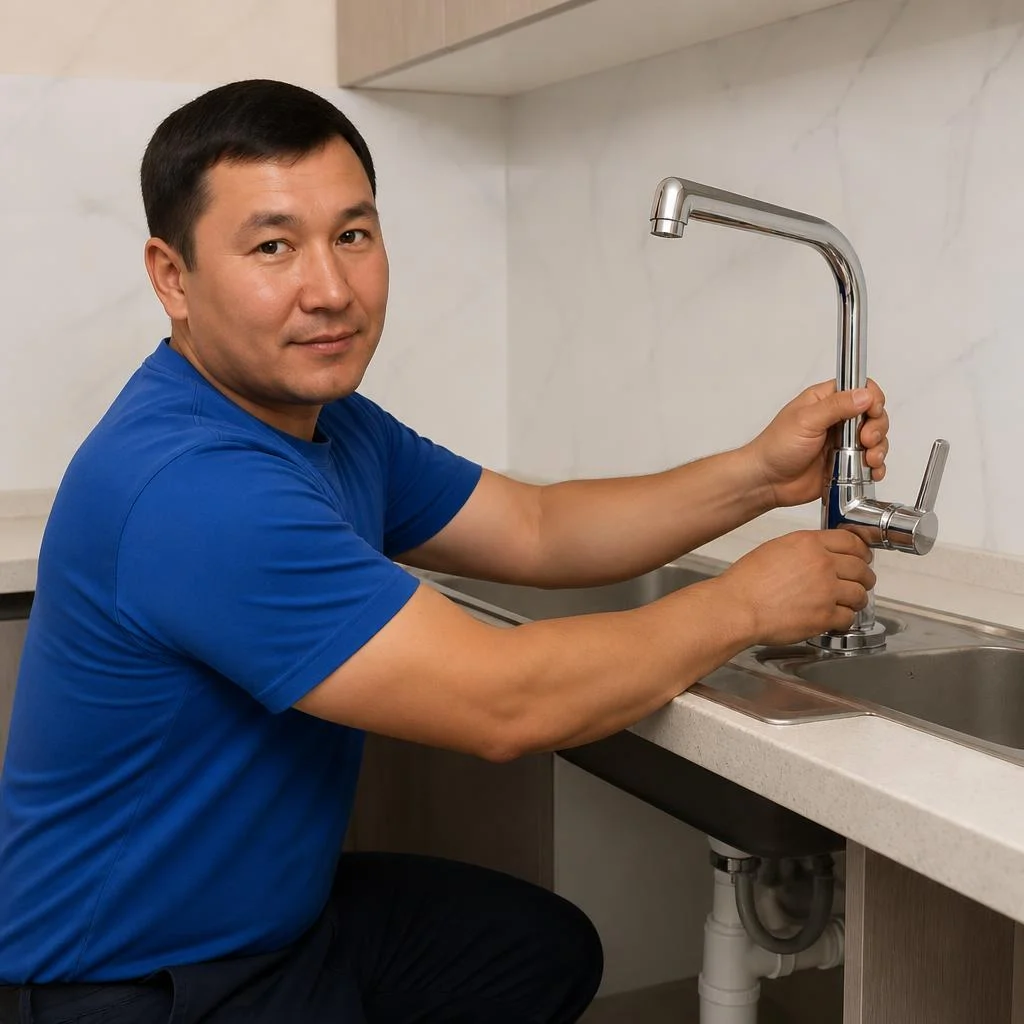








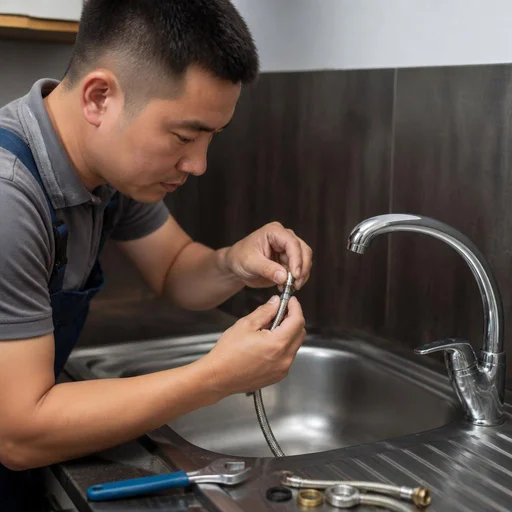
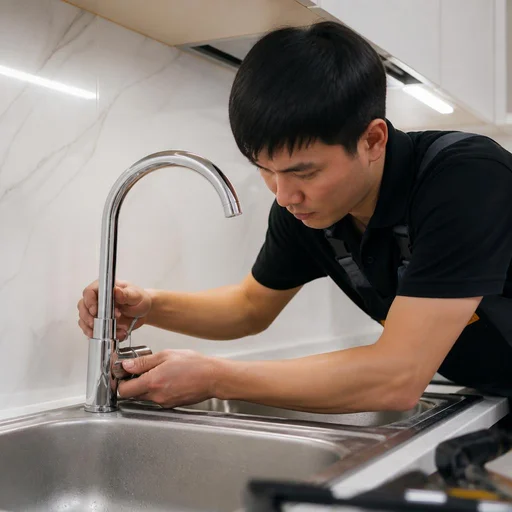
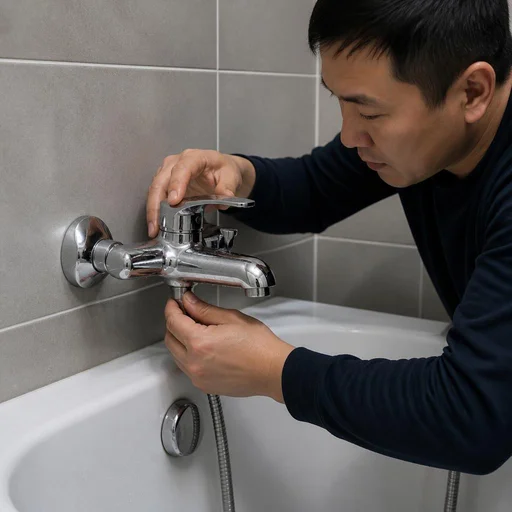
Why a faucet leaks: types of faults and what exactly breaks
A faucet leak doesn't happen "for no reason": each type of valve has its own wear-prone assembly. We'll show what breaks in different mechanisms and how to recognize a fault before calling a technician.
How to tell that a faucet needs repair, not adjustment
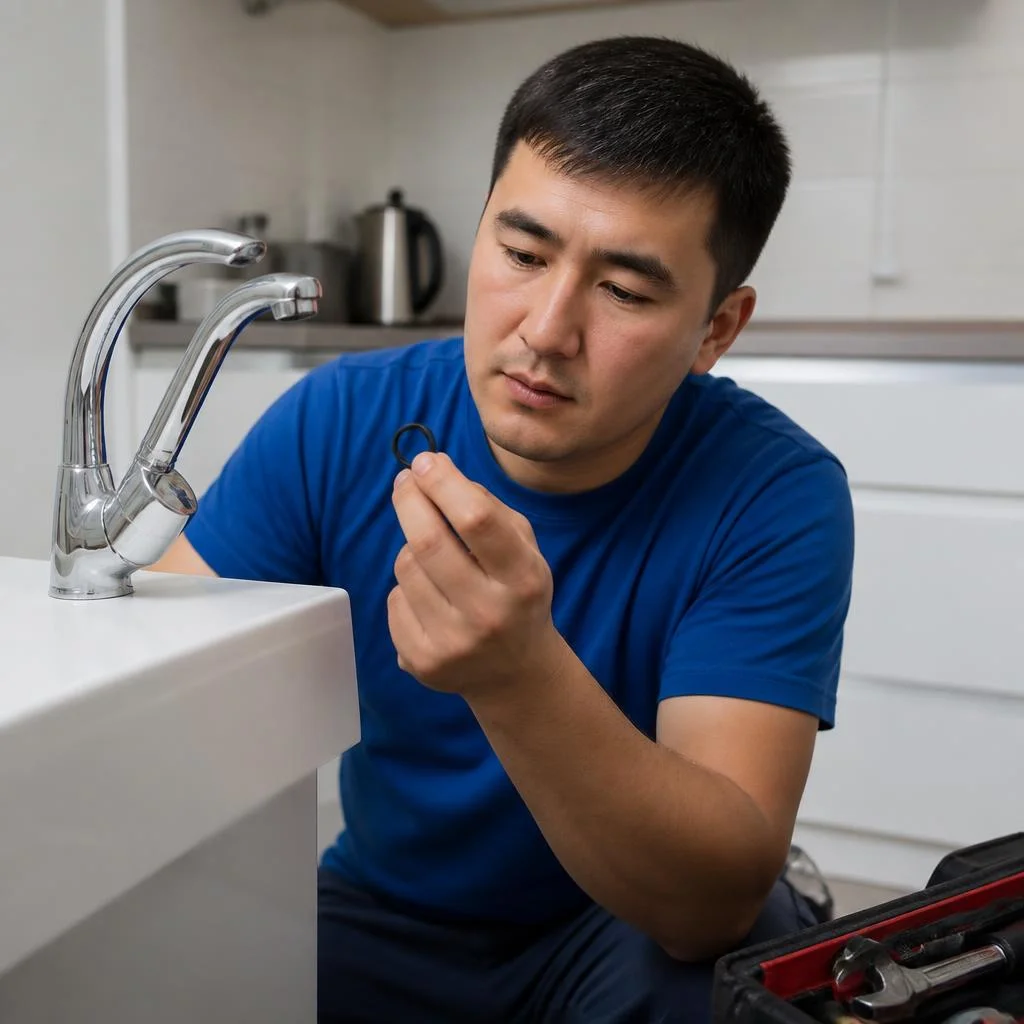
- Constant dripping from the spout: water seeps out even when the valve is closed — the seal or ceramic cartridge has worn out, and tightening the nut won't fix the situation.
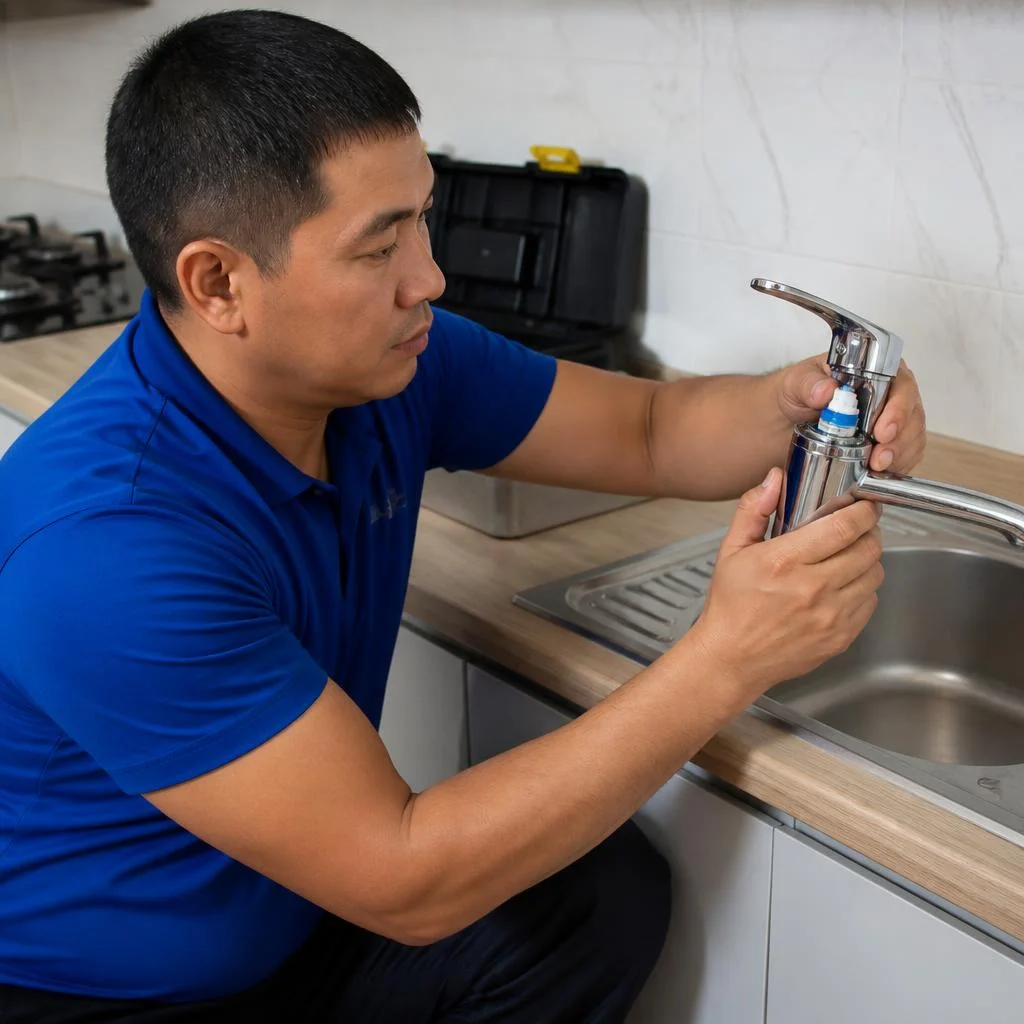
- Moisture along the stem under the handle: every time you turn it, water appears on the body — the gland packing or O-ring has lost its elasticity.
- Jerking and crunching when turning: the handle moves in steps, with effort — the cartridge's ceramic is breaking down or the thread on the stem is stripping.
- Leak only in one position: water escapes when turned in one direction — this is wear of the seat, not general wear of the assembly.
- Repeated leak after tightening: if water returns within a day after tightening the nut, the gasket has already hardened, and tightening it again will only strip the thread on the stem — replacement is needed.
What breaks in a ball, valve, and cartridge faucet
| Faucet type | What wears out | Repairability |
|---|---|---|
| Ball | Ball, seat, stem | Replaced entirely |
| Valve | Valve head, gasket | Restored by replacing the valve head |
| Cartridge | Ceramic cartridge, gland rings | Replacement of cartridge and seals |
| Quarter-turn | Stem, sealing rings | Partial repair |
A ball faucet with a worn ball is not restored part by part — it is replaced entirely, whereas a valve faucet is almost always repaired by replacing the valve head. In Bishkek practice, ball mechanisms are brought in for replacement three times more often than valve ones: they lose tightness faster during sharp pressure surges in the riser, especially in older buildings. Maintenance of shut-off valves in such buildings begins with checking the seat — on cast-iron risers it crumbles and requires reaming. If a client is looking for repair of a quarter-turn faucet, the technician first checks the stem and sealing rings: in quarter-turn models, these are exactly what wear out with frequent use, while the body itself remains intact.
Why a faucet leaks in a shower cabin and at a drinking water filter
In a shower cabin, the leak is most often caused by the "spout/shower" diverter and the flexible hose, while at a drinking water faucet — by the sealing rings and cartridge due to the constant pressure of the filter. Repair of a faucet in a shower begins with checking the ceramic diverter: it operates under the load of two flows and wears out faster than an ordinary mixer. In a drinking water faucet, the cartridge experiences pressure from the filter even in the closed position, so the rings lose their elasticity within 1.5-2 years of active use. A drinking water faucet cannot be repaired "by eye" — if assembled incorrectly, the filter loses its tightness, and water goes into the body rather than the spout. The request "drinking water faucet repair" occurs in our practice almost as often as complaints about mixers — and almost always the cause is the rings, not the body itself. Clients often formulate the task in general terms — faucet repair — and the technician clarifies on site which exact assembly has failed. Before disassembling, shut off the supply and relieve the pressure in the system, otherwise when removing the cartridge the flow will bypass the seal. A separate story is repair of a faucet with a thermostatic regulator: the thermoelement gets clogged with scale, and the water stops holding the set temperature, although externally the mechanism looks fine. More about this assembly — in the section on the bathroom.
Kitchen faucet repair: mixers, spouts and sinks
A kitchen faucet works under load more often than a bathtub one — the lever, flexible spout and aerator wear out faster. Let's break down exactly what gets replaced when the mixer leaks, jams or loses pressure.
Kitchen faucet with flexible spout: what we replace
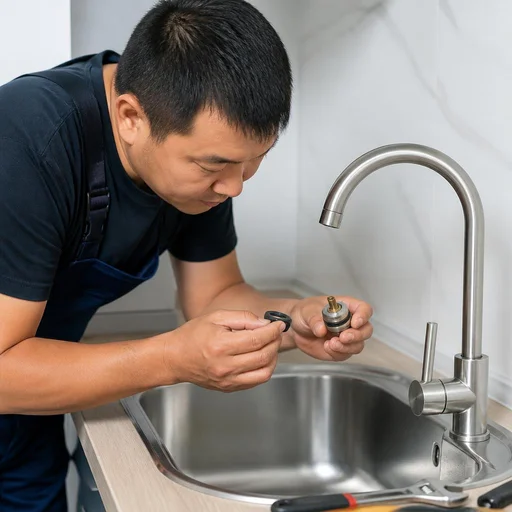
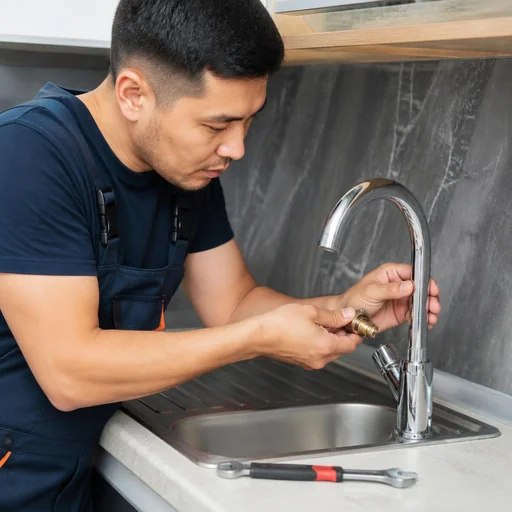
We perform kitchen faucet with flexible spout repair: we replace the pull-out hose, sealing rings and cartridge, which cause the nozzle to stop returning to its seat or leak at the base of the body. In models with a telescopic rod, not only the ceramic cartridge wears out, but also the guide bushing — over time it develops play, and the spout sags under its own weight. The sealing ring on the hose hardens from hot water within 12-18 months, after which a drip appears at the base. The flexible spout fails not from water, but from mechanical wear of the hose: if it jams, lubrication won't help, the hose needs to be replaced with disassembly of the body. Through Eco-Service such a replacement is carried out with the hose selected by the seating diameter of the specific model. In search, clients often type "kitchen faucet repair" — and land on this page, which describes all the typical components. Below we'll cover mixer replacement and work with the valve head separately.
Mixer replacement and work with the valve head
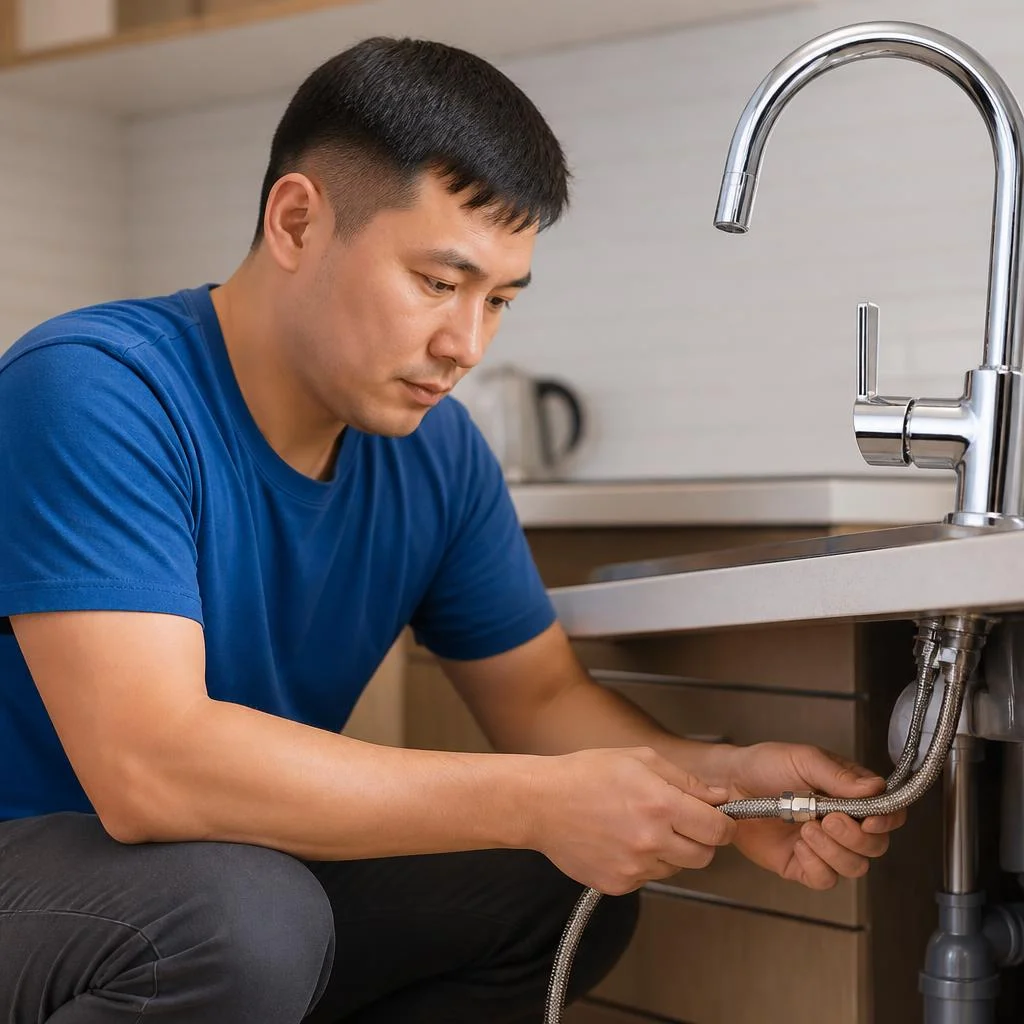
If the mixer body has cracked or the thread is stripped, we perform a complete kitchen mixer replacement — with removal of the old one, installation of the new one and pressure-testing of the supply lines. Kitchen sink faucet repair often begins with diagnostics of the valve head and seat: in valve models the seat becomes overgrown with scale, and even a new gasket won't hold water. In cartridge mixers with a lever, the problem is more often in the cartridge itself — it is replaced without disassembling the body if the model provides top access. In new kitchen sink mixers, you should immediately check the included flexible supply lines: they come in the kit, but their service life rarely exceeds five years. The query "quarter-turn faucet repair" occurs less often in our practice, but the mechanics are the same: a quarter-turn head requires gasket replacement and seat lapping. Before replacing the mixer, check the condition of the flexible supply lines: if they are more than five years old, replacing them together with the mixer is cheaper than opening up the assembly again a month later.
Cleaning and replacing the aerator, adjusting pressure
We carry out faucet repair and maintenance: we clean or replace the aerator, flush the cartridge of scale and adjust the mixer pressure if the water flows unevenly or in bursts. Maintenance of kitchen faucets in homes with old piping almost always includes flushing the aerator screen: mineral deposits from the pipes clog the nozzle within two to three weeks, and the pressure drops for no apparent reason. Kitchen faucet fixing with a lever mechanism often comes down to overhauling the cartridge — the ceramic plates become coated with deposits and stop fitting tightly, causing the flow to come in bursts. In search, clients type "water faucet repair" — and land on this page, which covers all the typical components. Kitchen faucet repair with a valve head also requires checking the stem travel: if it has seized up, pressure adjustment won't give any result until the head is replaced. A separate category is shower cabin faucet repair and water faucet repair in utility rooms: there the mixer works under less load, but suffers from hard water more. Before calling a technician, note at which lever position the leak appears — this halves the diagnostics time.
Faucet repair in the bathroom and shower cabin
In the bathroom, a thermostatic valve and a mode diverter are added to the faucet — components that aren't found in the kitchen. Let's look at how we service mixers, thermostats and shower faucets, and what to do about a leak along the stem.
Bathroom faucet servicing: mixer, stem, gland packing
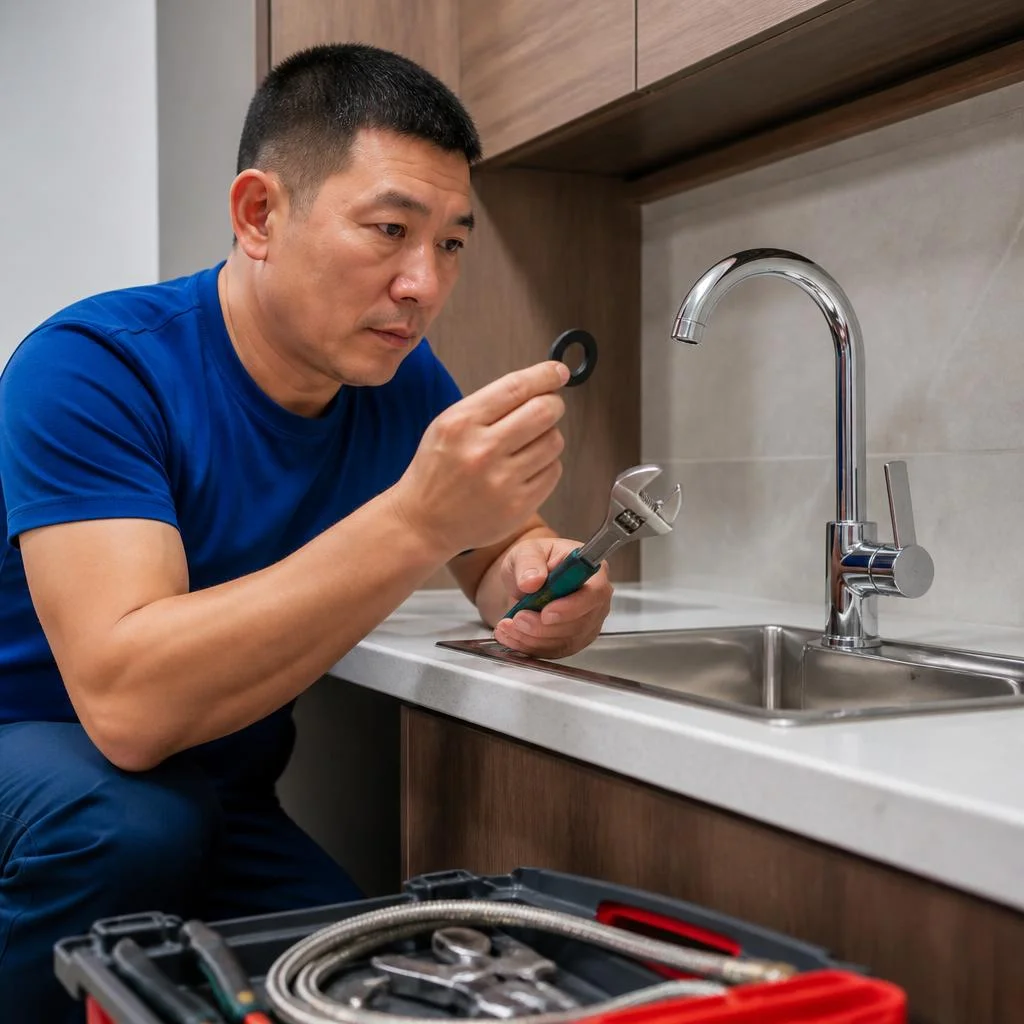
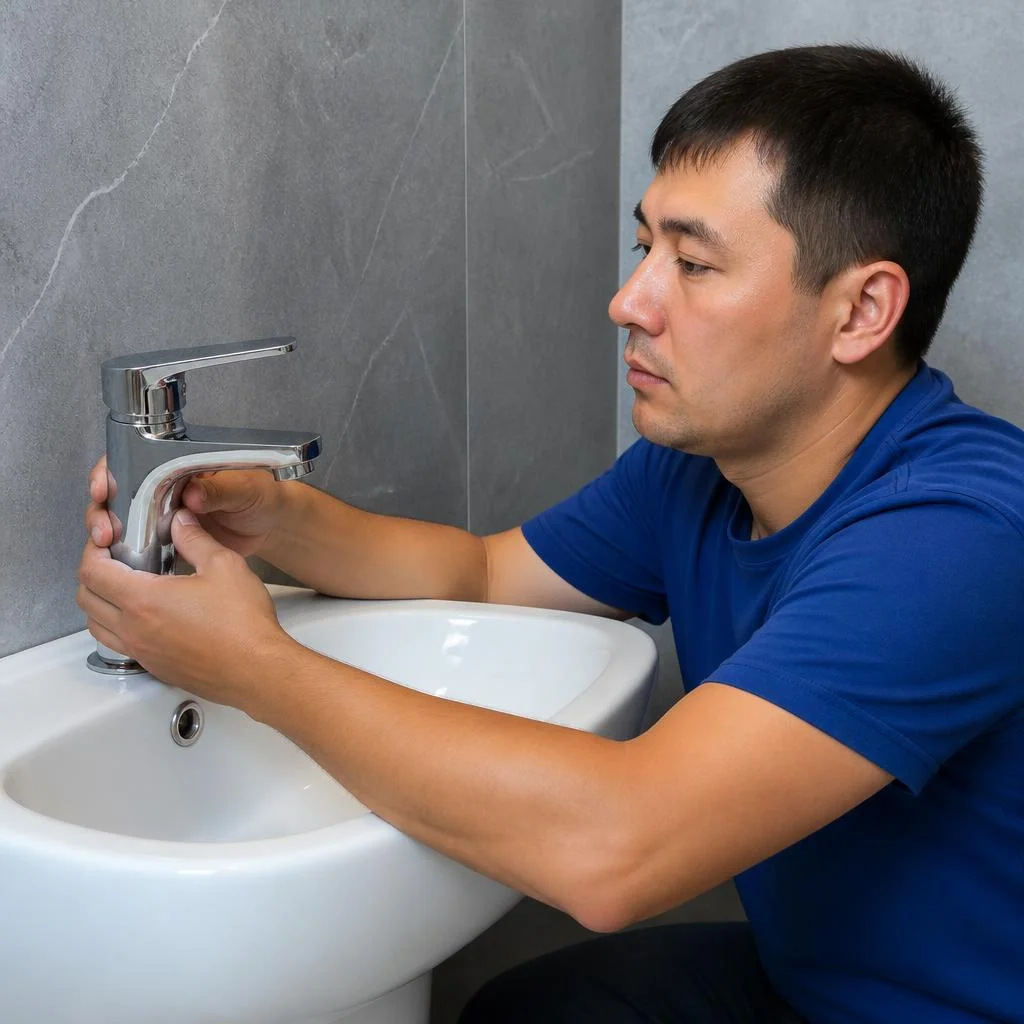
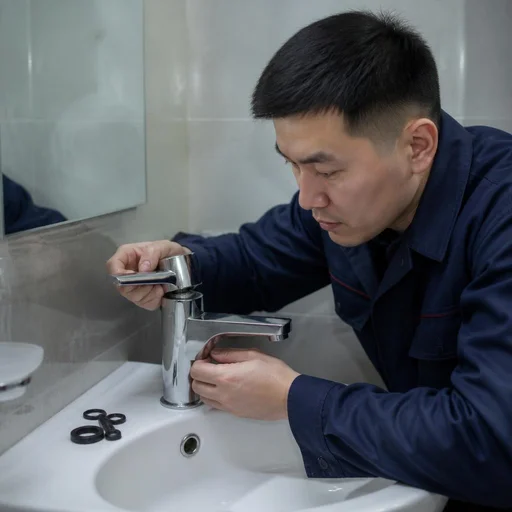
We begin work in the bathroom by disassembling the body: if there's a leak along the stem, we replace the gland packing; if there's dripping from the spout, we replace the cartridge and O-rings; and if the seat is worn or the body is cracked, we install a new mixer. Repairing a bathroom faucet with a valve head takes 40-60 minutes; with a cartridge mechanism, up to an hour and a half, if re-soldering of the supply line isn't required. In Bishkek's khrushchyovkas and panel buildings in Jalal and Asanbay, the stem is most often worn out due to pressure surges in the riser, so we also check the condition of the flexible supply line and the shut-off valve at the inlet. Repair of a washbasin faucet in the bathroom is carried out by the Eco-Service company: the technician arrives with a set of gland packing, cartridges for common models and O-rings. A leak along the stem is more dangerous than dripping from the spout: water goes behind the body and destroys the wall, so the gland packing is replaced immediately, not when it starts leaking more.
Servicing a faucet with a thermostatic valve
We work on a faucet equipped with a thermostatic valve at the first signs of unstable temperature: we replace the thermostatic cartridge and seals if the mixer stops holding the set temperature or only hot water comes out. The thermoelement inside the body reacts to the pressure difference between the hot and cold lines: if the filters are clogged or there's scale on the stem, it jams in one position, and the mixer delivers boiling water even at the minimum setting. The city's water is hard — salts are deposited on the thermoelement within 8-14 months of active use, so a preventive cleaning of the cartridge in citric acid is done once a year, doubling the service life of the unit. The thermoelement is sensitive to hard water — it should be checked at the first signs of temperature fluctuations, otherwise the cartridge will jam completely.
Servicing a faucet in a shower cabin and a shower faucet
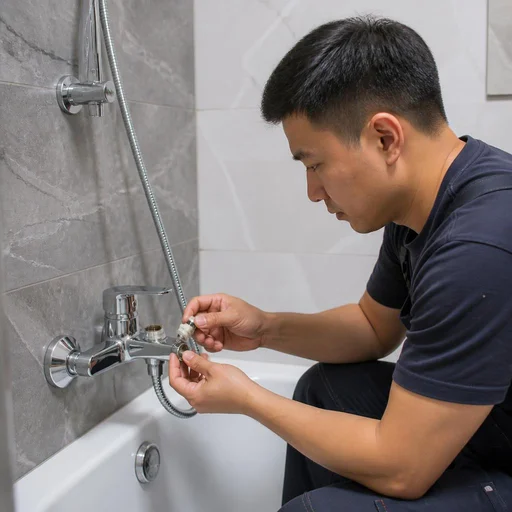
We begin work in a shower cabin with the "spout/shower" diverter: we replace the ceramic diverter cartridge, the flexible supply line and the seals, and check the tightness of all connections under a pressure of 3-4 bar. Clients often phrase the request as shower cabin faucet repair — and the technician immediately understands that this means the diverter and the common body with two valves. Servicing a shower cabin faucet with two handles is more complicated — there are two independent valves and a common body, so when one seat wears out, the entire mixer is often replaced. People often type shower faucet repair into the search bar — from this wording too, the technician understands without clarification that a visit to the shower cabin is needed. Work on a shower faucet in a bathroom with a flexible hose takes 30-50 minutes, but if the hose itself leaks at the base, we replace it entirely; repairing the braiding doesn't give a reliable result. In shower cabins, the leak often comes not from the faucet but from under the tray: if water remains on the floor after work, it's worth checking the drain and siphon, not just the mixer.
Servicing a washbasin faucet: what to check before calling a technician
- Stem and gland packing: if water seeps along the handle rather than from the spout, wear of the gland packing is confirmed — the technician brings it along.
- Aerator: scale in the mesh reduces pressure more than a clog in the supply line — check by unscrewing the nozzle by hand.
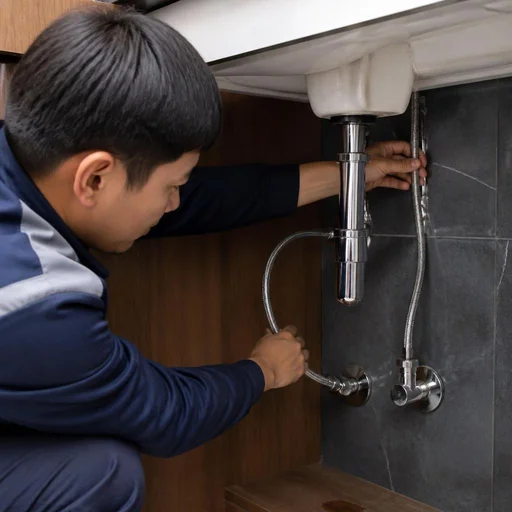
- Flexible supply line: inspect the braiding for rusty spots — if they appear, work on the washbasin faucet begins with replacing the hoses.
- Shut-off valve: shut off the water before the technician's visit — if the valve doesn't hold, work on the mixer is postponed until the shut-off valves are replaced.
- Mixer model: photograph the body and handle — from the photo the technician will select the cartridge and gland packing without an extra visit.
Repairing a water tap: valve, ball and quarter-turn types
A water tap is shut-off valve on a pipe, and its servicing differs from work on a mixer. Let's look at how valve, ball and quarter-turn models are constructed and what exactly fails in them.
Valve tap and replacing the valve head
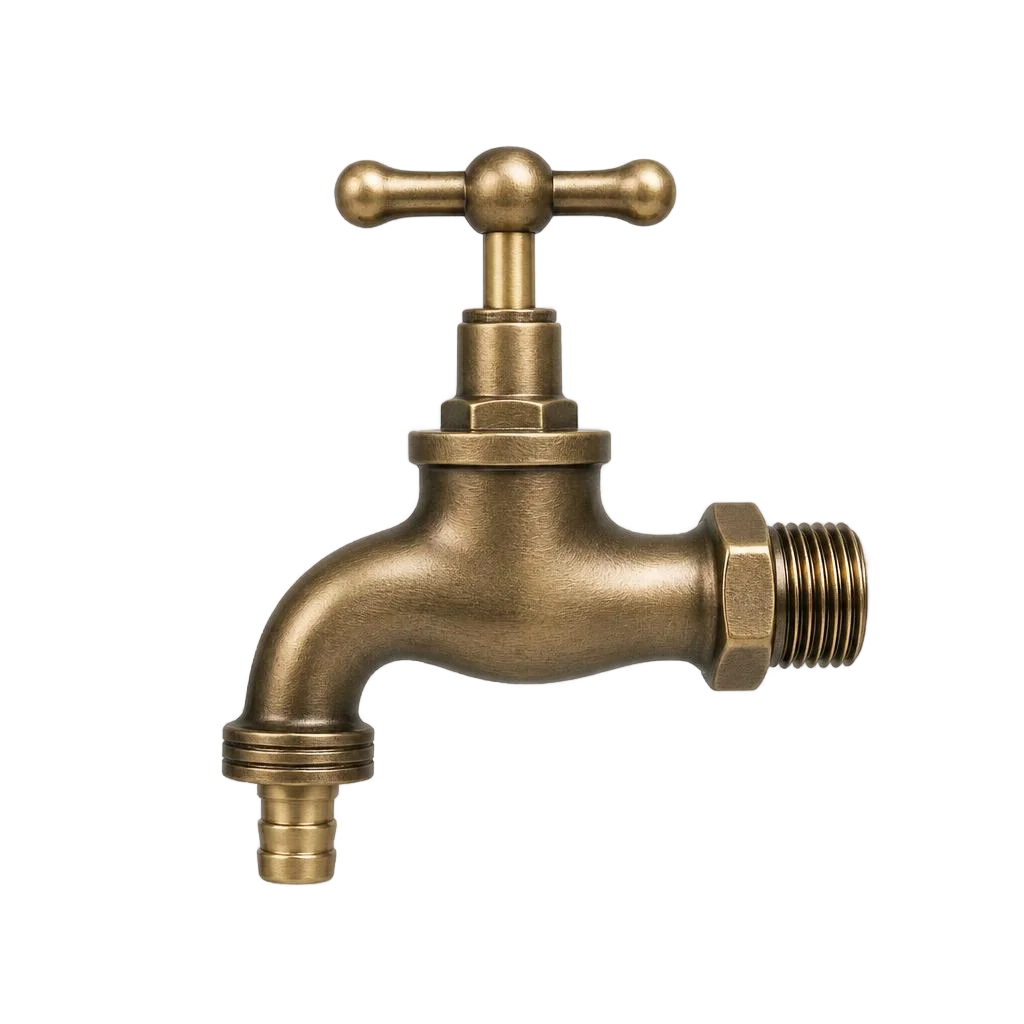
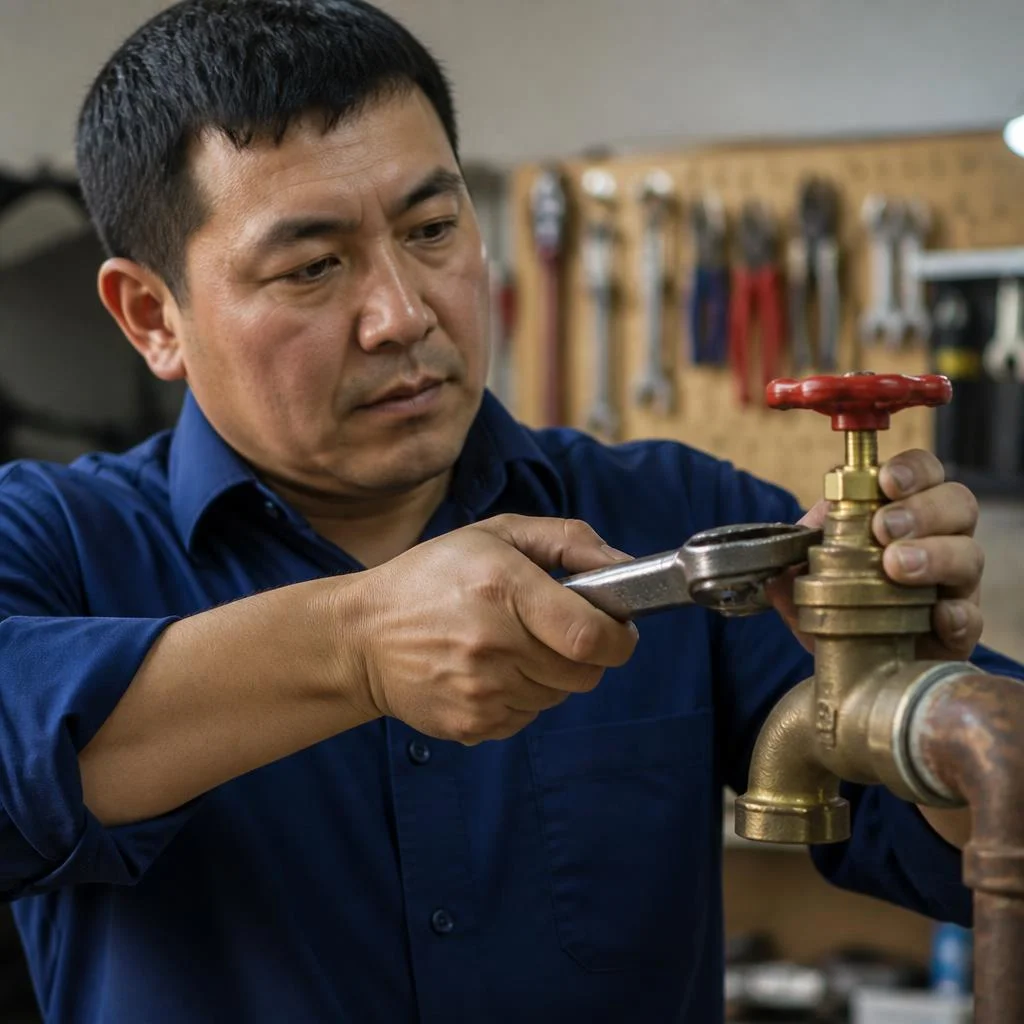
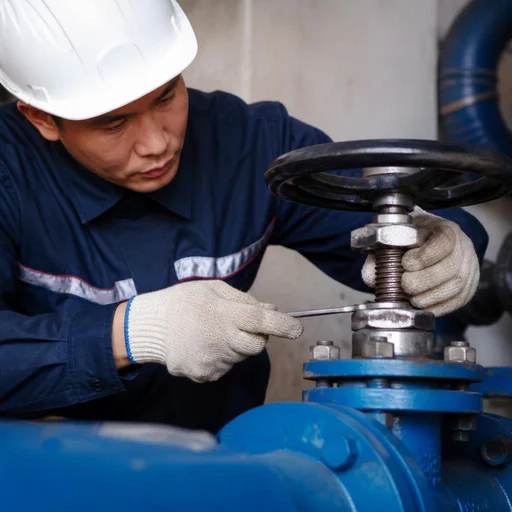
We restore valve taps: we replace the valve head and gasket, which cause the tap not to shut off the water completely or to leak along the stem when in the closed position. Such a job is requested when the handwheel turns with effort and water keeps dripping from the spout after being fully tightened. Work on a valve often involves the seat — over the years limescale builds up on it, and a new gasket does not seat hermetically until the technician grinds the surface in. Clients often phrase the request as valve tap repair — and from that it is immediately clear that a valve head replacement is needed, not the whole assembly. This is often exactly how people write to the service: valve tap repair — and the technician immediately understands what is meant. We service water taps on brass, silumin and cast-iron bodies, which are installed on risers and supply lines to the boiler. The valve head is selected by thread and stem height — there is no universal part, so the technician brings several sizes so as not to make a second trip for the spare part.
Ball tap in the kitchen and in the system
We service ball taps in the kitchen and in the water supply system: if the ball is worn or the handle does not shut off the water, we replace the tap entirely, and if it has seized up, we free it and replace the seals. The search query ball tap repair in the kitchen comes up most often when the handle turns stiffly or the water does not shut off completely. Work on a quarter-turn model begins with checking the handle travel: on a working one it turns 90° without jerking, while stiff movement means the edge of the ball has worn or the Teflon rings have settled. Restoration of quarter-turn models at the apartment inlet is done with pressure released from the riser and with neighbours warned — a standard procedure in Bishkek apartment blocks. A ball tap must not be left half-open for long — in that position the edge of the ball wears fastest, and after a season it stops holding pressure.
Ceramic, plastic and swivel tap
| Tap type | What we replace | When to replace entirely |
|---|---|---|
| Ceramic | Cartridge, rings | Crack in the body |
| Plastic | Seals, stem | Crack along the seam |
| Swivel | Bushing, play | Worn seat |
| Brass valve | Valve head, gasket | Stripped thread |
Work on a ceramic model comes down to replacing two ceramic plates that wear from hard water, while servicing a swivel tap involves the bushing and spindle: play is eliminated by replacing the sealing ring. At Eco-Service such work is done with the cartridge selected by diameter and height — ceramic has a shorter stem travel than a valve, and a part from another model will not fit. Plastic water tap repair — this is usually how clients enter the query when the body is fragile and cracks easily when overtightened, so work on plastic begins with releasing pressure in the supply line. If the body is cracked, plastic is not restored: under pressure it will burst along the seam, so a brass equivalent is installed.
Drinking water and filter faucet: installation and repair
A drinking water faucet works in tandem with a filter and requires care during installation — let's go over the installation and maintenance of such faucets.
Repair of a drinking water faucet and a drinking water tap
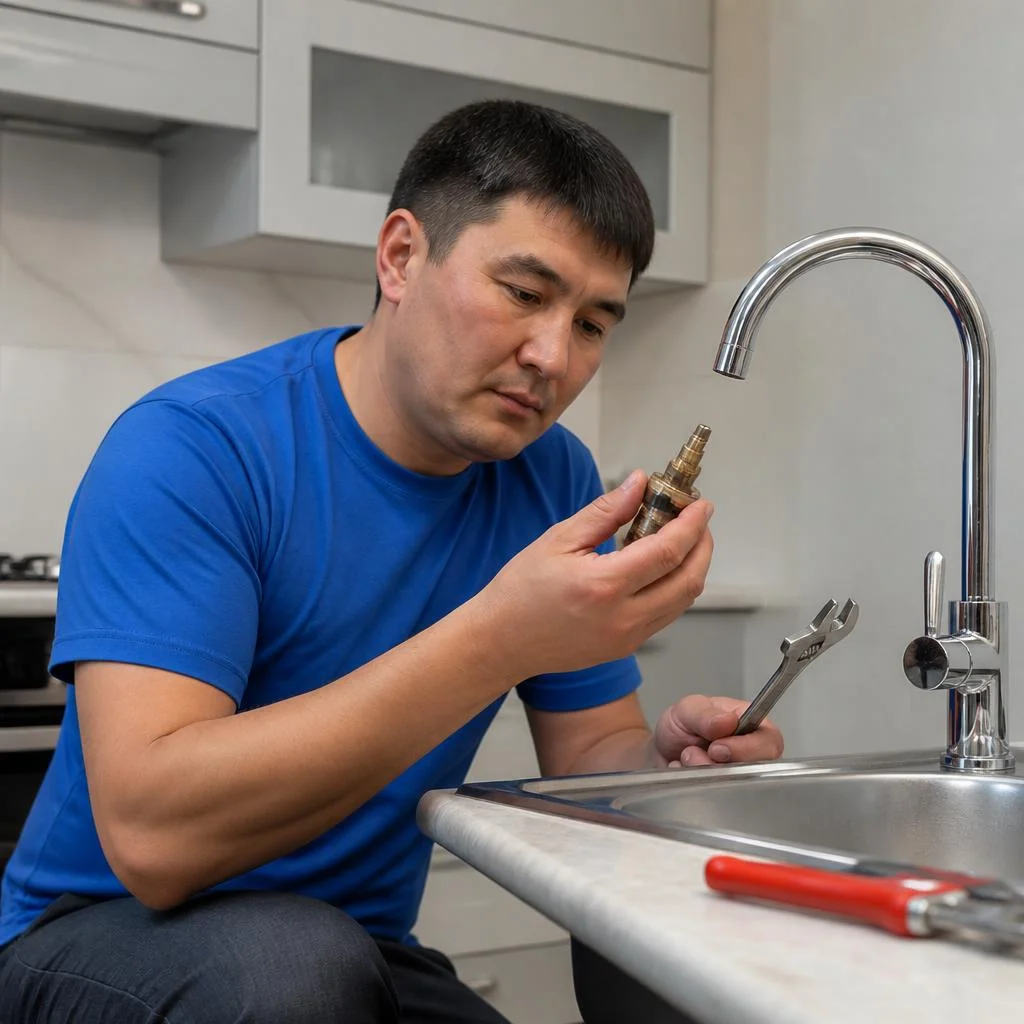
We perform work on drinking water faucets: we replace the cartridge and sealing rings, eliminate leaking at the base, and restore smooth lever movement. Clients search for "drinking water faucet repair" — and land on this page, because requests are most often related to three components: the ceramic cartridge, the compression nut, and the fitting connecting to the filter line. A microcrack appears on the ceramic, the nut loosens from vibration, and the fitting becomes clogged with salt deposits after 8-12 months of operation. The query "ceramic faucet repair" describes the same breakdown, only more precisely by the material of the shut-off component. In search, "water faucet repair" also appears — that's how those whose faucet on the filter line is already leaking but the model is unknown phrase the task. Work with reverse osmosis requires flushing the membrane and checking the pressure in the storage tank — without this, a new cartridge degrades within a couple of weeks. A drinking faucet leaks more often than usual due to constant pressure in the filter line, so after the work it's worth checking the filter itself too, otherwise the leak will return.
Installation of a faucet for a filter and relocating the connection point
We install a faucet for a filter and, if necessary, relocate the connection point: we drill a hole in the sink, connect the line, and check the connections under pressure. In search, such work is looked up as "kitchen faucet repair" and "water faucet repair" — the technician, in a single visit, installs a drinking faucet, replaces the gasket of the flexible supply line, and checks the pressure at the spout. Another frequent query is "water faucet repair": it usually means replacing the cartridge and seals on a mixer. Such installation with maintenance takes 40-60 minutes on a stainless steel sink and up to 90 minutes on artificial stone. The hole for the drinking faucet is drilled only in stainless steel or stone with a special hole saw — with a regular drill bit the sink cracks along the edge, and it has to be replaced. Work involving relocation of the connection point through Eco-Service is done with thread sealing using flax or an anaerobic compound. After installation, the water faucet is checked for leaks under operating pressure for at least half an hour.
How we work: diagnostics, on-site visit and a 2-year warranty
Our work follows a single scenario — from the request to pressure testing. We'll explain how the process is structured and what you get as a result.
How the technician's visit and diagnostics work
- Request: we take requests through the Eco-Service service center in Bishkek — by phone, on Telegram or via the form on the website; we confirm the address and the nature of the leak.
- Visit: the technician comes to your home in a convenient time slot and covers all districts of Bishkek — from Jalal to Asanbay and Vostok-5.
- Diagnostics: he inspects the unit, checks the supply line, threads and shut-off valves, and determines exactly what has failed.
- Estimate: he provides an exact list of work and parts before starting, with no hidden extra charges along the way.
- Work and testing: he replaces the worn component, reassembles the unit and tests it under operating pressure before leaving.
2-year warranty and original spare parts
For all faucet repair work we provide a 2-year warranty and install original spare parts — gaskets, valve cartridges and cartridges for the specific model. Plastic units are a separate story: repairing a plastic faucet requires care, because an overtightened thread cracks, and then instead of replacing the gasket you have to replace the entire body. We keep consumables in stock for Grohe, Hansgrohe, Kludi, Iddis mixers, as well as for the mass-market Chinese and Turkish series most commonly found in Bishkek apartments. We select cartridges by stem diameter and number of inlets, valve cartridges by thread type and stem height, and gaskets by the seat's mounting size. If the needed part isn't in stock, we bring it to order within one or two days. The warranty covers both the part and the work: if the same unit starts leaking a year later, the repeat visit and replacement are done at no extra charge. Clients often phrase their request as quarter-turn faucet repair — and from that phrase the technician immediately understands which unit he's dealing with. Another common search-bar variant is mixer water faucet repair: that's usually how people write it when water leaks from under the valve in the kitchen or bathroom.
Reviews, 2GIS rating and payment via MBANK
- Reviews: see them on 2GIS and Google Maps — there are photos of completed work and the technician's responses to comments.
- Rating: read recent ratings from the last few months — the overall figure for all years doesn't show how the service is performing now.
- Payment: we accept via MBANK and O!Dengi, in cash or by card — however is convenient for the client.
- Documents: we issue a report listing the replaced parts and the 2-year warranty period.
Conclusion
Faucet repair comes down to one question: what exactly has failed. Below are brief takeaways that help you choose a strategy before the technician arrives and avoid overpaying for unnecessary work.
Key takeaways
- The mechanism type determines the diagnosis: in a valve unit the valve cartridge wears out, in a ball valve it's the ball and seat, in a cartridge unit it's the cartridge itself.
- Minor repairs extend the unit's life: replacing a gasket, cleaning the aerator and a new supply line postpone major work, but they won't stop a crack in the body.
- A leak along the stem is more dangerous than a drip from under the nut: water goes behind the body, soaks the wall and tiles, so such a defect is fixed immediately.
- Drinking and shower faucets require a separate approach: in the former, the filter holds the pressure; in the latter, the mode diverter creates the load.
- A 2-year warranty and original spare parts matter more than speed: a repeat visit because of a cheap part costs more than the initial savings.