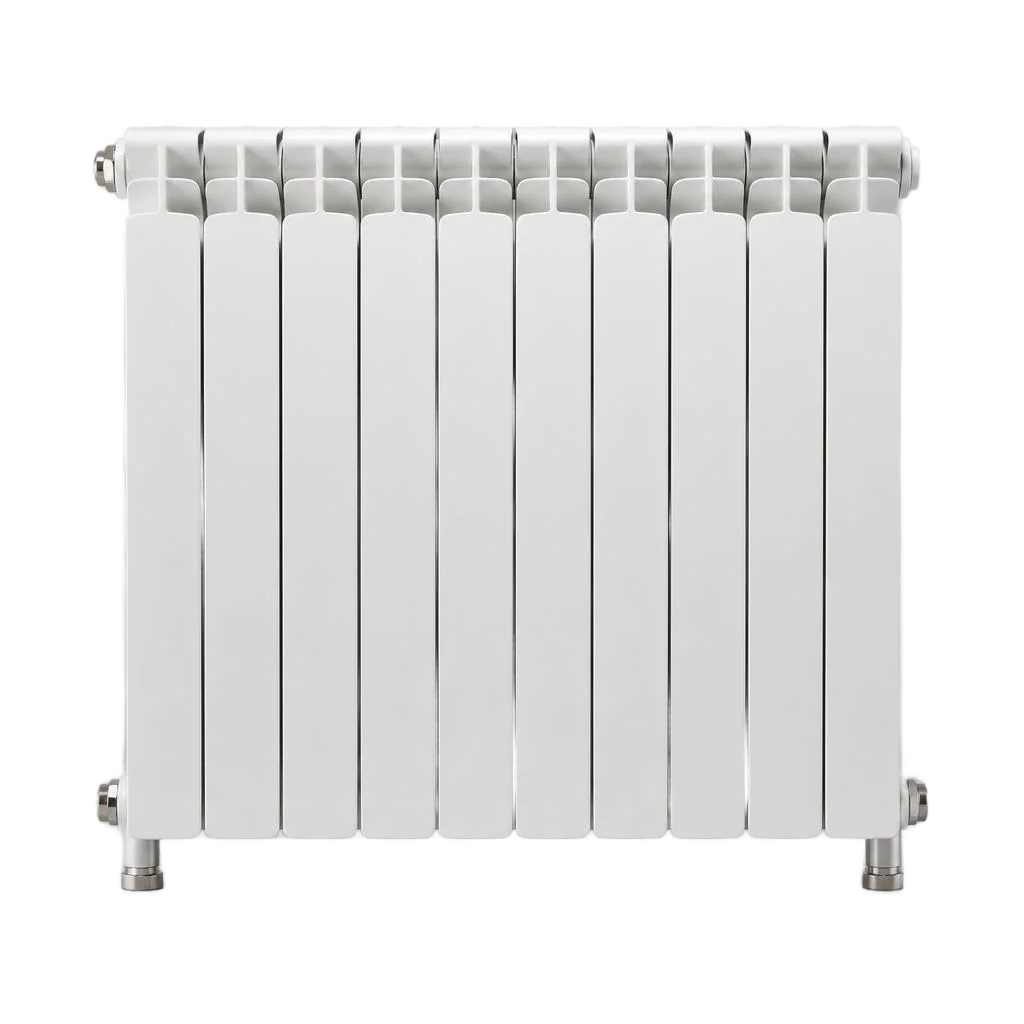

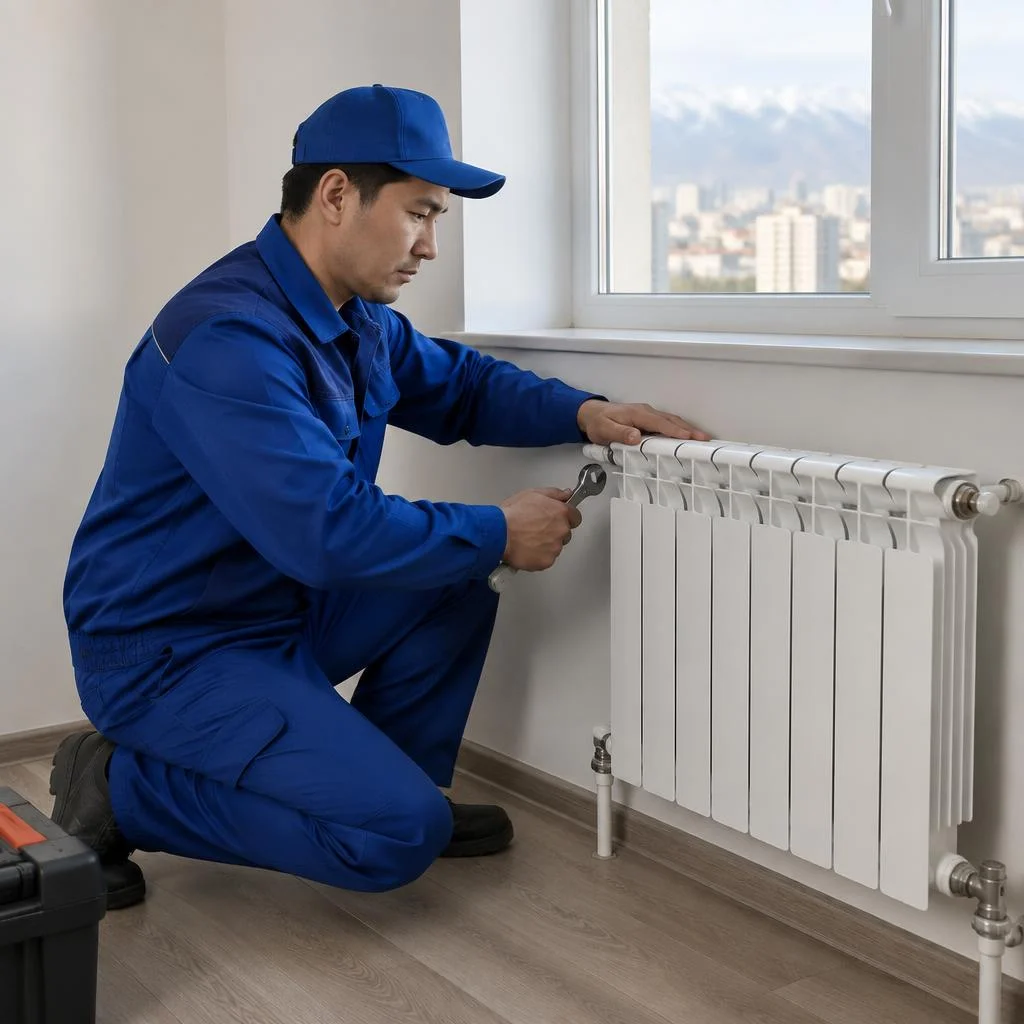
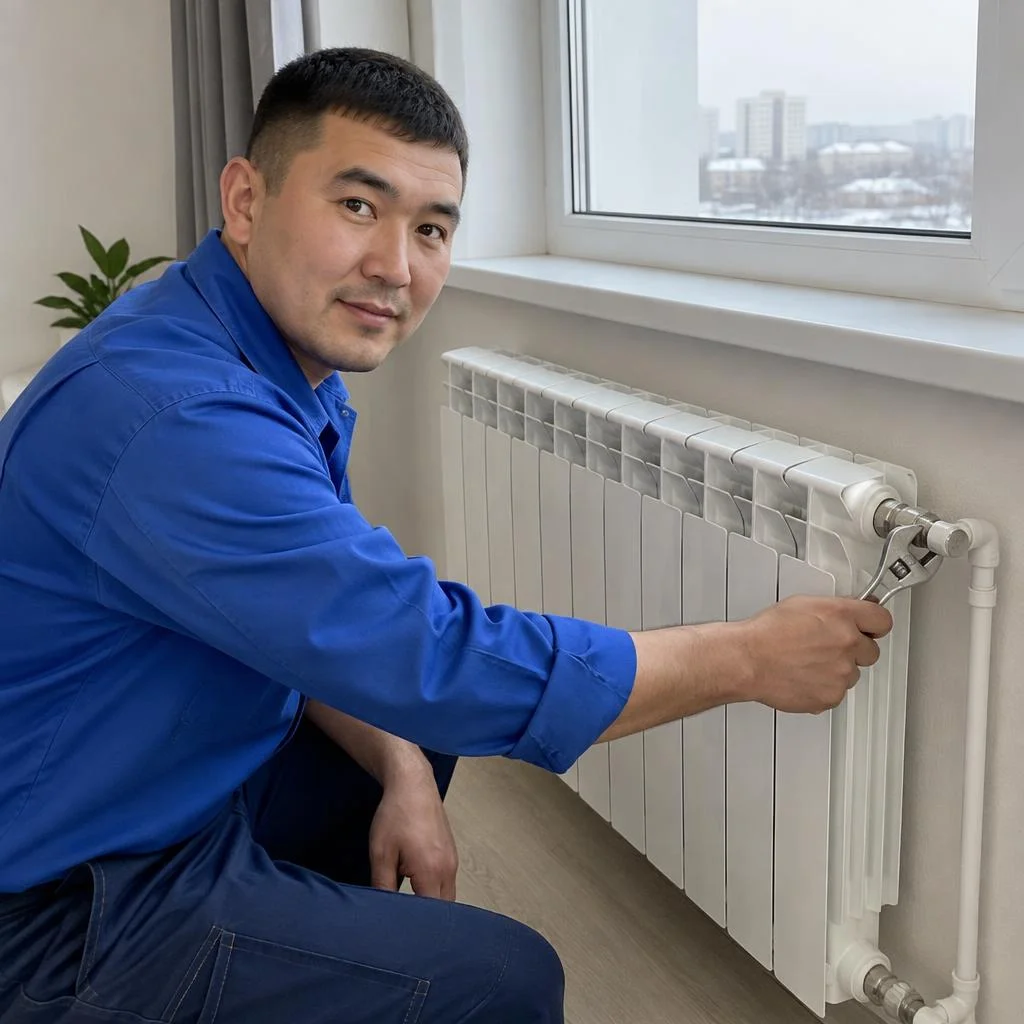
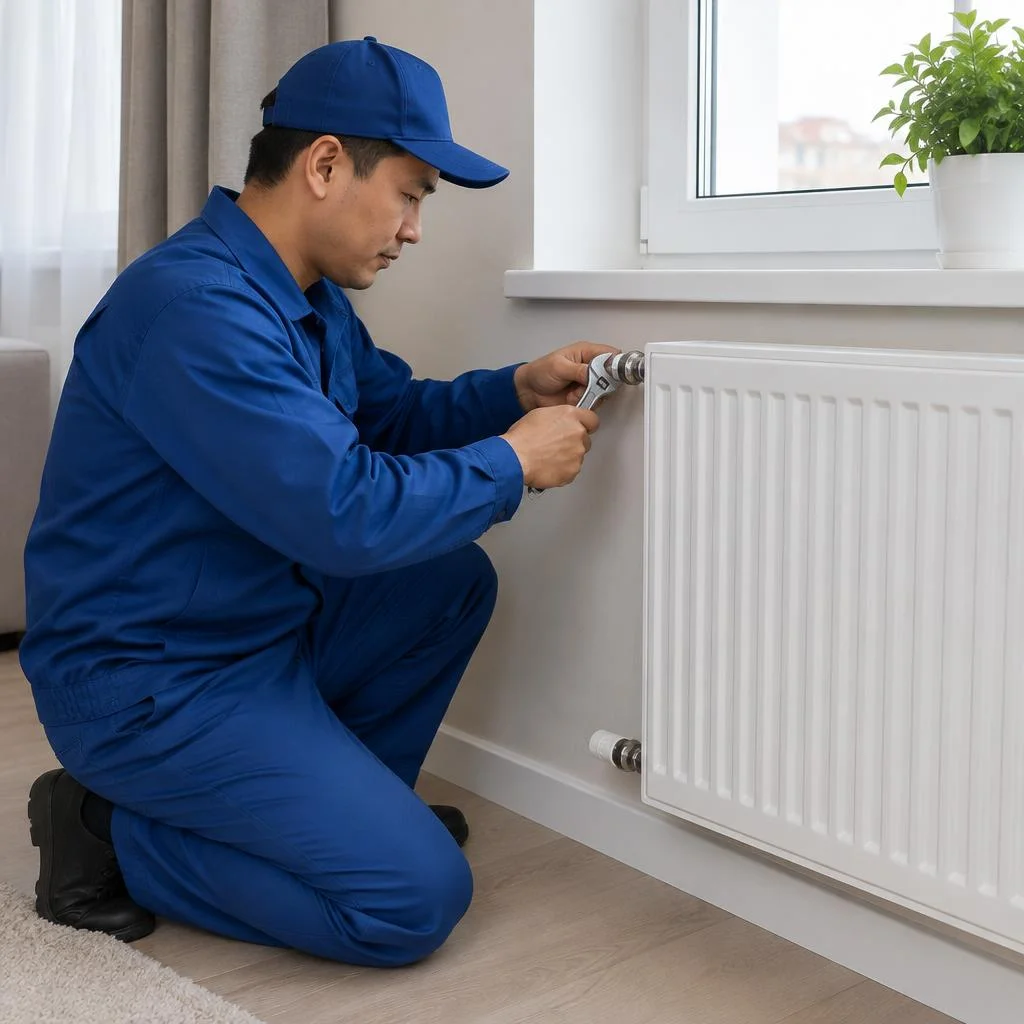








When radiator replacement is needed and which batteries are installed in Bishkek apartments
Bishkek's housing stock consists of panel and brick buildings from the 1960s-1990s with cast-iron units that have exhausted their service life. Pressure surges in the risers from the city's thermal power plant accelerate wear, so batteries here are replaced more often than in cities with a mild hydraulic regime.
Signs that a radiator needs replacing
- Cold sections: the bottom of the unit stays cold while the riser is hot — there is sludge inside, and flushing gives only a temporary effect.
- Thread leaks: drops appear at the connections to the supply lines, returning a few days after tightening.
- Rust stains and pinholes: brown spots on the paint and pinpoint holes from which water seeps under riser pressure.
- Age over 25-30 years: over such a period a cast-iron radiator becomes fouled with deposits and loses up to a third of its thermal output.
- Uneven heating across floors: it's hot at the neighbors' above, barely warm at yours — the unit is clogged or airlocked.
How bimetallic, aluminum, cast-iron and steel radiators differ
| Type | Working pressure | Heat output per section | Service life | Where to install |
|---|---|---|---|---|
| Bimetallic | up to 35 atm | 180-200 W | 20-25 years | Central riser, high-rises |
| Aluminum | up to 16 atm | 190-210 W | 10-15 years | Autonomous systems, manifold distribution |
| Cast-iron | up to 9 atm | 120-160 W | 30+ years | Old housing stock, low pressure |
| Steel panel | up to 10 atm | 150-180 W | 15-20 years | Autonomous heating, country houses |
A bimetallic radiator withstands water hammer during spring and autumn pressure testing, which is why it is the right choice for Bishkek's central heating. In Khrushchyovka buildings with a single riser per entrance, the pressure is higher than in new buildings with manifold distribution — aluminum there may not withstand a peak surge. When clients ask what to choose, we analyze the parameters of their riser, not just the area of the room.
Which batteries are best to install in an apartment in Bishkek
At Eco-Service we most often install bimetallic radiators — they withstand the pressure of the central riser and deliver 180-200 W per section, which is enough for panel buildings on Toktogul, Kievskaya and Zhibek-Zholu streets. For buildings of the old series with cast-iron risers, we take models with a 500 mm center-to-center distance so we don't have to re-weld the supply lines. Installing bimetallic batteries solves two problems at once — heat output and resistance to pressure surges during pressure testing. For the kitchen and bathroom we take a radiator with 2-3 fewer sections than for a room of the same area — heat loss there is lower due to the neighboring risers. Clients often phrase the request as replacement of heating batteries in an apartment, and in that case we first calculate heat loss for each room, rather than simply swapping the units for identical ones. Another common variant of the request is battery replacement in Bishkek — and for that we follow the same procedure: diagnostics, calculation, installation. We separately clarify that replacing radiator batteries with bimetallic ones in a panel nine-story building and in a brick Khrushchyovka follows different supply-line layouts. In search this is often phrased as radiator replacement in Bishkek, and we handle such a request by the same algorithm — from measuring the riser to selecting the model. Sometimes the request contains the short line replace batteries price, and that means the person wants to first see the order of the numbers, and only then choose a model.
How many radiator sections are needed per room
We calculate using the formula: 100 W per 1 m² multiplied by the room area and divided by the heat output of one section — for 18 m² and bimetallic, this is 9-10 sections. If the ceiling height is above 2.7 m, we add a correction factor of 1.05 for each extra decimeter. For a corner apartment on the first or last floor, we allow a reserve of 15-20%, for a room with two windows — plus one section for each additional window. In new buildings with an insulated facade and energy-saving double-glazed windows, the calculated figure can be reduced by 10%. An incorrectly selected number of sections results in either a cold room or overheating and excess heating consumption. When asked about the cost of replacing a radiator, we answer only after this calculation — the number of sections directly determines both the volume of metal and the labor costs. That is precisely why there is no fixed figure in the price list: to replace a radiator in an apartment, the price depends on the number of sections and the condition of the supply lines. Clients often enter the query as how to replace a heating radiator price, and we explain: the figure appears after the measurement, not before it. Another wording variant that we see in requests is replacement of a battery in an apartment price, and here the order is the same: first the measurement, then the estimate. In phone conversations this often sounds like replacement of a heating battery price, and the manager immediately moves the conversation to an on-site measurement.
Replacing cast-iron batteries with bimetallic ones: calculation and specifics
When switching from cast-iron batteries to bimetallic ones, we preserve the number of sections by heat output, but take into account that bimetallic heats 30-40% more efficiently. A cast-iron section gives off 120-160 W, a bimetallic one — 180-200 W, so for a room of 18 m², instead of ten cast-iron sections, seven or eight new ones are enough. The main specific is the diameter of the supply lines: old cast-iron appliances often have 32-40 mm, while bimetallic has an inlet of 1/2 or 3/4 inch, so an adapter and new supply lines are needed. The second point is weight: a cast-iron battery with 10 sections weighs about 70 kg, a bimetallic one — half as much, and brackets on a gypsum wall are easier to install. Often you can install 2-3 fewer sections — saving on metal and space, but not on heat. If you want to replace a radiator in an apartment with an old riser, first check the condition of the supply pipes — when replacing the appliance, they will have to be changed anyway. In requests this sometimes sounds short — battery replacement — but behind those two words is a whole sequence: dismantling, adapters, pressure testing, and restarting the riser. A separate line in our requests is replacement of batteries/radiators, and for it we follow the same work order as when switching to bimetallic. When a client writes replace radiators in an apartment price, we clarify the building series and floor, because the supply scheme and the scope of dismantling depend on this.
Replacing a heating radiator in an apartment: stages of work
What the installation of a heating radiator in an apartment looks like from request to pressure testing — step by step, with realistic timelines for each stage and a breakdown of what the technician does with his own hands and what he coordinates with the management company.
Removing the old radiator
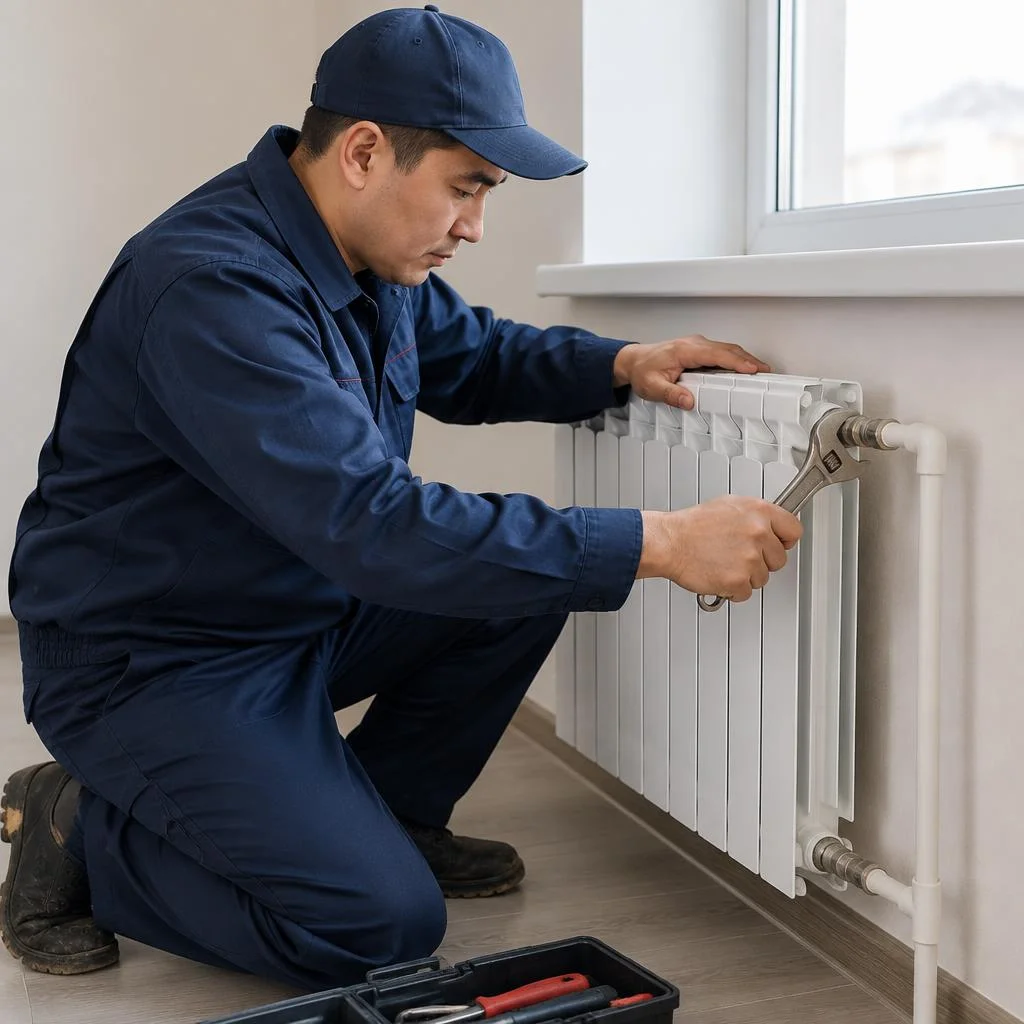
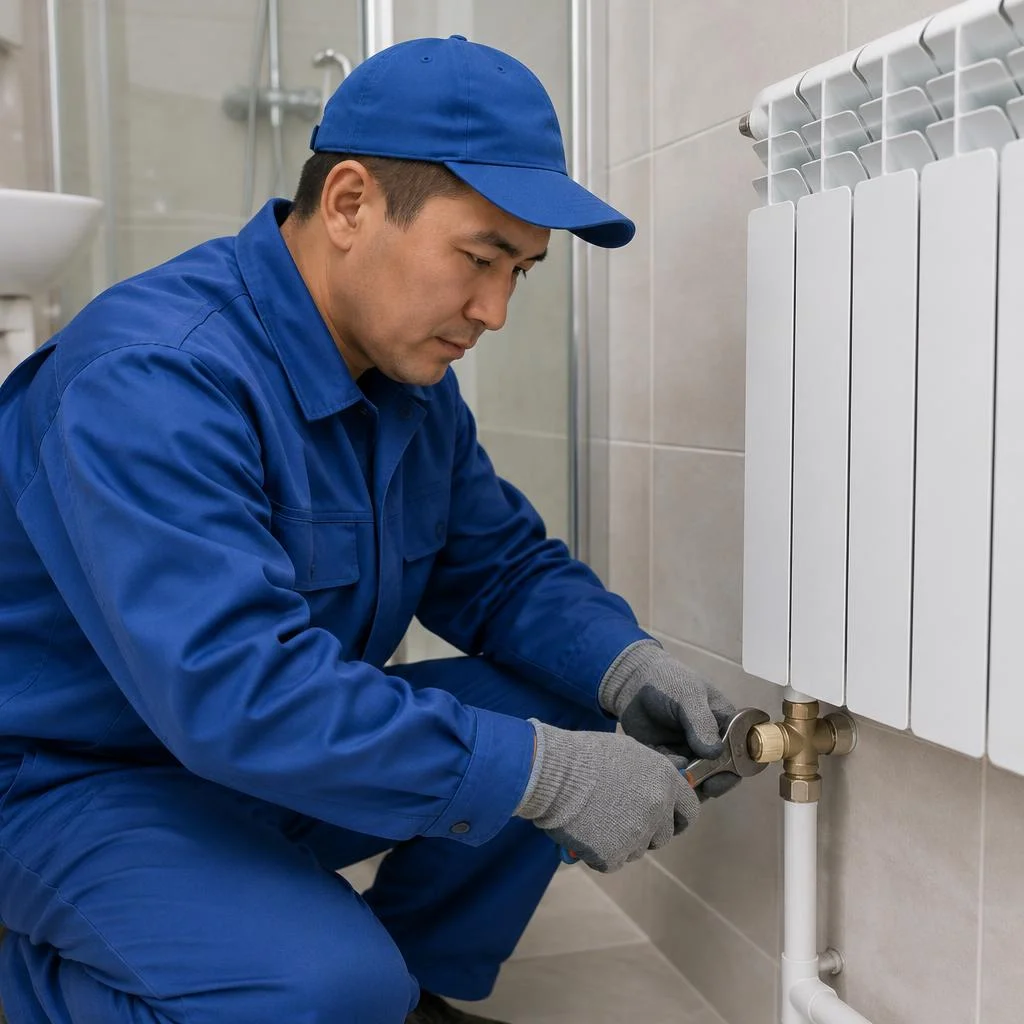
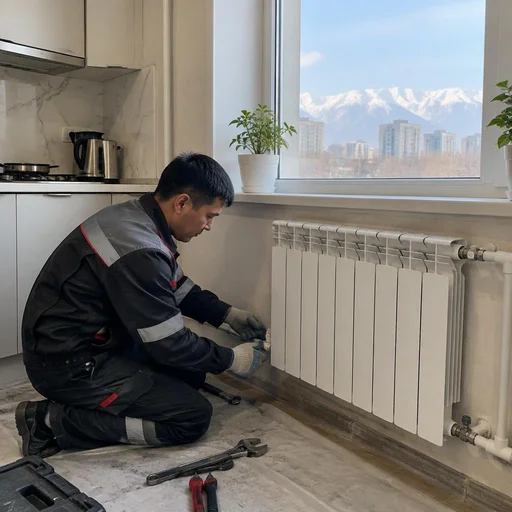
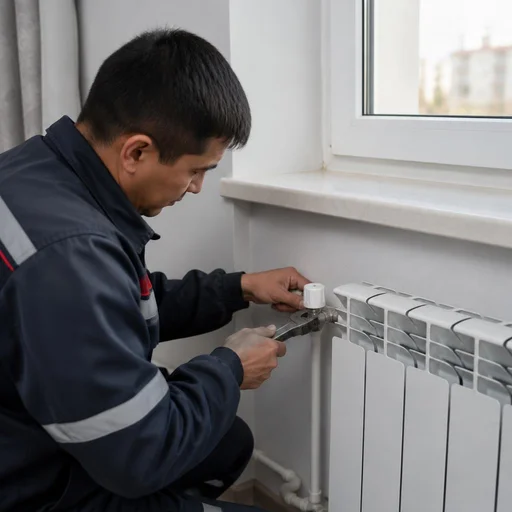
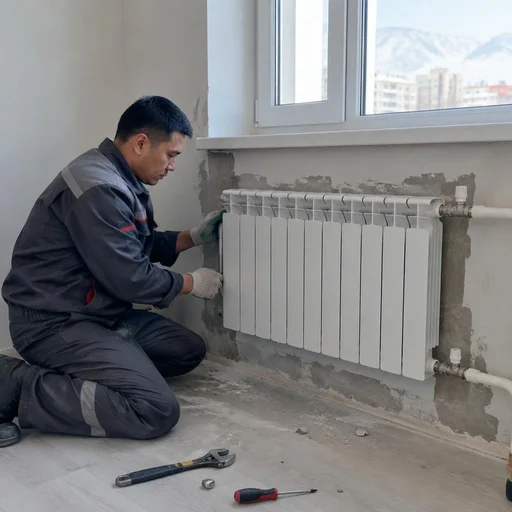
We shut off the shut-off valves, drain the water from the radiator, disconnect the supply lines and take the battery off the brackets — 30-40 minutes per radiator in a standard two-room apartment on the 9th floor. Installing new heating batteries begins with inspecting the radiator's shut-off valve and the supply line to the radiator: if the valve holds, water drains only from the battery; if not, we drain the riser through the basement. Clients often ask about replacing old batteries with new ones, and the first stage here is the noisiest: in buildings of the 1-464 series on Toktogul and Kievskaya streets the risers are cast iron, and the threads on the supply line are often seized — we heat the joint with a gas torch and unscrew it with a wrench with an extension so as not to strip the threads on the riser tee. Removing the radiator takes less than an hour, but if there are no shut-off valves, we drain the riser through the basement — we coordinate this with the management company in advance, otherwise the neighbors will be left without heat. When a person is looking for replacement of a heating battery in an apartment, he usually doesn't imagine how much dirt and noise removing a cast-iron section produces — warn the downstairs neighbors in advance. In search, such requests often look like replacement of cast-iron batteries price — and from the description of the building the technician immediately understands that heavy sections will have to be removed and the draining of the riser coordinated with the management company. In winter, removal follows a different scheme: if a person is looking for battery replacement in winter, the riser has to be shut off during the work, so we schedule such requests for morning windows, when the neighbors haven't yet gone off to their errands.
Hanging and connecting the new radiator to the riser
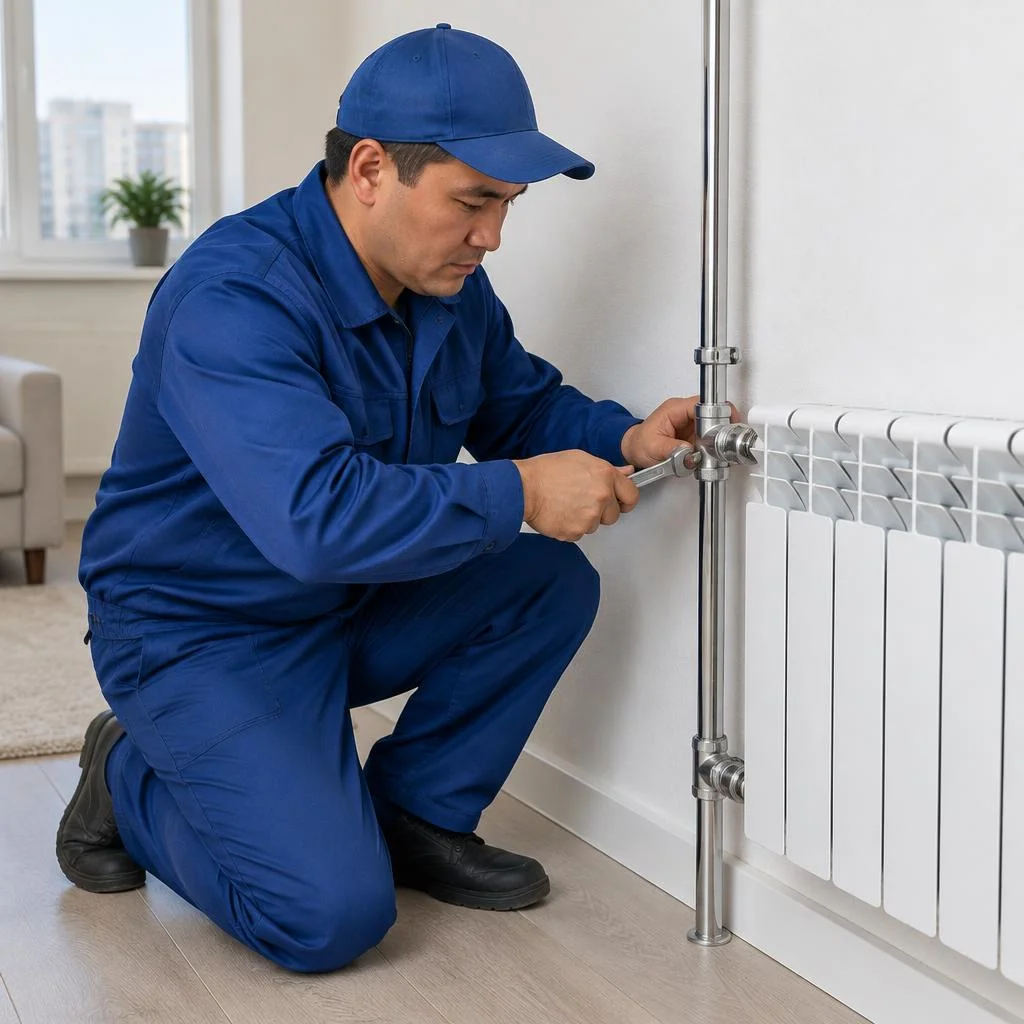
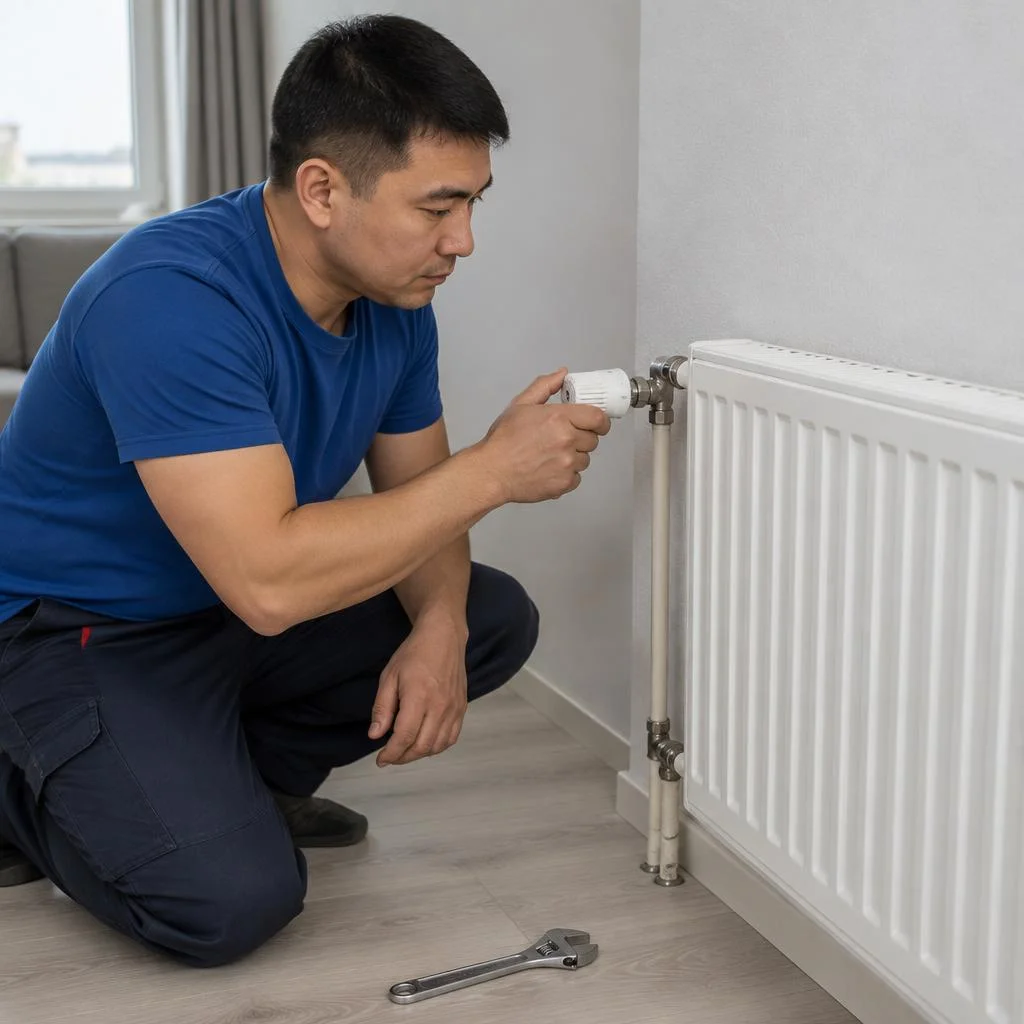
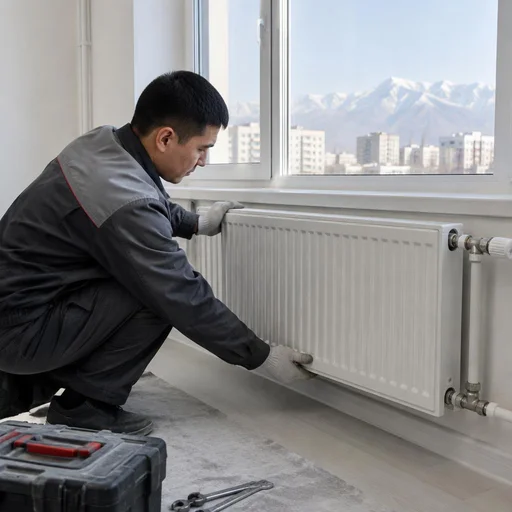
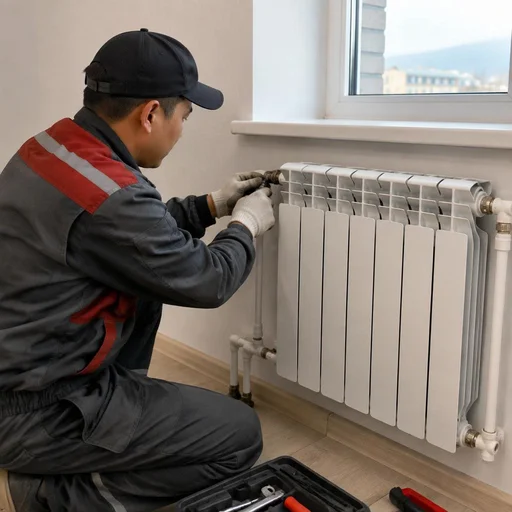
We mark the brackets by level, hang the radiator with a slope of 1-2 mm per section toward the Mayevsky valve, connect the supply lines and solder the polypropylene. Installing a heating battery is always work with geometry: in panel buildings of the Asanbay and Kok-Zhar microdistricts the wall can deviate from vertical by 8-10 mm, so we set the brackets by laser level, not by markings on the wall. If you need radiator replacement in an apartment, hanging a bimetallic one with 10-12 sections requires four attachment points: the two upper brackets carry the weight, the two lower ones secure it against displacement during water hammer. We solder polypropylene pipes with a soldering iron with a 20 mm nozzle; reinforced ones — with the foil stripped with a shaver, otherwise the joint will delaminate within 2-3 seasons. The slope is needed so that air escapes into the Mayevsky valve rather than accumulating in the far sections — otherwise the radiator will heat unevenly. In requests this most often sounds like replacement of a heating radiator, and from the description the technician immediately understands the scope. When a client phrases the request as change the heating battery, it almost always means a full hang from scratch, not a partial tightening of sections. A separate line in the price list is replacement of bimetallic radiators, and from it you can see that this refers to sectional units with four attachment points, not panel convectors. Often a request says change the batteries at home — and that's the same scenario: remove the old sections and hang new ones on prepared brackets. When someone types replacement of cast-iron batteries with steel into the search bar, this refers to switching from heavy sections to a lightweight steel unit — and here it's important to recalculate the attachment points for the lower weight in advance.
Pressure testing and leak check
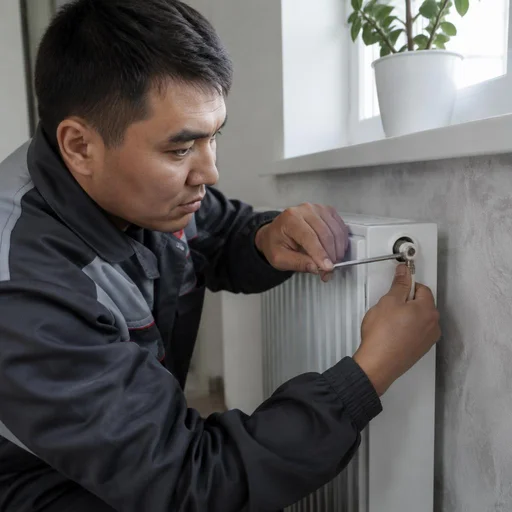
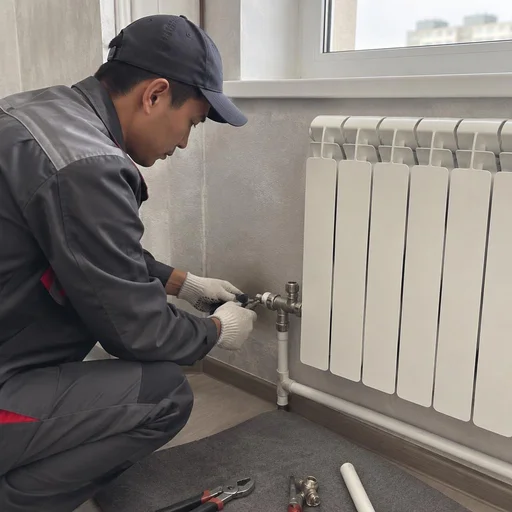
We pressure-test the radiator at 1.5 times the working pressure — 10-12 atm, hold it for 15 minutes and check all connections. Pressure testing of a radiator in new buildings on Dzhal-23 and in the old housing stock along Chuy Avenue follows the same procedure: we connect the hydraulic pressure tester to the Mayevsky valve, put the manometer on the supply, and go around every connection with a flashlight and a paper napkin. The tightening torque on bimetallic sections is 4-5 N·m, on cast-iron ones — up to 8 N·m; we wind flax with sealant along the thread in the direction of the turn. Installing a heating radiator with mandatory pressure testing before starting the riser is the only way to catch a leak on site: if you wait for the heating season, it will show up at the downstairs neighbors. Clients often phrase the request as heating radiator replacement, and pressure testing here is the stage that must not be skipped. There's no point in holding the pressure longer than 15 minutes: if a connection hasn't leaked in that time, it will withstand the riser's working mode too.
What the radiator replacement service includes
- Removal of the old radiator: we shut off the shut-off valves, drain the water, disconnect the supply lines and take the battery off the brackets.
- Mounting the new radiator: we mark and drill the brackets using a laser level, and set a slope of 1-2 mm per section.
- Connection to the riser: we tie into the supply lines, solder polypropylene or crimp press fittings, and install a Mayevsky valve in the top plug.
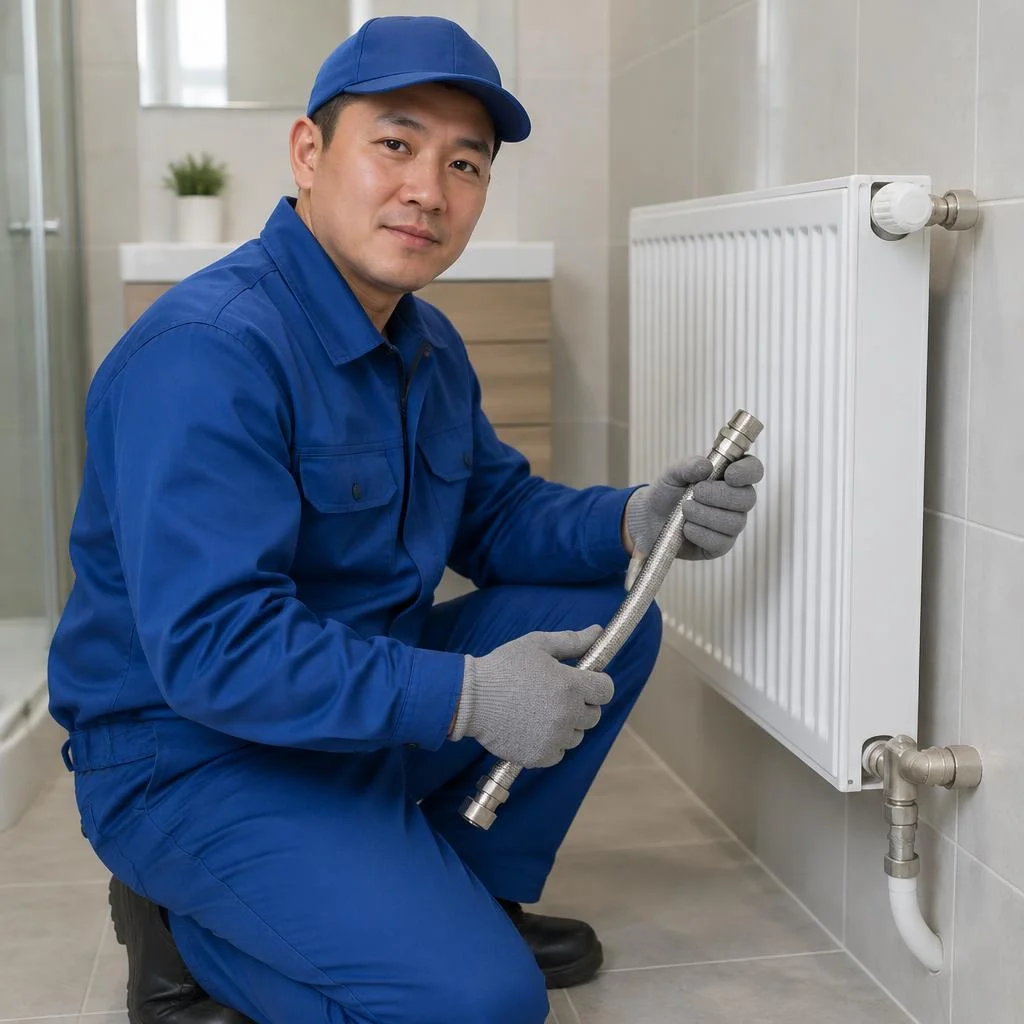
- Replacement of the supply lines to the radiator: we replace the flexible supply lines with reinforced polypropylene if the old ones do not meet the tightening torque requirements.
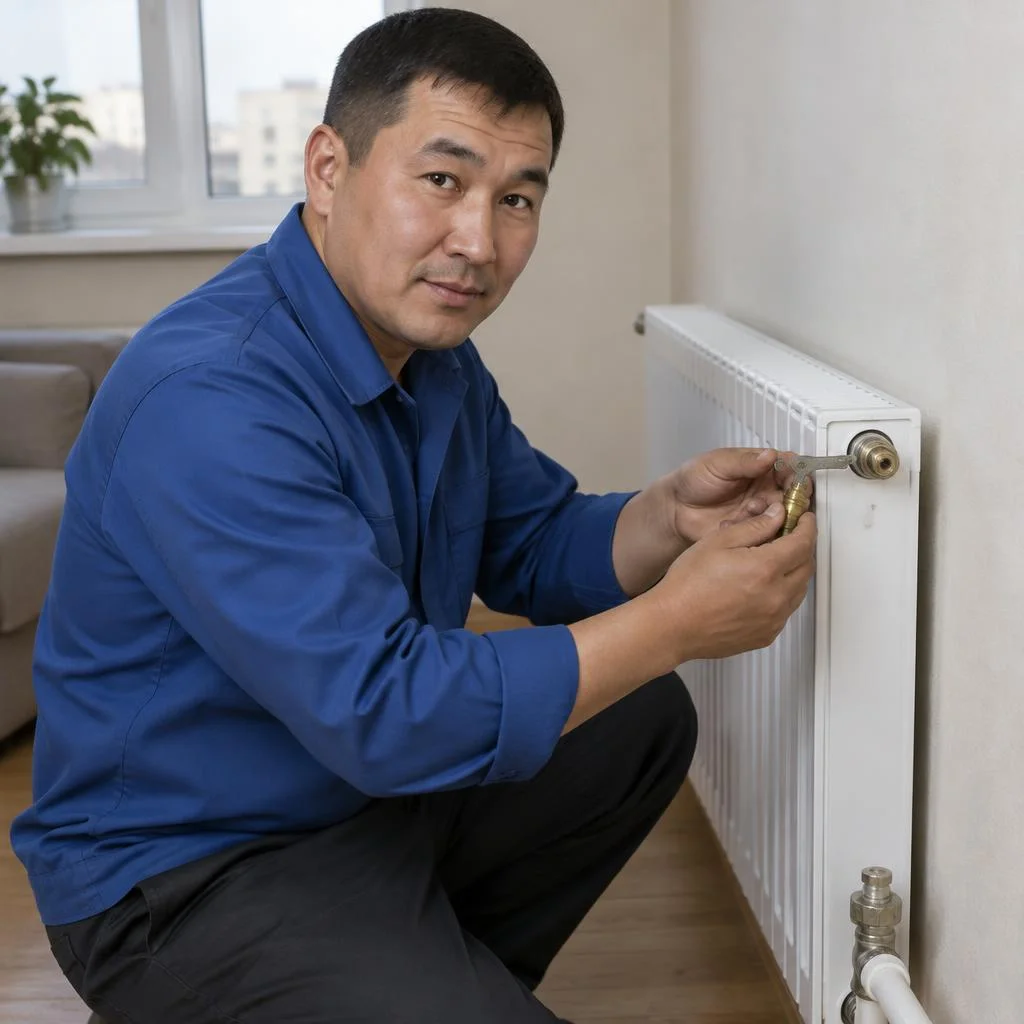
- Installation of a Mayevsky valve: we tap it into the top plug of the radiator to bleed air after the riser is started up.
- Pressure testing of the radiator: we test the system at a pressure of 10-12 atm, hold it for 15 minutes, and inspect every connection.
Tools and materials we use
- Press tongs: crimp press fittings on metal-plastic in 10-15 seconds without soldering or open flame.
- Polypropylene soldering iron: with a 20 and 25 mm attachment, heats the pipe and fitting up to 260 °C, the joint sets in 30 seconds.
- Torque wrench: sets the tightening torque to 4-5 N·m on bimetallic sections and up to 8 N·m on cast iron.
- Pressure tester: hydraulic or manual, raises the pressure up to 12 atm to check the tightness of the connections.
- Flax with sealant: we wind plumbing flax turn by turn along the thread, and on top — sealing paste to protect against leaks.
- Polypropylene shaver: removes the foil from the reinforced pipe before soldering so that the connection does not delaminate.
Replacing Heating Radiators in Winter and Without Shutting Off the Riser
Can you replace a radiator in the middle of the heating season and how to do it without draining the riser — we break down three working scenarios and the limitations we warn you about in advance.
Can You Replace a Heating Radiator in Winter
Yes, we replace radiators in winter — if there are shut-off valves on the supply line, the work takes 2-3 hours without draining the riser. The shut-off valve cuts the supply to a specific radiator, the riser continues to feed the neighbors in the building, so we carry out the removal and installation of the new unit on an isolated section. In Bishkek high-rises of series 1-464 and 105, corroded valves or their complete absence are not uncommon — then the scenario changes, and we switch to freezing or coordination with the management company. Clients often ask whether it's possible to replace heating radiators in an apartment in winter and how it differs from summer, and separately — replacing a cast-iron radiator with a bimetallic one, what price range they can expect. In winter it's important not to leave the apartment without heat for more than 4 hours — at -15°C the walls start to cool down, and then warming up takes a day. Check that the valves on the supply line turn before the technician arrives: if the stem won't turn, prepare for a different method.
Replacing Radiators Without Shutting Off the Riser: How It Works
We close the valves on the supply line, release the pressure in the radiator and replace it while the riser continues to serve the neighbors. Working without shutting off the riser is built on three steps: close both valves, release the residual pressure through the Mayevsky valve and drain the water from the unit, then cut off the old radiator and install the new one on the same supply lines. If there are no valves — we use pipe freezing or coordinate shutting off the riser with the management company for 1-2 hours during off-peak times. In buildings on Kievskaya and Toktogul streets, management companies usually give a window from 10:00 to 15:00, when the neighbors are at work and the risk of freezing is minimal. A plumber replacing a radiator in this format saves 3-4 hours on coordination and doesn't require notifying all the residents of the building. A separate topic is replacing radiator pipes: if the supply lines have rotted, we replace them too, otherwise the new unit will leak at the threads. Clients search for "apartment heating replacement price" — and land on this page, where we break down each scenario step by step.
Replacing Radiators with Pipe Freezing
We freeze a section of pipe with liquid nitrogen or carbon dioxide, cut and replace the radiator without draining the riser. Freezing works like this: a sleeve is attached to the supply line, refrigerant is fed inside, the water in the pipe turns into an ice plug, and the section between the plug and the radiator becomes dry — it can be cut and soldered. The procedure takes 15-20 minutes per plug, holds pressure for up to 40 minutes, which is enough to remove the old unit and install the new one. Freezing only works on metal pipes — on polypropylene the ice doesn't hold pressure, so a different method is needed there. If you're facing a replacement of an old radiator with a new one in a Stalin-era or Khrushchev-era building with metal supply lines, freezing is suitable; for polypropylene the technician will suggest coordinating with the management company in advance. Clients search for "replacing radiators with bimetallic ones" — this option is exactly for freezing, metal holds the plug more stably.
Replacing Radiators During the Heating Season: Risks and Limitations
The main risk of winter replacement is water hammer when the riser is started: if the radiator isn't pressure-tested, the connection may leak the very first night. Working during the heating season requires pressure testing at 1.5-2 bar — only after that does the technician open the valves and start the coolant flow. During peak frosts, the management company sometimes prohibits shutting off the riser — then the work is postponed to the morning or the next day. Another limitation: at -25°C and below, freezing doesn't produce a stable plug on thin-walled pipes, so on such days we suggest either waiting for a window or installing a temporary bypass so as not to leave the apartment without heating overnight. Replacing radiators during the heating season is safer in the first half of the day — by evening the system is already warmed up and the pressure is stable.
Replacing Heating Radiators in an Apartment Building: Approval and Documents
In an apartment building, replacing a radiator is not just technical work but also a matter of delineating responsibility with the management company. We break down who pays for what, which papers are needed, and how Bishkek's risers differ from new buildings.
Who Should Replace the Batteries — the Resident or the Management Company
The radiator in an apartment is the resident's area of responsibility, the riser and basement are the management company's; the resident replaces the battery in the home at their own expense. The management company services the common property: the distribution in the basement, the risers up to the first shut-off valve, the elevator unit. Everything located after the branch into the riser — shut-off valves, the supply line, the heating appliance itself, the thermostatic regulator — belongs to the in-apartment section. In Bishkek's old housing stock (series 1-464, 1-335, the "Khrushchyovkas" along Jibek-Jolu and in Jalal), the boundary runs at the first valve on the supply line. If the riser is in emergency condition and the management company replaces it, the radiator still remains the resident's responsibility — these are different sections of the system. Clients often phrase the request as radiator replacement Bishkek — and from it, it's immediately clear that they mean the in-apartment appliance, not the riser. Before calling a technician, photograph the branch point and check the demarcation point with the management company: in different buildings it can shift by 20-30 cm.
What Documents Are Needed for Radiator Replacement
We draw up a work completion certificate and provide a 2-year warranty card — this is sufficient for the management company upon acceptance. The standard package includes: an application to the management company for approval of the work, a responsibility demarcation act, a concealed work act (if the supply line goes into the wall), and a warranty card. If you are replacing the radiator with a different type — for example, cast iron with bimetallic with different heat output — the management company may request a project; we help with the heat output calculation for approval. For a standard "same-for-same" replacement, no project is required; a notification is enough. In search, this service is looked up as radiator replacement in Bishkek, although essentially it's the same procedure with a certificate and permit. Replacing radiators in an apartment with documents takes 1-2 days longer than the installation itself. If you are facing a heating battery replacement in an apartment, we prepare the full package of papers — from the application to the concealed work act.
Battery Replacement in an Apartment Building: Specifics of Bishkek's Risers
In Bishkek, risers in Khrushchyovkas run as a single loop per entrance, so the pressure in the radiator is higher than in new buildings with manifold distribution. The heat carrier comes from Bishkek's thermal power plant on a 95/70 schedule, but at the peak of the heating season the differential on the upper floors reaches 6-8 atmospheres — aluminum sections on threaded nipples withstand this for 2-3 seasons and crack along the sections. In the old housing stock, we install bimetallic with a pressure margin: a steel core and an operating threshold of up to 35 atmospheres. In new buildings along Toktogul and Ibraimov streets with radial distribution and a manifold on the floor, the pressure is more stable — there, aluminum and steel panels are acceptable. Before ordering, check the year the building was constructed and the type of distribution: both the appliance model and the cost of work depend on this. Clients often search for battery replacement Bishkek — and from such a request the technician immediately selects a model for the pressure in the specific riser.
Approving Radiator Replacement with the Management Company: Step-by-Step Procedure
- Application to the management company: submit a written application indicating the type of the new appliance and the work timeline — verbal approval is not enough.
- Demarcation act: record the branch point into the riser — this document determines who is responsible for a breakdown in the future.
- Approval of the appliance type: if you are replacing cast iron with bimetallic or aluminum, attach a calculation of the section's heat output for the room's area.
- Work permit: some management companies require notification 2-3 days before the start — check the regulations in advance.
- Acceptance and act: after installation, sign the concealed work act and keep the 2-year warranty card.
How Much Approval Costs and Who Pays for the Documents
The price consists of the cost of work, materials and paperwork — the resident pays for approval with the management company themselves. The total depends on the type of device: a cast-iron radiator costs less than a bimetallic one, but requires more time for dismantling. The estimate includes dismantling the old device, hanging the new one, connecting to the riser, pressure testing and drawing up the report. The cost of heating in an apartment is formed individually — the total depends on the floor, the type of distribution and the amount of piping. Clients often type the cost of radiator replacement into search to estimate the budget in advance, but only an inspection gives the exact figure. The calculation is made after the inspection: the technician assesses the condition of the riser, the number of sections and the need to update the shut-off valves. Before starting work, request an estimate broken down by stages — this way you will see what you pay for separately and what is included in the base rate. This is exactly how clients search: replacement of a central heating battery price — and they receive a calculation after the inspection. The search also contains the query battery replacement price — from it the technician understands that a preliminary calculation by the number of devices is needed. Another common variant is battery replacement cost: it means that the person wants to understand the order of figures before the visit. And the wording replace batteries in an apartment price shows that several devices are involved at once. Separately, clients ask battery replacement in a house price — and for such a query the technician calculates the entire volume for the apartment, not just one device.
Replacement of radiator batteries: what changes along with the device
Replacement of radiator batteries almost always entails related work — if the piping is old, replacing only the device is pointless. Replacement of pipes and batteries in an apartment is done simultaneously: polypropylene or metal-plastic piping lasts 25-30 years, while steel welded piping lasts 15-20, and if the riser has already been replaced, new piping will cost less than repeated dismantling a season later. Replacement of the heating system in an apartment includes not only the devices, but also shut-off valves, Mayevsky valves, thermostats, and if necessary — a manifold. Complete replacement of the heating is justified in old-stock buildings where the risers are from the 1960s-1970s: spot replacement of a battery there gives a temporary effect. We advise replacing the device together with the piping and shut-off valves — this eliminates repeated opening of the walls and shutting off the riser a year later. When a client asks for replacement of old batteries with new ones, we immediately calculate both the piping and the valves — otherwise a season later the walls will have to be opened again. A separate category of requests is replacement of old heating radiators: here the technician assesses not only the device, but also the condition of the piping along the entire branch. In essence, this is the cost of battery replacement broken down by stages: dismantling, installation, pressure testing. Clients leave the query replacement of heating radiators in an apartment price when they want to compare options for the whole apartment at once. The search also contains wording such as repair of heating batteries in an apartment — from it the technician understands that the person needs not only installation, but also an inspection of the unit. If the apartment is due for heating replacement, the price in an apartment is calculated by the number of devices and the footage of piping, not by a fixed rate.
Battery replacement in a house: typical scenarios by apartment type
- Khrushchevka with single-pipe distribution: battery replacement in a house requires bimetallic with a pressure margin — aluminium here does not withstand water hammer.
- New building with manifold distribution: aluminium and steel panel devices are acceptable, the pressure in the circuit is stable.
- Stalinka with cast-iron risers: we replace the device without replacing the riser, but with mandatory pressure testing and inspection of the shut-off valves.
- Corner apartment: we add sections for the heat loss of external walls — the calculation is based on the area and orientation of the rooms.
Battery replacement in a house and battery replacement in a house: how the work differs
Replacing a radiator at home is replacing one unit in one room; replacing radiators at home is a comprehensive replacement throughout the entire apartment with the riser shut off only once. Replacing heating radiators in an apartment one unit at a time is more expensive per section: each call-out of a technician, each riser shutoff, and each pressure test is paid for separately. Replacing heating radiators in an apartment all at once is more cost-effective in terms of labor — the technician works 1-2 days instead of four separate visits. We recommend replacing heating radiators in an apartment all at once before the heating season, in the off-season, when the management company approves shutting off the riser without time restrictions. If you are replacing only one unit, check whether there are shutoff valves on the supply line: without them, the riser will have to be drained completely. Clients often phrase the request as how much does it cost to replace a radiator — and based on that, the technician immediately calculates for one unit, not the entire circuit. Another variant from search — radiator replacement price: it means the person wants to understand the ballpark figure before the technician's visit. Separately, it is worth mentioning replacing radiators in winter without shutting off the risers: in Bishkek this is done according to the management company's schedule, by freezing the supply line or shutting off only your own circuit, if there are valves at the inlet.
Replacing heating pipes and radiators: a comprehensive approach
Sometimes replacing just the radiator is not enough: the old supply line, riser or distribution negate the effect. We explain in which cases pipes and fittings are replaced together with the radiators and how it is done.
When pipes need to be replaced together with radiators
We replace pipes together with radiators if the supply line is clogged, has pinholes or is older than 20 years — otherwise the new unit will clog up within a season. When replacing cast-iron radiators with bimetallic ones, the calculation also takes into account the condition of the supply line: a steel pipe becomes overgrown with deposits inside by up to 70% of its cross-section, so the sections on such a line heat at half strength. Reinforced polypropylene pipes last 25-30 years and do not narrow the bore, while metal-plastic on press fittings withstands pressure up to 10 bar. Replacing a cast-iron radiator with a bimetallic one on an old steel supply line is money thrown away: within a year the unit will have to be removed and flushed. Clients often ask about replacing a heating radiator battery — and the technician immediately understands that this means the combination of "supply line plus unit". Check the supply line before ordering the work — the technician will assess the bore and pinholes in 10 minutes.
Replacing the heating riser
We replace the riser with the entire entrance section shut off — we coordinate with the management company and work in 4-6 hours. Replacing a heating radiator in an apartment does not require touching the riser, but if there are visible pinholes on it, rusty streaks near the floor slabs, or it is older than 25 years, the section is replaced together with the radiator — otherwise, after pressure testing, it is precisely the old elbow that will leak. Steel risers in Bishkek's khrushchevkas and 1980s panel buildings are often narrowed to half their diameter, which reduces the temperature on the upper floors. The riser is rarely replaced — usually only during major repairs or an emergency; if it is intact, it is left alone. Clients often search for "replace heating radiator price" and "battery replacement in Bishkek" — and the technician immediately understands that a site visit is needed. Coordinate the shutdown with the management company in advance: work on the riser is prohibited without written permission.
Installing a heating manifold and distribution
We install manifold distribution when replacing the heating system in an apartment — each radiator gets its own supply and return. A brass or stainless steel manifold with 3-8 outlets is placed in a cabinet at the apartment entrance, each radiator has its own pair of pipes in the screed or skirting, and on the supply of each circuit there is a shut-off valve and a balancing valve. This scheme allows each radiator to be regulated separately and one to be shut off without stopping the others — unlike series distribution, where closing one radiator shuts down the entire riser. A thermostatic regulator on each circuit maintains the set temperature with an accuracy of 1-2 degrees. If you are doing a renovation from scratch, install manifold distribution right away — redoing a series scheme later is more expensive.
Replacing the heating system in an apartment
Replacing the heating system in an apartment means radiators, supply lines, shut-off valves and a manifold; we do this in 2-3 days. A full replacement is ordered when switching from cast-iron sections to bimetallic ones, during redevelopment, or when individual pipe sections have already been replaced twice and the distribution has become "patchwork". In a typical Bishkek two-room apartment of 55-60 sq.m this means 4-6 radiators, 30-40 meters of polypropylene, a manifold with 4 circuits, Mayevsky valves and thermostatic regulators on each unit. Replacing the heating system in an apartment is a one-time job: afterwards only radiators and fittings are replaced, while the pipes in the screed last for decades. Plan the replacement for the inter-heating season — then you will not have to coordinate the riser shutdown with your neighbors.
Replacing the heating system in an apartment — cost and scope
The cost of replacing heating depends on the number of radiators, the footage of the supply lines and the type of distribution — the technician calculates the exact estimate after inspection. The cost of work on replacing heating batteries consists of dismantling the old sections, hanging the new ones, soldering pipes and pressure testing; the cost of replacing radiators is not fixed, but calculated for each circuit. The cost of replacing a heating battery in a typical two-room apartment includes 4-6 units, 30-40 meters of polypropylene and a 4-outlet manifold — the total depends on whether the old screed remains. The price of replacing a heating battery and the cost of replacing a radiator are calculated together with the fittings: Mayevsky valves, shut-off valves and thermostats are included in the total bill. Clients search for "heating replacement price" and "cost of replacing a heating radiator" — and land on this page. Replacement of heating radiators in an apartment and replacement of heating in an apartment are paid after acceptance — the price list for the work is visible next to the article.
Replacing a battery in an apartment building and in winter
Replacing a battery in an apartment building requires coordination with the management company if the riser is affected — when replacing only the unit, no permission is needed. Replacing batteries without shutting off the riser is possible through pipe freezing or compressed air: the main line is shut off for 30-40 minutes, the ice plug holds the pressure, and the neighbors are not left without heat. Replacing radiators in winter during the heating season is done according to the same scheme — the technician arrives with a compressor and nitrogen, and works without draining the entire system. You can change batteries in an apartment both in summer and in freezing cold: the only limitation is coordination with the management company for shutting off the entrance, if the riser is in an emergency condition. Replacing radiators in winter is most often needed during a burst or when the sections no longer hold pressure.
Small jobs: kitchen, cast iron, battery
Replacing a battery in the kitchen usually takes 2-3 hours: most often there is a cast-iron section there, which is replaced with bimetallic or aluminum. The price of replacing cast-iron batteries with bimetallic ones depends on the number of sections and the type of supply lines — when switching from cast iron to bimetallic, adapters and new brackets are needed. Clients often write briefly: battery replacement — and the technician immediately understands that a site visit is needed. Replacement of a radiator battery and replacement of a cast-iron radiator with a bimetallic one are performed with pressure testing — after soldering, the circuit is checked at a pressure of 10 bar. The cost of replacing a radiator and the cost of replacing radiators are recorded in the report before work begins.
Warranty, timelines and payment: how Eco-Service works
After installing a radiator, you receive a warranty, a work completion certificate and a warranty card. Let's break down how long installation takes, where requests are accepted, how to pay and where to read reviews.
2-year warranty on work
Eco-Service provides a 2-year warranty on all radiator installation work — from dismantling to pressure testing. In the warranty card we enter the type of device installed, the number of sections, the pressure testing date and the pressure readings during testing: for bimetallic models we keep the operating pressure in the system at 15-20 bar, for aluminum sections — up to 12 bar. If after a month a connection starts leaking through our fault, the technician comes out under warranty and redoes the assembly free of charge. The warranty does not cover damage from water hammer on the part of the thermal power plant — we record this separately in the certificate, because a pressure surge in the city main line does not depend on the quality of installation. Clients often ask how much radiator replacement costs — and in the warranty card we separately specify exactly what is covered for the entire two-year period. We also clarify separately that radiator replacement in Bishkek is not covered by the warranty case if the device is mechanically damaged after acceptance. If radiators are to be replaced in an apartment, we issue a warranty card for each point separately — with the device number and the pressure testing date.
Timelines for work with a radiator
- One radiator: installing heating radiators in an apartment at one point takes 2-3 hours — dismantling, hanging, connecting to the riser, pressure testing.
- Entire apartment: replacing radiators with 3-4 devices — 1-2 days with breaks for pressure testing each circuit.
- Heating system: comprehensive installation of radiators in winter without shutting off risers and wiring — 2-3 days, if the riser does not need to be replaced.
- Winter shift: installing a radiator during the heating season adds 1-2 days to coordinate shutting off the riser with the management company.
- Pressure testing: a separate stage lasting 40-60 minutes; without it we do not connect the radiator to the system.
Our own service center in Bishkek
We accept requests in person at our own Eco-Service service center — you can come in, show a photo of the radiator and get an estimate. The plumber on duty clarifies the type of riser (single-pipe or two-pipe), the floor, the presence of a bypass and a thermostatic valve, after which he selects a model for your system: bimetallic for high-rises with high pressure, aluminum for an autonomous circuit, steel for narrow niches. Clients often phrase their request as heating radiator replacement price — and for such a request the technician immediately calculates an estimate based on the photo and the number of points. If a heating radiator is to be replaced in a room or in the bathroom, the technician immediately calculates the number of sections for the area and heat loss of each room. An in-person appointment allows you to choose the type of radiator and the number of sections without a site visit and unnecessary calls. If the device has already been purchased independently, bring its data sheet: we will check compatibility by center-to-center distance and pressure before starting work. Clients often search for "bathroom radiator replacement" — and for this request the technician immediately clarifies whether there is a towel warmer in the room and how the riser is connected.
Payment via MBANK and O!Dengi
You can pay for the work in cash or via MBANK and O!Dengi — we issue the receipt and warranty card on site. A transfer via MBANK goes through the app in a couple of minutes; O!Dengi is convenient if a relative from another city is paying: we send the payment details via Telegram after the estimate is agreed. Payment after pressure testing — first we check tightness, then we accept payment. This procedure protects both parties: if during pressure testing a leak is found on the thread, we fix it before signing the certificate, and the amount in the estimate does not change. We also state separately that heating radiator replacement does not require prepayment: the estimate is fixed, and you hand over the money after the system has been pressure tested. Clients often search for "apartment radiator replacement cost" — and for such a request the manager sends the payment details along with a ready estimate.
Customer reviews on 2GIS and Google Maps
Reviews of Eco-Service's work can be viewed on 2GIS and Google Maps — there you'll find before/after photos and customer ratings. The listings show which models were installed (Global bimetallic, Royal Thermo aluminum), which buildings were worked in — from panel buildings in Asanbay to new developments in Jalal — and how long each visit took. In the reviews, customers most often note that the technicians arrive at the agreed time and clean up after themselves. Clients often type "replacement of heating radiators" in search and find our listings with photos of the work through these queries. Before ordering, look at recent reviews from the past few months: they show how the service operates now, not two years ago. Reviews often mention how the replacement of a cast-iron radiator with a bimetallic one went — with photos of the dismantling, mounting, and pressure testing.
How the price is calculated and what affects the estimate
The cost of installing a radiator in an apartment consists of three parts: dismantling the old unit, installing the new one, and connecting it to the riser. Clients often search for "radiator replacement price" and "radiator replacement in apartment price" — for these queries, the estimate is calculated based on the number of points and the type of unit. Replacement of a heating radiator is listed as a separate line item, and its total depends on the model and whether a thermostatic valve is present. In winter, coordination for shutting off the riser is added, so replacing heating radiators in winter costs more and takes longer. If the unit is cast iron, the estimate includes dismantling with weight taken into account — this is how the "cast-iron radiator replacement price" is formed. When several points are involved, we calculate "radiator replacement Bishkek" as a package, and the "replace heating radiators price" for the entire scope is fixed before work begins. We clarify in advance the cost of radiator replacement in an apartment and the replacement of old heating radiators, so that replacing a radiator in a room doesn't grow during the process. Clients often type "heating radiator replacement price" and "radiator replacement price" — for such queries, the estimate is sent the same day. If the apartment has cast iron, we clarify whether radiator replacement is needed during the heating season or whether the work can be moved to the off-season. When clients ask to replace radiators in an apartment, we calculate each point separately and fix the total before installation begins.
Conclusion
We've gathered the main things that determine the result of replacing a radiator in an apartment: the type of unit suited to the riser pressure, calculation of sections, the procedure for work in winter, and the division of responsibility with the management company.
Key takeaways
- Bimetallic for the riser: for Bishkek's central heating, a bimetallic radiator is suitable — it withstands riser pressure and outputs 180-200 W per section.
- Work in winter: replacing a radiator during the heating season is feasible without shutting off the riser if the supply line has working shut-off valves.
- Section calculation: the number of sections is calculated based on area and the unit's heat output — 100 W per 1 m² at a standard ceiling height of up to 2.7 m.
- Areas of responsibility: the radiator in an apartment is replaced by the resident at their own expense, while the riser and basement are the management company's responsibility.
- Post-installation check: after installation, pressure testing at 1.5 times the working pressure is mandatory — it detects leaks at the threads before coolant is supplied.