










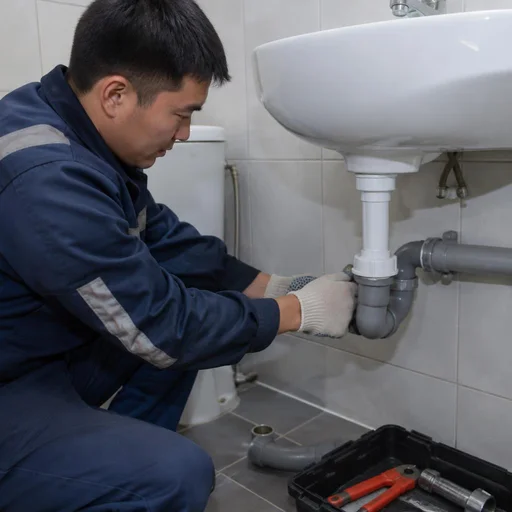
When the sewer system needs replacement: signs of wear and typical Bishkek buildings
The sewer system in Bishkek's old housing stock is cast iron with an exhausted service life. Let's break down the signs by which residents understand that it is time to replace the pipes rather than clean them.
Signs that cast-iron sewer pipes need replacing, not cleaning
- Frequent clogs: if the pipe clogs more often than once every 2–3 months, cleaning gives only a temporary effect — the internal cross-section is already narrowed by corrosion.
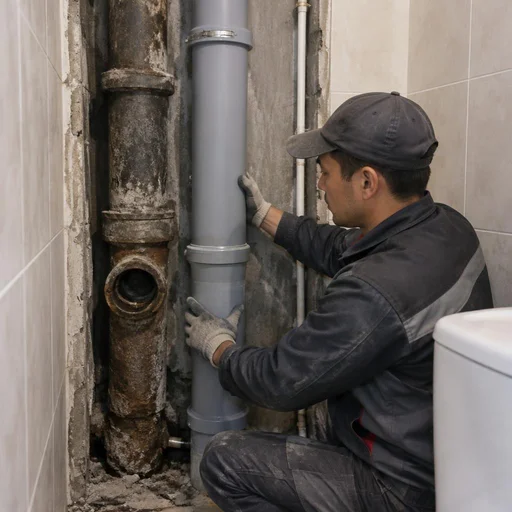
- Rusty streaks: brown stains on joints and sockets signal that the metal has thinned from the inside and holds pressure worse and worse.
- Smell from the inspection port: a persistent sewage smell in the bathroom means the seals have deteriorated and deposits have accumulated in the joints.
- Deformation of joints: sockets coming apart, cracks on fittings and traces of emergency clamps indicate that the assembly has already been put together in a hurry.
- Slow drainage throughout the apartment: water drains sluggishly equally from the bathtub, kitchen and toilet — this is a sign of general narrowing, not a local blockage.
Which Bishkek buildings most often need riser replacement
In Bishkek, risers are most often replaced in panel buildings constructed in the 1970s–1990s and in the old housing stock in the center — there the cast iron has served 40+ years and has exceeded its standard service life. Such addresses include series 1-464 and 1-335 in the Alamudin-1, Asanbay, Dzhal and Vostok-5 microdistricts, as well as the low-rise housing stock in the block bounded by Kievskaya — Toktogula — Zhibek-Zholu streets. Eco-Service works specifically with this housing stock: technicians visit to diagnose the riser and horizontal run and assess the condition of tees and inspection ports before work begins. For apartment-by-apartment replacement, it makes sense to assess the entire riser as a whole: in buildings of the same series, wear is uneven — on the upper floors the cast iron is usually in better condition than on the first floors, where deposits accumulate.
Why delayed replacement is dangerous: from a leak to flooding the neighbors
A fistula or rupture of the riser in an apartment on the upper floor floods the apartments below along the entire vertical stack, and the repair of someone else's property falls on the culprit — this is the main argument not to postpone replacement. Cast iron fails along the welded seam or at the point where the tee exits: that is where the wall is thinnest, and the pressure during water discharge at peak hours finishes off the metal. Emergency leak repair closes the fistula with a clamp or bandage, but does not solve the cause — a few weeks later the water finds a new weak spot, and the scenario repeats with an even larger rupture. It is cheaper to replace sewer pipes according to plan with an estimate drawn up and an agreed schedule than to deal with the consequences of an accident: an emergency call-out does not cancel replacement, it only postpones it. Planned work proceeds without legal disputes with neighbors, while urgent sewer pipe repair in an apartment after a rupture comes with them.
Replacing Cast Iron Sewer Pipes with Plastic: Why It's the Standard
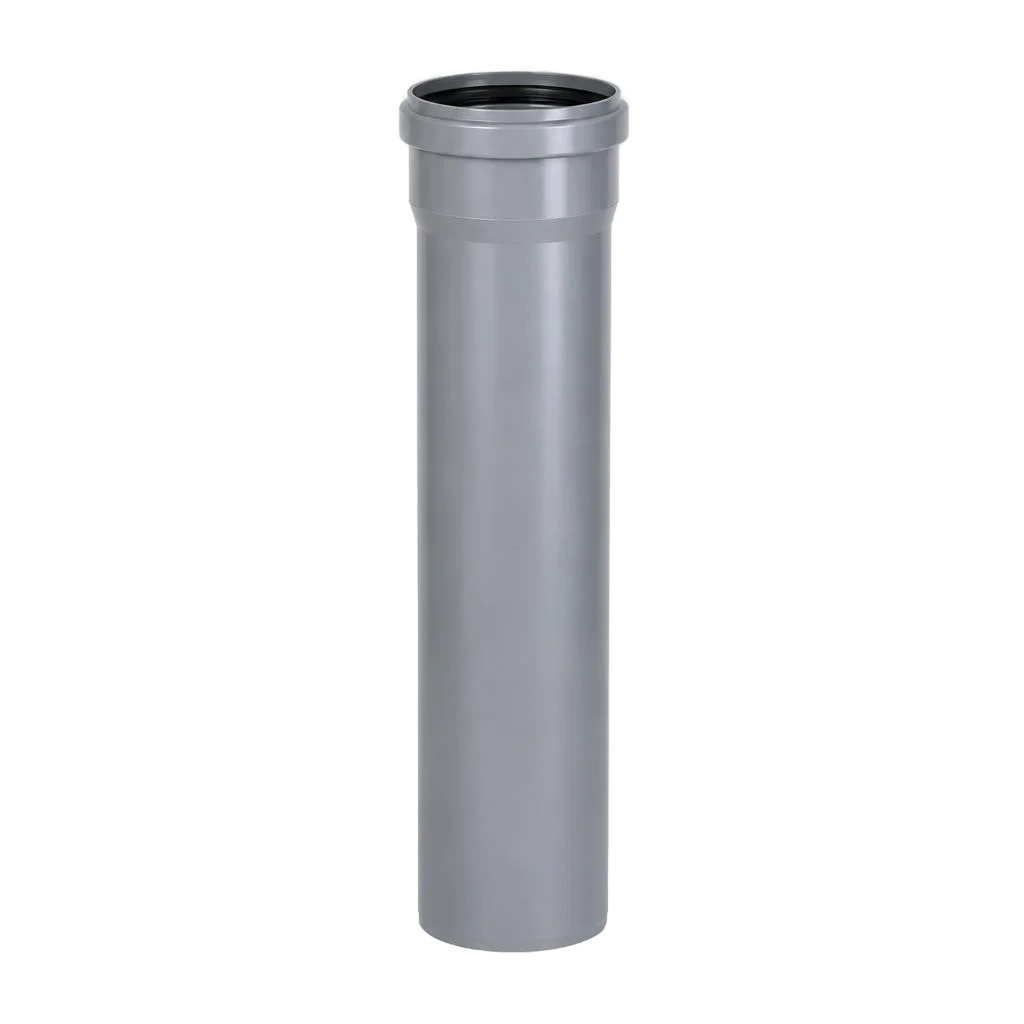
Plastic has displaced cast iron not because of fashion, but because of service life and repairability. We break down how the transition from cast iron sewer pipes to plastic works and in which cases partial replacement is possible without dismantling the entire riser.
Plastic vs Cast Iron: Service Life, Weight, Maintenance Cost
| Parameter | Cast Iron | PVC / PP Plastic |
|---|---|---|
| Service life | 20-25 years | 50 years and more |
| Weight of 110 mm pipe per meter | about 13 kg | 2-2.5 kg |
| Inner surface | clogs with deposits | smooth, does not clog |
| Corrosion resistance | rusts from the inside | does not corrode |
| Repairability | welding, cutting with an angle grinder | cutting, socket assembly |
| Installation of a section | 2 people and a winch | 1 technician by hand |
Can a Cast Iron Pipe Be Replaced with Plastic Without Replacing the Riser
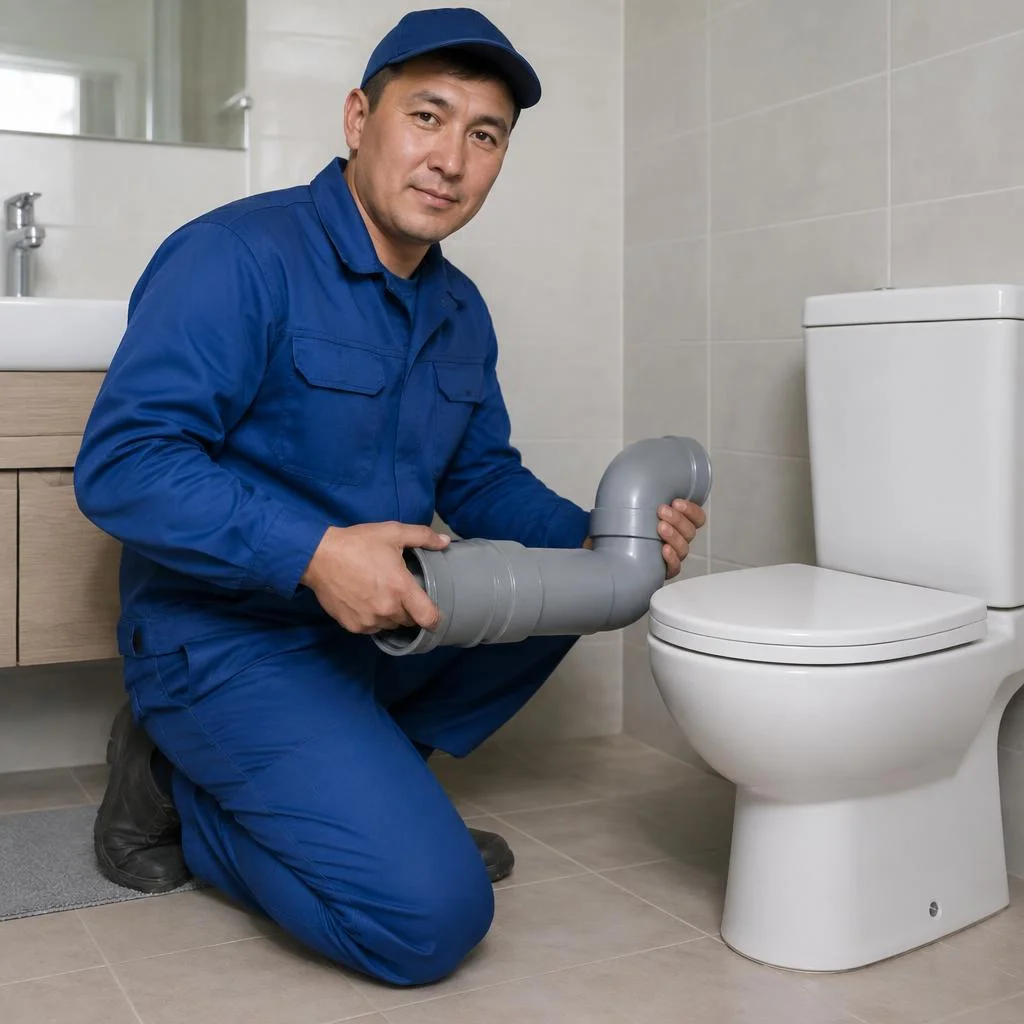
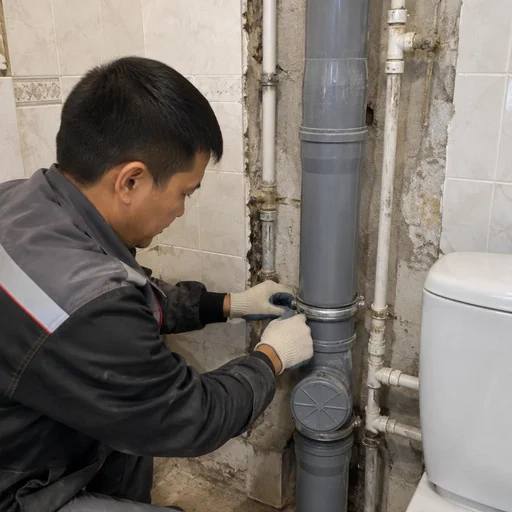
Yes, we perform partial replacement: we swap a section of cast iron pipe for plastic with a transition via a rubber sleeve or expansion joint, without touching the rest of the riser. This approach addresses the need to replace a sewer pipe in a targeted way — when only the branch to a plumbing fixture or a short section between floors is worn out. Here in Bishkek, customers order both local repairs and full riser replacement: the decision is made after an inspection. Partial replacement is justified when one section is worn out rather than the entire riser — cast iron crumbling along its entire length won't hold an insert, and a local repair will give a temporary result. This is often exactly how people write to the service: transition from cast iron to plastic — and the technician immediately understands what is meant.
Transition from Cast Iron to Plastic: How the Joint Is Sealed
- Transition sleeve: a rubber ring with two sockets of different diameters, providing an elastic connection between cast iron and plastic without welding or cement.
- Expansion joint: an insert with a movable element that absorbs the linear expansion of plastic during temperature fluctuations of the water in the riser.
- Socket assembly: the plastic branch pipe is inserted into the sleeve all the way, and the joint is fixed without rigid embedding.
- Testing under load: after assembly, the section is flushed with water and inspected for leaks before the channel is sealed.
Why the Transition to Plastic Has Become the Standard
The replacement of cast iron sewer pipes with plastic in Bishkek homes increasingly involves a full transition to polymers: cast iron risers in buildings from the 1970s-1990s have exhausted their service life, while plastic equivalents are cheaper to maintain and do not require welding during repairs. The key argument is repairability: a PVC section is replaced in a single technician visit, whereas a cast iron branch has to be cut out and reconnected. The rigid sealing of the joint with cement, which private technicians sometimes use, cracks under temperature deformation — that is why Eco-Service always uses elastic adapters.
Types of work: riser, horizontal run, outlet and branches to fixtures
Sewerage in a house is not a single pipe, but several sections with different diameters and access conditions. Let's break down how working with a riser differs from a horizontal run, an outlet and branches to fixtures.
Sewer riser: in the bathroom unit, kitchen, bathroom and toilet
| Room | Feature of the section | What the work includes |
|---|---|---|
| Bathroom unit | Ø110 mm, upper access point | Removal of cast iron, breaking out the concrete embedding |
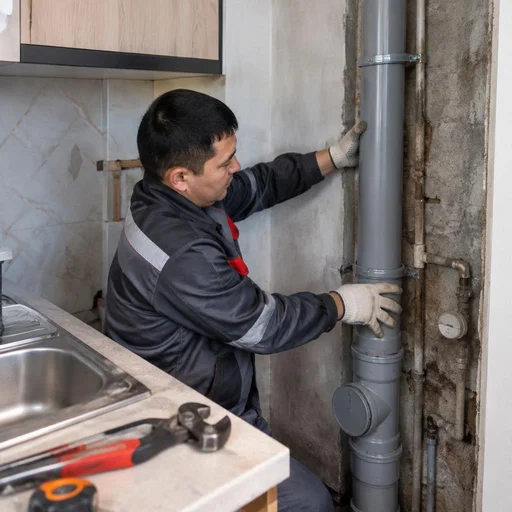
| Kitchen | Ø50 mm branch, grease deposits | Replacement of the kitchen branch, installation of an access point |
| Bathroom | Combined unit, heated towel rail | Riser replacement, sealing of joints |
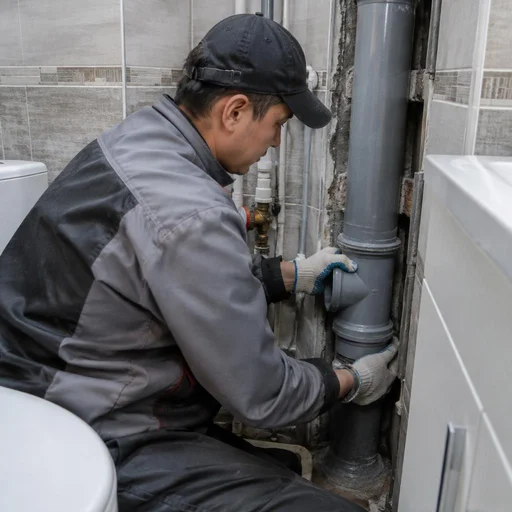
| Toilet | Toilet connection, tee | Replacement of the toilet branch, replacement of the tee |
With us you can replace the sewer pipe in the toilet together with the tee and branch — the work is done in a single stage, without re-opening the concrete embedding. Such a scope covers both local wear and the fixture connection at once. The kitchen riser is often thinner than the bathroom unit's and clogs with grease deposits faster, so when renewing it, it makes sense to install an access point for cleaning right away, even if there wasn't one in the old layout.
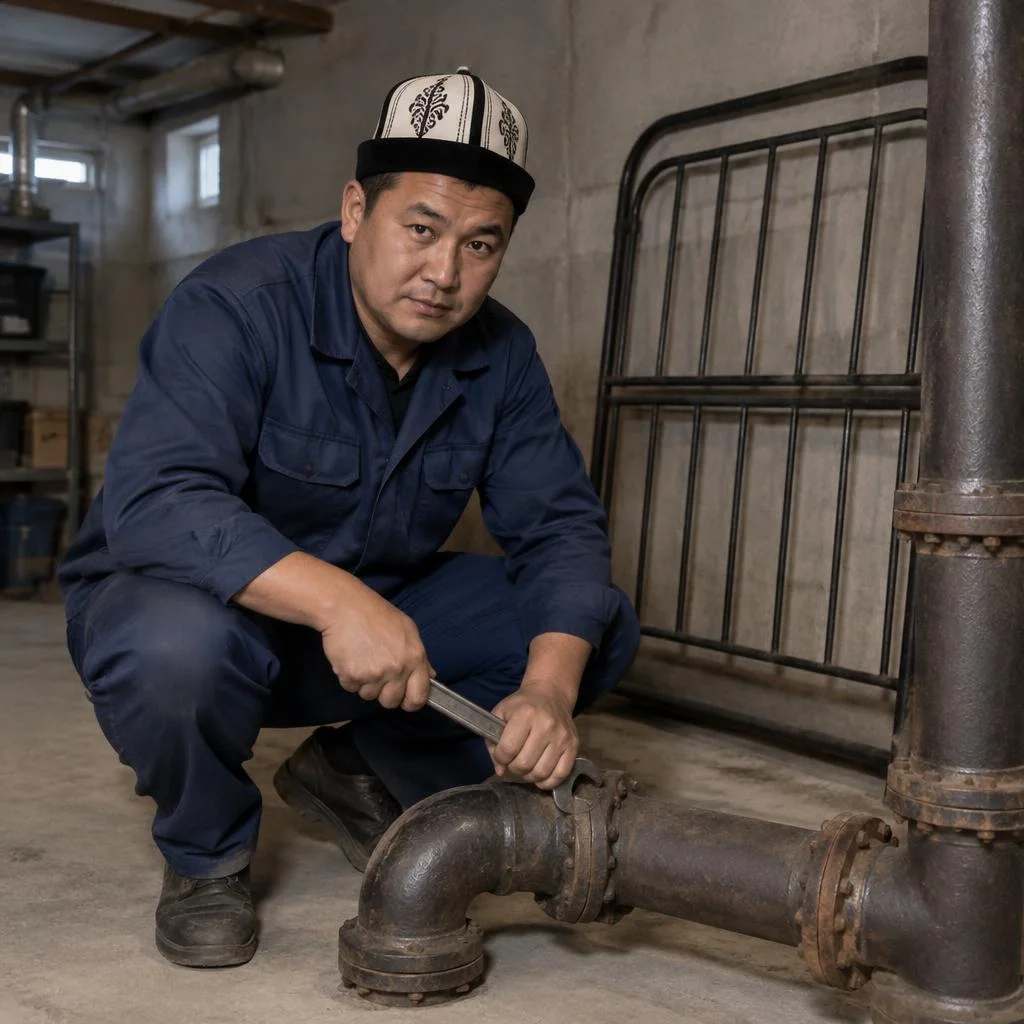
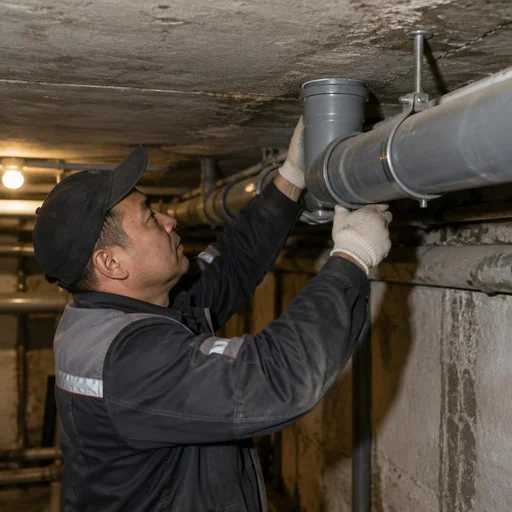
Horizontal run in the basement and on the floor: how the work differs
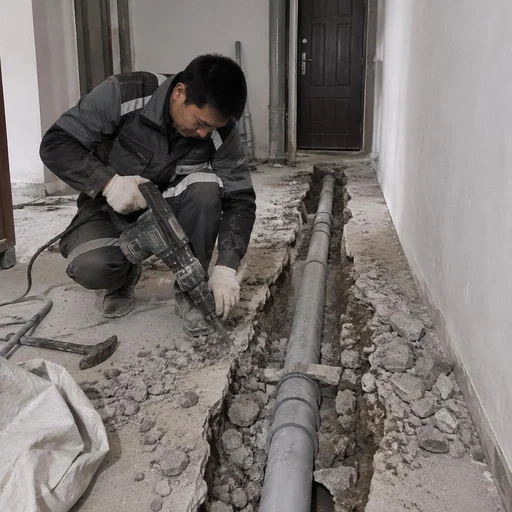
The horizontal run in the basement is a horizontal section of Ø160 mm, access to which is only possible through the basement; the horizontal run on the floor passes under the ceiling slab and requires opening the floor or the ceiling of the neighbours below. The horizontal layout collects wastewater from all the risers of the building entrance, so the diameter here is larger than that of the vertical sections, and the slope is set strictly according to the standard — if it is violated, water drains slowly and sediment accumulates within just a few months. In panel and brick buildings in Bishkek, the horizontal run is more often replaced during major repairs of the entrance, whereas in an apartment only the vertical part is renewed. Clients often phrase their request as sewer pipe replacement price — and with such a request the technician immediately understands that a calculation is needed for the entire section, not just the visible part. The basement horizontal run serves the entire entrance, so its replacement is usually coordinated with the management company/homeowners' association and the neighbours on the riser — this lengthens the timeline, but reduces the risk of repeated blockages for all apartments.
Sewer outlet and branches to plumbing fixtures
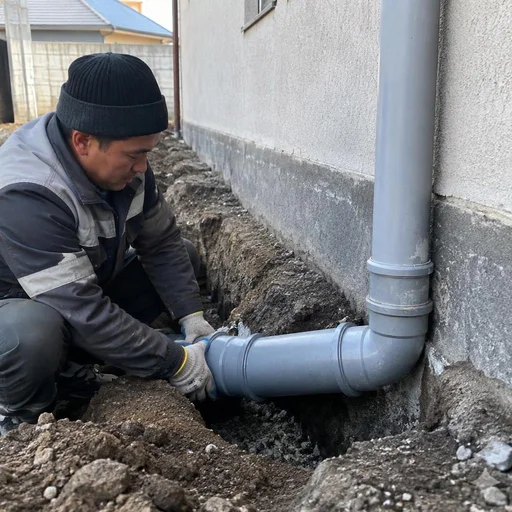
- Sewer outlet: the section from the riser to the external network, passes through the foundation or basement, requires waterproofing of the entry point.
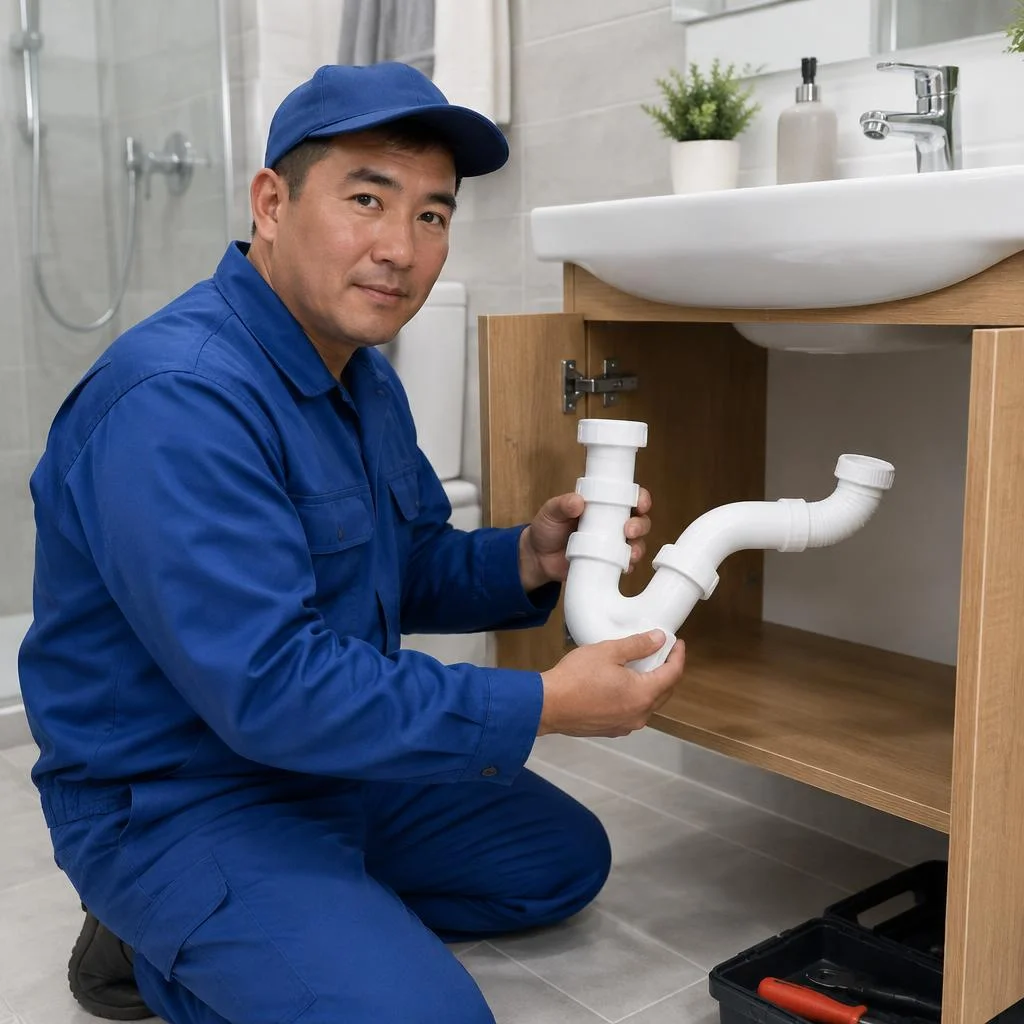
- Branch to a plumbing fixture: a Ø50 mm pipe to the toilet, sink, bathtub and washing machine, replaced in case of local wear.
- Tee in the riser: the connection point of the floor branch, the most vulnerable spot for blockages and cracks.
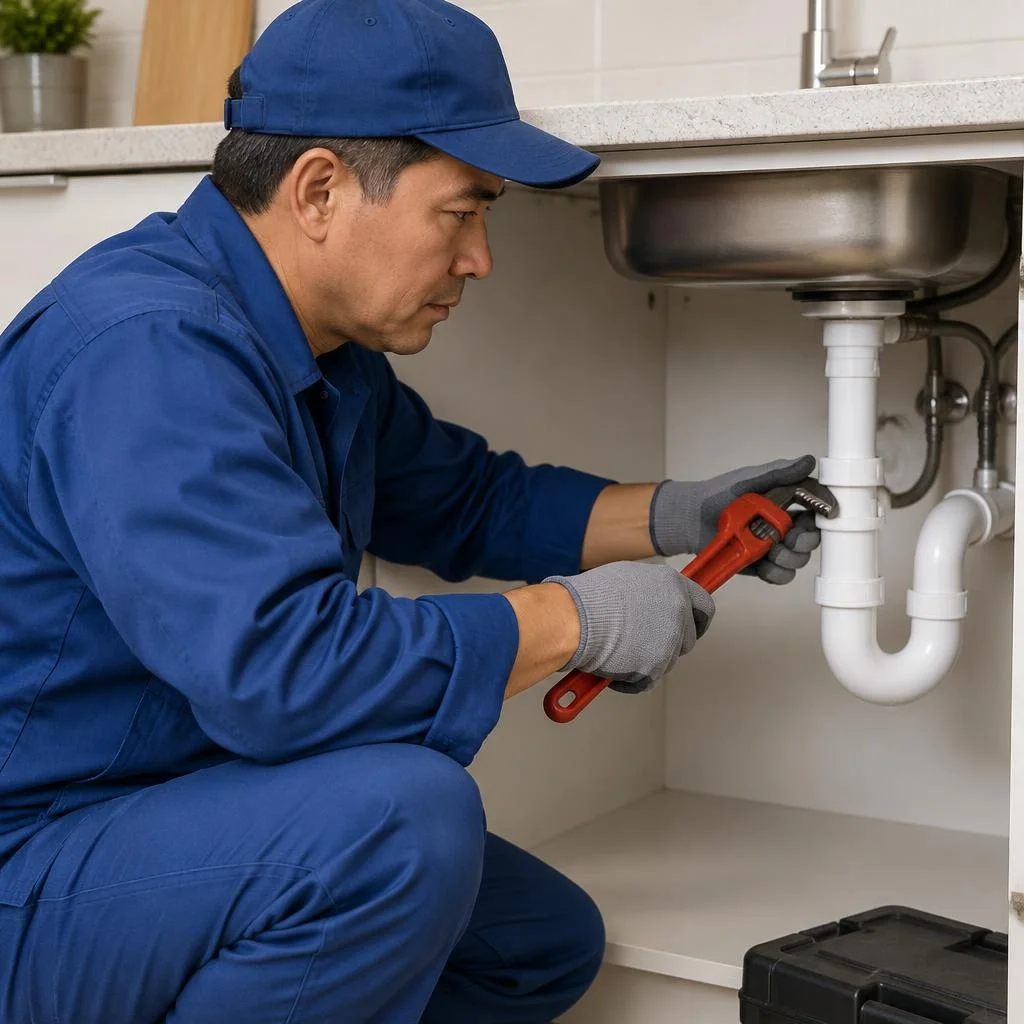
- Siphon and branch: sealing of the connection between the fixture and the riser, checking the slope along the entire section.
- Pipe with a diameter of 50 mm: a short section between the fixture and the riser, replaced separately from the vertical part.
- Cost of the section: depends on the diameter, material and access to the section, the estimate is calculated after inspection.
How sewer pipe replacement in an apartment is carried out: stages and timelines
Installing new sewer pipes in an apartment follows a clear sequence — from the estimate to the quality check. We break down the stages, realistic timelines, and what to do if a smell remains after the work.
Stages of work: from estimate and dismantling to quality check
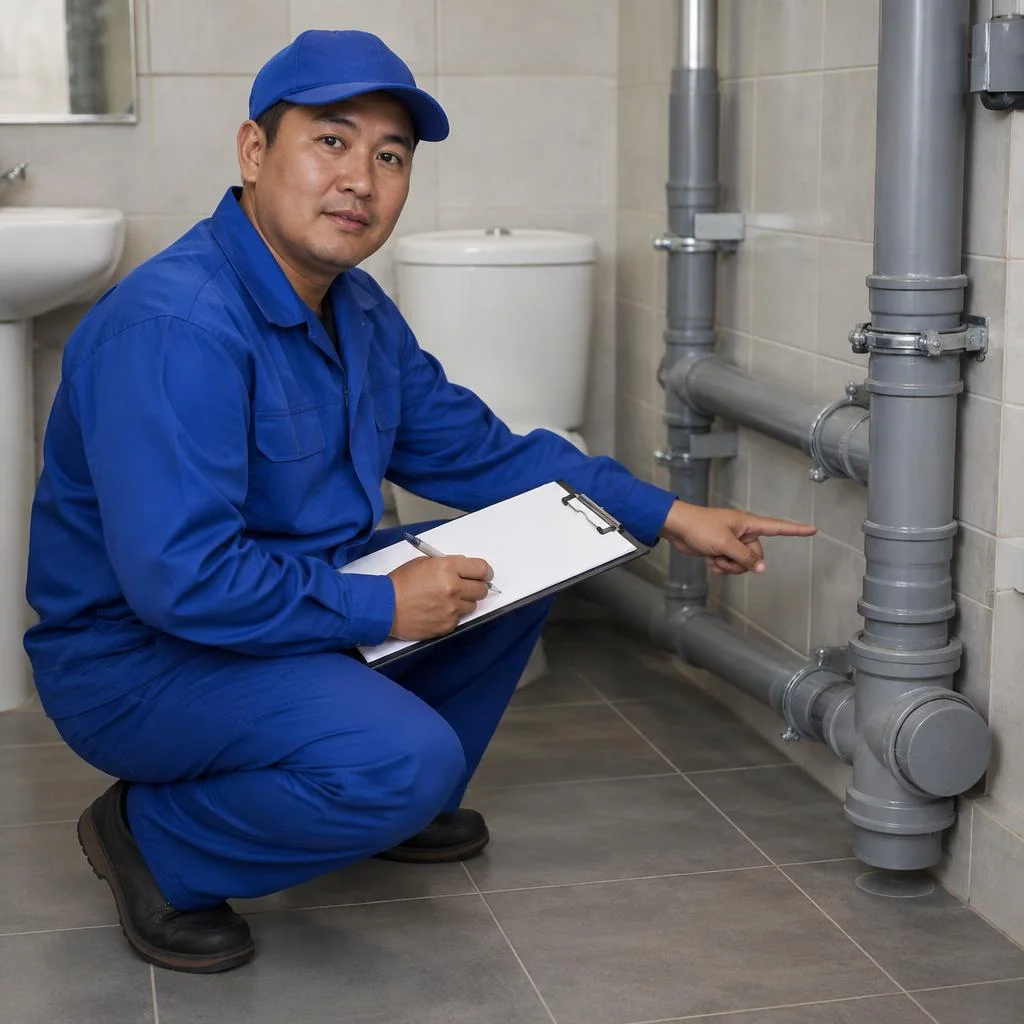
- Drawing up the estimate: the technician inspects the riser, records the diameter of the cast-iron pipes, the condition of the sealing in the floor slab, and the number of branches to the fixtures.
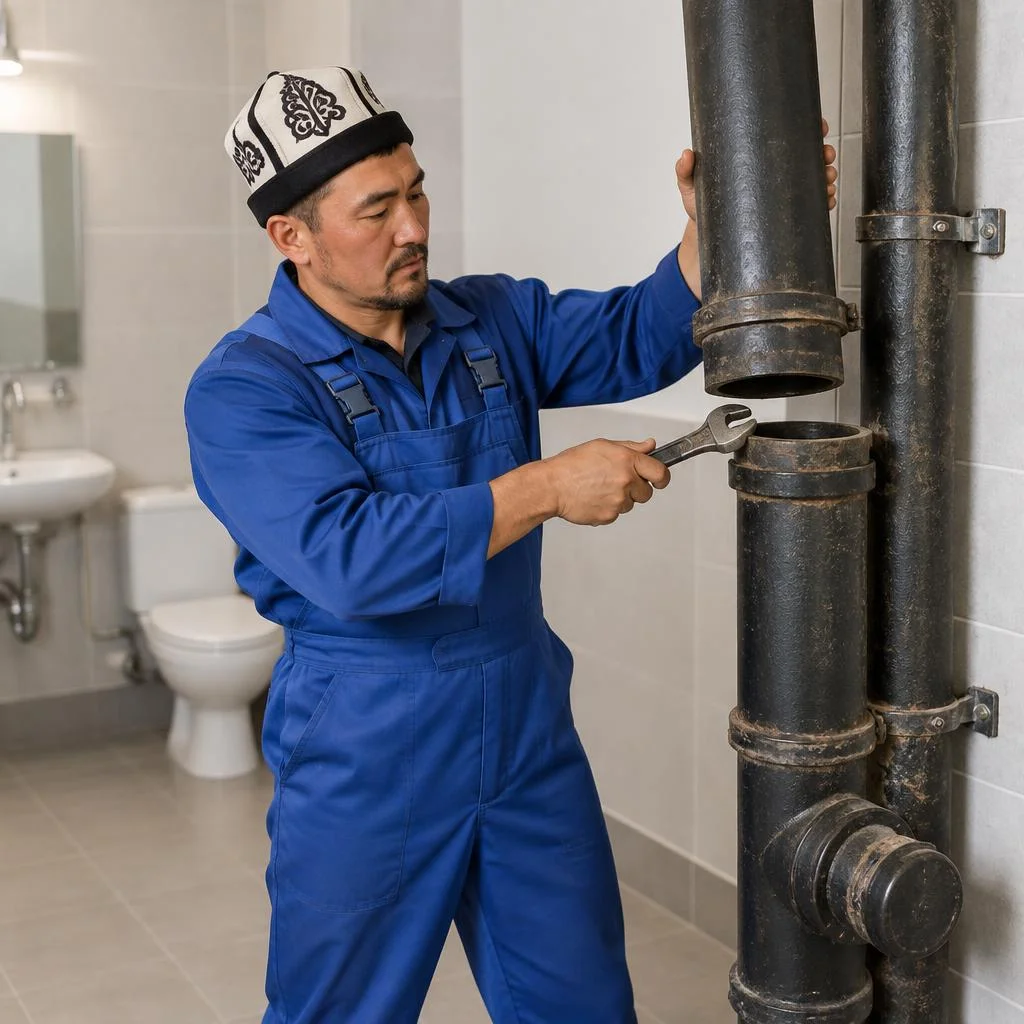
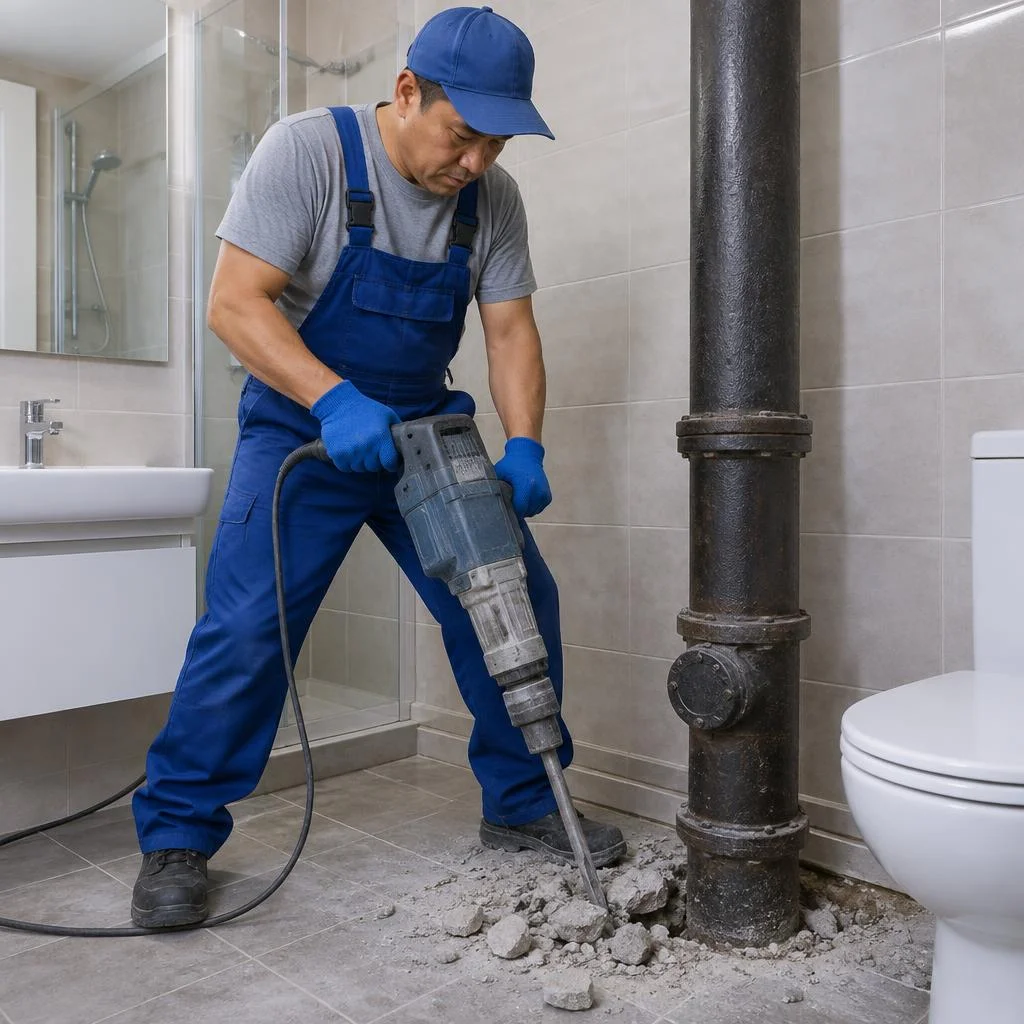
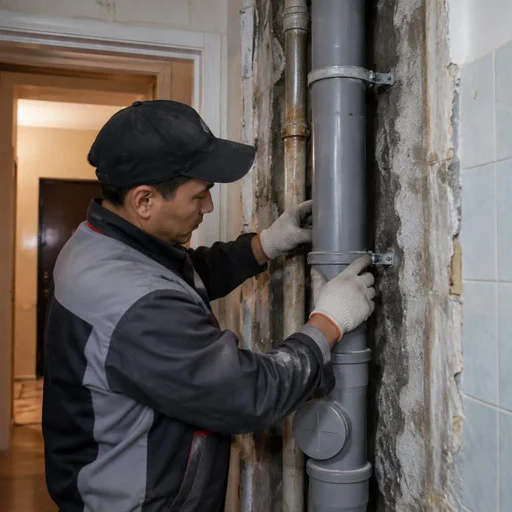
- Dismantling the old riser: the cast iron is cut with an angle grinder section by section so as not to damage the neighboring pipes and the floor slab.
- Breaking out the concrete sealing: a rotary hammer is used to remove the concrete around the socket, freeing up space for the new transition and expansion compensator.
- Installing the new pipes: the plastic is assembled with a slope of 2-3 cm per meter, the joints are sealed at the socket, and the riser is fastened to the wall with clamps.
- Connecting the fixtures: branches are run for the sink, toilet, bathtub, and washing machine, and the outlet height is checked.
- Quality check: the system is flushed under full load, and every joint and the sealing in the floor slab are inspected.
How long riser replacement takes and whether you can live in the apartment
Replacing the riser in a single apartment takes one working day, replacing the horizontal run in the basement takes up to two days, and throughout this time the bathroom remains at least partially accessible. Dismantling the cast iron and breaking out the sealing take 3-4 hours, installing the plastic with fixture connections takes another 3-5 hours, and flushing and acceptance take about an hour. When replacing the riser in the kitchen or bathroom, the water is shut off for the specific fixture rather than the whole apartment, so the second bathroom can be used during the process. If the entire riser in an entrance is being replaced, the work proceeds from top to bottom with short shutdowns per floor — this allows residents to use the sewer in the intervals rather than going without it for the entire duration. We fix the timelines in the contract before dismantling begins, so any postponement to the next day is agreed in advance.
What to do if a smell remains after replacement
- Check the trap seal: if the siphon has not been used for several days, the water in it has evaporated — pouring in half a liter of water is enough, and the smell goes away.
- Inspect the riser joint: tighten the cleanout and the clamp, and check whether air is being drawn in through a loose socket.
- Check the pipe slope: with a back slope or no slope at all, water stagnates in the branch and produces a smell even with sealed joints.
- Check the riser ventilation: a clogged or blocked vent outlet on the roof creates negative pressure and draws the smell out of the siphons.
Coordination with the management company, HOA, and neighbors: who is responsible for the riser
The riser is common property of the building, and its replacement affects neighbors and the management company. We break down who is responsible for what by law and how to coordinate the work so deadlines aren't missed.
Who should replace the riser: the resident, the management company, or the HOA
The riser up to the first connection with the apartment's internal piping is considered common property of the building, so its replacement is the responsibility of the management company or HOA, while the section after the branch to the fixture is the responsibility of the apartment owner. In Bishkek, panel nine-story buildings in Asanbay and on Jala are served by different management companies, and each has its own regulations: in some places requests are accepted through the subscriber department, in others a written application with residents' signatures is required. The boundary runs at the tee — everything above the branch to the sink or toilet is a shared pipe, everything below is private. In practice, the management company often doesn't have the budget for planned work, so residents along the riser join together and order it themselves — in that case it's important to draw up a contract to fix the contractor's responsibility. Clients often search for the cost of replacing a sewer pipe, and that's the right question: the estimate depends on the number of floors, the riser material, and the number of tees, not just on linear meters. Check the building's technical passport before applying: it lists the balance holder, and submitting the request to the right authority saves one to two weeks of correspondence.
How to coordinate access to neighbors along the riser
- Door-to-door visits over 3-5 days: our technician visits the apartments along the riser and records a convenient time for each.
- Notices in the entrance hall: posting notifications with the date and working hours — insurance in case a neighbor wasn't home.
- Phone and messenger: we get apartment numbers from the building entrance supervisor and duplicate them on Telegram a day before installation.
- Plan B for the work day: if a door isn't opened, we replace the riser in sections — this extends the timeline and adds extra joints.
- Access to your own section: replacing water pipes in a private house requires no door-to-door visits — only the time of the crew's visit needs to be coordinated.
2-Year Warranty, Contract, and Direct Provider: Why It Matters
In the Bishkek market, there are many private craftsmen who take money for work without a contract or warranty. Let's break down what a direct service provider offers and why the length of warranty obligations matters to the customer.
What the 2-year warranty on sewer replacement covers
- Joint sealing: if a leak appears through a connection due to our fault, we eliminate the cause free of charge during the warranty period.
- Slope compliance: we check the pipe's angle of inclination at every section — an error in slope leads to stagnation and blockages.
- Installation quality: we redo the work under warranty if the pipe sags, shifts, or deforms at the fastening point.
- Quality check: we run water through the entire riser and record the result in a report that remains with the customer.
Direct provider without intermediaries: what it means for the customer
We operate as a direct service provider: the work is performed by our own plumbers, not subcontractors, so responsibility for the result is not diluted among intermediaries. When an order goes through a dispatcher, a claim travels along the chain "client — dispatcher — contractor," and resolution times grow: each intermediary passes the task to the next one. With a direct provider, the claim is addressed directly to the contractor — the craftsman who handled the site comes on the warranty call himself. The work contract is signed with the same organization that performs the installation, not with an intermediary. Clients often phrase their request as: sewer pipe replacement price — and it's clear from this that the person needs a transparent estimate without hidden markups for dispatching. A direct provider's estimate does not include such a markup, so the final amount is closer to the real cost of materials and the craftsman's work.
How we select craftsmen and control work quality
- Experience with old housing stock: we take on craftsmen who have worked with cast-iron risers in older Bishkek buildings, not just with new plastic.
- Internal regulations: every stage from dismantling the cast-iron riser to the final check follows a checklist with photo documentation.
- One craftsman per site: sewer riser installation is carried out by a single specialist from start to handover, so responsibility isn't passed between shifts.
- Post-installation check: running water, inspecting joints and slope, customer's signature on the acceptance report; the cost of laying the sewer pipe is fixed in the estimate before work begins.
Conclusion
The breakdown is complete — we've gathered the key points that determine the decision on sewer replacement: when you can't put it off, why plastic is replacing cast iron, how the types of work differ, and how to protect yourself with documents.
Key takeaways
- Time to replace: recurring blockages, rust stains, and odor from the inspection port are signs of wear where cleaning only gives a temporary effect.
- Material: plastic lasts 50+ years and doesn't build up inside, while cast iron loses flow capacity after 20–25 years of use.
- Scope of work: riser, horizontal run, outlet, and branches to fixtures are different operations with their own diameters (50, 110, 160 mm) and access conditions.
- Approval: the riser is common property, so work is coordinated with the management company or homeowners association and vertical neighbors before dismantling begins.
- Documents: a 2-year warranty and a written contract protect the customer — without them, there's no one to file a claim with for a leak or blockage.