

















What electrical installation work Eco-Service performs in Bishkek
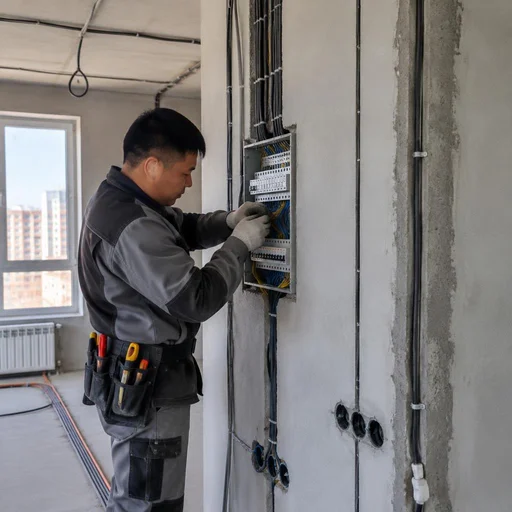
A direct provider of specialized services: we work with apartments, private houses and offices — from point tasks like installing a socket to full turnkey wiring installation.
Full list of services: from a socket to a turnkey electrical panel
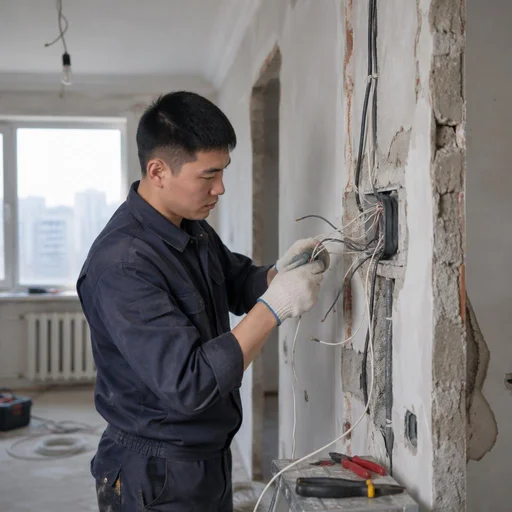
- Electrical wiring installation: laying lines in a new building, private house or office from scratch — routes, back boxes, connecting groups.
- Electrical wiring replacement: dismantling the old aluminum or copper line and laying a new one with a reinforced cross-section.
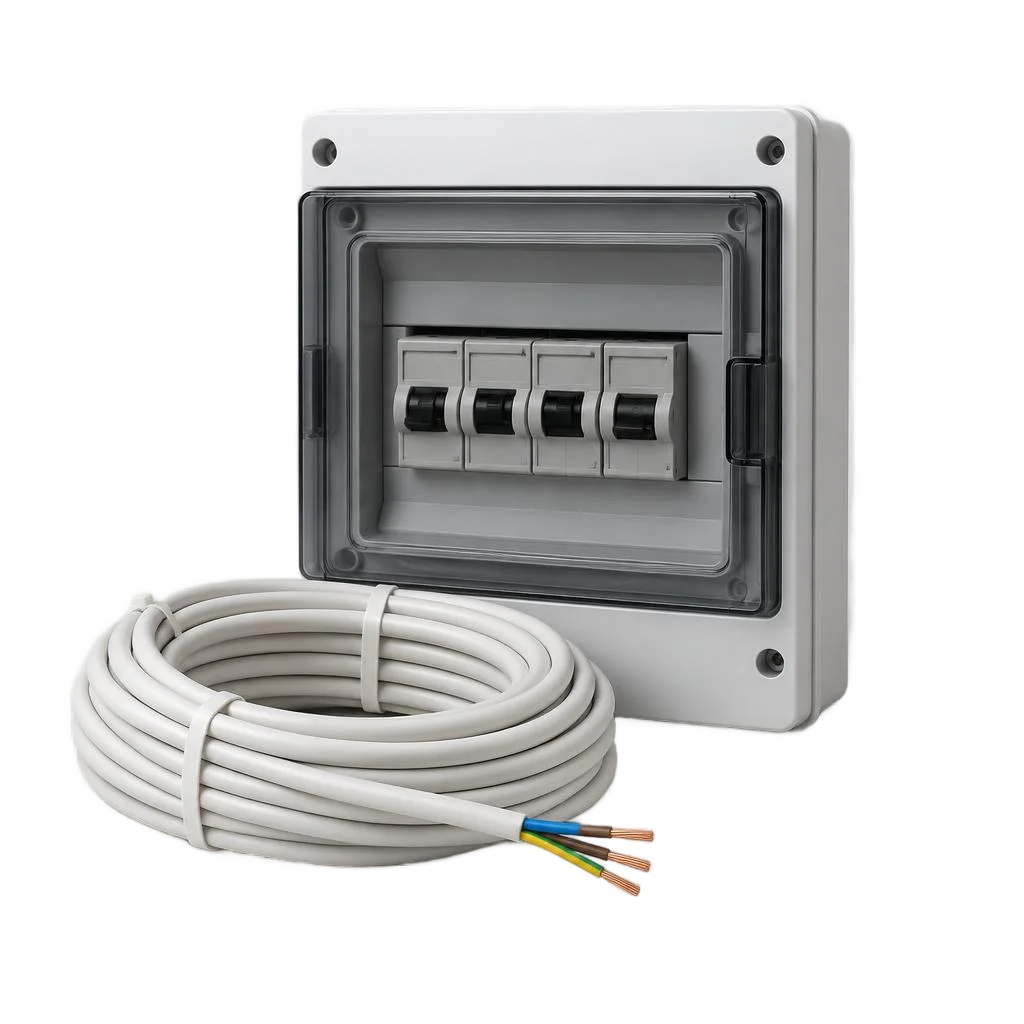
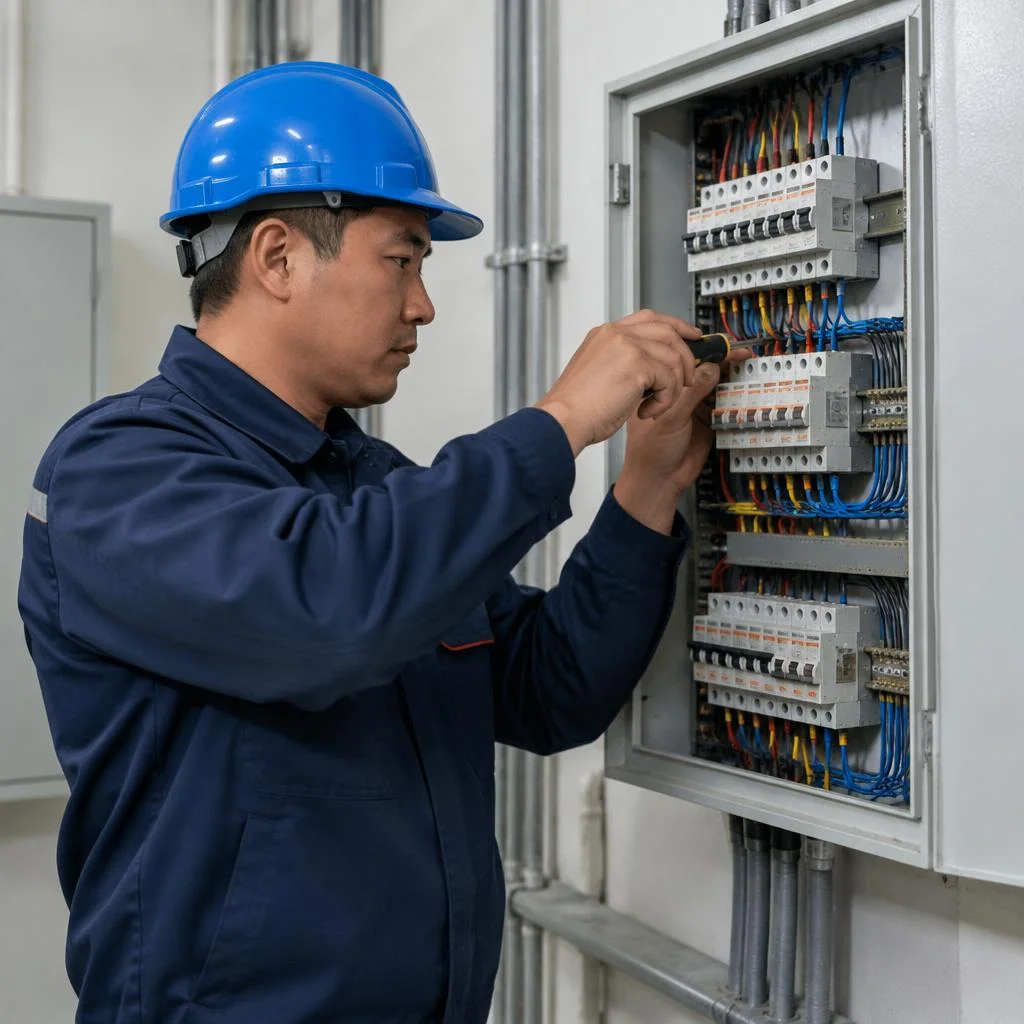
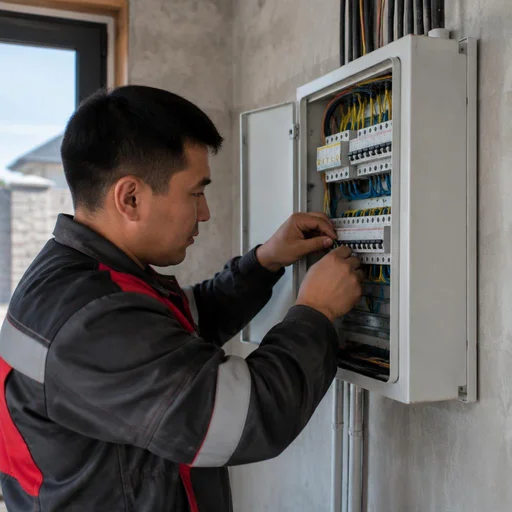
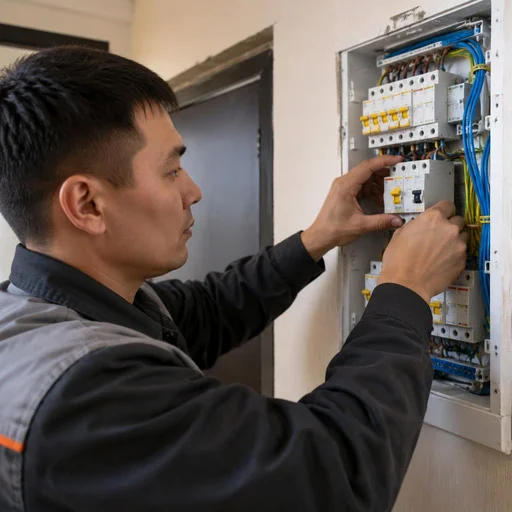
- Electrical panel assembly: arranging circuit breakers, RCDs, voltage relays and a contactor into a single unit with group labeling.
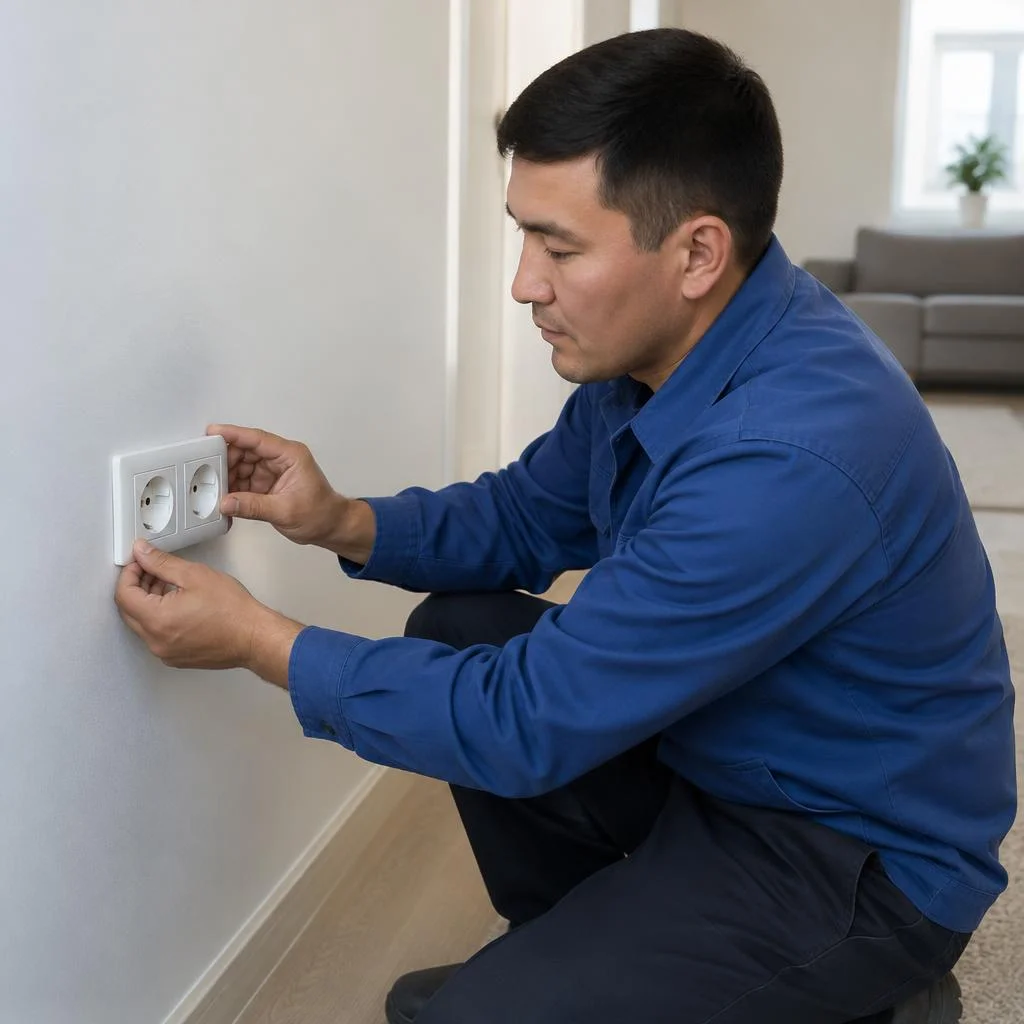
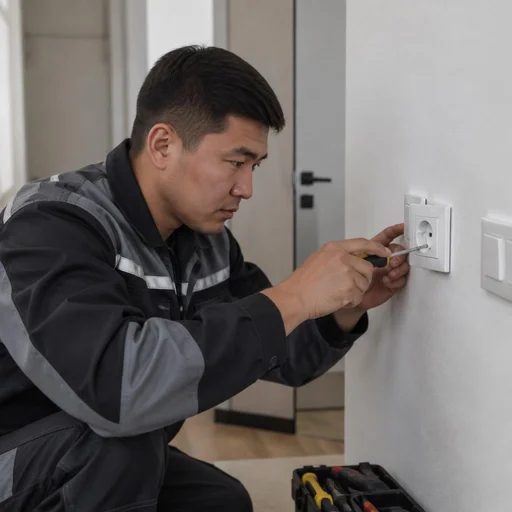
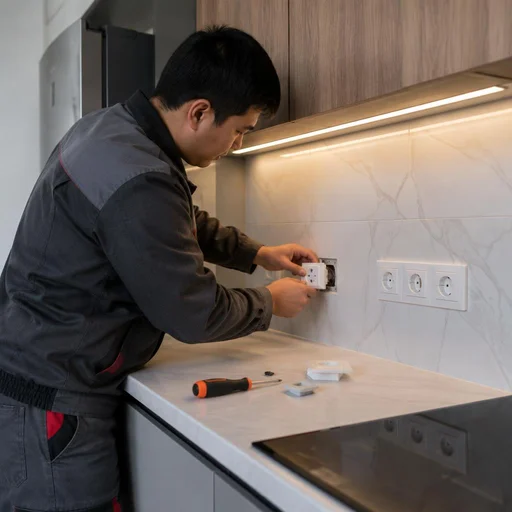
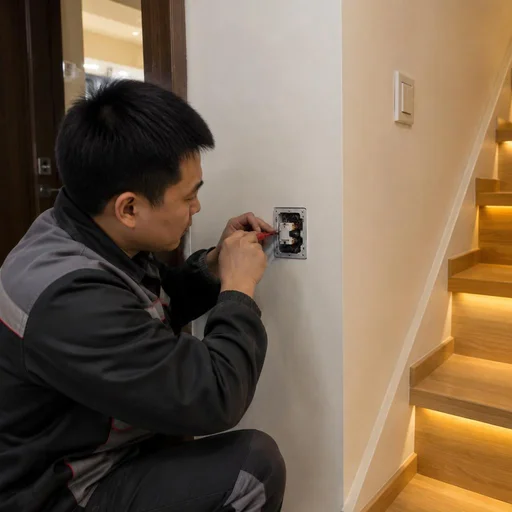
- Installation of sockets and switches: single points, socket blocks, two-way switches, back box replacement.
- Lighting installation: chandeliers, wall sconces, spotlights, LED strip, street lights.
- Turnkey electrical installation: the full cycle from design to commissioning with a 2-year warranty on the work.
- Price list for performing specialized tasks — the technician fixes it during the site inspection; the scope of tasks and volume are determined on site.
Installation, replacement and relocation: how the types of work differ
Installation is laying new wiring from scratch, replacement is dismantling the old line and laying a new one, relocation is moving an existing point without replacing the cable throughout the entire apartment. A full replacement covers all groups and the panel, a partial one covers individual sections: kitchen, bathroom, room. Relocating a socket takes 30-60 minutes, whereas a full replacement of a three-room apartment stretches over several days due to wall chasing and rough patching. Eco-Service performs electrical wiring replacement in stages: first the new line, then disconnecting the old one — the apartment does not remain without light during the process. If the cable is aluminum and older than 20 years, relocating without replacing the section gives a weak contact and a risk of heating under load — in my opinion, it is cheaper to immediately replace the line up to the nearest junction box. Clients often describe the task in one phrase — electrical installation work, and the technician already understands the scope. In search, people often type this: electrical installation work Bishkek — and land on our page.
Work by object types: apartment, private house, office
| Object | What is included | Installation specifics |
|---|---|---|
| Apartment | Routes, back boxes, panel, lighting, sockets | Work on finished walls, minimal wall chasing |
| New building | Rough-in installation, distribution by groups | We lay routes before final finishing |
| Private house | Grounding loop, outdoor lighting, main panel | Grounding and voltage relay are mandatory |
| Office | Cable routes, socket blocks, emergency lighting | In stages, without stopping workstations |
| Commercial premises | Panel, power lines, hall lighting | Load calculation for the tenant's equipment |
Specialized work in Bishkek is characterized by dense development: in new buildings, routes are partially laid by the developer, so our work begins with an audit of the existing lines — sometimes it is easier to add what is missing than to redo everything. When a customer asks about electrical installation prices, we first clarify the footage, number of groups and type of walls — the calculation depends on this. The second frequent request sounds like this: price list for performing electrical installation work — the technician shows it during the inspection so that the estimate matches the actual scope.
How electrical installation proceeds: stages from request to commissioning
The work sequence is the same for any site: first inspection and estimate, then load calculation, rough-in installation and final commissioning. Let's go through each stage — from request to handover of the site.
Site inspection and work estimate before installation begins
Eco-Service prepares a work estimate after inspecting the site and before installation begins — the client sees the list of items and scope before signing. A specialist visits the site, measures the length of runs, counts the number of points, back boxes and groups in the panel, and checks the result against the price list. For an apartment of 60-70 sq. m this is usually 40-60 points and 6-9 circuits; for a private house, the service entrance, grounding and outdoor groups are added. Clients often search for us like this: estimate for electrical installation work — and they get exactly a list of items, not a single figure for everything. Many type in rates for electrical installation work — and for this query we show what items make up the total for each circuit. Another frequent query is rates for electrical installation work in Bishkek: from it we can see that the person needs a budget reference before the technician visits. If a contractor quotes a sum after the fact without an inspection, surcharges for wall chasing, back boxes and consumables almost always appear during the process — lock in the list of items in advance.
Load calculation and cable cross-section selection
The cable cross-section is selected for the load of the circuit: for socket groups and high-power appliances — a separate calculation, for lighting — the minimum cross-section. For the apartment service entrance and the kitchen group we lay separate circuits: the cooktop, oven, washing machine and boiler consume more than all other appliances combined. For each circuit, a circuit breaker is selected by rating, and for wet areas — an RCD. In a private house, circuits are added for the pump, boiler and outdoor sockets. Lay separate circuits for the kitchen and the service entrance — when replacing appliances with more powerful ones, you won't have to open up the walls again.
Wall chasing, routing runs and rough-in installation
Runs are laid along walls and ceilings taking future finishing into account; wall chasing is done to the cable size with subsequent patching. Horizontal chases run at socket height, vertical ones — strictly up to the ceiling or down to the floor, so that the run can be found from the plan. Back boxes are set on alabaster or gypsum adhesive, the depth is selected for the socket block. The cable is laid in corrugated conduit or a chase and secured before plastering. Mark out the socket and switch points before wall chasing — moving a point after the rough-in stage means a new chase and re-patching the wall.
Connection, commissioning and testing of protective automation
At the final stage, Eco-Service connects the circuits, tests the operation of circuit breakers, RCDs and the voltage relay, and hands over the site with a 2-year warranty. First all groups are continuity-tested, then voltage is applied and each point is tested under load. The voltage relay is set to trip when network parameters go beyond permissible limits — in Bishkek, surges in the evening hours occur regularly. Clients often phrase the request like this: price electrical installation work — and from this phrase we show what makes up the total. After commissioning, ask them to show which breaker is responsible for which circuit — when the protection trips, you'll immediately understand where to look for the cause.
Electrical installation in an apartment, private house and office: what to consider
The type of property determines the scope of work and the set of protective devices — let's break down what electrical installation includes for an apartment, a private house and an office.
Work in Bishkek for an apartment and a new building
In an apartment, Eco-Service installs wiring by groups — lighting, sockets, kitchen, incoming supply — with the installation of a panel and protective automation. For a two-room apartment of 60-70 square meters we plan 6-8 groups: separate lines for the hob, washing machine, boiler and air conditioner, each with its own circuit breaker. In a new building with a rough finish, the runs are laid openly along the ceiling and walls before plastering — no chasing into concrete is required, and we take cable with a reserve in cross-section. The estimate for such work in such an apartment comes out lower precisely because there is no hammering of load-bearing walls. In a new building with a rough finish, it is cheaper to do the installation before plastering — the runs are laid openly and do not require chasing.
Wiring installation in a private house: grounding and outdoor lighting
In a private house, a grounding loop, an incoming panel with a voltage relay and outdoor lighting are added to the standard installation. We make the grounding loop from three rods of 2.5 meters each, driven in a triangle at a distance of 3 meters from the foundation, with a 40×4 mm strip around the perimeter. We install the voltage relay on the incoming supply after the meter — in the private sector of Bishkek, surges in the grid up to 260 volts are not uncommon, and the relay disconnects the line when it goes outside the 190-250 volt range. We run separate lines to the plot for lamps and path lighting with IP65 moisture protection. Grounding in a private house is done before the internal wiring — if the loop is installed afterwards, some of the lines will have to be reconnected.
Office installation without stopping work
In an office, Eco-Service plans the work by zones and stages so as not to stop the workstations — the installation proceeds during non-working hours or in free areas. We agree the schedule with the administrator: we close meeting rooms and corridors in the evening, and we wire the main socket zone in the open space on weekends. Clients often look for prices for electrical installation work — and end up here, because the cost depends on the number of zones and the density of workstations: for 20 employees we plan a minimum of 8 groups and socket blocks for every 4-5 seats. In offices with a server room and office equipment, a separate line with stabilization and an RCD is mandatory — a shared socket group will not withstand the simultaneous load. The final cost is made up of the length of the runs and the number of points, not the area of the premises, so we calculate the estimate after an inspection.
Electrical panel and protective automation: assembly, RCD, voltage relay
The panel is the node on which the safety of the entire wiring depends. Let's break down which devices are installed in it, why each is needed, and how the replacement of protective automation is carried out.
Electrical panel assembly: what's included and how it's selected
Eco-Service assembles the electrical panel for a specific site: main circuit breaker, group circuit breakers, RCD, voltage relay and contactor — according to the number of lines and the load. For an apartment with an electric stove and boiler, 12-16 modules are used; for an office with a server room — 24-36, and each line gets its own circuit breaker rated for the cable cross-section. RCDs are installed on groups in wet areas and socket lines, the voltage relay — on the input after the main circuit breaker, the contactor — to control a powerful load based on the relay signal. Clients often phrase the request as a price list for electrical installation work, although what's meant is a specific panel assembly. The enclosure is taken with a reserve on the DIN rail: leave a reserve of modules in the panel — when adding a new line (air conditioner, boiler), you won't have to change the enclosure.
Circuit breaker, RCD, voltage relay and contactor: what each is responsible for
| Device | What it protects against | Where it's installed |
|---|---|---|
| Circuit breaker | Overload and short circuit | On each group line |
| RCD | Current leakage, electric shock to a person | Socket groups, wet areas |
| Voltage relay | Surges and drops in the network | On the input, after the main circuit breaker |
| Contactor | Switching of a powerful load | Control of boiler, furnace, pump |
| RCBO | Overload, short circuit and leakage in one enclosure | Instead of a pair of circuit breaker plus RCD |
In Bishkek, the voltage relay is installed on the input — during a surge, the entire apartment is disconnected, not individual appliances, so the tripping threshold is fixed in advance: upper limit 250-260 V, lower — 170-180 V.
Replacing a circuit breaker and installing an RCD
Replacing a circuit breaker and installing an RCD are performed on a de-energized panel with line verification after connection. First, voltage is removed from the main switch and an indicator confirms that the phase conductor is dead, then the old module is dismantled, the cores are stripped, a new one is installed and the terminals are tightened with a torque screwdriver — a loose contact heats up and melts the enclosure. After assembly, each group is checked with a tester and the "Test" button on the RCD: the device should trip within fractions of a second. In everyday usage, such requests sound like electrical installation work price lists, and the technician immediately understands what's meant. If the circuit breaker trips regularly, first check the load and the condition of the line — replacing the device without diagnostics doesn't solve the problem.
What affects electrical installation price lists in Bishkek
Electrical installation price lists in Bishkek depend on the number of lines, the type of cable and the difficulty of access to the panel. The price list includes separate items for panel assembly, installation of an RCD, voltage relay and contactor — the total is calculated by the number of modules and groups, not by the square footage of the apartment. Clients often look for estimates for electrical installation work, although the total depends on the number of modules and groups. The cost of replacing one circuit breaker and a complete panel overhaul differ by several times, because in the second case diagnostics of each line and re-marking are added. Often people search for electrical installation work price lists in Bishkek — and end up here, although the exact calculation is still done after inspecting the site. Request an estimate with a breakdown by device before starting work: that way you can see exactly what you're paying for.
Lighting and connection points: chandeliers, spotlights, strip lights, wall sconces
Lighting is the most visible part of the work: the client judges the result by the light. Let's break down which points we connect, how to plan scenarios, and what drives the price for this section.
Installation of chandeliers, wall sconces and spotlights
Eco-Service connects chandeliers, wall sconces and spotlights with line testing and selection of fasteners for the ceiling or wall. For drywall, a butterfly anchor or a mounting block is used; for concrete, an anchor wedge; for models heavier than 8 kg, we mount a mounting plate directly into the floor slab. Connecting a wall sconce to the wall requires chasing for a concealed line if the outlet was not provided during the rough-in stage. For spotlights, calculate the total wattage in advance — more than 8-10 points on one line requires a separate circuit breaker, otherwise the terminals overheat and voltage drops at the far points. Clients often search for electrical installation work prices to estimate the lighting budget before calling a specialist.
LED strip, two-way switch and outdoor lighting
Eco-Service installs LED strip with a power supply, connects two-way switches for controlling light from multiple points, and installs outdoor lighting. A 12 or 24 V strip requires a driver with a 20-30% power reserve and an aluminum profile for heat dissipation — without it, the crystals degrade within a season. We install two-way switches in bedrooms, on staircases and in long corridors: two switches control one group without an intermediate relay. We connect outdoor lighting via moisture-proof IP65 fixtures and a separate circuit breaker with an RCD. Place the power supply for the strip in an accessible location — if it fails, it can be replaced without dismantling the ceiling. Many clients request an electrical installation work price list in advance to verify the estimate for the strip and outdoor points.
Sockets, switches and socket blocks: installation and relocation
Eco-Service installs sockets, switches and socket blocks, and also relocates points with replacement of the mounting box if necessary. Work in Bishkek on socket groups is most often related to rearranging furniture or relocating a work area: we dismantle the old mounting box, chase a new route, and make connections using Wago terminals rather than twisting. It is more convenient to wire a socket block in the kitchen on a separate line — simultaneous use of appliances does not overload the shared group. Replacing the mounting box is needed when the old one is crumbled or does not hold the mechanism: we select a model for drywall or concrete based on the wall type. The final prices for a socket group depend on the number of points and the depth of chasing, and we calculate electrical installation work in Bishkek per point separately.
2-Year Warranty, Timelines and Acceptance of Work
We provide a 2-year warranty on all types of work and fix the timelines before installation begins. Below is what exactly the warranty case covers, what the timelines consist of, and how the acceptance of the project is carried out.
2-Year Warranty: What It Covers and How It Is Issued
Eco-Service provides a 2-year warranty on installation — it covers the connection and operation of the installed protective automation. Each project is assigned its own team of electricians, not an outsourced contractor, so a warranty request is accepted by the same technician who carried out the installation. Requests are handled through our own service center in Bishkek: a site visit, line diagnostics, and replacement of a failed component are performed in a single request, without being redirected between departments. The warranty certificate is issued for the project with a list of completed work and materials used. The warranty is valid when materials agreed upon in the estimate are used — if a cable or circuit breaker is replaced with one that does not match the parameters, the case is not considered a warranty case.
Timelines: How Long Installation and Wiring Replacement Take
Eco-Service fixes the timelines in the estimate before work begins — point operations such as installing a socket are completed in a single visit, wiring installation in an apartment takes several days, and a full replacement in a private house takes longer due to the rough-in stage with wall chasing and pouring. Clients often ask about the price of electrical installation work even before the technician's visit, so we discuss the ballpark figures right away over the phone. A site visit for inspection and measurements usually takes place within 24 hours of the request. The duration is affected by the footage of the runs, the number of groups in the panel, and the readiness of the walls for chasing: in a new building with open channels, the rough-in stage goes faster than in a house with concrete slabs. People often type exactly this into the search bar: electrical installation work rates — and the technician immediately understands that the client needs a budget estimate before the visit. The final estimate is affected not only by the scope, but also by the number of floors, access to the ceiling, and the need to dismantle old lines. If a contractor only gives an "approximate" figure, it is difficult to plan the renovation and purchase of materials.
Acceptance of Work and Payment: What the Customer Should Look At
During acceptance, Eco-Service demonstrates the operation of each line, the labeling of the circuit breakers in the panel, and the results of testing the protective automation — an RCD test with the button and measurement of the phase-zero loop resistance. The connection and commissioning are completed under load: all groups are switched on one by one, heating of contacts and the tripping of the voltage relay during a dip are checked. The customer receives a panel schematic with line labels and a certificate of completed work. Payment is accepted in cash and via MBANK or O!Dengi, settlement is made upon acceptance, not as an advance for the entire scope. We provide detailed electrical installation work rates together with the panel schematic so that the customer can see what they are paying for on each line item. Ask for a panel schematic with labeled lines — for future renovations or connecting equipment, this saves time in finding the right circuit breaker.
Conclusion
We have gathered the main things that determine the result of the work: from preparing the estimate to checking each line when handing over the project.
Key Takeaways
- Estimate and load calculation: installation begins with these two documents — without them, the list of work and the scope of materials remain undefined.
- Type of project: in an apartment, these are line groups and the panel; in a private house, grounding and outdoor lighting are added; in an office, work is carried out without stopping the workstations.
- Protective automation: circuit breakers, RCDs, voltage relays, and contactors are selected based on the load and number of lines, not "by eye."
- Timelines and warranty: fix them before the start — this protects against additional charges and disputes during acceptance.
- Acceptance: check the operation of each line and the labeling of the circuit breakers in the panel.