








What is an ATS and when is it needed in Bishkek
An ATS automatically switches power between the main grid and a backup source when the voltage disappears or goes beyond acceptable limits. For the capital of Kyrgyzstan and its suburbs, this is not an option but a way to protect equipment and avoid being left without power.
What is an automatic transfer switch and how it works
The device automatically switches the load from the main grid to a backup source when the voltage disappears or goes beyond acceptable limits. In a basic single-phase scheme, a voltage monitoring relay keeps an eye on the input, and a contactor, on its command, breaks the main line circuit and closes the backup one; the input circuit breaker protects both legs from overload and short circuit. The scheme works without human involvement: when the grid returns to normal, the load just as automatically goes back to the main input. The key parameter is switching time: in relay-based schemes it is measured in tenths of a second, and it is precisely this that determines whether the load will "survive" the dip. Installing protection for refrigerators and pumps requires a deliberate delay — 5-10 seconds — so that the compressor has time to release pressure and does not start under load.
Why in Bishkek an ATS is installed not "just in case"
In the capital and its suburbs, outages and voltage sags are a regular occurrence, so an ATS protects not only against a complete loss of power but also against surges that ruin equipment. In the private sector on the outskirts — in the residential areas of Ak-Orgo, Kok-Zhar, Mayevka — the networks are overloaded, and the evening peak causes a sag below 180 V, at which a refrigerator or boiler no longer starts. A separate problem is a "floating neutral" and phase imbalance in a three-phase network: without voltage monitoring on each phase, some equipment fails even without an outage, and on one phase the voltage jumps to 300 V and above. For a house with a gas boiler and a pump station, a voltage monitoring relay pays for itself in a single season — repairing the boiler's circuit board is comparable to installing the entire protection system, and ATS installation takes a crew one working day.
Who needs an ATS first and foremost
- Private house: a boiler, pump station and refrigerator cannot tolerate prolonged outages — a backup input keeps them running.
- Office panel: servers, routers and point-of-sale equipment require switching within tenths of a second and a smooth sine wave.
- Store: refrigerated display cases lose goods after more than an hour of downtime — the backup pays for itself in a single shift.
- Manufacturing: stopping a machine for a line restart costs more than installation, so a scheme with generator priority is used.
- Server rack: here the quality of the backup source's sine wave is critical — a generator with a "dirty" output reduces the benefit of the protection to zero.
- Pump station: without phase monitoring, the motor burns out within minutes of an imbalance, so protection is installed together with the switching automation.
Through Eco-Service you can order installation for a specific load — from a private house to a server rack.
Types of ATS: which scheme to choose for your network
The choice of scheme is determined by the number of phases, load power and type of backup source. Let's look at the options that we install most often at facilities of various scales.
Single-phase and three-phase ATS: what's the difference
We install single-phase ATS in apartments and small houses on inputs up to 63 A, and three-phase — in manufacturing and facilities with powerful motors where losing a phase is unacceptable. Between these two versions lies a difference in selectivity: a single-phase scheme monitors one "phase-neutral" pair, while a three-phase one watches three lines simultaneously and breaks all poles when a fault occurs on any of them. Eco-Service performs the connection of ATS to a three-phase network with per-phase voltage monitoring, so that a break on one line does not go unnoticed. In a three-phase scheme you cannot cut corners on monitoring each phase: if one of them breaks, single-phase consumers receive overvoltage, and the protection must trip faster than the equipment fails.
Scheme based on a voltage monitoring relay and on contactors
We assemble a scheme based on a voltage monitoring relay for household panels and on contactors — for loads where switching of large currents and clear priority logic are needed. The relay takes up one module on a din rail and is suitable for inputs up to 63 A: it tracks voltage going beyond the set limits and sends a signal to switch. A contactor assembly handles currents of hundreds of amperes, works with three-phase motors of pumps and machine tools, and the logic is set by a separate controller. Setting the switching threshold is a separate operation: the lower and upper limit setpoints are configured for the actual network of the facility, not by average values. If you set the threshold "per the datasheet," the ATS will trip on every voltage sag and quickly wear out the contactor.
ATS with bypass and with generator priority
Bypass provides a manual bypass of the automation for maintenance without shutting down the facility, and generator priority makes the backup source the primary one while it is running. Bypass is a separate switch that feeds power directly, bypassing the automation: a technician takes the panel out of service without cutting the load. Generator priority is needed where the backup is switched on for a long time: while the generator is running, the scheme keeps power from it and does not return the load to the grid until commanded. Backfeed voltage interlocking prevents simultaneous supply from two sources — without it, an accident at the input is possible. Bypass is mandatory at facilities where a stoppage is unacceptable: without it, any inspection of the panel means downtime, and with it the automation is taken out of the scheme in a minute.
Comparison of ATS options by facility
| Facility type | ATS scheme | Backup source | What installation includes |
|---|---|---|---|
| Apartment, house | Single-phase, relay-based | Generator / UPS | Din rail mounting, threshold setting |
| Office, shop | Single-phase / three-phase | Generator | Panel assembly, circuit breakers |
| Manufacturing | Three-phase, contactor-based | Generator | Panel, cable, grounding |
| Server rack | Single-phase with bypass | UPS / generator | Bypass, selectivity |
| Pumping station | Three-phase | Generator | Grounding loop, commissioning |
| House with solar | Hybrid cascade | Solar + generator | Inverter, source priorities |
The cost of installation depends on the scheme and scope of work — the total is calculated after inspecting the panel. For hybrid systems (grid + solar + generator), the scheme is built as a cascade, and the order of priorities is set in advance — otherwise the sources "conflict" with each other.
Installation of ATS with Generator and Solar Panels
A generator and solar panels place different demands on the automation: one needs a cooldown cycle after shutdown, the other needs coordination with the inverter. Let's look at how we link the sources into a single circuit.
Connecting the ATS to the Generator
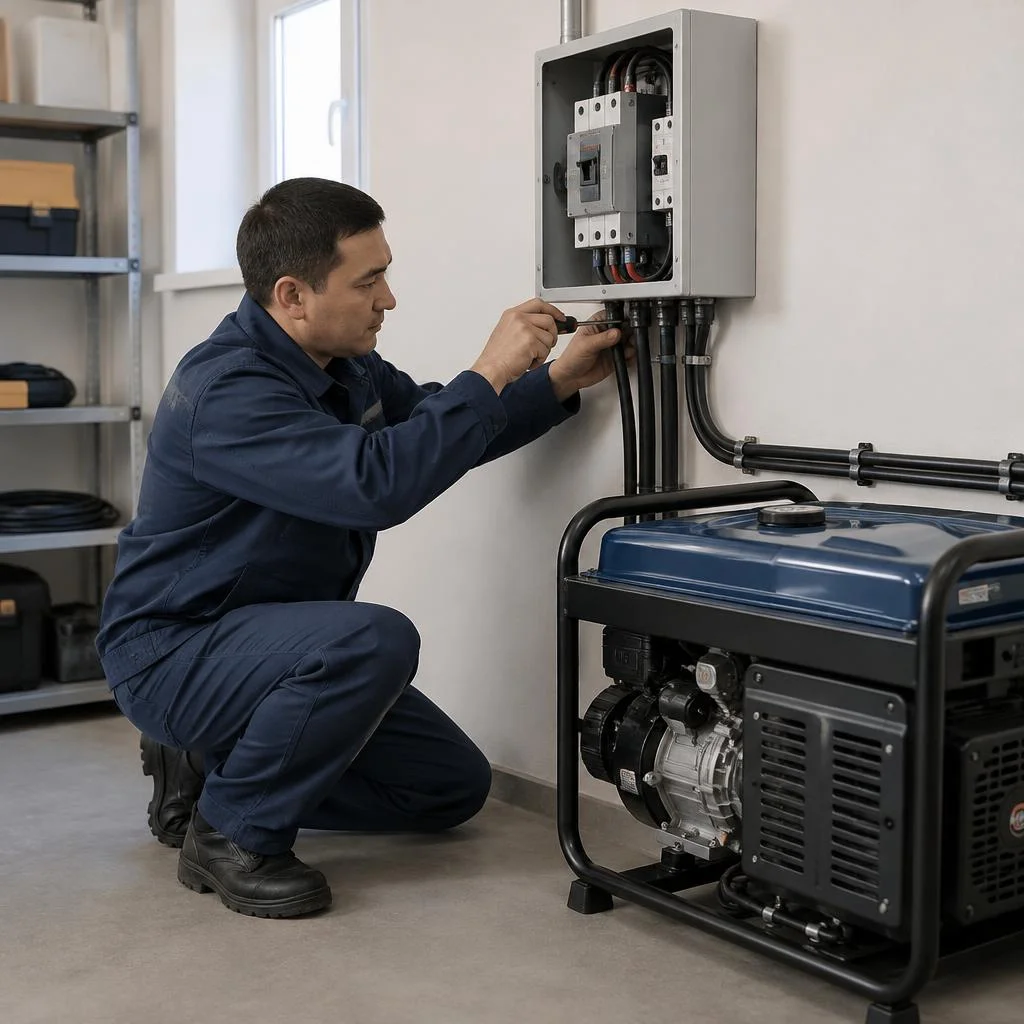
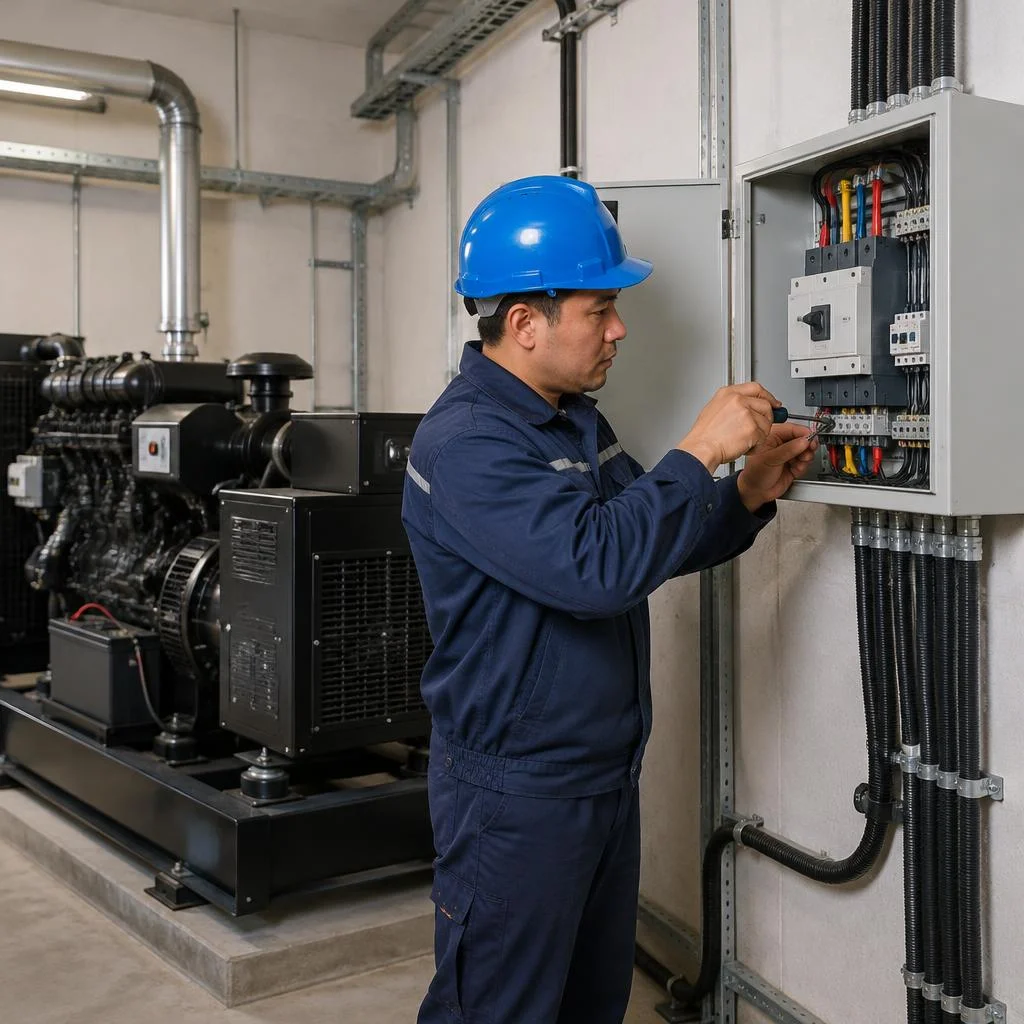
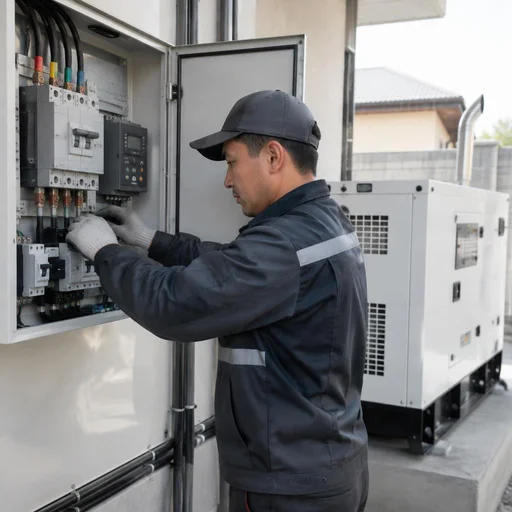
We connect the automation to the generator so that when the grid appears, the load returns to it, and the generator completes a cooldown cycle and shuts down. Between the generator and the grid we install mechanical and electrical interlocking against counter voltage: the grid contactor and the generator contactor physically cannot close simultaneously. On a single-phase input we install a two-position switch with a motor drive; on three-phase ones, a contactor circuit with a phase monitoring relay and a 10-15 second delay for return. If the generator has auto-start, we add a controller that issues a start command after three seconds of grid absence and a stop command after five minutes of cooldown operation. Between the generator and the grid, mechanical and electrical interlocking against counter voltage is mandatory — without it, the generator could be fed "into the grid," damaging equipment and injuring the network operator's personnel. Work with generators at Eco-Service always includes testing the interlock under load.
ATS for Solar Panels and Inverter
For solar systems, we assemble an ATS that switches the load between the grid, the inverter, and the generator, preserving the priority of own generation. We place the hybrid inverter on a separate line with its own breaker, and the ATS at the input: when the grid drops, the load transfers to the inverter within 10-20 milliseconds; when the battery discharges below the threshold, it transfers to the generator. For rooftop stations of 5-10 kW we use inverters with an uninterruptible power supply function, so a separate UPS is not needed. The hybrid inverter and the ATS must be coordinated in switching time: if the inverter enters recharge mode before the ATS returns the grid, the battery discharges for nothing. Therefore we set the return-to-grid delay 30-60 seconds longer than that of the inverter — otherwise the battery drains to zero at night even though the grid is already available. We perform the connection of the ATS to solar panels with the controller flashed for the specific inverter model.
Source Priority: Grid, Sun, Generator
- Grid first: for facilities with a night tariff and stable supply — the generator turns on only during an outage, the sun works to recharge the battery.
- Sun first: for off-grid homes and farms where the grid is weak or absent — the inverter carries the load, the generator provides backup during prolonged passive weather.
- Generator first: for production facilities with a peak load above the inverter's capacity — the generator takes on the machine tools, the sun powers lighting and the office.
- Seasonal change: in winter we give priority to the grid, in summer to the sun; we make the switch through controller settings without rebuilding the panel.
What is included in ATS installation and how the installation process works
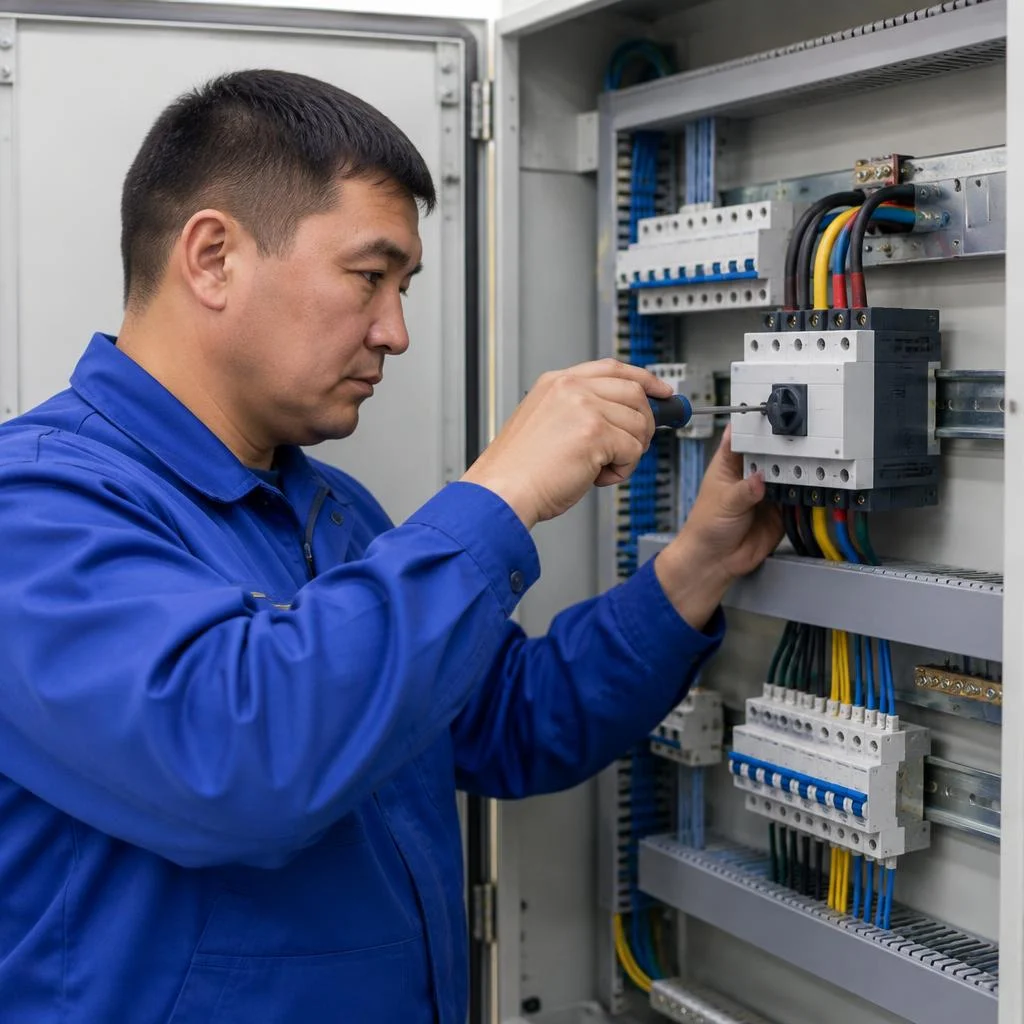
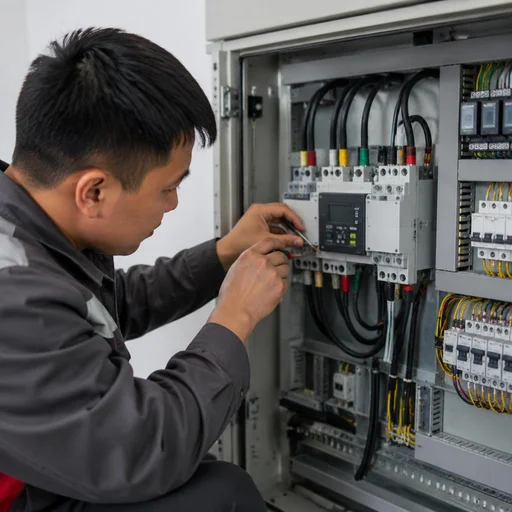
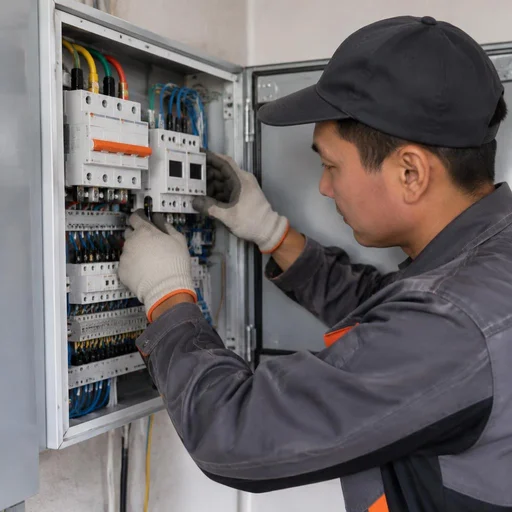
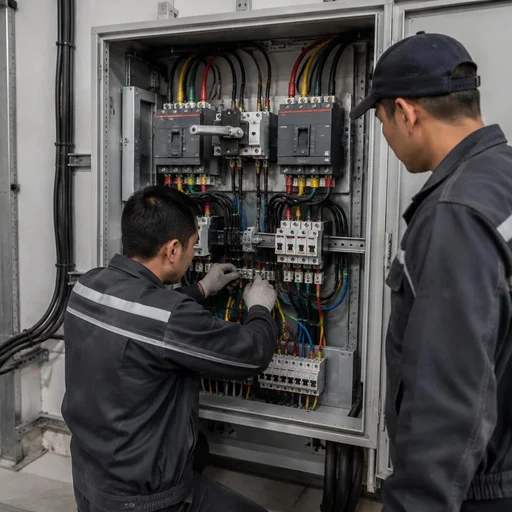
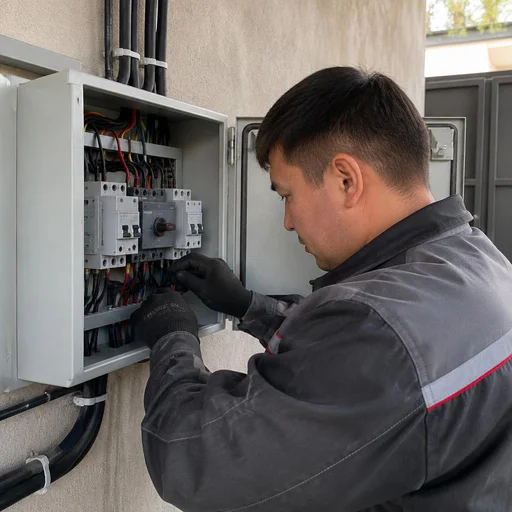
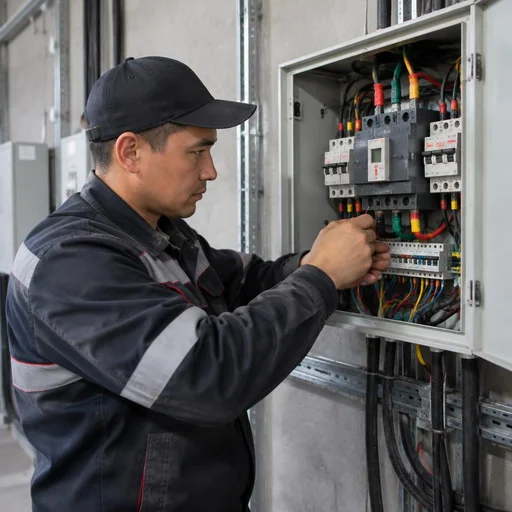
ATS installation is not only the installation of the device in the panel, but also the preparation of cable lines, assembly of the distribution unit and testing of the entire circuit under real load.
ATS installation stages: from measurement to commissioning
- Measurement and diagram: site visit, determination of load power, selection of circuit breaker ratings and the backup input point.
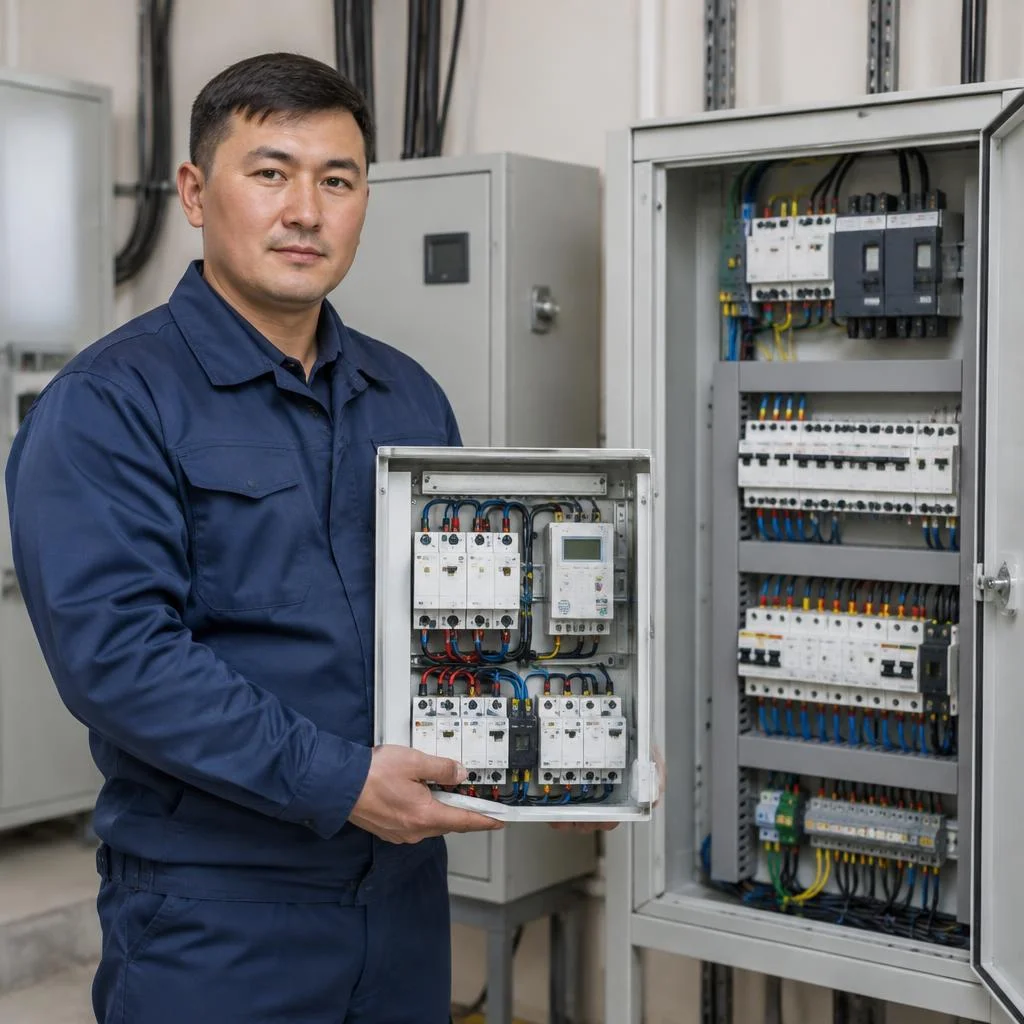
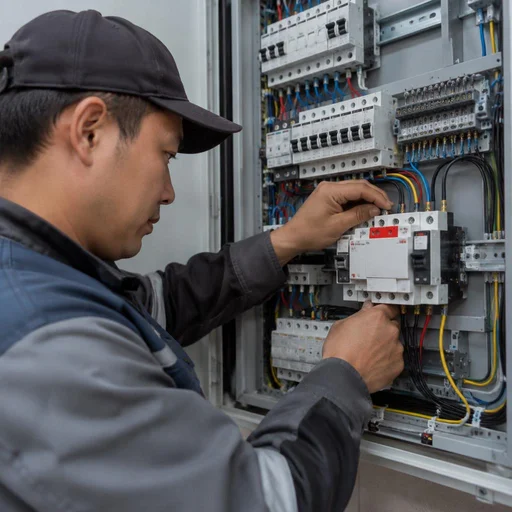
- Panel assembly: layout of the distribution unit with the incoming circuit breaker, voltage monitoring relay and contactors.
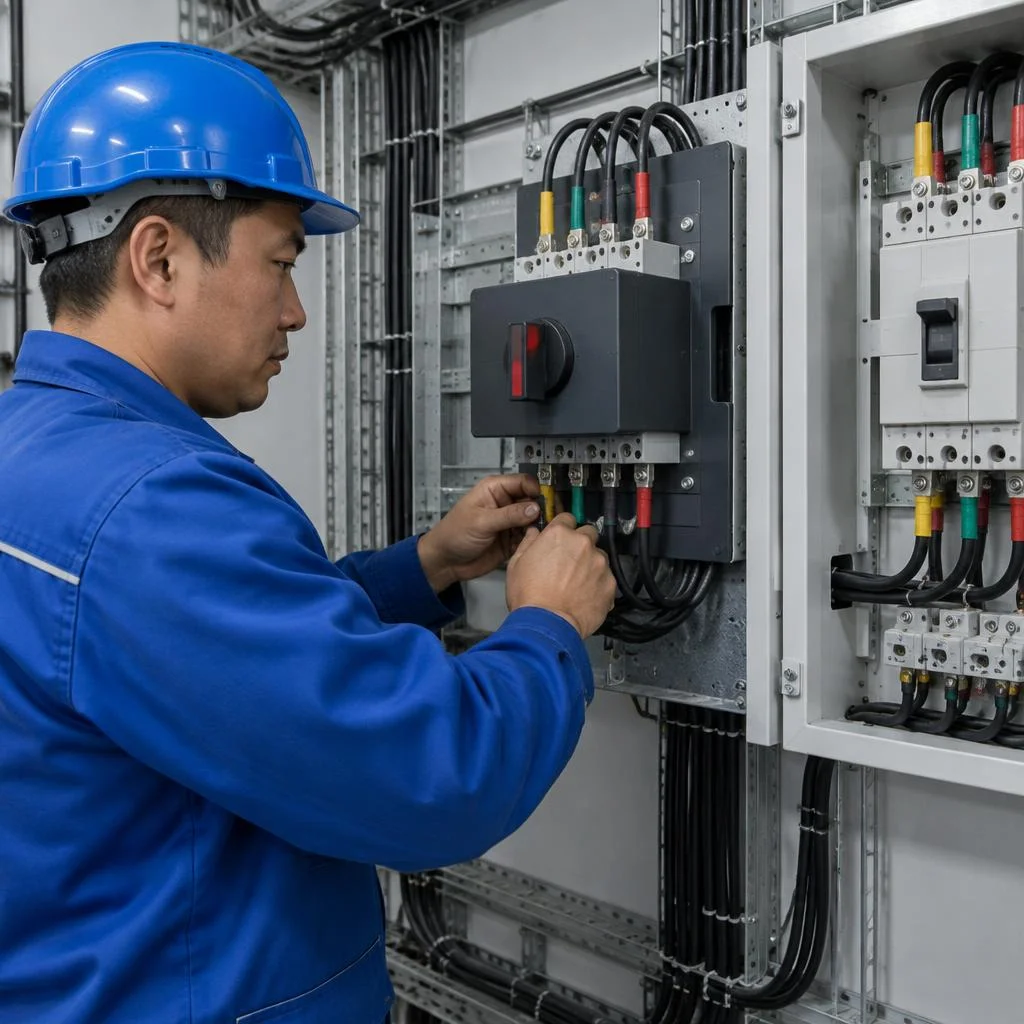
- Cable routing: pulling the incoming cable and lines to the ATS panel, installation of the grounding loop.
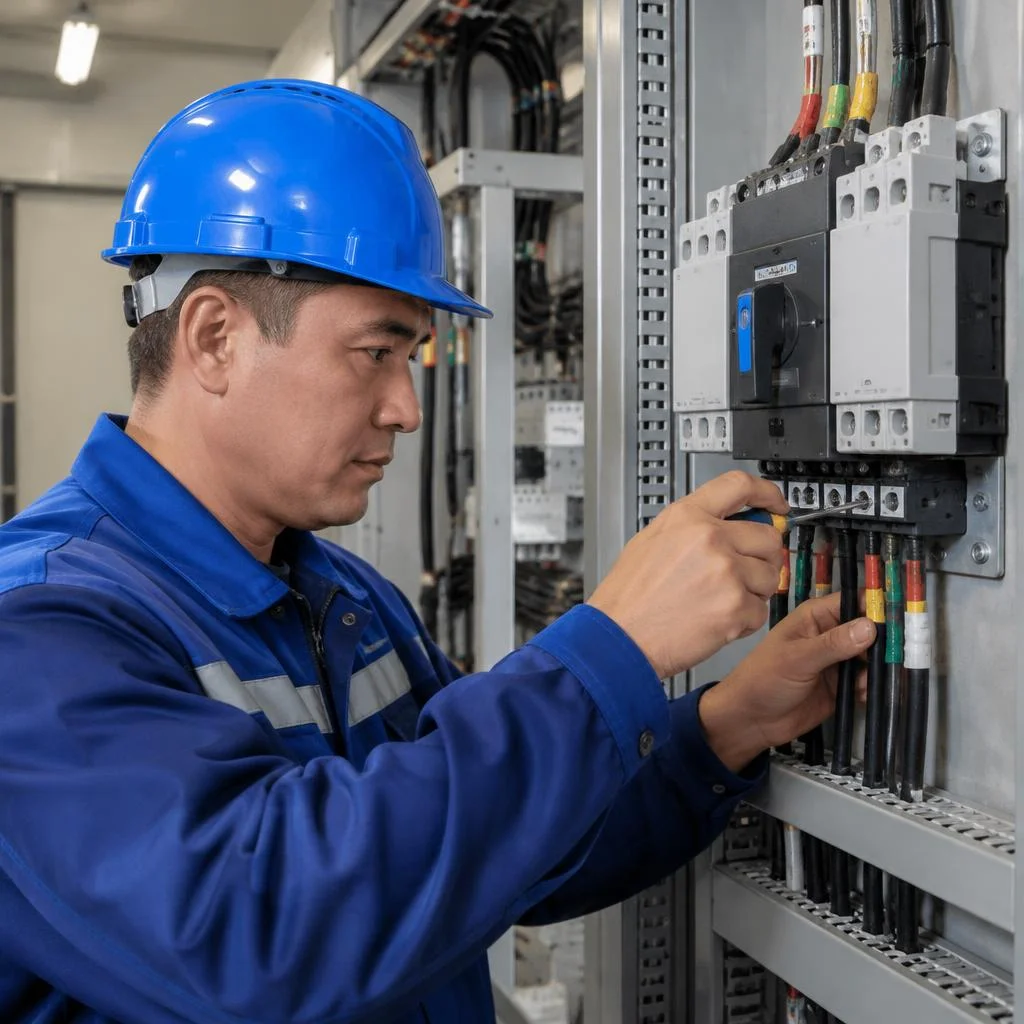
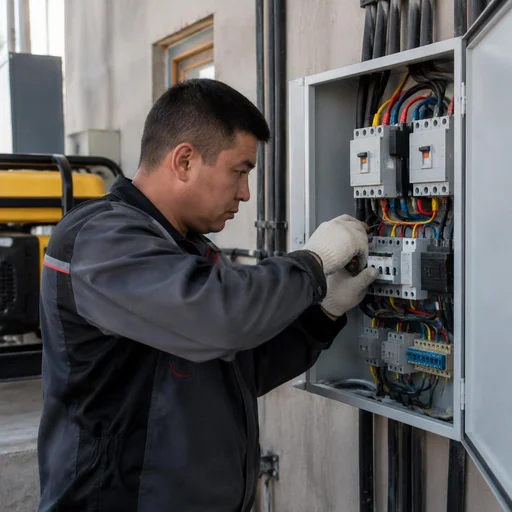
- Device installation: mounting the ATS on a DIN rail or at the input, connection of power and signal circuits.
- Threshold setting: setting the response time and switching threshold according to the site's power supply parameters.
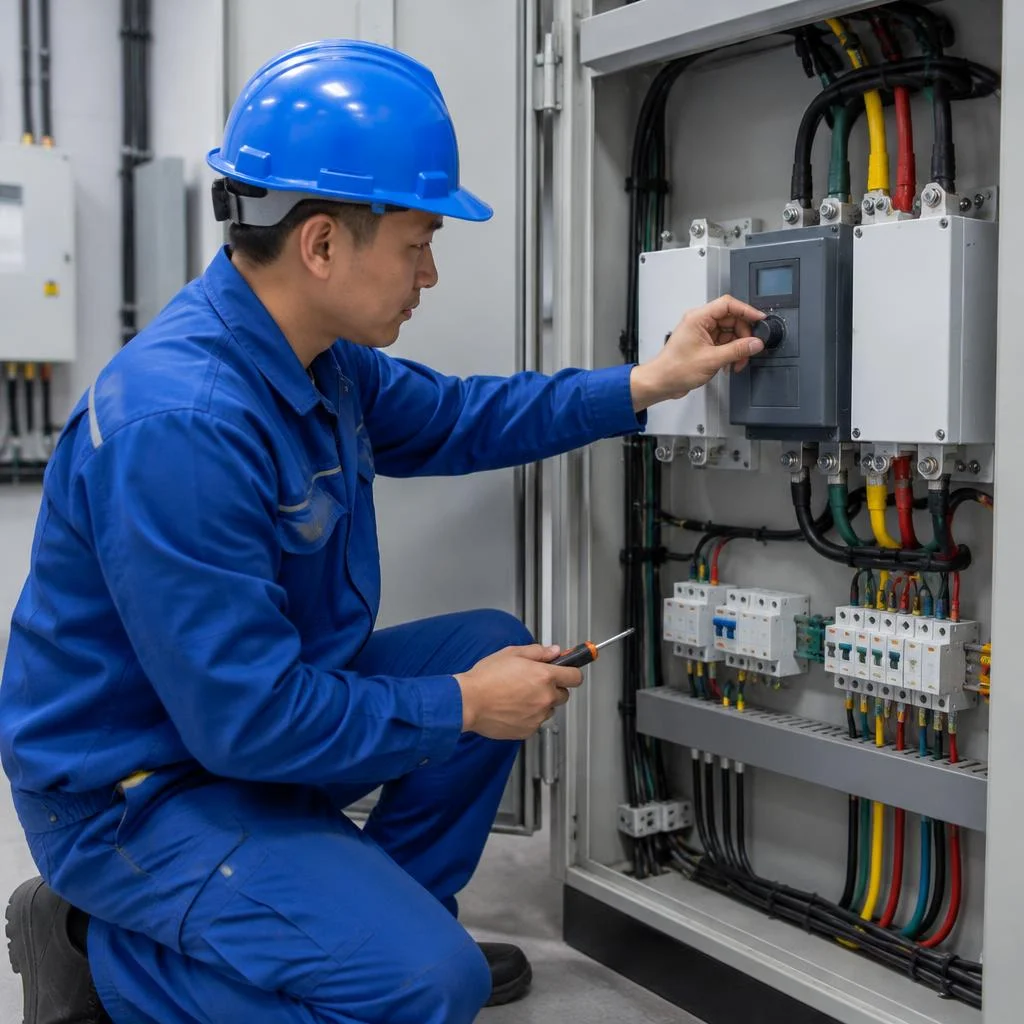
- Commissioning: testing ATS operation by simulating mains failure and restoration under load.
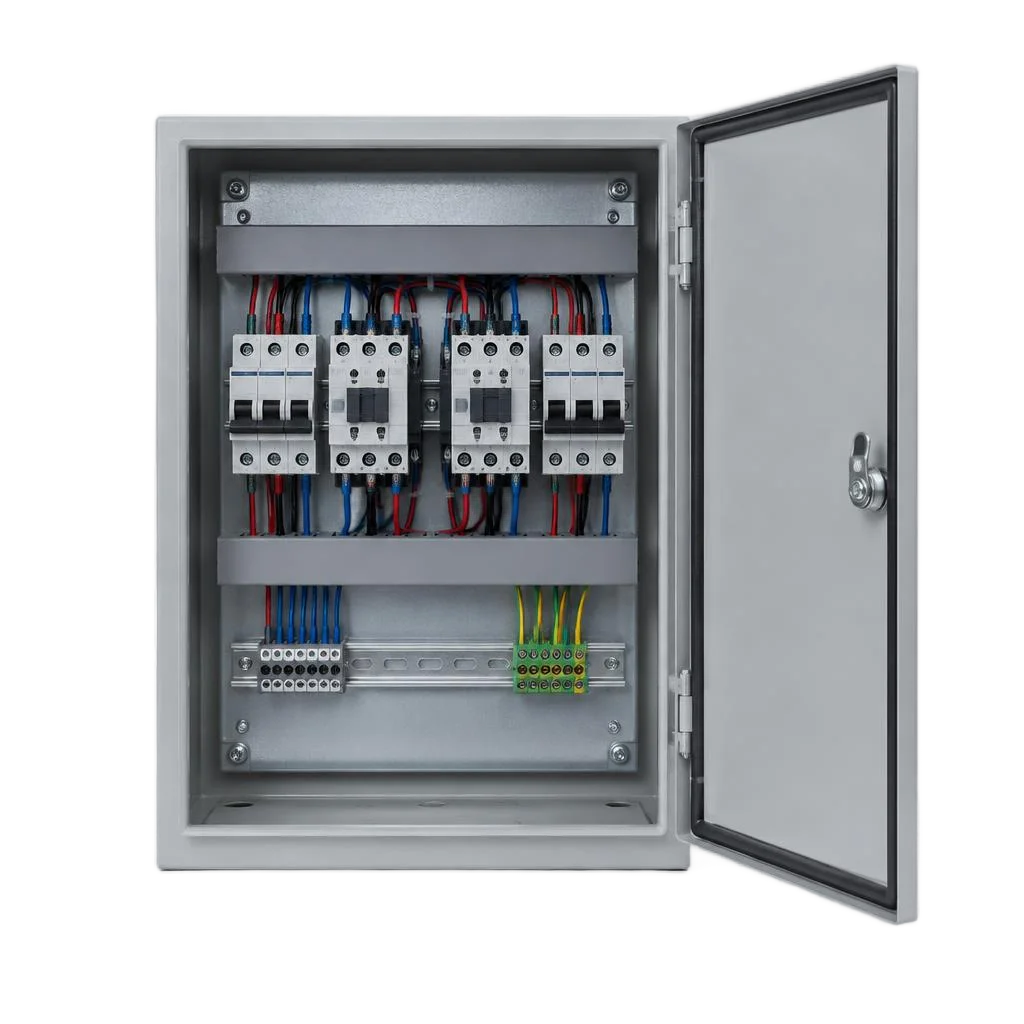
What is inside the distribution panel
- Distribution panel: enclosure with a mounting plate, DIN rails and terminal blocks for power and signal lines.
- Incoming circuit breaker: protection of the incoming line with a rating matched to the site's calculated power.
- Voltage monitoring relay: monitors voltage sag, phase imbalance and phase loss, and sends a switching command.
- Contactors: switch the main and backup inputs, preventing simultaneous connection of two sources.
- Protective circuit breakers: individual breakers for each outgoing line — lighting, sockets, boiler, pump.
- Grounding loop: rods and strip connected to the panel enclosure and the PE busbar.
ATS installation on a DIN rail and at the house input
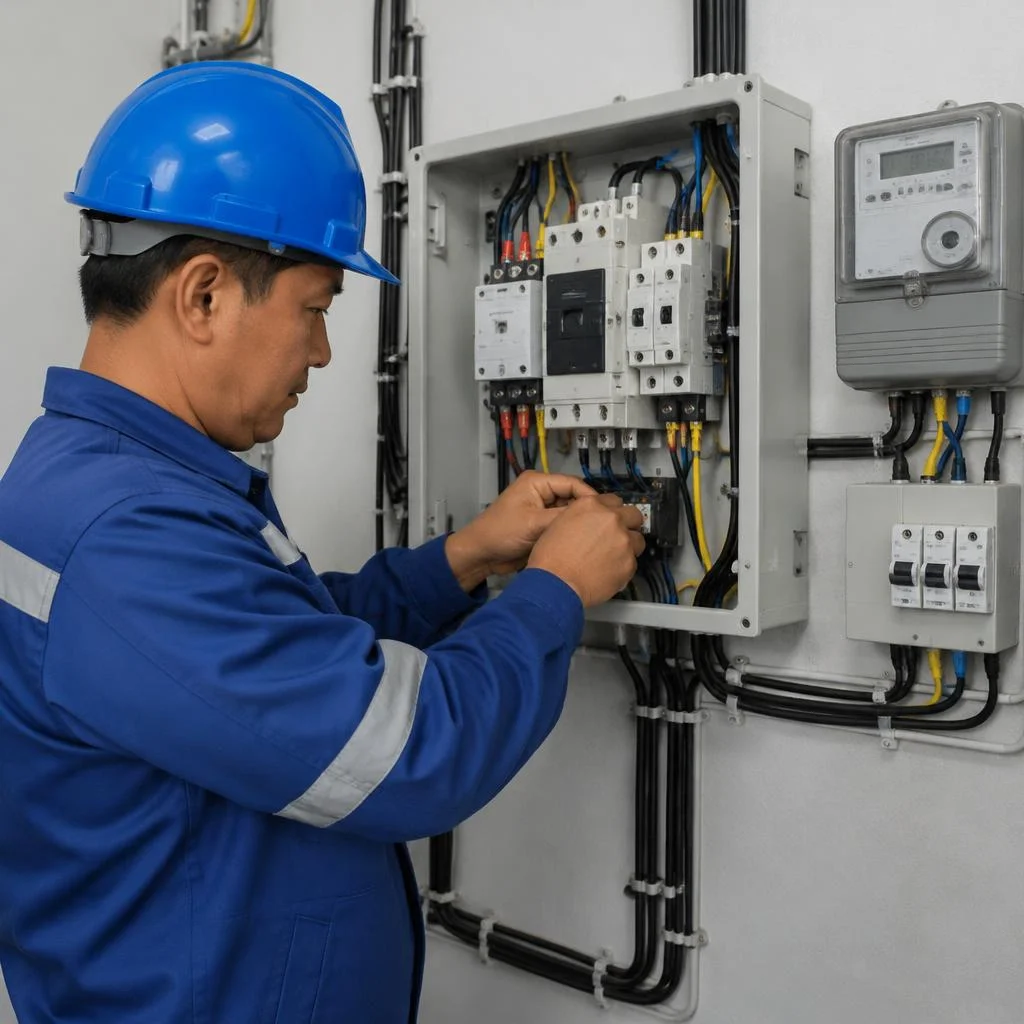
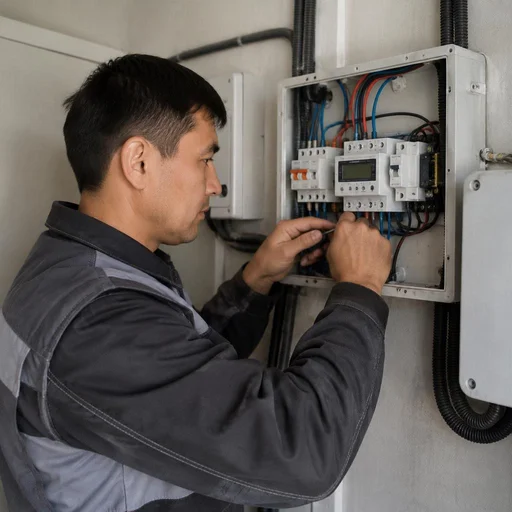
We perform basic installation on a DIN rail inside the panel, and at the house input the device is installed first after the meter, before all the wiring. On a DIN rail, the enclosure takes up from two to four modules — this is enough for single-phase models rated 40-63 A, whereas three-phase models take up more space and require a panel with extra depth. At the house input, the ATS is installed in a separate box next to the meter if the main panel does not have room for an additional row. The installation location determines selectivity: if the ATS is installed after the group circuit breakers, some lines will remain unprotected during switching — the incoming circuit breaker must be upstream in the diagram. Clients often search for ATS installation price, and this makes sense: the final estimate depends on the installation point and the number of switched lines, so it is calculated only after a site measurement.
Connecting the ATS to a single-phase and three-phase network
Connecting the ATS to a single-phase network takes less time and requires two-pole switching; to a three-phase network — four-pole switching with monitoring of each phase. In a single-phase circuit, a cable with two conductors — phase and neutral — goes to the input, and the contactor switches both conductors simultaneously so as not to break the neutral circuit during switching. In a three-phase 380 V circuit, each pole of the contactor carries its own phase, and the relay monitors imbalance and phase loss separately on each of the three lines. In a three-phase circuit, it is important to maintain the phase rotation sequence when switching back to the mains: violating it leads to reverse rotation of pump and machine motors and to an accident. Assembling the panel for a three-phase site includes marking the conductors by phase — A, B, C — and checking the phase rotation with a phase sequence indicator before applying power.
Errors in ATS Installation and How to Avoid Them
Most automation failures are related not to the device itself, but to installation and configuration errors. Let's go over the typical mistakes we see at sites in Bishkek.
Why ATS Triggers Falsely
False triggering is most often caused by an incorrectly set switching threshold and the absence of a return time delay. In our practice, panels at sites in the Asanbay and Jalal districts, after correct configuration of the switching threshold based on actual input voltage sag, stopped chattering the contactor 10-15 times per evening. On three-phase inputs, phase imbalance adds to this: if one phase sags by 15-20% while the threshold is set to the average value, the automation switches to backup while the voltage on the other two phases is still normal. The return time delay suppresses grid "chatter": without it, the ATS chatters the contactor on every brief voltage sag and quickly fails.
Mistakes That Lead to Accidents
- No interlock against back-feed voltage: without mechanical or electrical interlocking, the grid and generator can connect — a direct path to a short circuit.
- Violation of protection selectivity: if the main breaker and the generator breaker have similar ratings, both trip under overload and completely de-energize the facility.
- Operation without a grounding loop: when switching to the generator, a dangerous potential appears on the panel enclosure, posing a threat to people.
- Protection breaker rated lower than the generator: it trips before the generator reaches operating power, and the backup remains unused.
Can You Build an ATS Yourself
Building a simple relay-based ATS is technically possible, but for three-phase and hybrid schemes, DIY installation almost always ends in a redo. In Bishkek chats and on local forums, stories regularly surface where a homemade panel on a voltage monitoring relay worked for a month, and after the first thunderstorm or substation surge burned out the contactor and left the house without power for a day. The main risk of DIY assembly is not the circuit, but the selection of ratings: an error in the protection breaker doesn't show up immediately, but during the first serious overload. About 70% of requests for diagnostics of homemade panels end in a complete rebuild — it's cheaper to calculate the ratings for a specific input right away than to pay twice for installation.
Warranty, service, and why Eco-Service is trusted with ATS installation
The ATS must operate the moment the grid fails — which is why not only the quality of installation matters, but also warranty obligations, service availability, and how the technician checks the site before handover.
2-year warranty on ATS installation
We provide a 2-year warranty on ATS installation — it covers both the work and the correct configuration of the switching threshold and commissioning. During this time, the circuit undergoes dozens of real operations: in winter when grid voltage sags, in summer during substation outages, when starting a pump station or compressor. A warranty case is processed based on the work completion certificate and receipt — the technician records the condition of the panel, checks contactors, voltage monitoring relays, and terminal connections for heating. The warranty remains valid provided the panel has not been modified by third parties: any interference with the circuit removes responsibility for its behavior, because after someone else's modification it is impossible to determine which specific operation caused the failure.
Own service center in Bishkek and on-site technician visits
Eco-Service's service operates in Bishkek: device intake is in-person, and work is performed by a visiting technician directly at the site. Bench diagnostics take less time than on-site — voltage monitoring relays and contactors are easier to test under controlled load than to search for a defect in someone else's panel. The visiting team arrives with a stock of circuit breakers, terminals, and fasteners: in nine out of ten cases, the fault is resolved in a single visit, without a second trip for a part. In-person intake is also important because some failures are related to contactor mechanics — burnt power contacts are only visible upon disassembly, not from multimeter readings. If the site is far from the center, the technician coordinates the time in advance to avoid sending equipment twice.
What we check before handing over the site
- Switching time: we measure the interval between the loss of the main grid and the supply of backup power, and compare it with the design value.
- Operation under load: we connect a real load — a pump, boiler, machine tool — not just a light bulb, to see how the circuit behaves at current close to nominal.
- Protection selectivity: we check that in the event of a short circuit, the correct breaker trips, not the main one, otherwise the site will be left entirely without power.
- Return to the main grid: we verify that the circuit switches back with a delay, rather than "chattering" under unstable voltage.
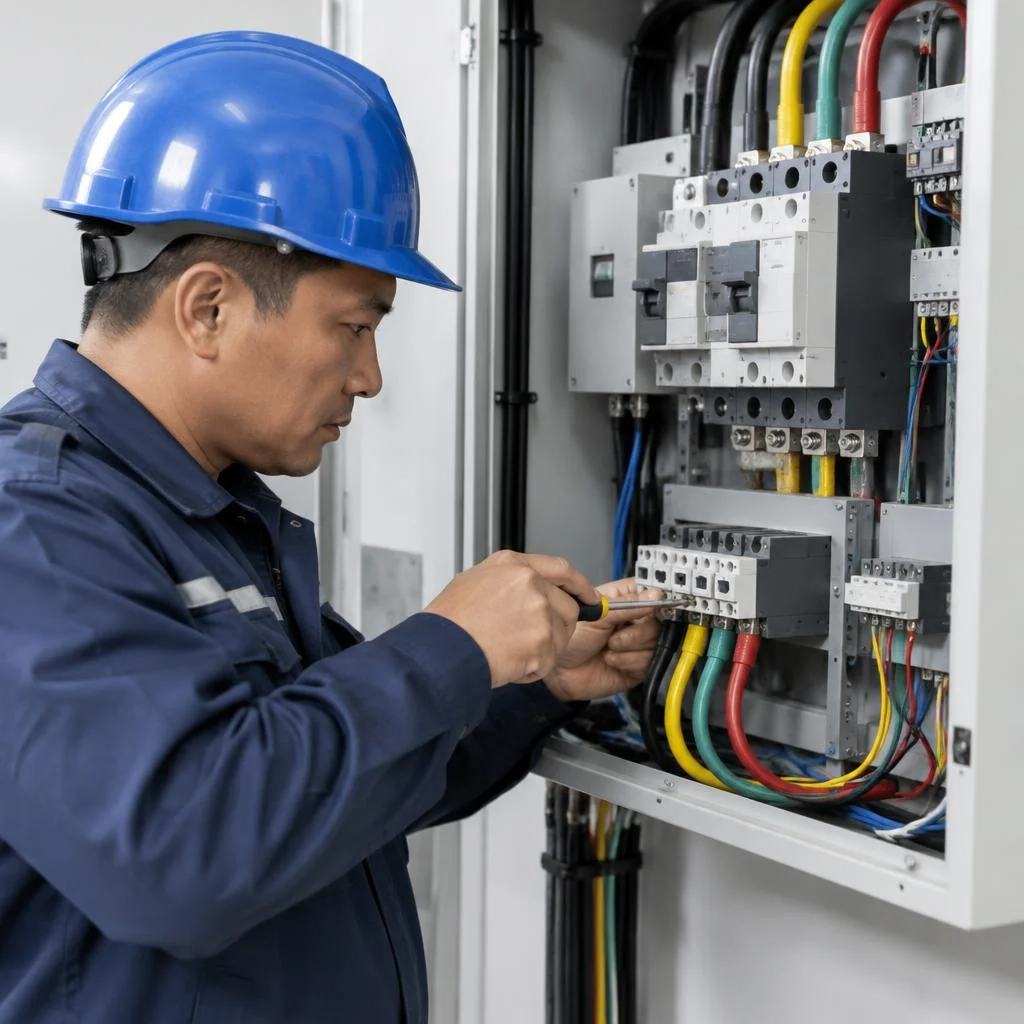
- Terminal tightening torque: we tighten power connections with a torque wrench — a loose contact heats up and burns out within a season.
Conclusion
We summarize the key takeaways: from selecting a circuit for a specific site to final commissioning under load. Below is what you should keep in mind before ordering work.
Main takeaways
- Circuit for the site: the ATS is selected based on the number of phases, load power, and type of backup source — there is no universal circuit.
- Source compatibility: for a generator and solar panels, back-feed voltage blocking and coordination of source priorities are critical.
- Grid-specific configuration: the switching threshold and time delay are configured for the specific grid, not according to the device datasheet.
- Full installation cycle: the work includes panel assembly, cable routing, grounding, and commissioning under load.
- Maintenance: a 2-year warranty and an in-person service center in Bishkek simplify maintenance and diagnostics.
- Weak grids: in areas with voltage sags, an ATS pays for itself after just two or three outages, protecting equipment from surges.