









What installation and replacement work on meters does Eco-Service perform
From installing a single-phase device in an apartment to assembling a turnkey metering panel in the private sector — the full range of electricity metering work is performed by our in-house crew. Below is what each area includes and which technical details matter before work begins.
Installation of a single-phase and three-phase electricity meter
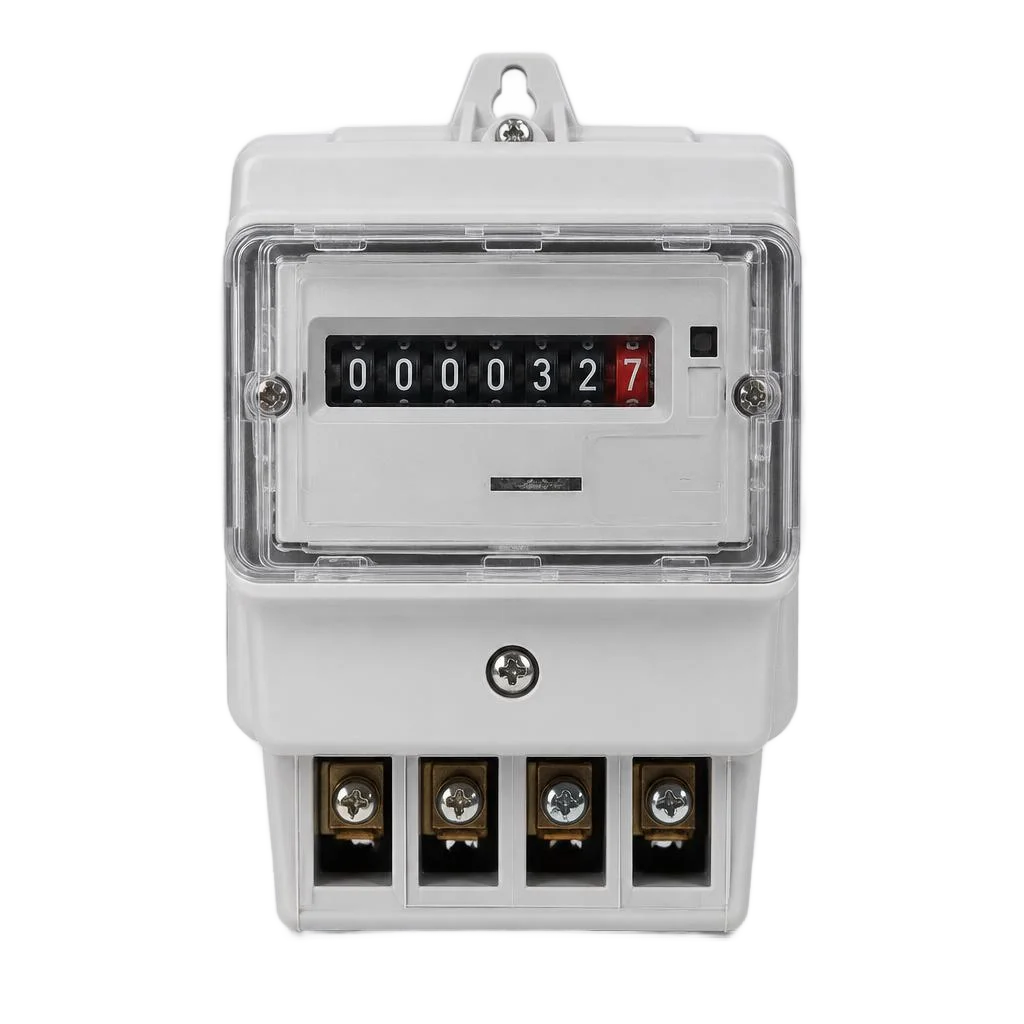
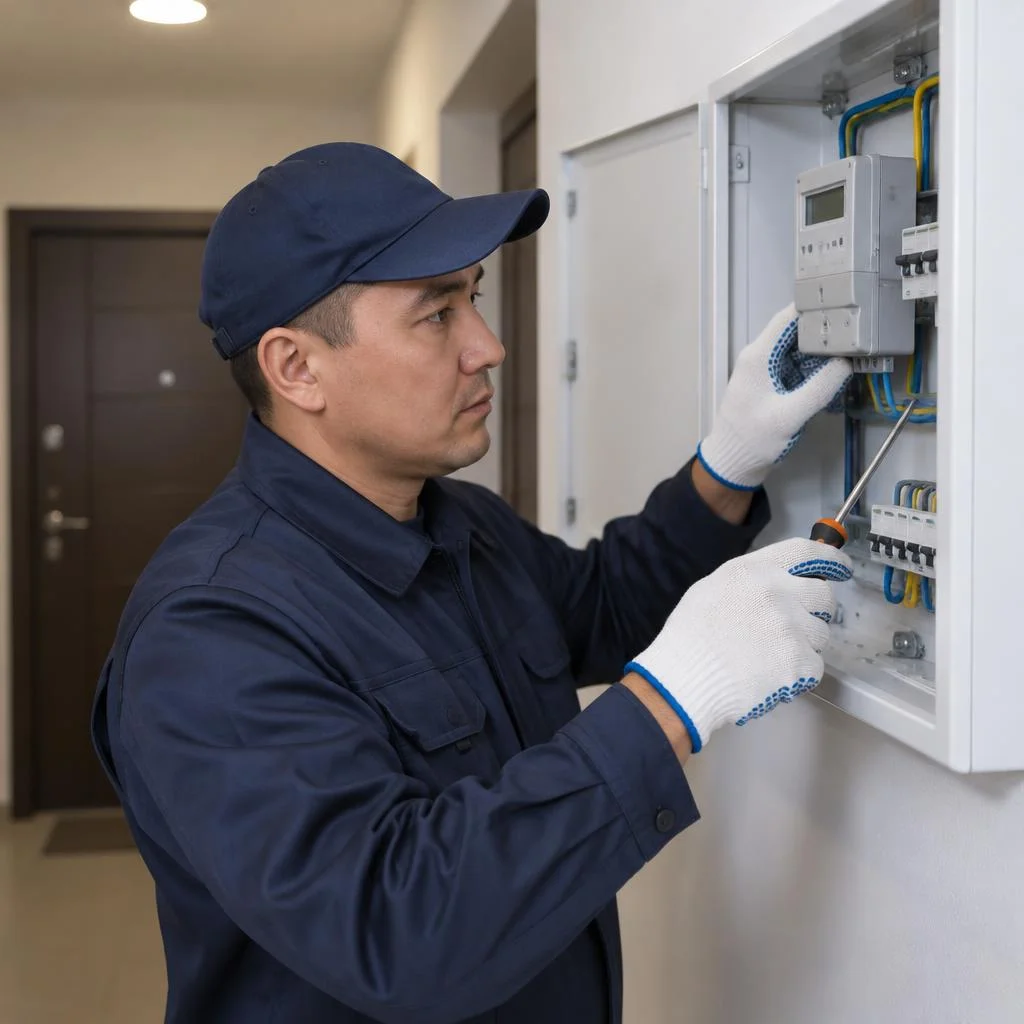
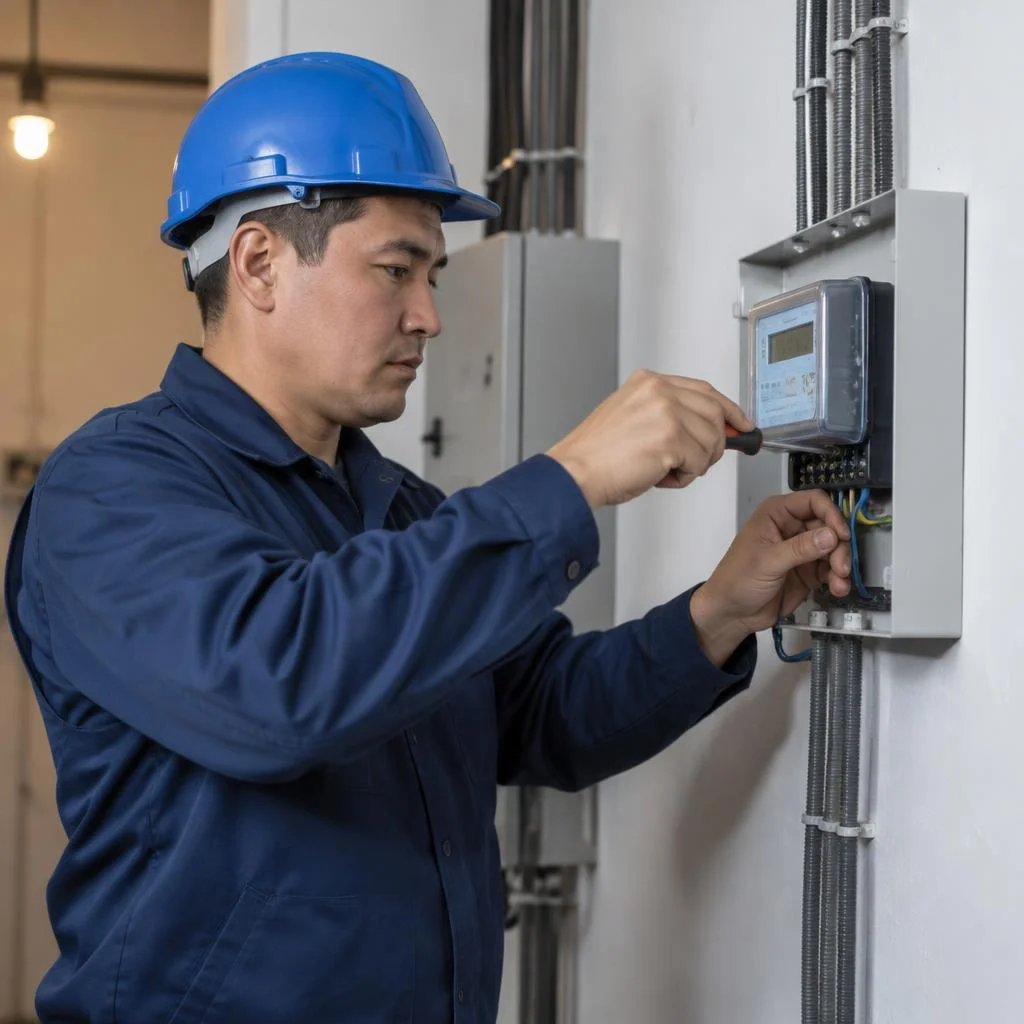
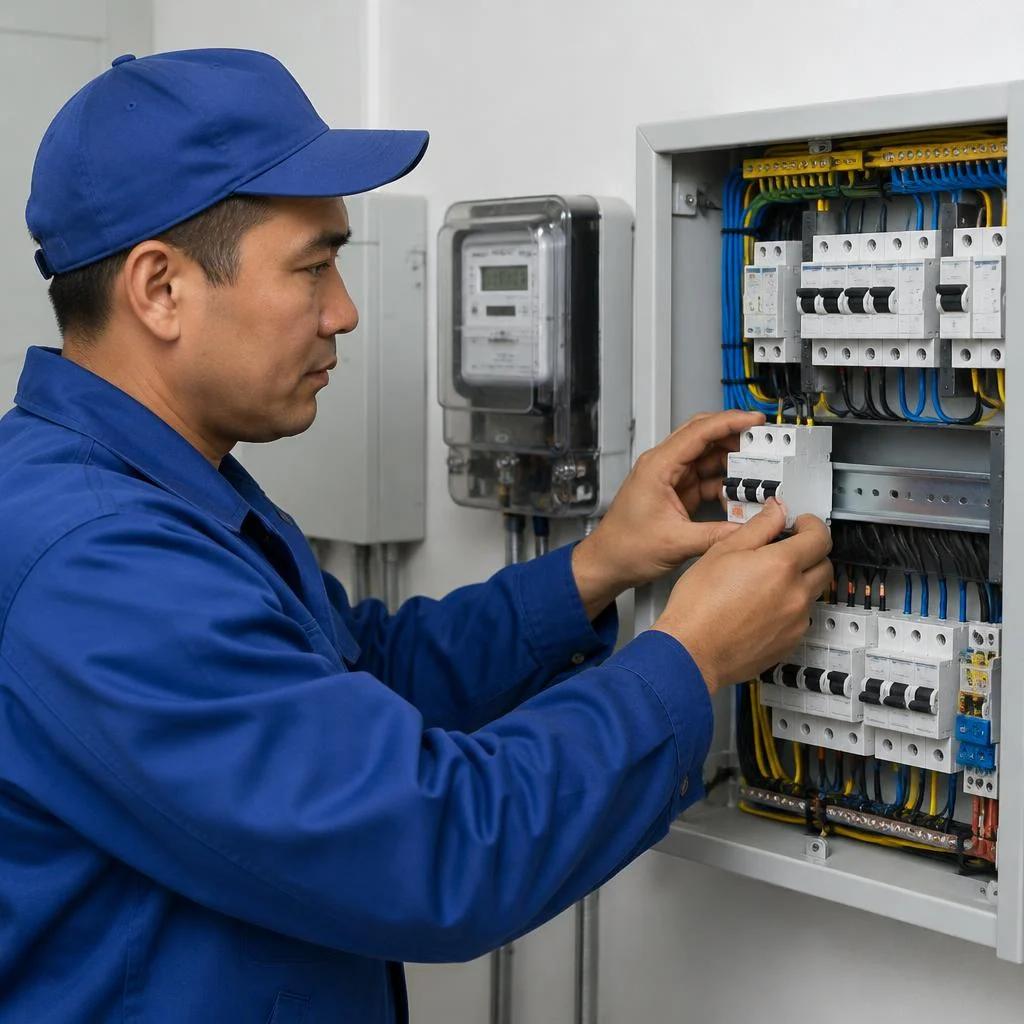
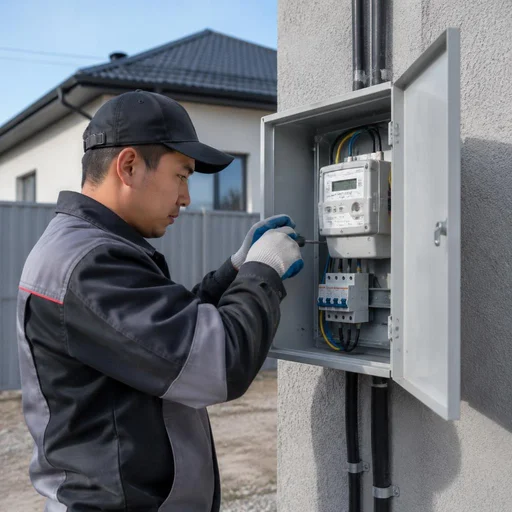
We install single-phase devices for apartments and standard houses, and three-phase ones for facilities with electric stoves, boilers and machine tools. Work on 220 V takes the crew 1-2 hours: mounting on a DIN rail in a box, connecting the incoming cable, checking the circuit under load. For a three-phase 380 V supply the work takes longer — the technician balances the phases, checks the phase sequence and connects the neutral with grounding to separate terminals. Three-phase models are installed in houses with electric boilers from 6 kW and in workshops with motors. Before installation, the technician checks the actual load and the number of phases at the supply — if a three-phase device is specified but the supply is single-phase, changing the circuit will require separate approval from the power supply organization.
Replacement of a single-phase and three-phase meter
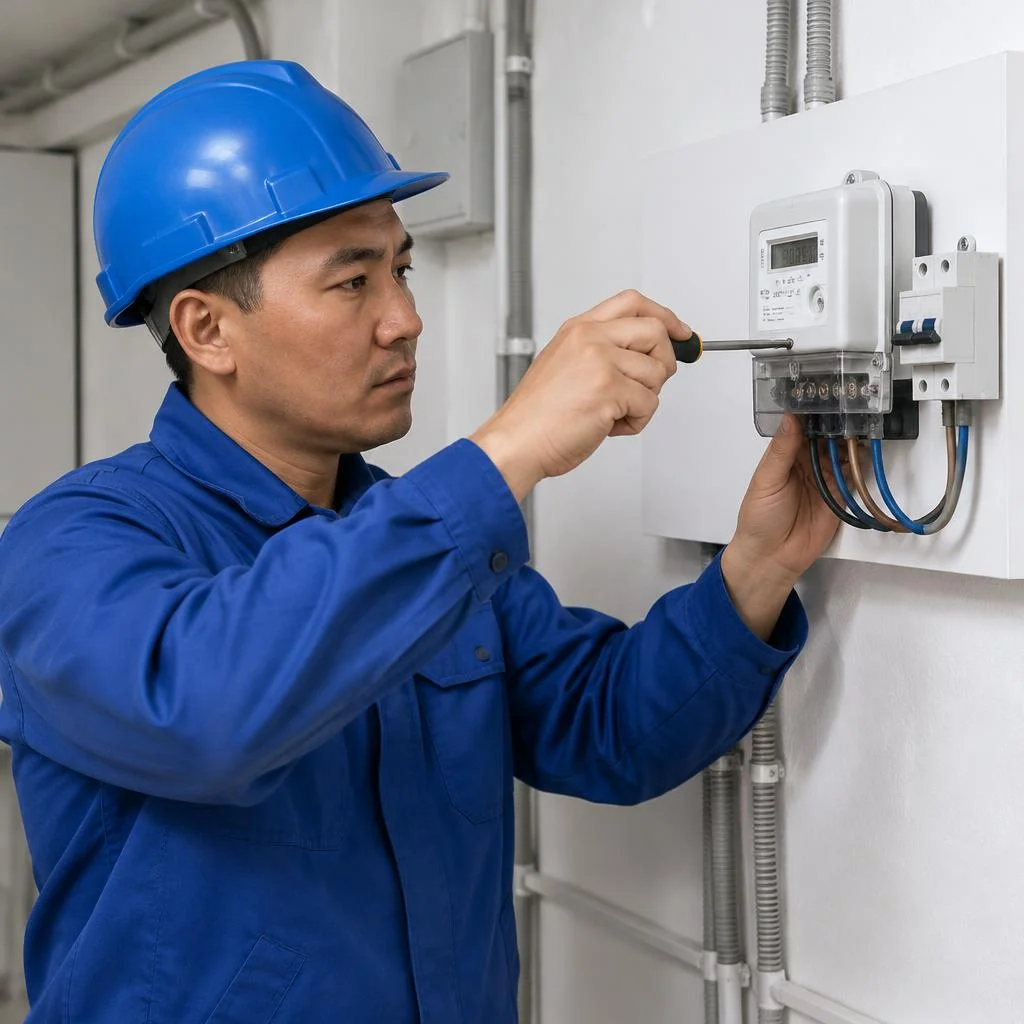
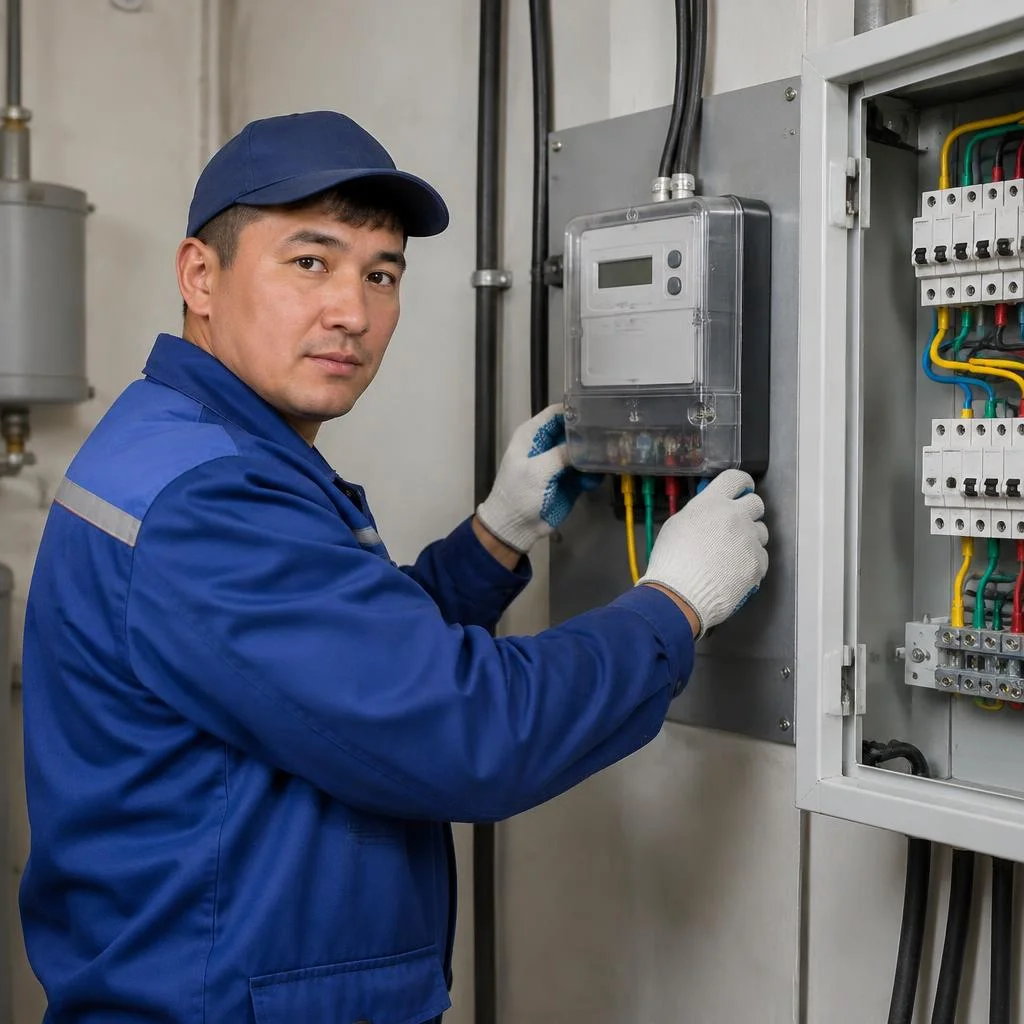
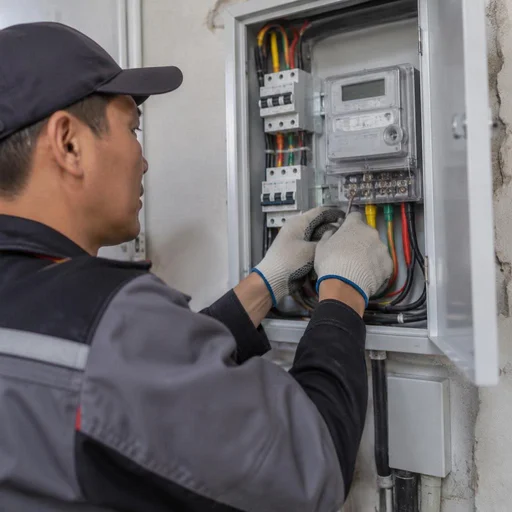
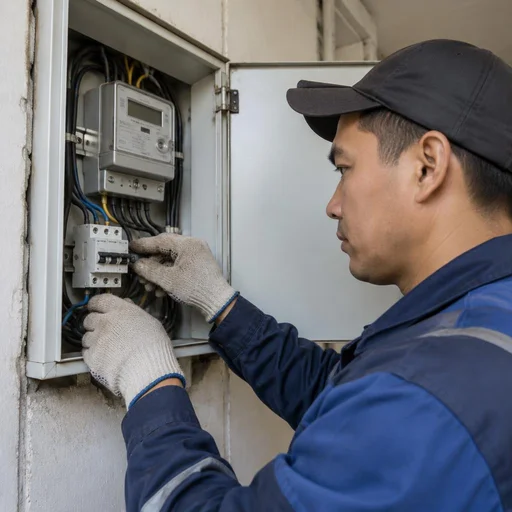
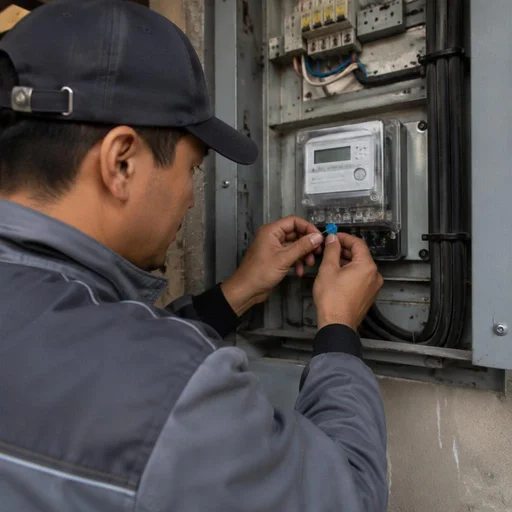
We perform replacement of a single-phase and three-phase meter with dismantling of the old device, installation of a new one and preparation for sealing. The reasons for replacement are usually an expired verification interval, mechanical damage to the housing or a switch to multi-tariff metering — in each case the technician checks the old device's readings against the report and records them before removal. The terminal block of the new meter is tightened with a torque screwdriver: a loose contact at the supply heats up and melts the box housing within a month. The old device is dismantled only after switching off the incoming circuit breaker and verifying the absence of voltage with a tester. Changing the meter "head-on" without removing the load is not allowed — the technician first de-energizes the supply, then dismantles the device, otherwise there is a risk of damaging the terminals and leaving the facility without metering during the paperwork.
Meter relocation and installation on a pole
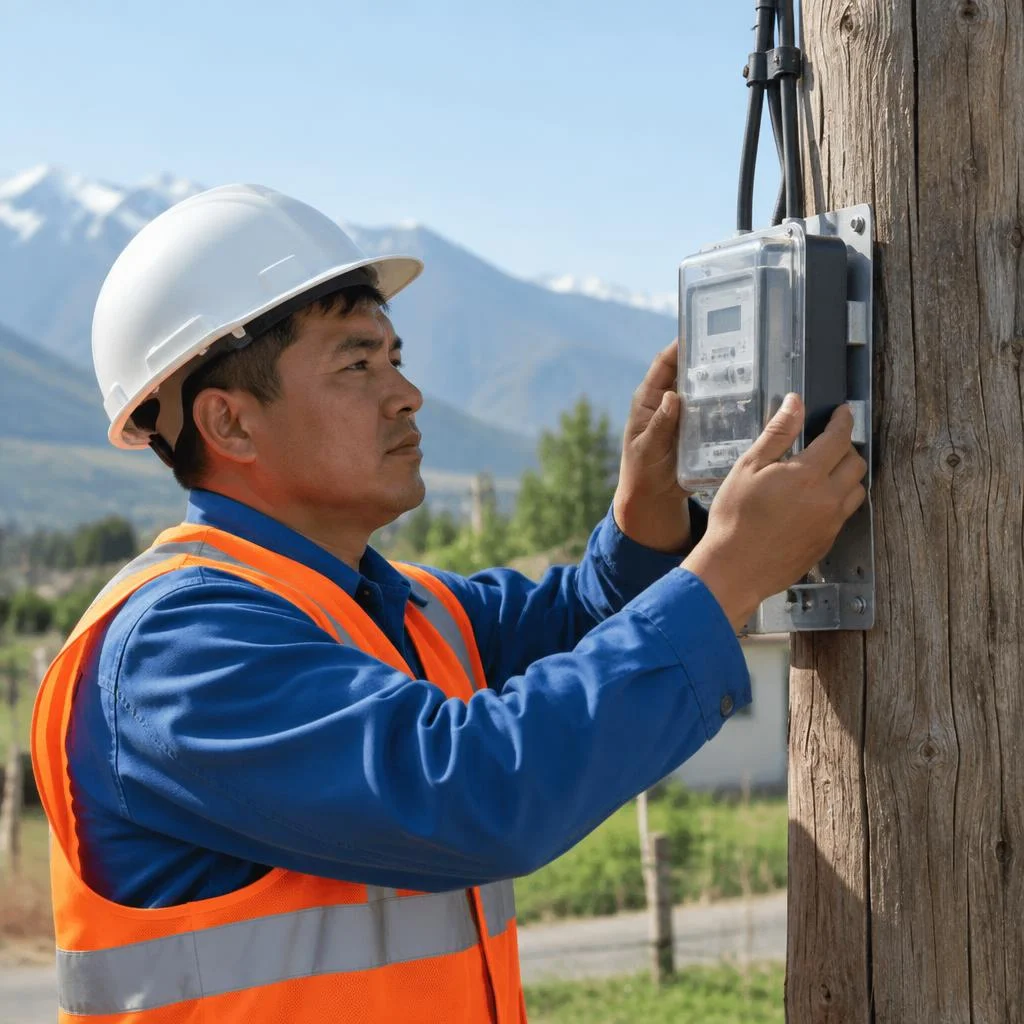
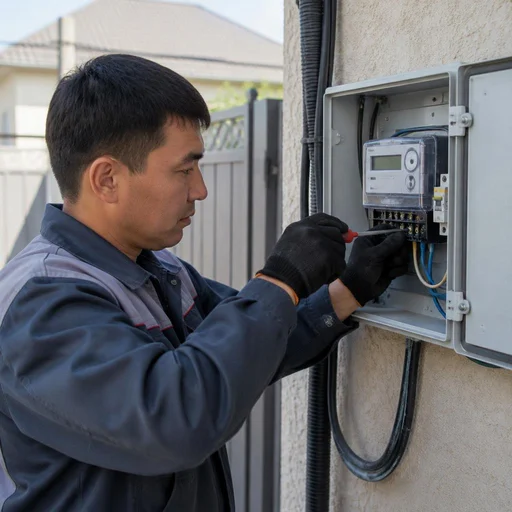
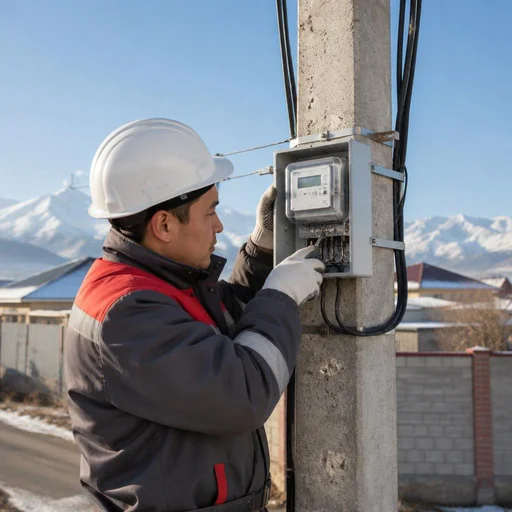
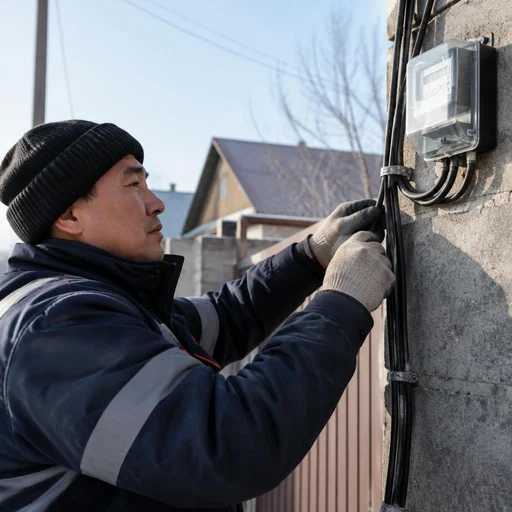
We relocate the electricity meter within the plot and mount the device on a pole — a standard solution for the private sector of Bishkek and the suburbs. When relocating inside the house, the technician extends the incoming cable and moves the box to a new point, preserving the connection route to the load. Pole mounting is done at a height of 1.6-1.8 m from the ground: the device is placed in a sealed box with IP54 protection rating so that moisture and dust do not reach the terminals. Laying the cable to the meter through the air is done with self-supporting SIP cable with a cross-section of 16 mm² — it withstands wind load and requires no additional insulation. When moving the meter to a pole, it is important to determine in advance the entry point into the house and the cable length — this determines whether a separate cable run to the meter is needed or the existing route will suffice.
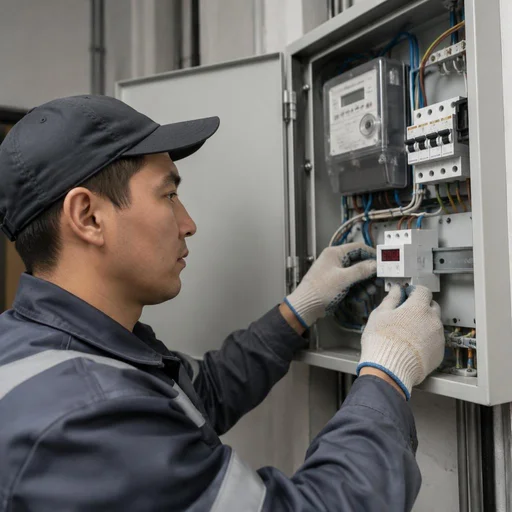
Turnkey assembly of a metering panel
- Housing: a metal or plastic box with a DIN rail, the protection rating is selected for the installation location — IP41 for an apartment, IP54 for outdoors.
- Metering device: a single-phase or three-phase meter fixed on the rail with access to the terminal block for sealing.
- Protection: an incoming circuit breaker rated for the load, a 30 mA RCD and a voltage relay that cuts power during surges above 265 V.
- Wiring: copper jumpers between the circuit breakers, tightening of contacts and marking of groups — according to the diagram agreed with the owner.
- Electricity meter installation: connection to the load, checking the circuit under current and preparing the panel for the inspector's visit.
How electricity meter installation works: stages of the job
Electricity meter installation follows a sequence: request, technician visit, cable routing, connection to the load, circuit check, terminal tightening, and preparation for sealing. Each stage is recorded in a report, so the owner has a record of all the work.
Routing and connecting the cable to the meter
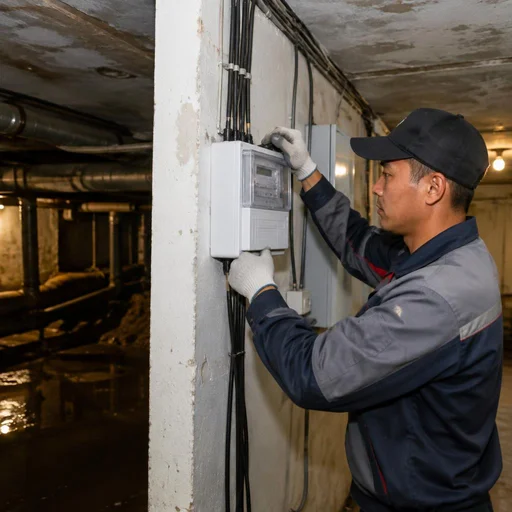
We route the cable to the device and connect it to the terminals — the cross-section is selected for the actual load and the type of service entrance. For a single-phase line of 5-7 kW, 6 mm² copper is sufficient; for a three-phase 15 kW service entrance, 10 mm² or more is needed; and for an outdoor service entrance, a cable with double insulation and a UV-resistant sheath is used. The run is laid along the wall or in corrugated conduit, entering the panel through a gland so the sheath is not rubbed through on a sharp edge. If the cable is already installed, the technician checks its condition and, if necessary, replaces the service-entrance cable — old outdoor insulation often does not survive reconnection.
Connecting the meter to the load and checking the circuit
We connect the device to the load and check the connection circuit — we verify the phase sequence, the metering direction, and operation under load. The technician runs the phase and neutral conductors through the terminals according to the manufacturer's diagram, separately checks the neutral terminal and the grounding loop, then applies a load from household appliances and watches whether the disc spins or the indicator blinks in the right direction. In search, clients often type electricity meter installation Bishkek — and land on this page, which describes the entire procedure. Checking the circuit is mandatory before sealing: if a connection error is discovered after sealing, the device will have to be opened through the energy supply organization.
Tightening terminals and preparing for sealing
We tighten the meter terminals after installation and prepare the device for sealing — tightening the terminals under load prevents heating and burning. A torque wrench provides the required force on the terminal block screws, and the breakers and busbars in the panel are tightened before the cover is installed, so the seal does not have to be removed later. On a three-phase device, the terminal block is wider and the screws seat unevenly: the technician tightens them in a cross pattern in two passes, monitoring the torque separately on each pair. Tightening should be repeated after several months of operation — under load the terminals settle, and a loose connection becomes a cause of false breaker tripping.
Timelines and procedure
- Request: the technician clarifies the address, type of service entrance, number of phases, and whether a cable run is ready — this determines the set of tools for the visit.
- Visit: the specialist arrives with the device, cable, breakers, and fasteners so as not to return for parts twice.
- Installation: electricity meter installation in Bishkek with a prepared panel takes one visit, while assembling a metering panel from scratch takes a working day.
- Documents: after the work, the technician draws up a work completion report and submits the data for sealing to the energy supply organization.
Single-phase or three-phase, standard or multi-tariff: which meter to choose
The choice of metering device depends on the number of phases at the input, the nature of the load, and the willingness to save by tariff zones. We break down how these parameters determine the model and what actually affects the final bill.
How single-phase and three-phase devices differ
| Parameter | Single-phase | Three-phase |
|---|---|---|
| Number of wires | One phase, one neutral | Three phase, one neutral |
| Typical load | Lighting, sockets, household appliances | Electric stove, boiler, machine tool, pump |
| Facility power | Up to 10 kW | From 10 kW and above |
| Application | Apartments, small houses | Houses, workshops, facilities with 380 V |
The type of device is determined by the actual input to the facility, not by the owner's wish: installing a three-phase meter on a single-phase line is technically pointless — it will not measure on the two missing phases. Installation of a single-phase electricity meter is suitable for an apartment with a gas stove, a three-phase one — for a house with an electric boiler or welding machine. Before purchasing, verify the input type according to the project or the act of the energy supply organization.
Accuracy class and multi-tariff models
For household metering, a device with an accuracy class corresponding to the requirements of the energy supply organization is suitable, and a multi-tariff model allows you to pay by time-of-day zones. The accuracy class denotes the permissible measurement error: for household devices this is usually 1.0 or 2.0, for modern electronic ones — 0.5S. A multi-tariff meter keeps separate records by zones — night, semi-peak and peak — while a smart meter additionally transmits readings via GSM or PLC without a controller's visit. Savings from a multi-tariff device appear only when the main load is shifted to night hours: if the washing machine, boiler and car charging operate during the day, the overpayment for such a meter does not pay off. In our practice, payback comes from shifting at least the boiler and laundry to the night.
What is included in the installation kit
- Meter box: protects the device from moisture, dust and mechanical damage, selected according to the model's dimensions and the installation method — on a wall or on a support.
- Input circuit breaker: disconnects the line entirely in case of overload or short circuit, the rating is calculated based on the total power of the facility.
- RCD: trips on current leakage and protects a person from electric shock when insulation breaks down to the device's casing.
- Voltage relay: cuts off power when network parameters go beyond permissible limits, and after stabilization returns it automatically.
- Cable: the cross-section is selected for the current load and the length of the route from the input to the metering panel; installation of electricity meters in Bishkek includes its laying and connection.
Eco-Service equips the installation with a box, input circuit breaker, RCD and voltage relay — the composition is selected for the facility and agreed upon before the visit. The voltage relay is especially relevant for the private sector: surges in the network damage both the metering device and household appliances, and protection costs less than replacing equipment.
Legalization: documents, approval and sealing after installation
Installing the device is only half the job: the meter must be legally brought into account through the power supply organization. We break down who is authorized to install the device, which documents are drawn up, and how sealing is carried out.
Who has the right to install and replace the meter
Installation and replacement of the device is performed by an organization with the appropriate permit, and Eco-Service operates as a direct provider of the service — the work is carried out by its own crew with the paperwork handled. Metering in Bishkek is managed by OJSC "Severelectro": the organization issues technical specifications, accepts the installed device and places it on the subscriber's balance sheet, and without an approval certificate from it the meter legally does not exist — readings are not accepted, and charges are calculated according to the norm. The technical specifications fix the device type, accuracy class, installation location and connection diagram; deviation from them is a frequent reason for rejection during acceptance. Self-installation without a permit creates a problem not at the stage of work, but at sealing: the power supply organization has the right not to accept a device installed without compliance with the requirements. Before calling the crew, request the current technical specifications for your address from "Severelectro" — they determine which model and diagram will be approved on the first try, and plan the installation of the electricity meter, the price of which depends on the scope of work, around the acceptance date.
Which documents are drawn up after installation
- Device passport: factory documentation with the serial number, year of manufacture and accuracy class — it is used to verify the model during acceptance.
- Work documents: the work completion certificate and warranty card confirm who installed the device and when.
- Technical specifications: the document issued by "Severelectro" with the agreed connection parameters and installation location.
- Approval certificate: the document signed by a representative of the power supply organization on putting the device into operation.
Sealing the meter after installation
We prepare the meter for sealing after installation, while the seal itself is applied by a representative of the power supply organization — until then the device is considered not brought into account. Preparation includes tightening the terminals with a torque wrench, checking the circuit under load and closing the terminal cover: a weak contact causes heating and distortion of readings, which is why the inspector returns the device for rework. A "Severelectro" specialist verifies the serial number against the passport, checks the integrity of the housing and factory stickers, after which they apply the seal and draw up the certificate. Before sealing, the integrity of the terminal cover must not be violated and factory stickers must not be removed — this is grounds for rejection of the device during acceptance. Installation of electricity meters with preparation for the inspector's visit is planned in advance: a repeat call due to an unprepared panel delays bringing the meter into account by two weeks or more.
Protection and automation: circuit breaker, RCD, voltage relay
The meter records consumption, but does not protect the network from accidents. Next to the device in the meter panel, an incoming circuit breaker, an RCD and a voltage relay are installed — they cut off the power in case of overload, leakage and surges.
Incoming circuit breaker and automatic switch
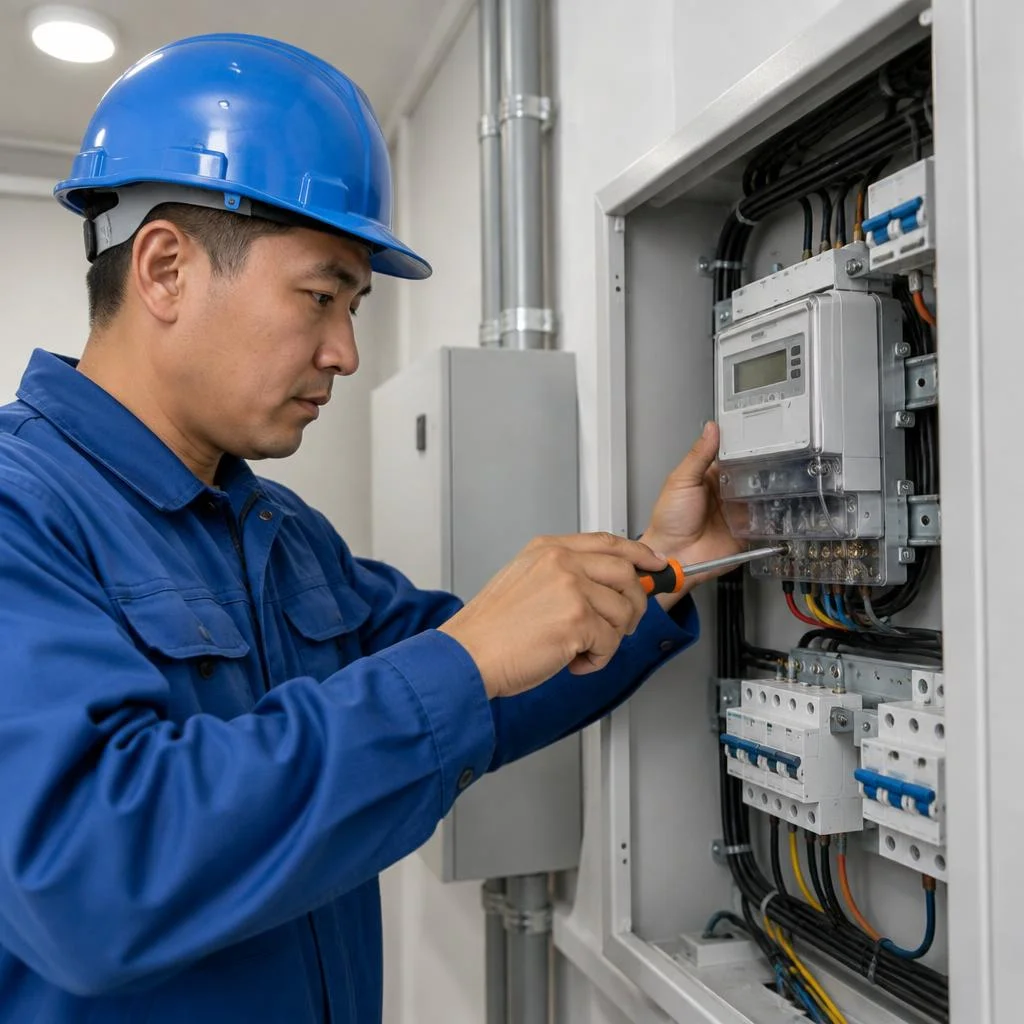
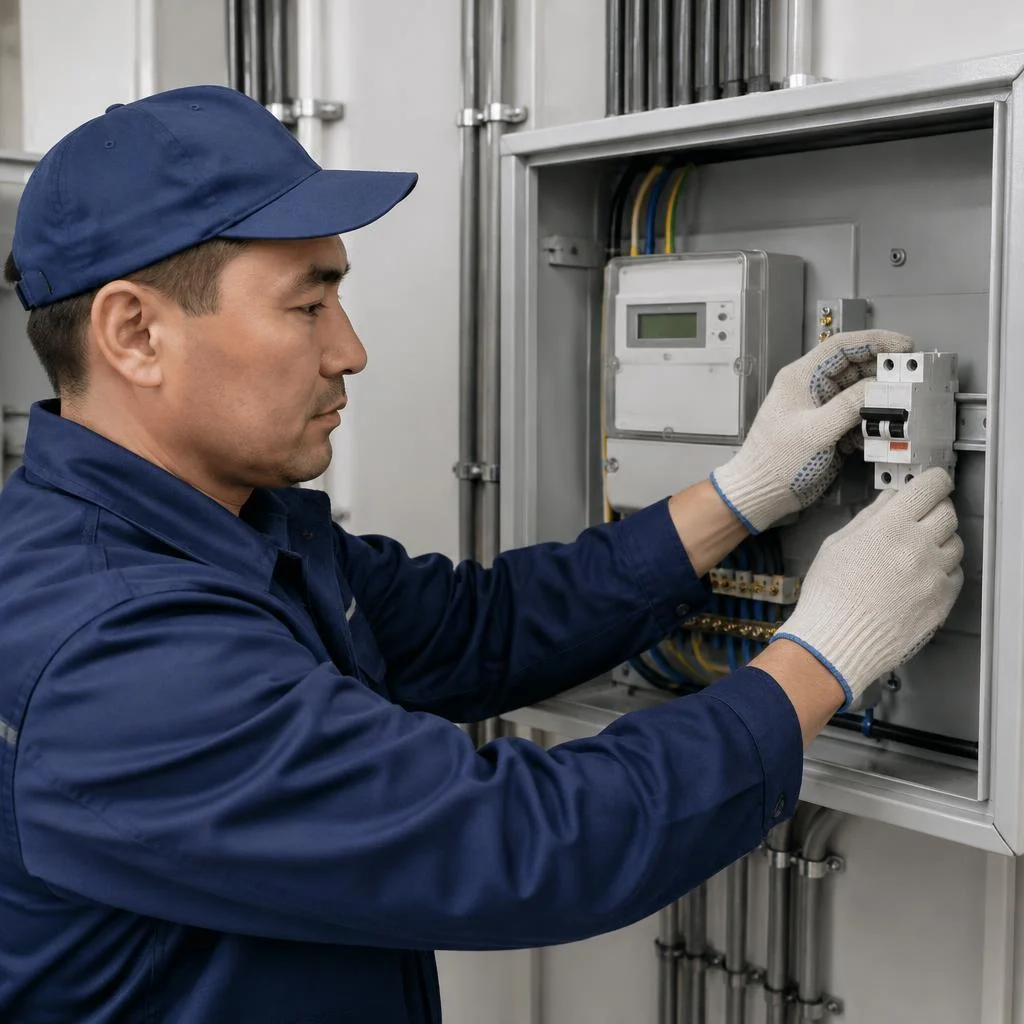
We install an incoming circuit breaker at the input and automatic switches on the outgoing lines — they disconnect the section in case of overload and short circuit. The incoming device is installed after the meter and before the distribution lines, while group modules protect individual branches: lighting, sockets, boiler, kitchen line. When installing the electricity meter in the panel, it is immediately marked which module is responsible for which load, so that when it trips it is clear where to look for the cause. The rating of the incoming circuit breaker is selected according to the cross-section of the incoming cable, and not "by eye": an overrated rating will not protect the wire, an underrated one will cut off the power under normal load.
RCD and voltage relay
We install an RCD for protection against current leakage and a voltage relay for disconnection during surges — both devices are placed in the meter panel. The RCD trips at a leakage of 10 to 30 mA and protects a person when touching a bare wire or when insulation breaks down to the body of the appliance. The voltage relay monitors the level in the network and breaks the circuit when the phase value goes beyond the operating range — this saves the refrigerator, boiler and household appliances from burning out during a neutral break. The voltage relay is configured to the trip threshold taking into account the real state of the network in the area — in the private sector of Bishkek and the suburbs, surges occur more often than in new buildings.
Replacing the incoming cable and connecting to the load
We replace the incoming cable when the insulation is worn and connect the meter to the load — from the input to the distribution panel of the facility. Connection to the load is performed after tightening the contacts and checking the circuit: the cable is stripped, the conductors are crimped with ferrules, tightened into the meter terminals with a specified torque. If the input is aluminum and more than two decades old, the insulation crumbles, and the twists heat up under load — such a section is replaced entirely, and not patched meter by meter. An old aluminum input eventually loses contact at the twists — when replacing the meter, it is reasonable to switch to copper cable right away, so as not to return to this in a year.
Why customers order light meter installation from Eco-Service
A direct provider of metering installation services: our own service center, an in-house team of electrical installers, a warranty on the work, and preparation of documents for the energy supply organization. Below is how the service model is structured and what it gives the customer.
Our own service center in Bishkek
Eco-Service operates through its own service center — requests are accepted in person, and a technician travels to the site within the city and nearby suburbs. The in-house team covers the full cycle: light meter installation, panel assembly, tightening contacts, and preparation for sealing. In-person intake is convenient when non-standard work needs to be agreed upon — for example, moving the device onto a pole or assembling a panel for a specific load. During intake, the technician checks the type of input, the number of phases, and the condition of the existing wiring so that the site visit goes without additional ordering of components. For Bishkek addresses and nearby suburbs, the team travels out on the day of request if there is an opening in the schedule.
2-year warranty on installation
A 2-year warranty on installation work — if contact is broken, there is an error in the circuit, or the installed equipment fails, the technician travels out again. The warranty period covers tightening terminals, checking the connection diagram, and the correct operation of the automation in the panel. The warranty applies to the work, not to the device purchased separately — so it is better to agree on the components before installation so that responsibility lies with one party. This simplifies the resolution of disputed situations: there is no need to prove that the cause of the failure is in the installation rather than in the device or components. For multi-tariff models, the correct connection of phase and neutral circuits is recorded separately — an error here distorts the readings.
Payment and contact methods
- Phone: requests are accepted at the service center number; the technician clarifies the address, type of input, and a convenient time for the visit.
- Telegram: in the messenger it is convenient to send a photo of the panel and the input cable — these are used to preliminarily estimate the scope of work.
- Service center in Bishkek: in-person intake for agreeing on non-standard installation, moving the device onto a pole, and panel assembly.
- Payment: Eco-Service accepts via MBANK, O!Деньги, and Optima Bank — in cash or by transfer after acceptance of the work.
Conclusion
Installing metering devices is a procedure with legal and technical details: from choosing the device to sealing. We have gathered the key takeaways that will help you go through the process without rework and fines.
Main takeaways
- Device type for the load: a single-phase meter is installed for a standard load, a three-phase one for electric stoves, boilers, and machine tools; an error in selection leads to redoing the panel.
- Accuracy class not lower than 1.0: for settlements with households, class 1.0 and higher is suitable; multi-tariff models pay for themselves with night consumption of 30% or more of the daily volume.
- Approval and sealing are mandatory: without the seal of the energy supply organization, readings are not accepted for calculation, and unauthorized connection risks recalculation according to the norm.
- Automation protects the device: an input circuit breaker, RCD, and voltage relay extend the service life of the meter during grid surges, which are frequent in Bishkek high-rise buildings.
- Documents are prepared before voltage is supplied: the approval certificate, the device passport, and the connection diagram — without them, sealing is delayed for weeks.