








When heating system flushing is really needed: signs of clogging and diagnostics
Bishkek water from the city water supply is characterized by increased hardness, so scale and sludge settle in the circuits faster than in regions with soft water intake. Early diagnostics catch clogging before it reduces heat output and leads to an emergency shutdown.
Signs of clogging: cold radiators, noise and uneven heating
- Cold bottom with a hot top: the lower part of the radiator stays cool while the upper part heats up — settled sludge blocks the flow through the sections.
- Noise and humming in the riser: air pockets and a narrowed passage force the coolant to move with acceleration, hence the whistling and clicking in the pipes.
- Uneven heating across rooms: rooms farther from the elevator unit heat up less than nearby ones with identical fixtures.
- Long time to reach operating mode: the circuit reaches operating temperature one and a half to two times slower than in the first seasons after installation.
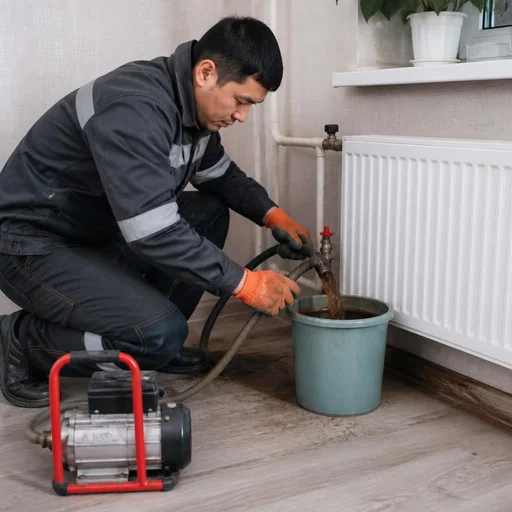
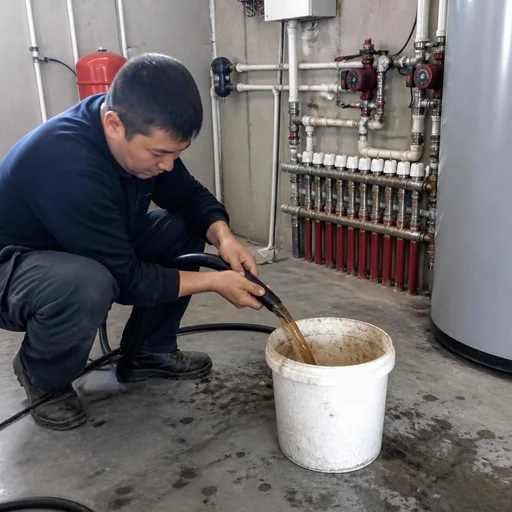
- Rusty color of the coolant: when drained through the Mayevsky valve, the water comes out brown, with flakes — these are iron oxide deposits and corrosion products.
Checking coolant circulation and thermometry of risers
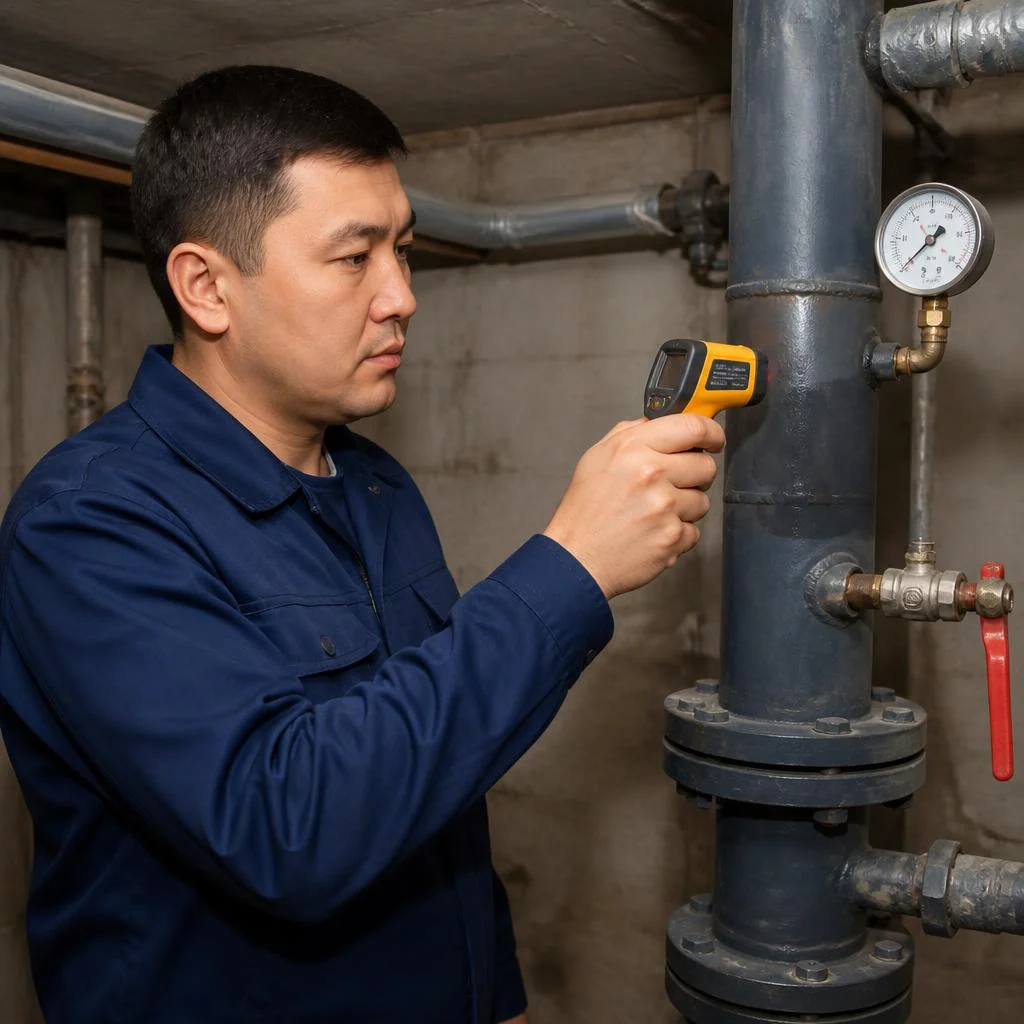
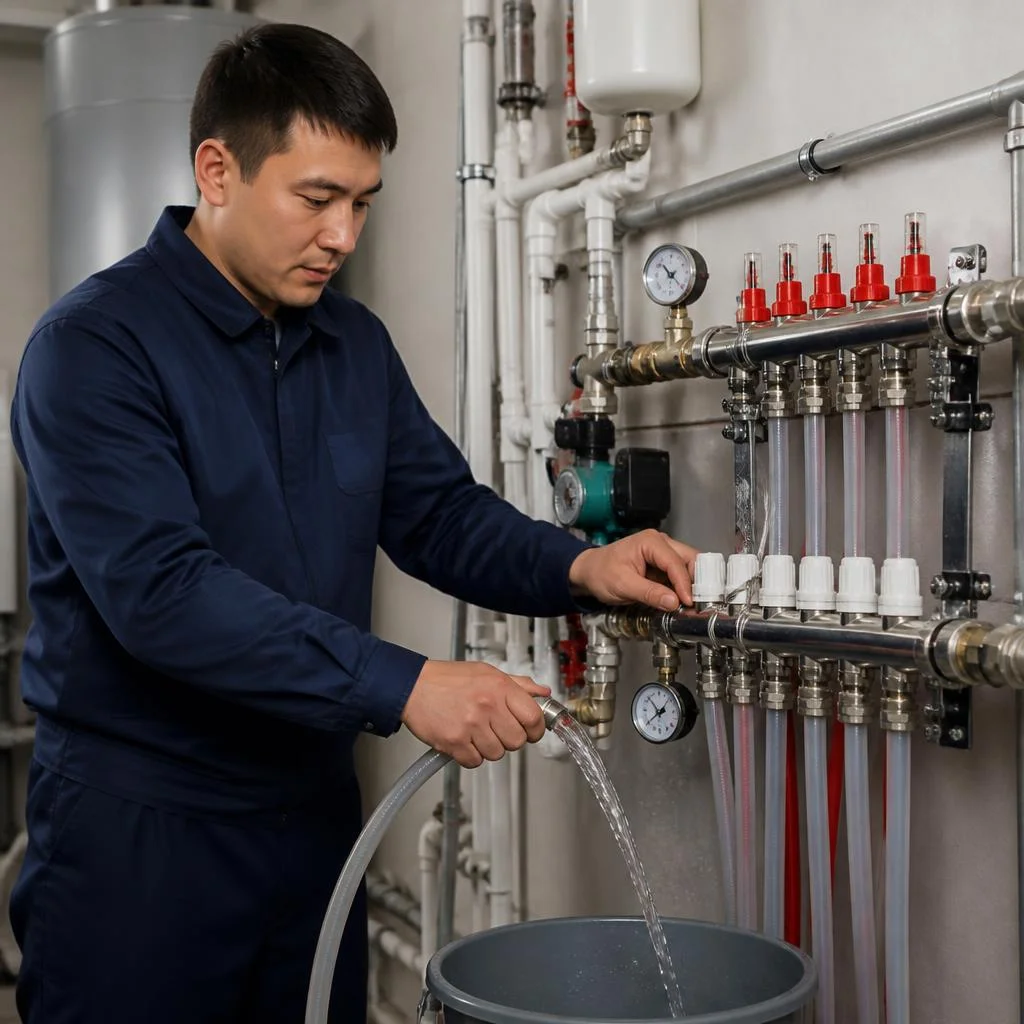
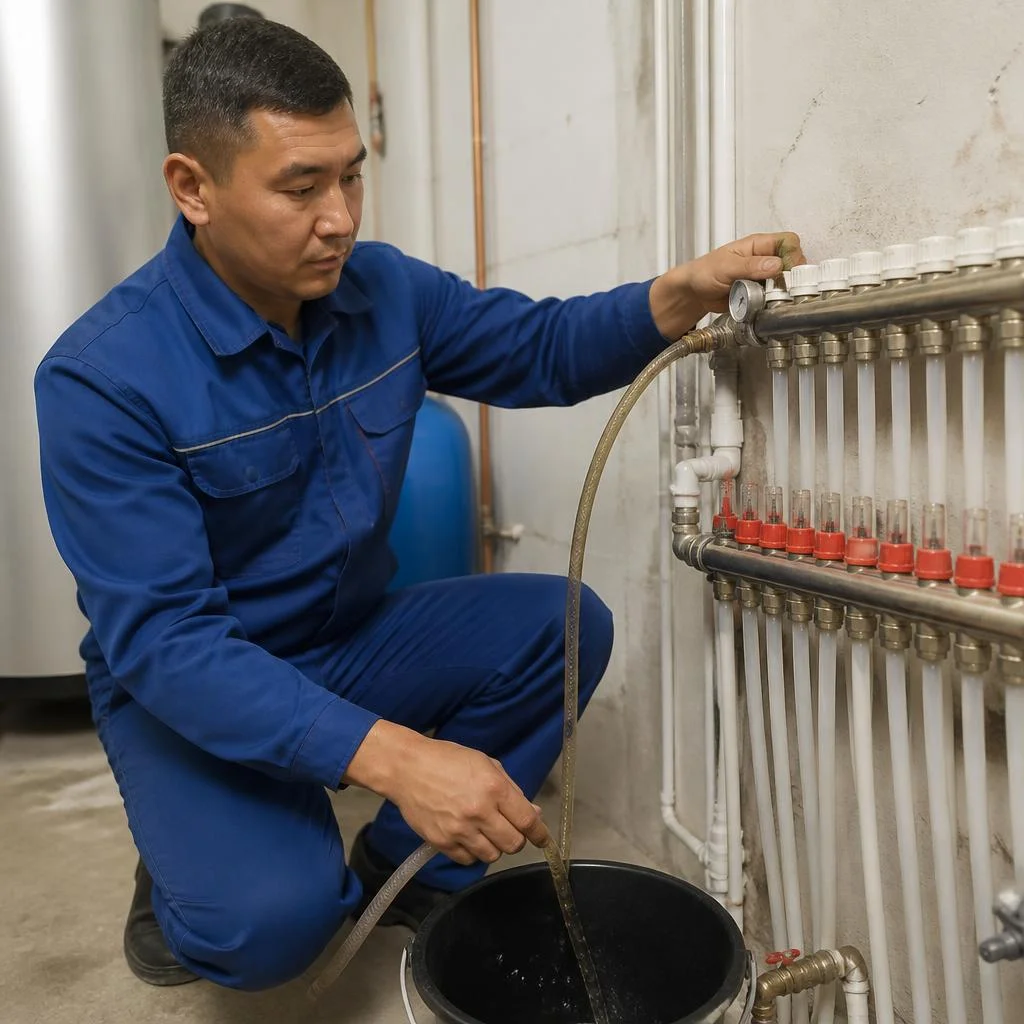
Flushing of the heating system in Bishkek begins with checking coolant circulation and thermometry of risers and radiators — this stage shows exactly where the passage is narrowed. A specialist measures the temperature at the inlet and outlet of each fixture with a pyrometer, compares the readings with the supply and return pipelines, and compiles a map of cold zones by floor and room. In panel buildings of the 1-464 series and brick "Stalinka" buildings, the spread across risers reaches 12-18 °C even with a working elevator unit. Thermometry identifies "dead" zones that are not visible visually: a temperature difference between supply and return of more than 15 °C indicates a local clog, not a general loss of capacity. It is convenient to record the measurements in 2GIS or Google Maps by address — this way you can see which risers in the building need attention first. If thermometry confirms clogging, the next step is cleaning the heating pipes: mechanical or chemical, depending on the material of the circuit and the thickness of the layer. Clients often describe the task in their own words — "flushing pressure testing of the heating system" — and from such a request we immediately understand that a comprehensive service is needed: both flushing and leak testing under pressure. When fixtures heat unevenly, technicians often receive a request phrased as "how to bleed the heating system" — behind it there is usually an airlocked circuit on the upper floors, where an air pocket blocks the flow no worse than sludge. In residents' requests there is also another phrasing — cost of flushing the heating system — and from it we immediately see that the person has already gone through diagnostics and wants to understand how the calculation works before the technician's visit.
How often to flush the heating system in Bishkek
Due to hard water, flushing of the heating system in Bishkek is recommended once every 3-5 years, and in buildings with cast-iron radiators — once every 3 years. The interval depends on the pipe material and the intensity of make-up water: in panel buildings of older construction, scale builds up faster because make-up with fresh water is constant and every liter brings new calcium and magnesium salts. In private houses with an autonomous circuit and a steel boiler, the interval shifts to 4-5 years if the make-up volume is minimal. Residents of the upper floors of multi-story buildings encounter clogging earlier — more sludge and air accumulate in the upper risers. The frequency is determined not by the calendar but by the thickness of deposits: with a scale layer of 1-2 mm, heat output drops by 10-15%, and the procedure pays for itself within one season. The material of the fixtures should also be taken into account separately: flushing cast-iron heating batteries requires a gentler mode than cleaning steel or bimetallic sections, otherwise the internal partitions can be damaged. Start with diagnostics — if thermometry shows a spread within the normal range, scheduled cleaning can be postponed for a year. Owners of autonomous circuits more often search for how to flush the heating system in a private house — there, everything is determined by the quality of the make-up water and the volume of the expansion tank.
Prevention of the heating system and coarse filters
- Coarse filter before the boiler: a mesh or magnetic trap captures large particles and sludge, extending the interval between flushes by 1-2 seasons.
- Expansion tank monitoring: checking the pressure and membrane integrity once a year — a depressurized tank adds air to the circuit and accelerates corrosion.
- Annual coolant drain: draining 2-3 liters from the lowest point removes settled sludge before it compacts into a dense layer.
- Scale protection: a water softener or reagent dispenser on the make-up line reduces water hardness and slows the growth of limescale on pipe walls.
- Seasonal inspection of fittings: checking Mayevsky valves, balancing valves and shut-off valves before the heating season starts reveals leaks and air pockets.
- Cleaning the heating system from rust: reagent treatment before the season dissolves iron oxide flakes and prevents them from settling on the sections.
- Cleaning heating boilers: removing the burner and flushing the heat exchanger once a year removes soot and scale that reduce the unit's efficiency.
Flushing Methods: Chemical, Hydrodynamic, Pulse, and Hydropneumatic
The method is selected based on the type of contamination and the configuration of the circuit — this determines whether the deposit will leave the system or settle back. Below we break down each method and its working zone.
Chemical Flushing of a Heating System: When the Reagent Is Indispensable
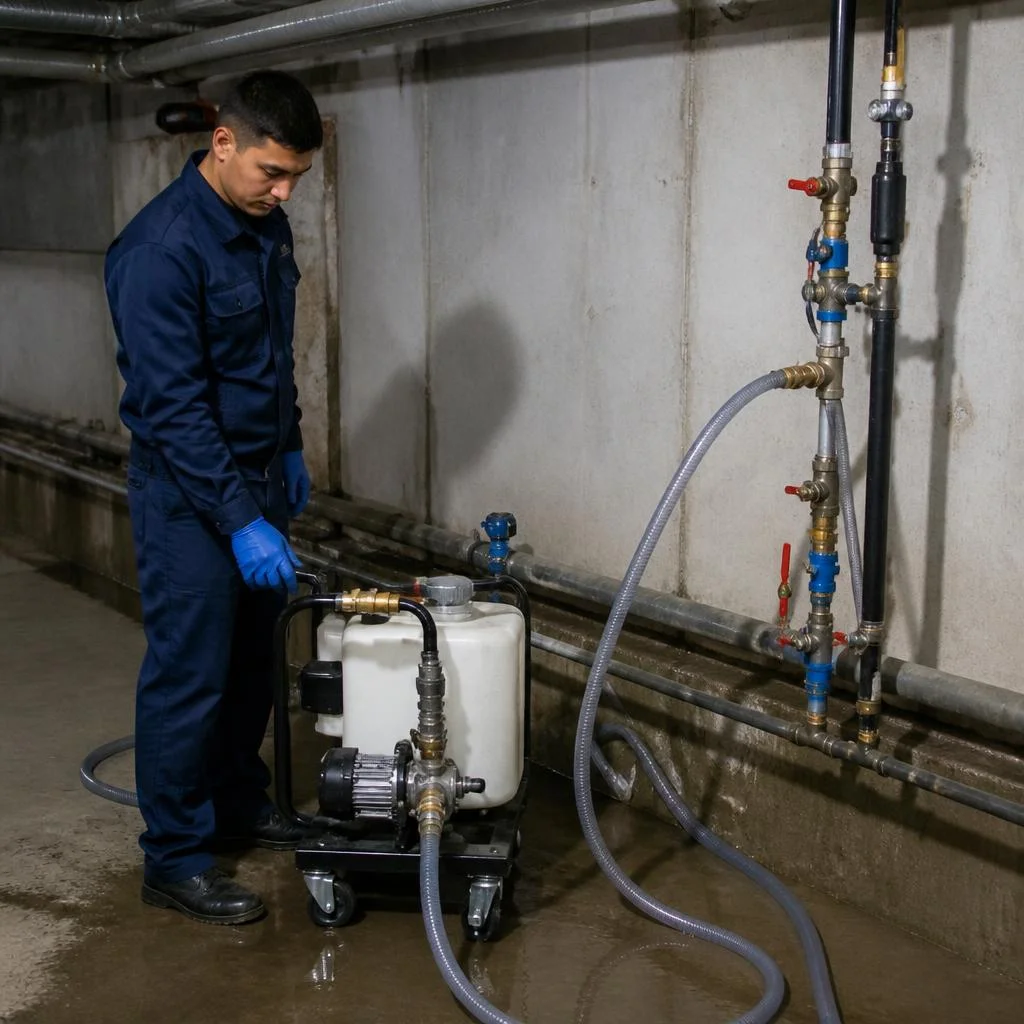
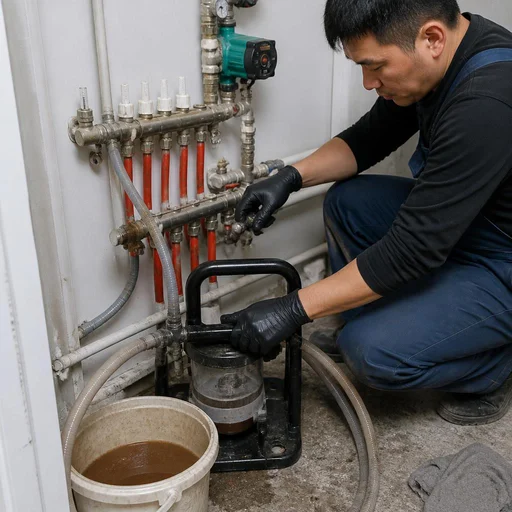
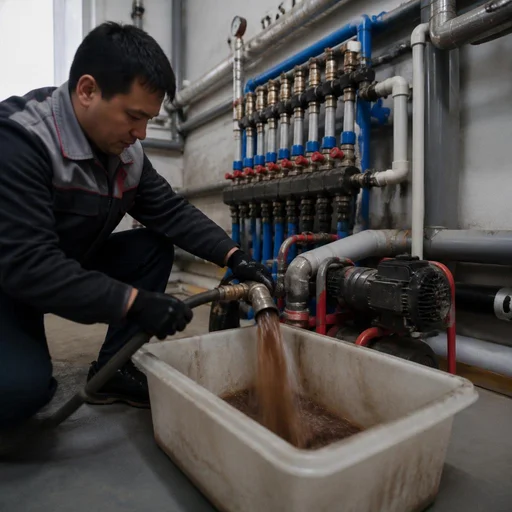
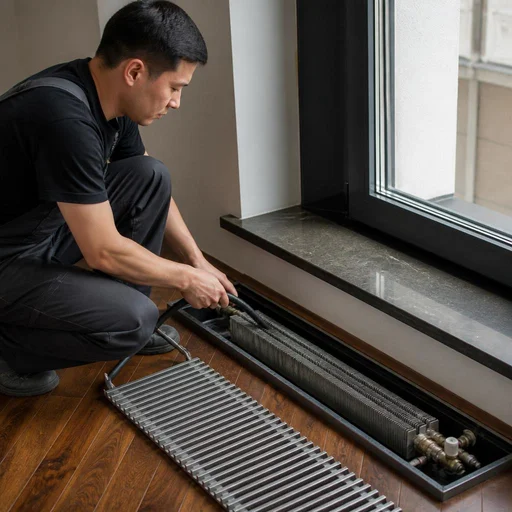
Chemical flushing of a heating system at Eco-Service dissolves limescale and iron oxide deposits where mechanical action is unavailable — in curved supply lines, sections of cast-iron radiators, and the heat exchanger coil. The reagent is selected based on the type of contamination: against carbonate scale, an acid compound based on sulfamic or orthophosphoric acid works; against rust, a reducing agent with complexones. Universal chemicals lose to both: on scale they give incomplete dissolution, on iron oxides they leave a dense crust. The temperature of the solution accelerates the reaction — at 60–70 °C an acid compound removes the calcium layer one and a half to two times faster than at 20 °C. Treating a circuit with aluminum sections requires an inhibitor: pure acid attacks the metal within the first minutes. Clients often formulate the task as cleaning the heating system — and the technician immediately understands that reagent selection is needed for the specific type of deposits. When the owner wants to flush the heating system on their own, we warn: without pH control, an acid compound will eat through aluminum sections within a day.
Hydrodynamic Pipe Flushing and Hydropneumatic Flushing of a Heating System
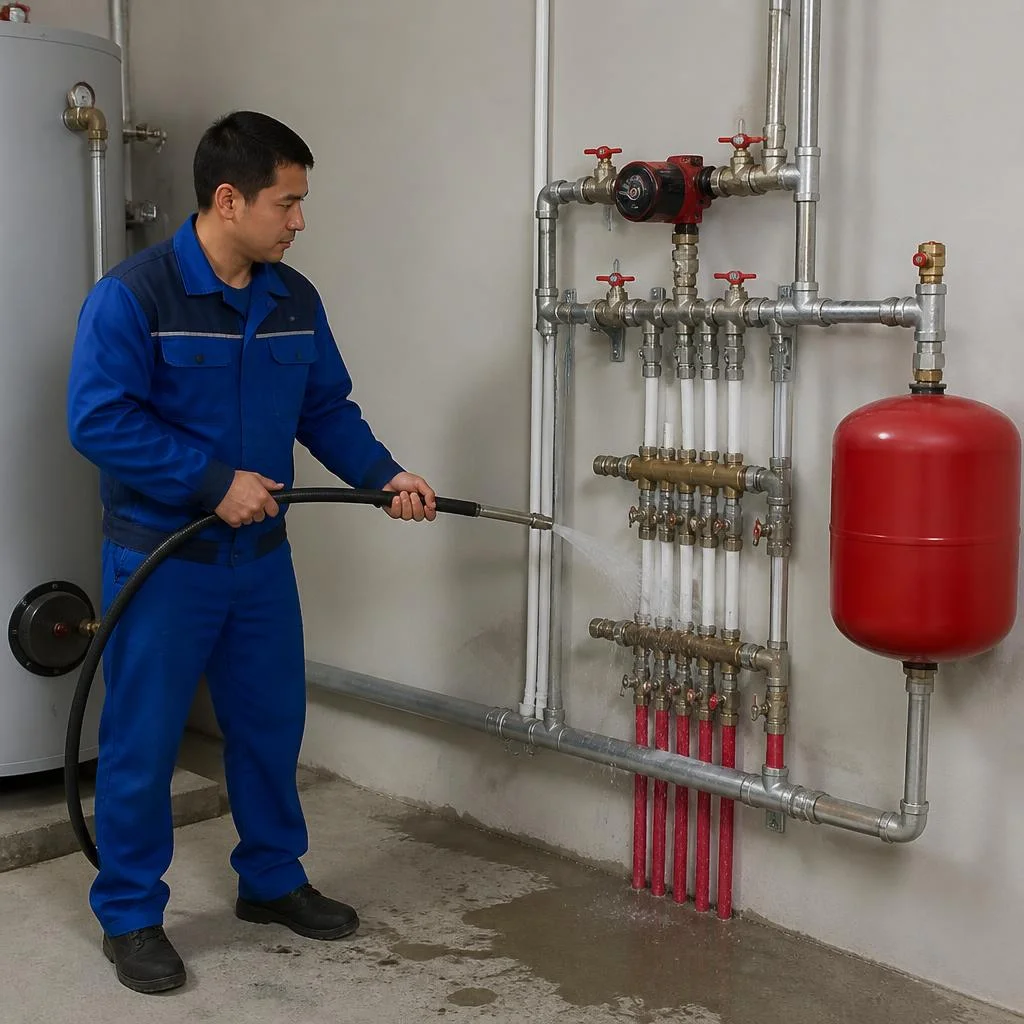
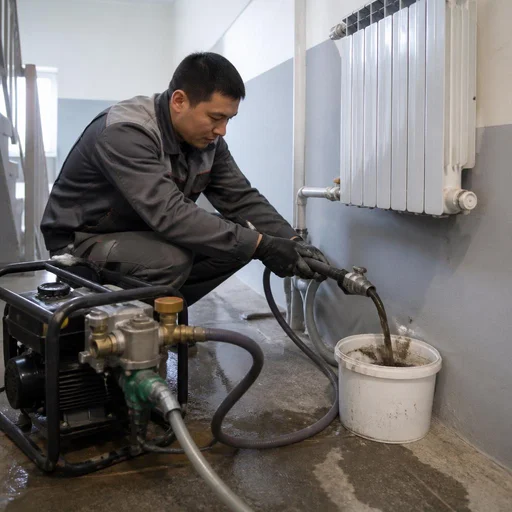
Hydrodynamic flushing of a heating system supplies water under high pressure through reverse-flow nozzles, while hydropneumatic flushing of a heating system in Bishkek adds compressed air to the flow for a pneumatic-hydraulic shock. The compressor injects air in portions, and shock waves arise in the circuit that knock deposits off the walls along the entire length of the riser — from the top distribution to the return line. Hydrodynamics is more effective on straight sections and in supply lines with a small bend radius, where the jet reaches the metal. Hydropneumatic takes on long vertical risers: the air plug accelerates in the flow and works like a piston, carrying sludge to the drain. On looped circuits of a private house with horizontal distribution, both technologies deliver results in a single pass. Pressure is selected according to the pipe specifications: for polypropylene it is kept lower than for steel, otherwise the fitting will not withstand the shock. In requests this often sounds brief — flushing of heating pipes — but in fact one must choose between the jet and the pneumatic shock. Hydraulic flushing of a heating system in our practice is the first stage at sites with a thick layer of sludge in the risers.
Pulse Flushing of a System and Flushing with an Inhibited Compound
Pulse flushing of a system alternates sharp pressure releases, while treatment with an inhibited compound protects the metal from corrosion during the procedure. The pulse works without reagents: a valve sharply releases pressure, the flow changes direction and tears loose sludge from the walls. The inhibitor does not dissolve deposits — it forms a film on the cleaned metal, so it is applied after the main treatment, not instead of it. In a compound with an inhibitor, the acid reagent works more gently: the film covers exposed areas of steel and aluminum while the compound removes scale from the rest of the surface. For bimetallic radiators, where aluminum fins are adjacent to a steel core, inhibited chemistry is the main option, because pure acid corrodes aluminum in a matter of hours. When the owner asks for cleaning of heating pipes without disassembling the circuit, the pulse method closes the task in a single visit. A separate scheme is flushing of a heating system with a gas boiler: here the pulse is carried out with the burner switched off, so that sludge does not clog the nozzles and heat exchanger.
Comparison of Flushing Methods by Type of Contamination and Circuit
| Type of contamination | Circuit | Method | What happens |
|---|---|---|---|
| Carbonate scale | Heat exchanger, boiler | Chemical flushing | Acid dissolves the calcium layer |
| Iron oxide sludge | Cast iron radiators, risers | Hydro-pneumatic | Pneumo-hydraulic shock knocks sludge off the walls |
| Mixed deposits | Horizontal distribution | Hydrodynamic | A pressurized jet carries out the suspension |
| Loose sediment | Closed loop | Pulse flushing | Pressure release detaches the loose mass |
| Residual acid | Aluminum sections | Inhibited compound | A film protects the metal from etching |
Combining methods gives the best result: chemistry softens deposits, hydro-pneumatics carries them out of the circuit. At sites with cast iron batteries and steel risers, the crew usually goes with a pair of "chemical treatment of the circuit → hydro-pneumatic" — this way, both scale and sludge are removed in a single visit.
Flushing from iron oxide deposits and from limescale
- Flushing from iron oxide deposits: removes black sludge from cast iron radiators and steel risers, where iron oxides accumulate over years.
- Flushing from limescale: removes the hard calcium layer in pipes and the boiler, which reduces heat transfer and narrows the passage.
- Sludge deposition zone: iron oxide particles fall to the bottom of the radiator and into the branches, where the flow is weakest.
- Scale deposition zone: calcium crystallizes on the heating surfaces of the heat exchanger and on the inner walls of pipes.
- Method against sludge: hydro-pneumatic flushing of the heating system and a pulse carry the suspension out of the circuit without acid.
- Blowing out heating pipes: drives out residual moisture and loosened sediment from the upper points of the circuit after the main treatment.
Neutralization of the reagent after flushing
After chemical treatment, Eco-Service neutralizes the reagent and rinses the circuit with clean water — residual acid destroys aluminum radiators, corroding the walls from the inside in a single season. The neutralizer is fed into the circuit with a pump, held for the reaction time, then drained together with the spent compound. Verification is done with an indicator: if the pH of the drained water has not returned to neutral, the circuit is flushed again until the reading falls within the safe range. The spent liquid is collected in a container and disposed of — pouring acid into the domestic sewer system of an apartment building leads to damage of the cast iron pipes in the entrance. At sites with aluminum sections, neutralization is done in two passes with intermediate testing of each sample. Before the final filling of the circuit, the heating system is blown out with compressed air to drive residual moisture out of the upper points. Clients search for hydro-flushing of the heating system price — and land on this page, where all methods and the order of work are explained.
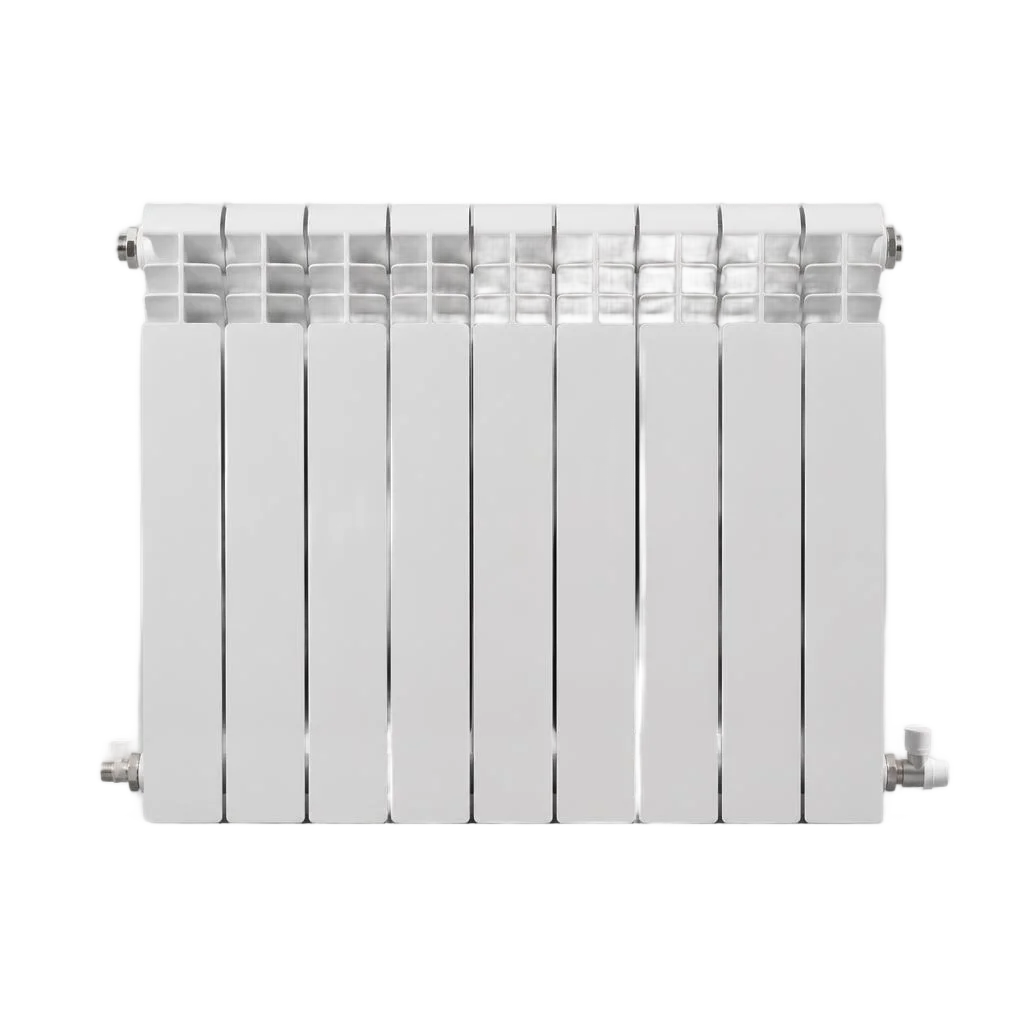
Flushing radiators and batteries: by device type and material
Different materials and designs of radiators require different approaches — from cleaning without removal through the supply lines to complete dismantling of sections. The choice of method depends on the metal, the thickness of deposits, and the age of the connections.
Cleaning a radiator without removal and with removal
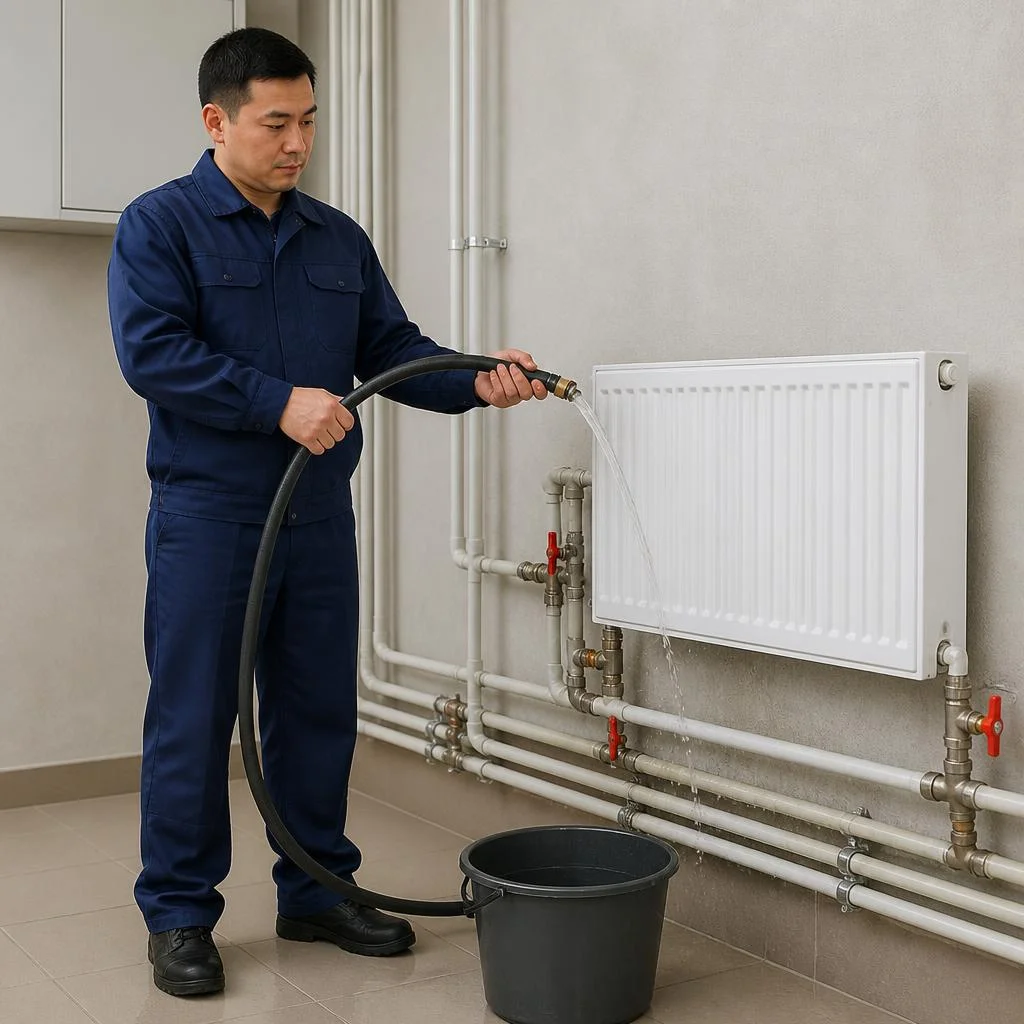
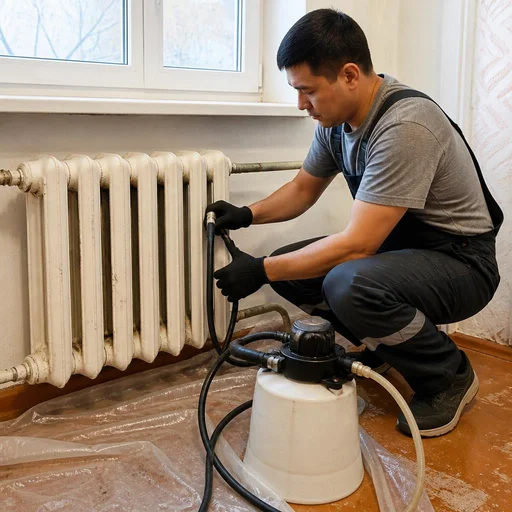
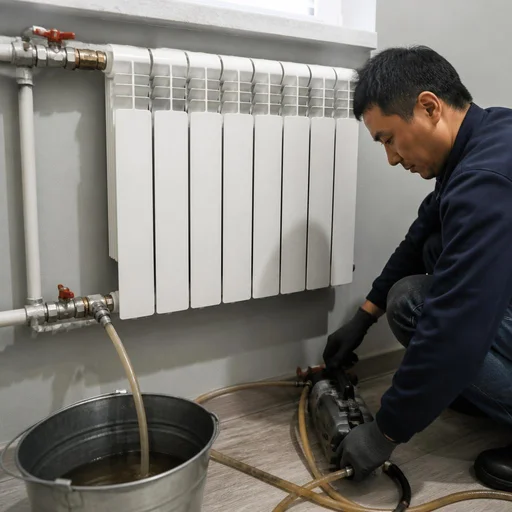
Cleaning a radiator without removal at Eco-Service is performed on site through the supply lines, while removal and cleaning are needed when there is dense sludge in the lower sections. The cost of work depends on whether the device is removed or work is done on site. At sites across Bishkek, we first take a thermal image of the device: if the top is heated and the bottom lags by 12-18 degrees, the cause is sediment at the bottom of the sections, not airlocking. Through the supply lines we feed the reagent under pressure and run it through the radiator circuit in both directions, simultaneously pushing the sludge toward the drain. When the deposit thickness exceeds 2 mm, this method does not wash out everything. Without removal, up to 70% of deposits can be washed out; if after the procedure the device is still cold at the bottom, it is removed and treated separately. When the circuit does not start after a seasonal shutdown, blowing out the heating system helps: an air pocket in the riser blocks circulation more than sludge in the sections. Clients often find us with the query heating system flushing Bishkek — and through it they land on this page.
Treatment of bimetallic and aluminum radiators
Treatment of a bimetallic radiator at Eco-Service is carried out with gentle compounds: aluminum sections are sensitive to acidic chemicals. Aluminum devices require an even gentler regime — thin-walled metal loses strength on contact with strong acid, so technicians work with neutral and inhibited reagents with a pH within 6-8. Bimetal combines a steel core and aluminum fins: an aggressive compound corrodes the outer aluminum, and the device loses heat output even with a clean core. For such devices, we select the compound based on a water sample from the circuit — hard water produces scale on the core but does not tolerate an excess of acid. Flushing aluminum heating radiators is based on short contact of the reagent with the metal: the fill is held no longer than the specified time and the residue is immediately neutralized. Before pouring in the reagent, check the material of the sections against the device's data sheet — a universal compound on a mixed system will ruin aluminum in a single cycle. In requests this sounds like flushing for a heating system — from that wording we immediately understand that the compound needs to be selected for the material of the sections.
Treatment of cast-iron radiators and cast-iron batteries
Treatment of a cast-iron radiator at Eco-Service removes dense iron-oxide sludge that accumulates in the wide sections of khrushchyovkas and panel buildings. Cast-iron devices in old MS-140 series are treated with the pulse method: the wide channel holds a large volume of sediment, and a weak flow does not carry it out. Flushing cast-iron heating radiators in homes in Osh and Jalal-Abad often requires two or three cycles — rust in the sections compacts over years and comes out in flakes. Cast iron is resistant to acids, but its sections are joined with gaskets — during pulse treatment, pressure is selected so as not to tear off old connections. On batteries older than 25 years, perform pressure testing before and after the work: a pressure drop exposes outdated gaskets that had previously held only on a layer of sludge. Clients describe a private house with two or three branches with the query heating system flushing for a house — there we plan cycles separately for each riser.
Cleaning a heating convector and supply lines to radiators
- Heat exchanger diagnostics: we check the passage through the pipe and the condition of the fins — ribs clogged with dust and sludge reduce convection by 30-40%.
- Circuit cleaning: we run the reagent through the convector coil, washing out sediment from the internal small-diameter channels.
- Fin cleaning: we blow out and wash the finning separately — without this step the housing remains cold even with a clean pipe.
- Supply line cleaning: we clear the supply sections from the radiator to the riser, where narrowing of the channel accounts for up to half of the pressure losses.
- Heating control: we measure the housing temperature after startup — the difference from the supply should not exceed 8-10 degrees.
Table: flushing radiators by device type
| Device type | Method | Feature | What's included |
|---|---|---|---|
| Bimetallic | Neutral / inhibited compound | Sensitive to acid | Core flushing, pH control |
| Aluminum | Gentle compound pH 6-8 | Thin-walled metal | Section flushing, scale check |
| Cast iron | Pulse flushing | Wide sections, old gaskets | Flushing in 2-3 cycles, pressure testing |
| Convector | Circuit flushing and fin cleaning | Fins and pipe clog separately | Coil flushing, finned surface blow-through |
| Connections | Clearing narrow sections | Narrowing causes pressure loss | Flushing from radiator to riser |
For mixed systems (cast iron + bimetallic), methods are combined by section rather than applying a single compound to the entire circuit.
How to blow through heating radiators and clean the radiator
How to blow through heating radiators is a question that more often concerns air locks rather than sludge: blowing through a heating radiator drives out air through a Mayevsky valve or an air vent on the upper manifold. Blowing through heating radiators is done with a compressor at a pressure of 2-3 bar — it is not raised higher so as not to strip the threaded connections of old devices. Cleaning a heating radiator from sludge requires not air but liquid under pressure: cleaning a heating radiator with a hydrodynamic nozzle washes out sediment from the lower sections, where air cannot reach. Cleaning heating radiators on cast iron devices is done in several passes — after each one, the sections heat more evenly. Washing a heating radiator and washing heating radiators are jobs with a reagent and subsequent neutralization, not a one-time blow-through. Washing a heating radiator without removal is feasible with sediment up to 2 mm; with a dense layer, the device is dismantled. When sludge has compacted in the sections and the reagent flows weakly, we connect pressure cleaning of the heating system — this way the sediment is carried out of the narrowest sections of the circuit.
How much does flushing cost: what affects the price
Heating radiator flushing price depends on the number of sections, the material of the device and the method — without removal or with dismantling. Heating radiator flushing price and heating radiator flushing price are calculated by device type: bimetallic is cheaper than cast iron due to the smaller volume of sediment. Heating radiator flushing Bishkek is a separate line item: cleaning heating radiators price on site is lower than with removal, because dismantling and reassembly are not included. Heating radiator flushing price and heating radiator flushing price differ for mixed systems, where methods are combined by section. Heating radiator flushing as a separate service is taken when the device heats worse than the others in the circuit. The cost of heating radiator flushing is fixed after inspection — the result depends on the thickness of the sludge and the condition of the gaskets. If the circuit is started after a long downtime, clients ask about hydropneumatic heating flushing — this method combines the supply of water and compressed air and carries out sediment even from stagnant sections.
Flushing of risers, distribution lines and pipelines in an apartment building and a private house
The circuit of an apartment building and a private house are flushed differently: in the first case, the work proceeds from the riser and requires coordination, in the second, it covers the horizontal distribution, radiators and the boiler as a whole.
Flushing of the heating riser and system in an apartment building
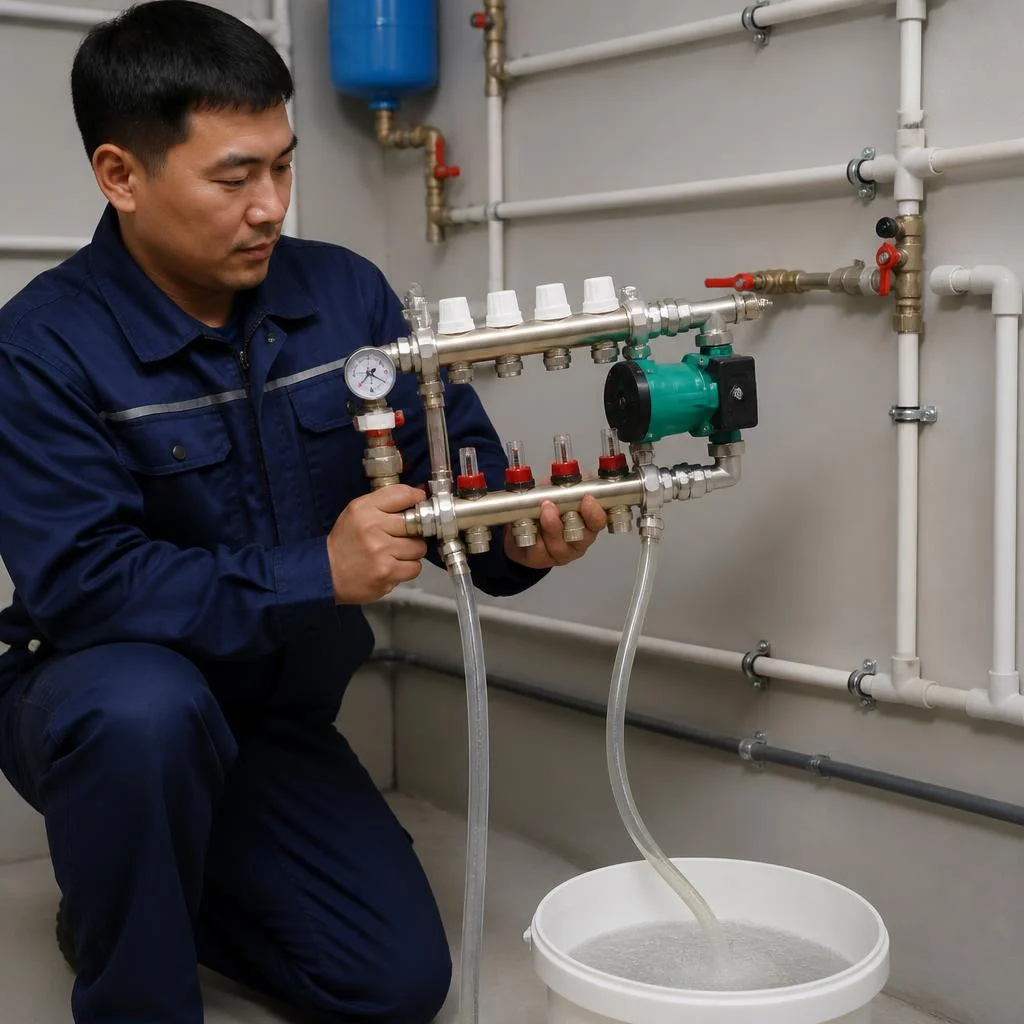
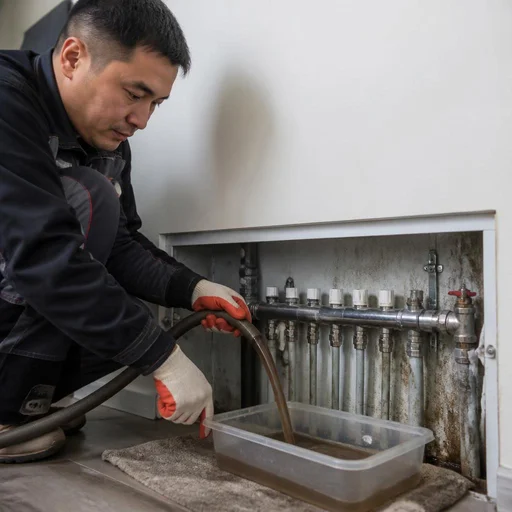
Flushing of heating risers at Eco-Service is performed from top to bottom with the circuit shut off, and cleaning of the heating system in an apartment building, the price of which depends on the number of floors and entrances, is coordinated with the management company before work begins. Clients often search for "heating blow-through" — and land on this page, although what is meant is a full hydraulic treatment with a reagent, not a brief air release. In Bishkek panel series 105 and 106, the risers are connected by jumpers on each floor, and deposits are distributed throughout the entire bundle, not just one section. The technician shuts off the supply at the inlet, releases the pressure, connects the unit to the upper radiator and runs the compound through to the lowest point, monitoring the discharge of sludge through a transparent hose. In panel buildings, the risers are connected by jumpers — treating one riser without the neighboring ones leaves sludge in the jumpers, so the circuit is flushed in pairs.
Flushing of the heating system in a private house and horizontal distribution
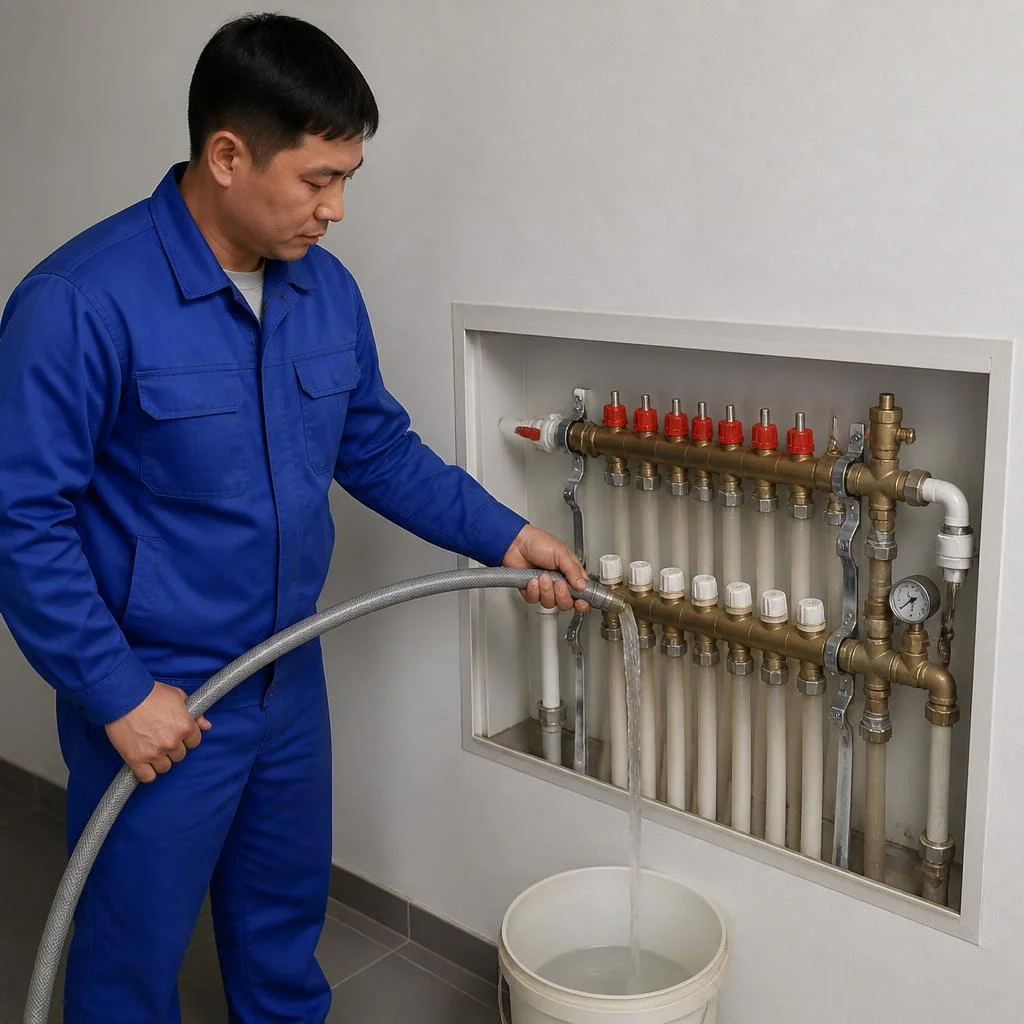
Flushing of the heating system in a private house, the price of which is formed by the number of branches and radiators, covers the horizontal distribution, the appliances and the boiler — the circuit is flushed as a whole or by individual branches. In individually built houses, the distribution is more often dead-end: 3-6 branches diverge from the manifold, and each is flushed separately so as not to drive sludge from one branch into another. Requests are often placed with the query "hydro-pneumatic flushing of the heating system" — that is how the client describes the combined method, where water is supplied in pulses together with compressed air. In search, one also encounters such a wording as flushing of the heating system in a private house — from it the technician immediately understands that a full cycle with the boiler and distribution is needed. Treating horizontal distribution takes more time than riser flushing, because the pipe diameter is smaller and the flow velocity in them is lower. In a private house with a gas boiler, the procedure is done before the start of the season: residual reagent during the first startup can damage the boiler's heat exchanger. A separate line in the price list is flushing of the heating boiler, because the heat exchanger and the burner are treated with a separate compound and at a different supply temperature.
Flushing of the supply and return pipelines
Flushing of the supply pipeline removes scale from the hot side, while cleaning of the return pipeline removes sludge that settles at low temperature. On the supply, water flows at a temperature of 70-95 °C, and hardness salts crystallize on the walls in a dense layer; on the return, the flow is cooler, and loose iron-oxide sediment with sand accumulates there. Clients search for the service with the wording "cleaning of heating systems" — and the technician clarifies which side of the circuit is to be treated. Because of this difference, technicians select two different compounds: an alkaline or acid inhibited one for the supply and a dispersing one for the return — a single universal reagent washes away both types of deposits less effectively. The supply and return pipelines become clogged with different types of deposits, so the compounds are not mixed in one circuit and the sides are flushed alternately, with intermediate neutralization. In requests for cleaning of heating systems, technicians immediately ask for a photo of the inlet — from it one can see which side of the circuit is more clogged.
Flushing of the central heating system and the heat supply system
Flushing of the central heating system at Eco-Service is carried out according to the management company's schedule, and cleaning of the heat supply system — with pressure testing after the work. The central circuit in Bishkek high-rise buildings is served by a thermal power plant or a district boiler house, and the pressure in it is maintained by the heat supply organization, not the residents. The query "heating system flushing Bishkek" comes from HOA chairpersons and owners of private houses equally often, and in both cases the technician first looks at the connection diagram. The technician coordinates a time window, drains the circuit, flushes the risers and connections, then applies pressure 25% above the working pressure and holds it for 10-15 minutes — a drop on the pressure gauge will reveal pinholes and loosened threads. The central circuit is flushed in the off-season: in summer the water is drained, and the procedure takes place without the risk of flooding the neighbors.
Flushing the heating system in an apartment and in a house: how the work differs
- Scope of work in an apartment: flushing the heating system in an apartment covers the riser, the connections and the radiators; there is no boiler in the circuit.
- Scope of work in a house: cleaning the heating system of a house includes the boiler, the distribution piping, the appliances and the expansion tank — the scope is 2-3 times larger.
- Coordination: in an apartment, the pressure in the riser cannot be tampered with at will; the work is carried out during a daytime window by agreement with the neighbors and the management company.
- Freedom of choice: in a private house, the owner decides for himself when to flush, by which method and at what frequency.
- Checking the result: in an apartment, the evenness of heating across the floors is checked; in a house, the difference between the supply and return temperatures at the boiler.
- Frequency: in an apartment, flushing once every 3-5 years is sufficient; in a private house with hard water — once every 2-3 years, and cleaning the heating system in a private house with an open expansion tank is needed more often because of the water's contact with air.
Flushing the entire circuit: how the scope of work is chosen
- One riser: flushing the heating system in an apartment building, the price of which depends on the number of floors, begins precisely with the riser when only one entrance is left cold.
- Horizontal distribution: cleaning the heating system of a private house requires separate flushing of each branch from the manifold to the last radiator.
- Supply and return: flushing the heating system in a private house with a significant temperature difference at the boiler inlet and outlet includes both lines with separate compounds.
- Open tank: cleaning the heating system in a private house with an open expansion tank is needed more often than usual, because the water becomes saturated with oxygen.
- Apartment appliances: flushing a heating radiator in an apartment without removing it takes 40-60 minutes per appliance and does not require dismantling the connections.
- Cast-iron appliances: flushing the heating system in a private house with cast-iron radiators without removing the appliances is often not enough — the sludge stays in the fins.
Flushing of the boiler, heat exchangers and pressure testing of the heating system
The boiler and heat exchanger are the most vulnerable components of the circuit: thin walls, narrow channels, high temperature. These elements are treated with a separate circuit and with caution, and after the work their tightness is обязательно checked under pressure.
Cleaning of the heating boiler and heat exchanger treatment system
Cleaning of the heating boiler at Eco-Service is carried out with a separate circuit, and the heat exchanger flushing system is connected via a bypass so that the solution does not get inside the housing of the gas unit. The heat exchanger of a wall-mounted Baxi or Ferroli boiler is a stack of thin-walled plates with a gap of 1.5-2 mm: scale and sludge clog the channels within 2-3 seasons, while aggressive acid eats through the wall in minutes and causes a leak. For heat exchangers, an inhibited compound with a pH of 2-3 is used, which dissolves calcium carbonate but does not affect copper and stainless steel. The service is more often required in houses with hard water from wells — salt deposits there grow faster than in apartments on the city water supply. Scheduled boiler cleaning is timed to the end of the heating season, while the deposit has not yet hardened and can be removed without mechanical disassembly.
Maintenance of a heating system with a gas boiler
Maintenance of a heating system with a gas boiler at Eco-Service is performed with a bypass: the unit is disconnected from the circuit and the flushing station is connected directly to the supply and return pipelines. This way the reagent circulates through the radiators and piping without entering the heat exchanger, and the technician monitors the inlet and outlet pressure using pressure gauges. After chemical treatment, the circuit is flushed twice with clean water under pressure — residual acid during boiler startup causes pinpoint corrosion and pinholes on welded seams. For gas units with a capacity of 24-32 kW, the full cycle takes 3-4 hours; for turbocharged models with a closed combustion chamber — up to 5 hours due to additional treatment of the condensate drain. Flushing of heating in a private house follows the same principle as in an apartment, but treatment of the expansion tank and the safety group is added.
Pressure testing of the heating system: checking tightness after work
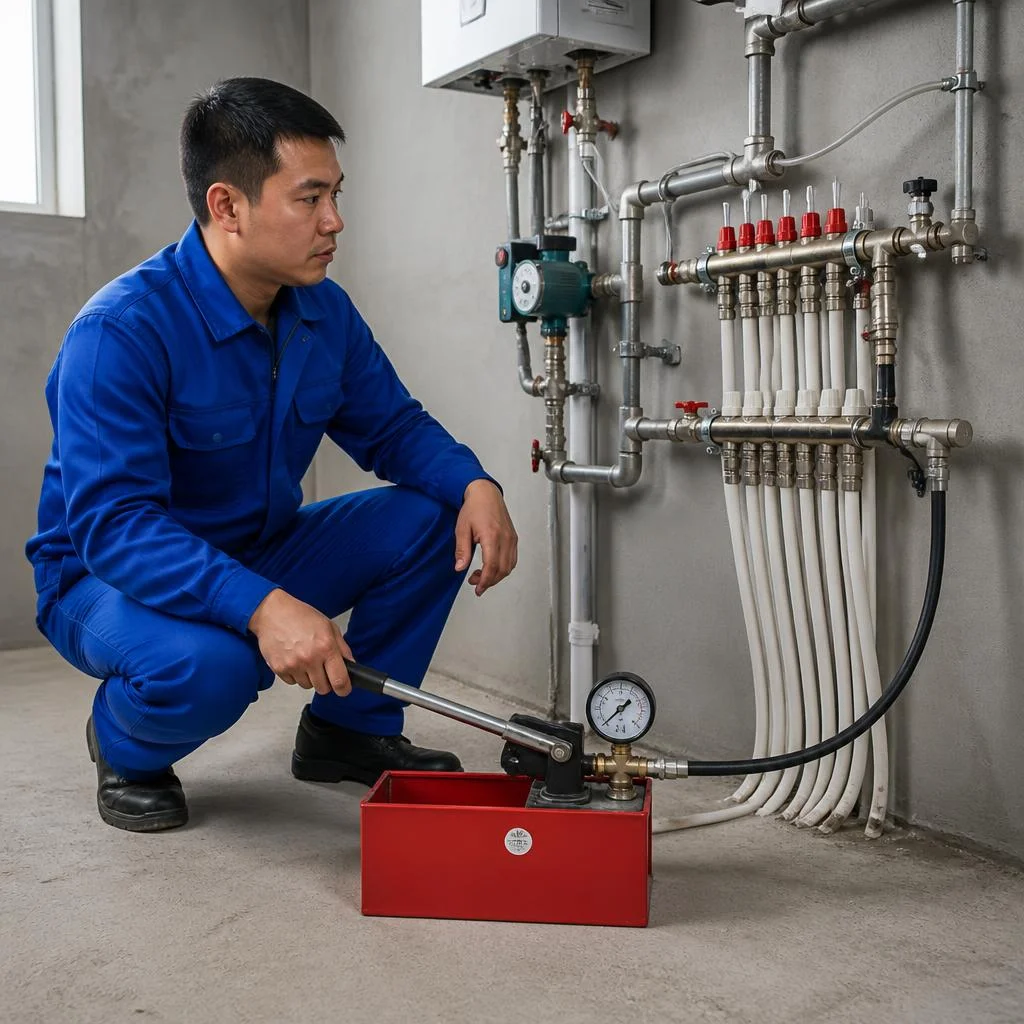
Pressure testing of the heating system at Eco-Service is done in a single visit: after flushing, the circuit is filled with coolant and checked for tightness under pressure. Pressure testing is carried out at a pressure 25-50% above the working pressure — for a private house with a working pressure of 1.5 bar this is 2.0-2.2 bar, for a multi-storey building with an elevator unit up to 6-8 bar. Weak joints that did not show up during normal operation will leak within 10-15 minutes under increased pressure, and the technician has time to record the problem before starting the boiler. Not only the threaded connections of the radiators are checked, but also welded seams, inlet flanges, automatic air vents and the safety group. If a leak is detected during pressure testing, the section is reassembled and the procedure is repeated — the circuit must not be started with a leaking connection.
Cost of pressure testing of the heating system and flushing: what is included in the work
- Diagnostics: checking circulation, thermometry of risers and radiators, inspection of the boiler and heat exchanger before work begins.
- Flushing: chemical, hydrodynamic or pulse treatment of the circuit with the compound selected for the type of contamination.
- Neutralization of the reagent: flushing with clean water and introduction of a neutralizer so that acid residues do not corrode the metal after startup.
- Pressure testing: filling the circuit and checking tightness under pressure 25-50% above the working pressure.
- Agreement on the scope: if thermometry reveals additional clogged sections, the cost of work is recalculated on site rather than added silently.
How the price for cleaning heating systems and hydroflushing is calculated
Heating system flushing cost and timelines are confirmed after diagnostics, not over the phone: the price in Bishkek is made up of the method, the volume of the circuit and the number of appliances, and is calculated based on the inspection. The final figure is influenced by three parameters: the treatment method (chemicals are more expensive than impulse due to the reagent and neutralization), the length of the piping and the number of radiators. For an apartment in a multi-storey building, riser treatment is added, for a private house — boiler and heat exchanger servicing, which is why no two estimates are ever the same. With heavy iron oxide deposits, two passes are required instead of one — this is also reflected in the calculation. Clients often search for hydropneumatic heating system flushing price and land on this page, so let's break down what the calculation consists of. Hydro-flushing is more cost-effective on circuits with cast-iron sections: the mechanical action of water and air removes sludge without a reagent.
Heating price: what is clarified before the visit and how the estimate is fixed
Clients often type "heating flushing price" — and land on this page, so let's break down how the estimate is formed. The cost is fixed in the request, but is still clarified after thermometry: the technician compares the actual condition of the circuit with what the client described over the phone. The estimate includes four items: the treatment method, the length of the pipeline, the number of radiators and the need for reagent neutralization. Related works are calculated separately — pressure testing after flushing, riser treatment in a multi-storey building and cleaning of the gas boiler heat exchanger. The query "heating system flushing in Bishkek price" most often comes from owners of two-storey cottages: there, the number of circuits and the number of floors are calculated differently than for a one-room apartment. If during the inspection clogged supply lines or a blocked return pipeline are identified, the scope is agreed on site and work begins only after confirmation.
Warranty, Timelines and Safety: How Eco-Service Works in Bishkek
Warranty, response times and reagent safety — these are what distinguish a service company with its own center from a private technician with a suitcase of tools. Let's break down the terms under which we work.
2-Year Warranty on Heating System Flushing
Eco-Service provides a 2-year warranty on heating system flushing — if circulation is not restored, the crew returns free of charge. The warranty certificate is issued for the property, not for the crew: if the apartment owner changes, the obligations remain. The report records the initial parameters before work — supply and return temperatures, pressure differential across risers, the results of radiator thermometry — and the same measurements are repeated after work, so that the result is measurable rather than "by feel." The warranty covers the result, not pipe wear: if the circuit heats unevenly due to design errors in the piping layout, this is recorded in the report as a limitation, not as a warranty case. Before signing the report, ask for the "before" measurements to be included — with them, a dispute about the result is resolved in a single visit. Clients often find us with the query "heating system flushing price" — and land on a page with a calculation where the cost depends on the number of risers and the number of floors.
Crew Dispatch on the Day of Request and Work Timelines
Eco-Service dispatches a crew for heating system flushing in Bishkek on the day of request, and standard radiator flushing takes 1-2 hours. We accept requests by phone, via Telegram and Instagram — the dispatcher clarifies the type of circuit, the floor and the material of the radiators, so that the crew arrives with the right set of adapters and hoses. Work on a riser and a full circuit is scheduled for the morning: it takes 3-5 hours, and by evening the circuit has time to warm up for checking the result. In new buildings with horizontal distribution it goes faster — here access to the manifold is open, and there is less scale than in older buildings. During the peak of the heating season, we work with the riser shut off, so we coordinate the time with the management company in advance. Book for the first half of the day: by evening you will already check the heating, and if necessary the crew will return the same day. Often the request is short — "heating duct cleaning" — and the dispatcher immediately understands that a visit is needed for a clogged circuit. If you were looking for how heating flushing in Bishkek is performed, the dispatcher will confirm a visit for the nearest morning.
Reagent Safety and Neutralization: Why This Matters for Neighbors
Eco-Service uses inhibited reagents and neutralizes them before disposal — this eliminates damage to risers and neighboring circuits. The inhibitor slows corrosion and does not destroy gaskets, so acid-based treatment leaves no consequences for aluminum sections and paronite seals. Discharging the reagent into the sewer without neutralization is prohibited: the acid corrodes the cast-iron pipes of the stairwell, and repairs cost more than the service itself. We neutralize the compound to pH 6-9 and only then discharge it — this is stipulated in the work regulations. If neighbors complain about a smell in the basement after a visit from a "private technician with acid," it is precisely the liquid discharged without neutralization that is to blame. We select the method based on the condition of the circuit: where deposits are dense, pressure hydro-flushing of the heating system works, and where the pipes are thin — a gentle compound. Clients ask about heating supply system flushing — and get the answer that the reagent is selected based on the pipe material.
Eco-Service's Own Service Center in Bishkek
Eco-Service has its own service center in Bishkek: the crew is based here, and equipment and chemicals are stored in the warehouse. The work requires not only chemicals, but also a pump station for hydrodynamic cleaning, a compressor for pulse flushing, and a set of pressure gauges for pressure testing — all of this is at our base, rather than rented for each order. On a repeat visit under warranty, the crew arrives with the same equipment instead of looking for it again. The equipment is serviced between seasons: pressure gauges are verified, hoses are replaced, and chemicals are stored according to their shelf life. Clients come to the center themselves if they need to submit a request or clarify details regarding the report. A warehouse within the city limits shortens the time between request and visit — especially during the peak weeks at the start of the heating season. For dense cast-iron pipe layouts, we use hydro-pneumatic flushing: pulsed air supply knocks scale off the walls without disassembling the sections. In the request, it is enough to specify heating system flushing for a private house and the address — the dispatcher will clarify the rest.
Conclusion
Heating system flushing is work that is planned according to the condition of the circuit, not according to a date on the calendar. Below is a short summary that helps choose the moment, the method, and the sequence of actions.
Main conclusions
- The sign matters more than the schedule: a cold lower part of the radiator, noise in the riser, and uneven heating are a signal for diagnostics, not a reason to wait until the end of the season.
- The method is selected according to the contamination: chemicals remove scale, hydro-pneumatics knock out sludge, and pulse flushing works on long risers.
- The material of the appliance decides: cast iron withstands acidic compounds, while aluminum and bimetallic radiators are cleaned only with inhibited liquids.
- An apartment building requires coordination: work is carried out with the management company and neighbors on the riser, while a private circuit is serviced in full before the start of the season.
- The final step is mandatory: after the chemical agent, neutralization is needed, followed by pressure testing — it confirms the tightness of the connections and the absence of leaks.