







Why sewers clog and leak: causes and first signs
Sewers in Bishkek's older buildings operate at their limit: cast-iron stacks 30+ years old, grease deposits, and sagging joints. We break down the causes of failures and how to tell when a section needs replacement rather than another cleaning.
Typical causes of clogs in apartments and private houses
In 8 out of 10 cases, a clog occurs because of grease deposits on the pipe walls, hair, and foreign objects — not because of a breakdown of the sewer itself. Kitchen grease settles on cold walls and within a month turns into a dense crust; hair in the bathroom catches on rough spots and builds up with soap. In the private sector of Osh and Jalal-Abad, sand and plant roots penetrating through the joints add to the problem. Cast-iron pipes in Bishkek's five-story buildings become so overgrown inside over 30+ years that the internal diameter narrows by half — auger cleaning gives a temporary effect, while high-pressure hydrojetting removes the layer of deposits around the entire circumference.
Signs that repair is needed, not cleaning
- Constant smell from the drain: if the stench returns 2-3 days after cleaning, the joint is depressurized and gases are coming from the stack into the apartment.
- Water drains slowly in all fixtures: simultaneous backup in the bathtub, sink, and toilet indicates a narrowing of the shared pipe section, not a local clog.
- Wet spots at the neighbors below: a leak on the ceiling of the lower floor is a consequence of a crack or a displaced socket, and water seeps into the floor slab.
- Clog returns within 2-3 weeks: recurring blockages in the same place are a sign of a displaced joint or a crack that cleaning does not fix.
How problems differ in old housing stock and new buildings in Bishkek
Soviet-era five-story buildings have cast-iron stacks with socket joints, while new buildings have plastic pipes with rubber seals: they break differently and are restored using different methods. Over time, cast iron develops pinholes and cracks along the pipe body — these are not "patched over" but cut out and replaced with a plastic insert. In new homes on the outskirts of Bishkek (Ak-Orgo, Kok-Zhar, the Ak-Bosogo residential area), sealing collars and bends at turns are more often affected: plastic is sensitive to hot water above 75 °C and to mechanical stress from improper installation. When a trench in the yard is impossible — a narrow driveway, a children's playground, fresh paving stones — trenchless sewer repair comes to the rescue: a liner is pulled through the existing stack or service line without breaking the ground. It is important for the technician to determine the material and year of construction before the visit — the set of tools and the restoration method depend on this.
Diagnostics: how to find the damage location without opening up
Before cutting a pipe or opening up the floor, the technician must see what's inside. We break down how CCTV inspection works, what it shows, and why sewer restoration without diagnostics turns into a lottery.
Television pipe inspection: what the camera shows
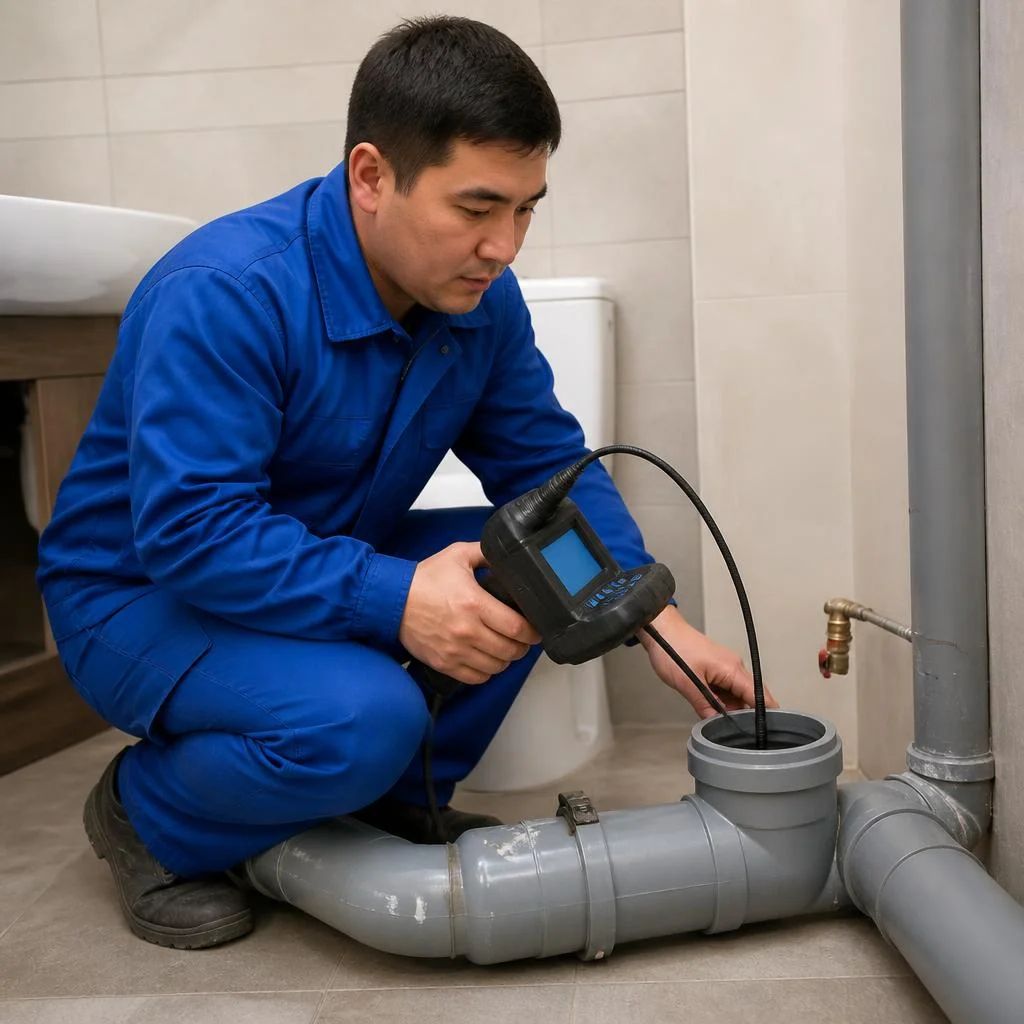
Television pipe inspection with a camera on a flexible probe shows cracks, joint displacements, plant roots, and the exact location of a blockage at a depth of up to several meters. A camera with a diameter of 40 mm and up passes through the stack cleanout and the horizontal run, and on outdoor networks — through a manhole; the image goes to a monitor in real time, and the operator records the depth based on the cable footage. A locator on the probe marks the damage point on the surface — the technician opens up the floor or soil directly above the problem, rather than feeling around through half a room. At Eco-Service, the inspection recording is saved to a flash drive: from the video you can later see exactly what was replaced and in which section. When a joint is displaced by 5-10 mm, the camera immediately shows water stagnation and a backfall — based on these signs, the technician calculates the scope of work before starting the dismantling. Clients often send a request for sewer repair, although in fact what they need is precisely a TV inspection before the estimate. Request a video inspection before the estimate: from the recording you can see which sections are healthy and can be left untouched.
When diagnostics are mandatory, and when cleaning alone will do
- Repeat blockage within a month: the pipe clogs a second time in the same section — the cause is not grease, but deformation or joint displacement.
- Buying an apartment with cast-iron pipes: an inspection before the deal reveals pinholes, lumen overgrowth, and cracks invisible from the outside.
- Before major sewer restoration: TV inspection provides an exact list of sections to be replaced, without opening up healthy pipes just to be safe.
- First blockage in a straight section: if the pipe is clean along its entire length and has clogged for the first time, hydrodynamic flushing without diagnostics is enough.
Clog Removal: Auger, Hydro-Jetting, and When They Are Not Enough
A clog is the most common reason for calling a plumber. We break down which tool is used to clear blockages at different points in an apartment and a house, and why sometimes a single cleaning is not enough.
Mechanical Auger Cleaning: Where It Works
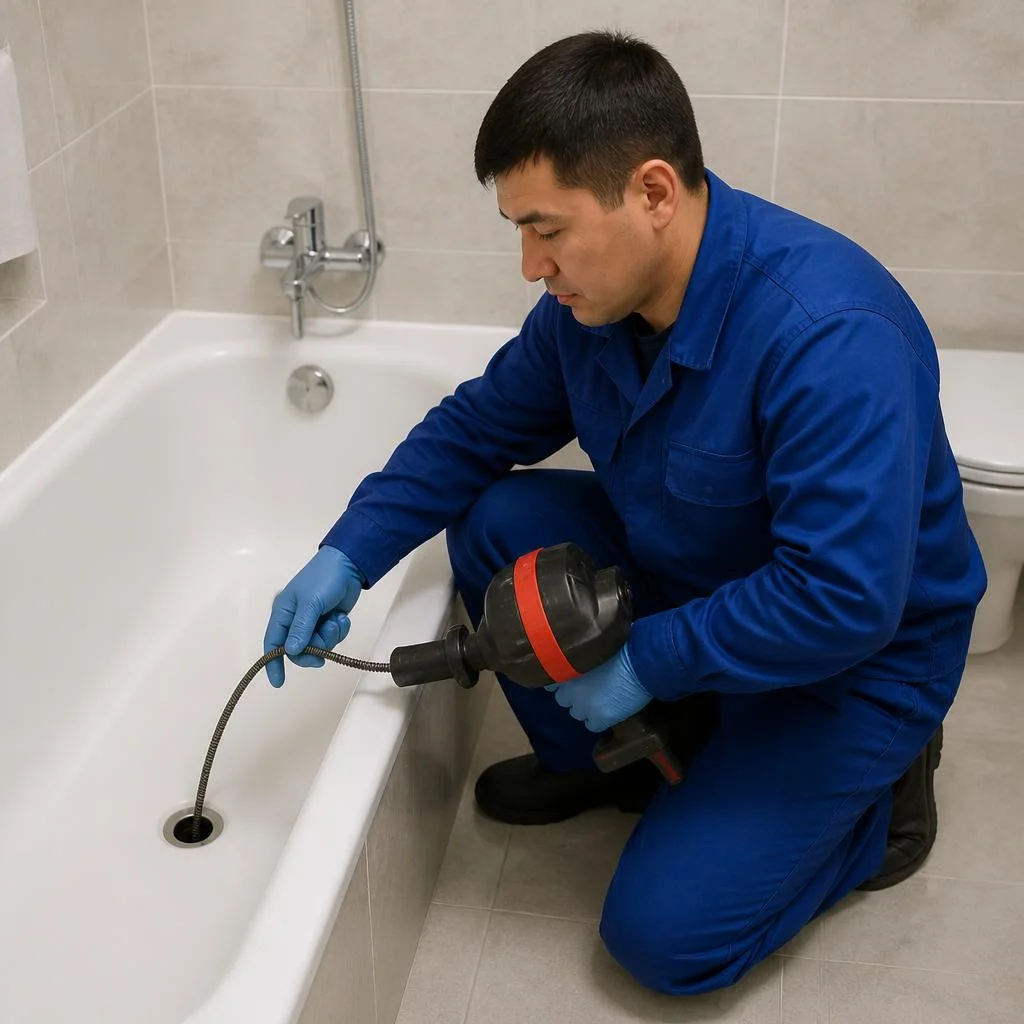
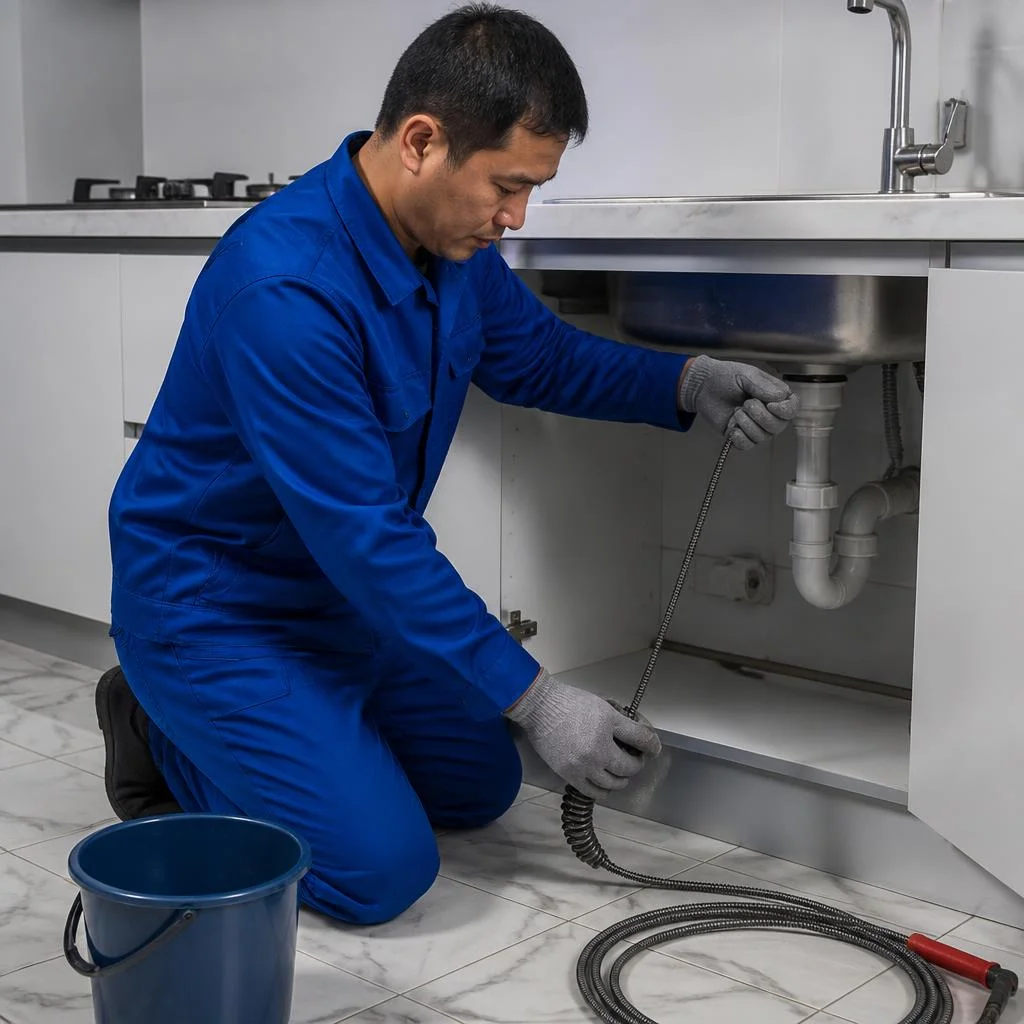
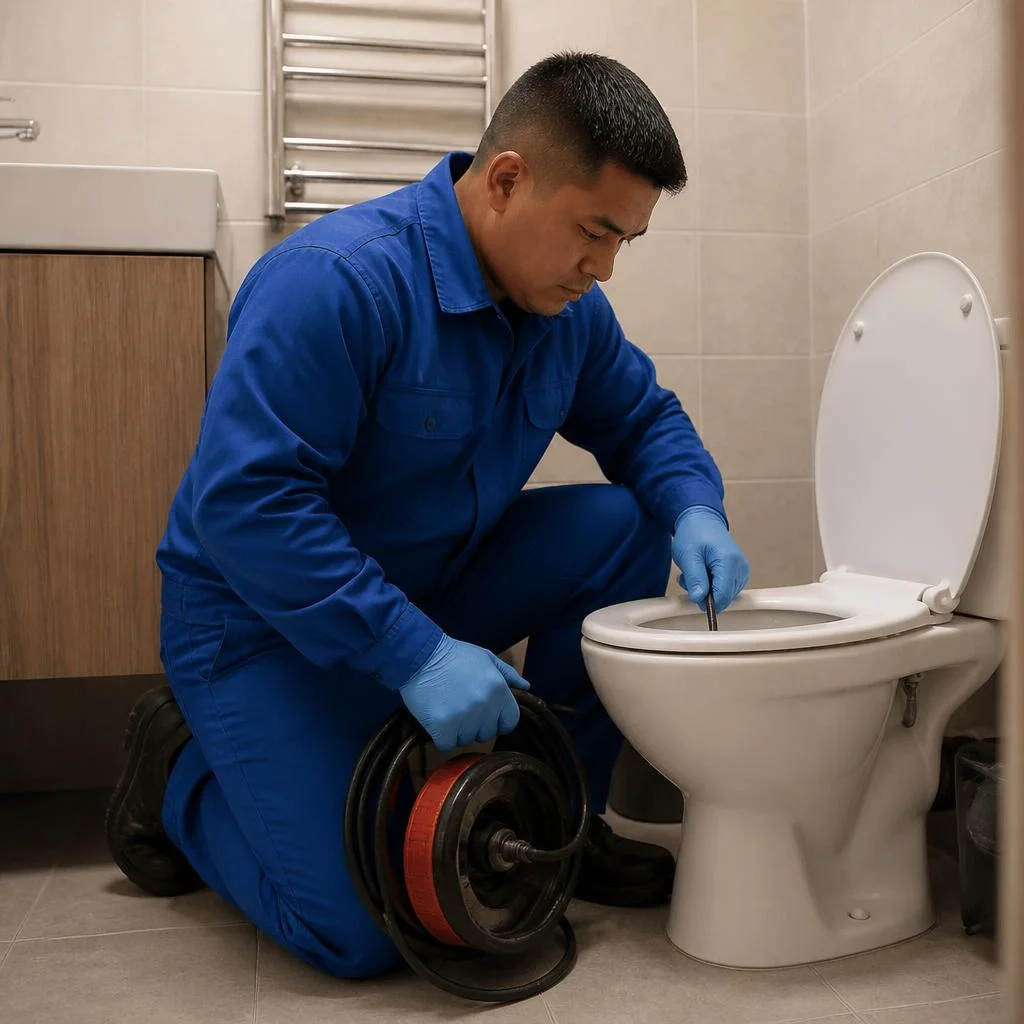
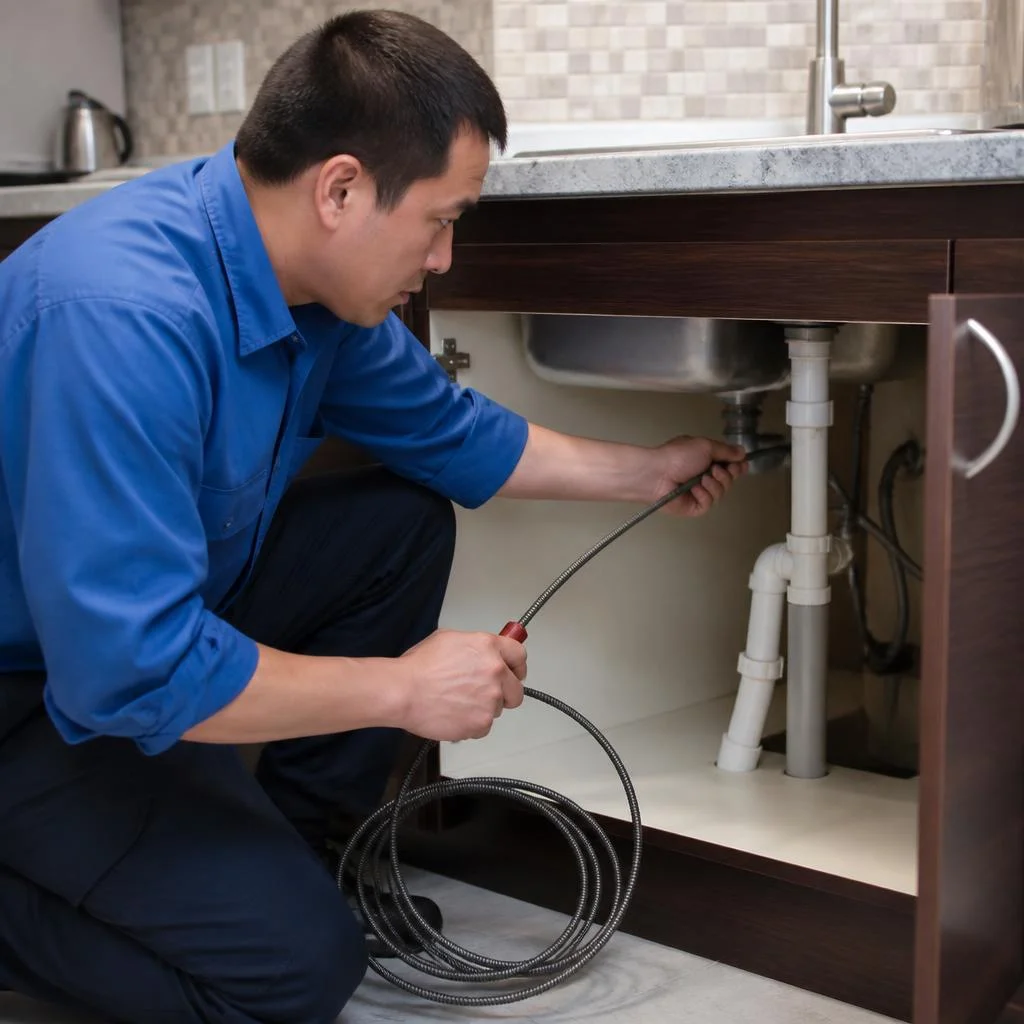
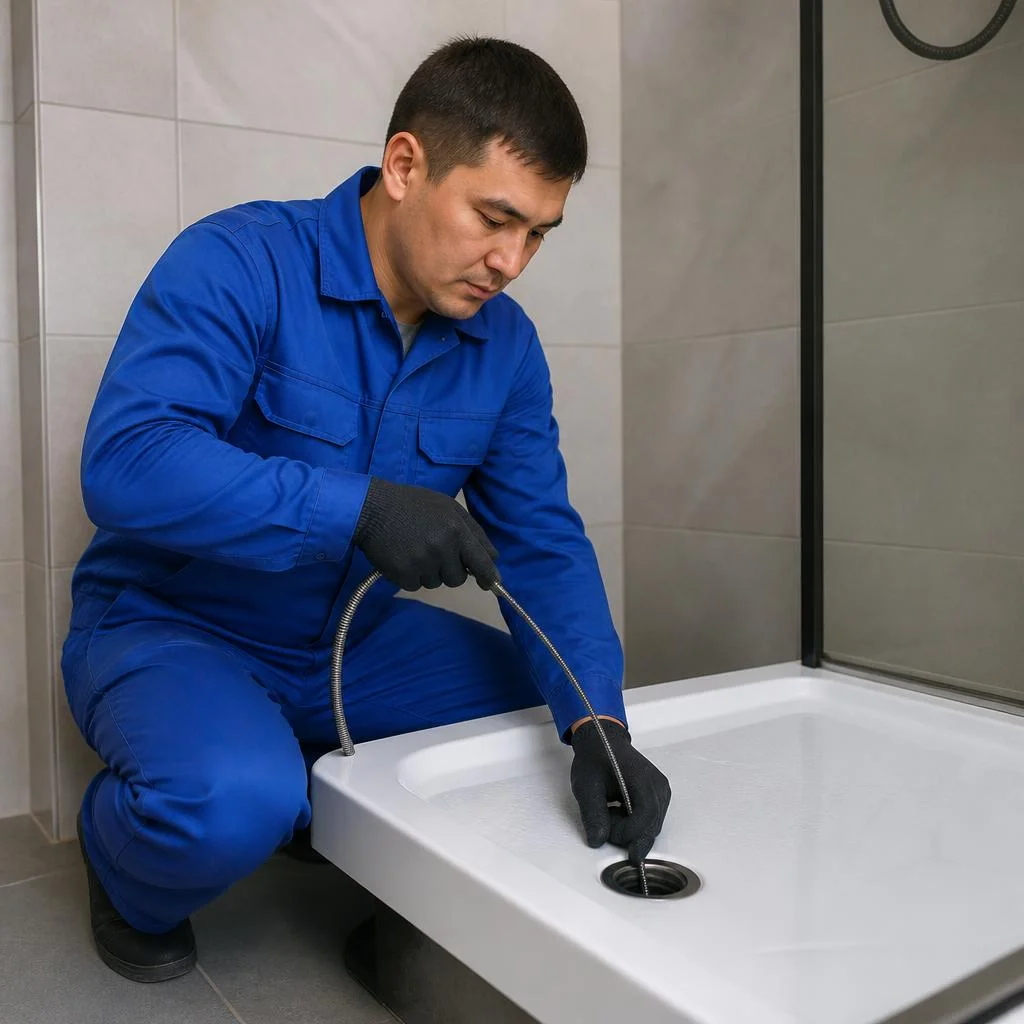
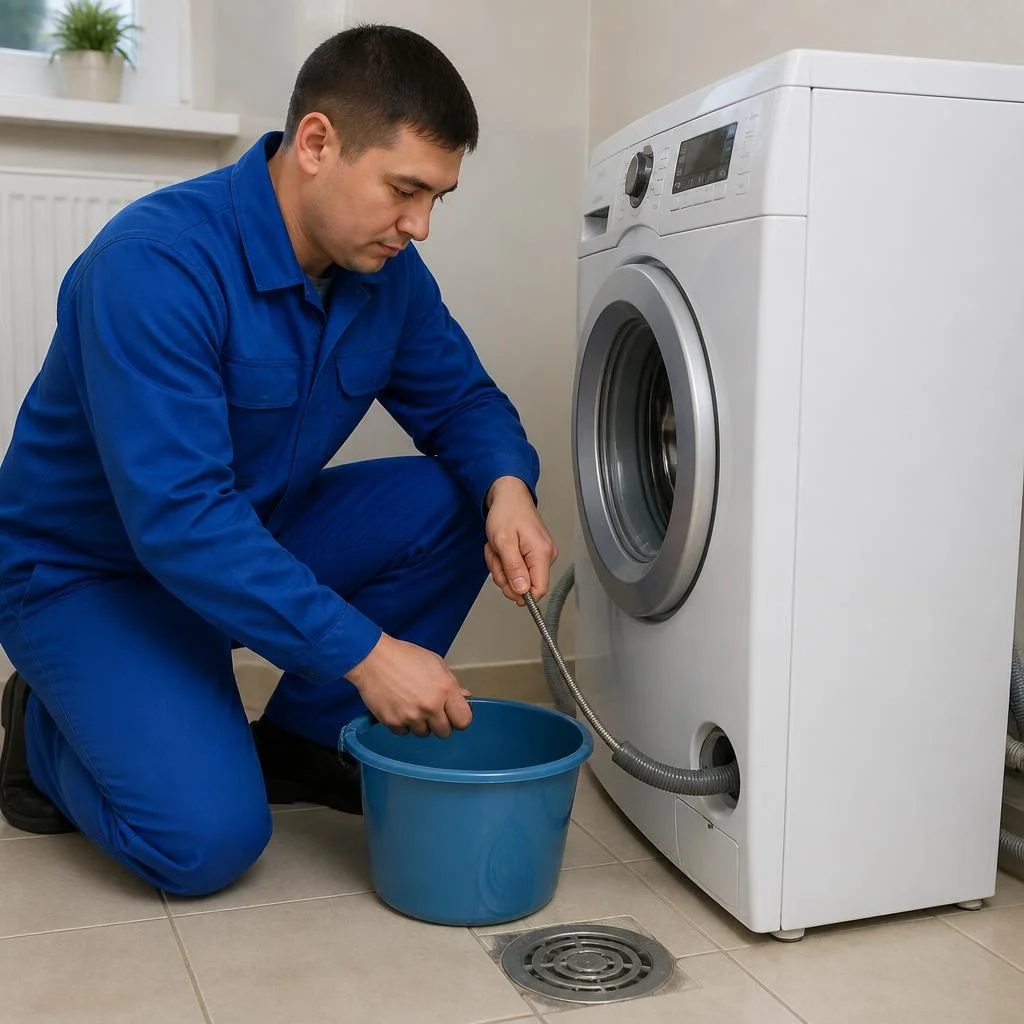
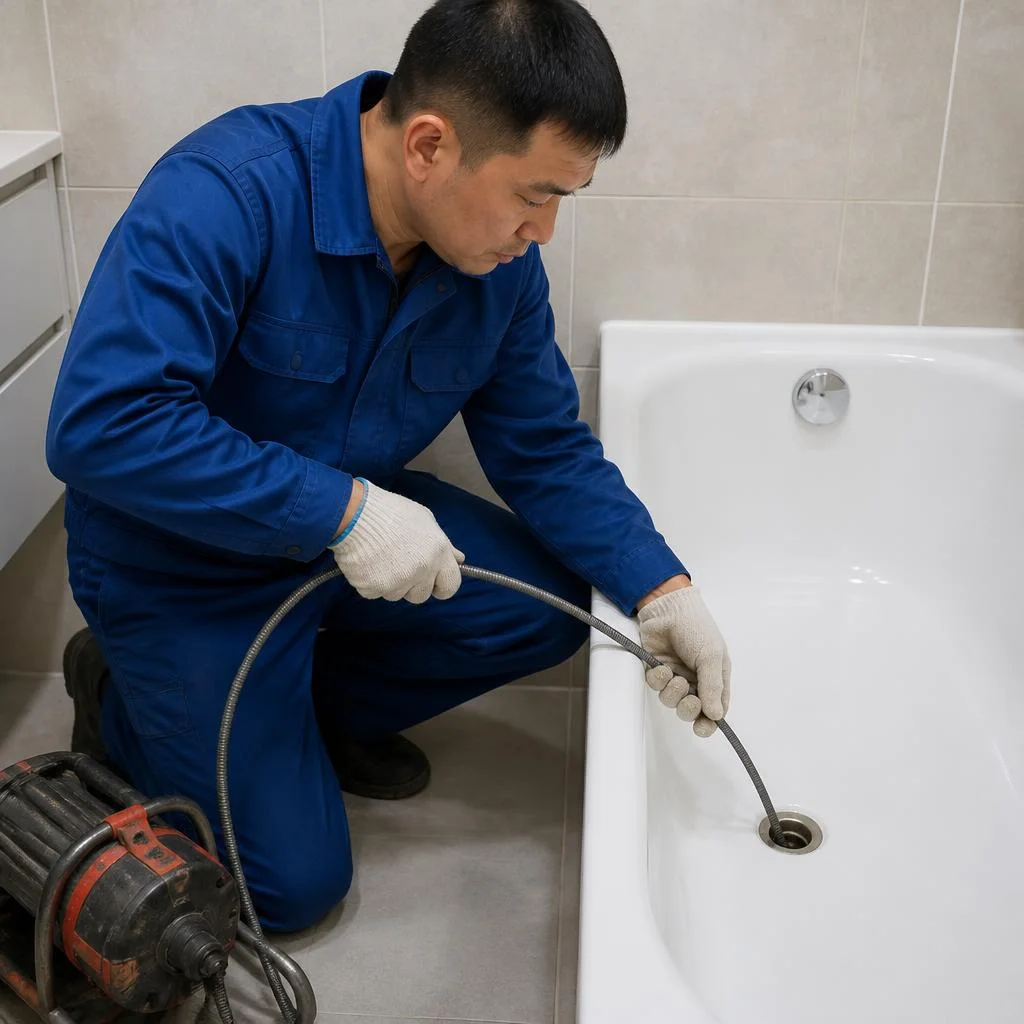
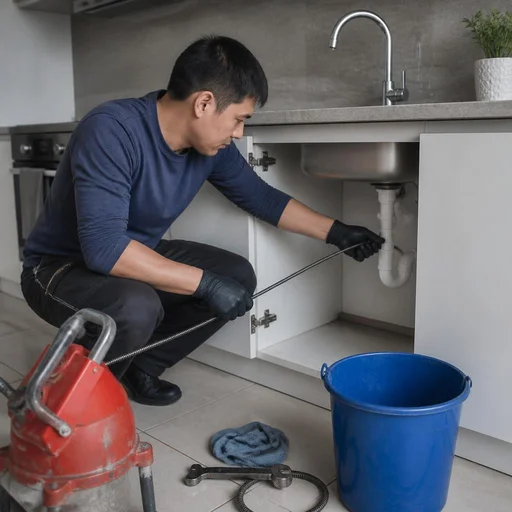
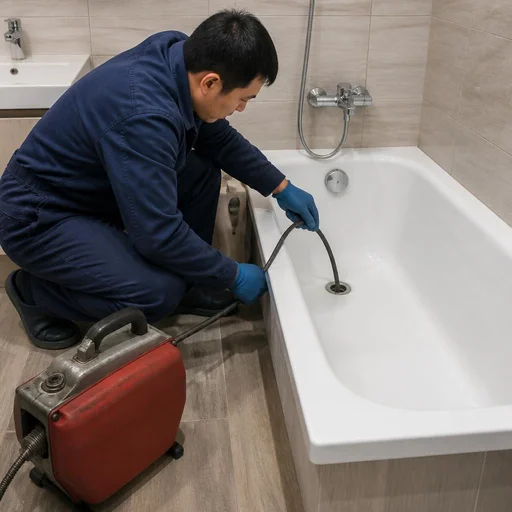
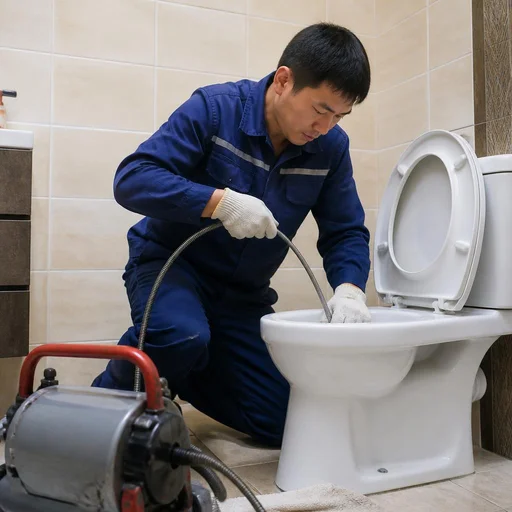
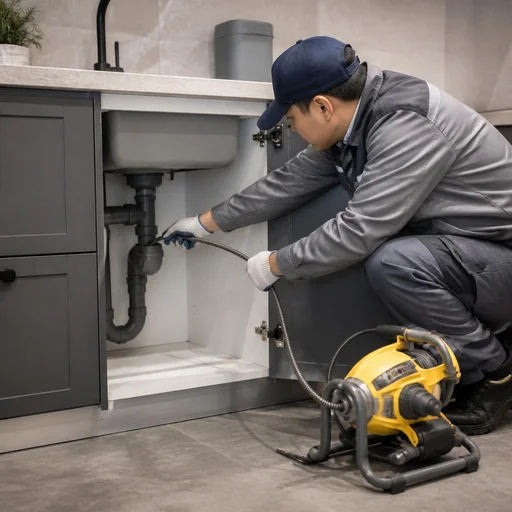
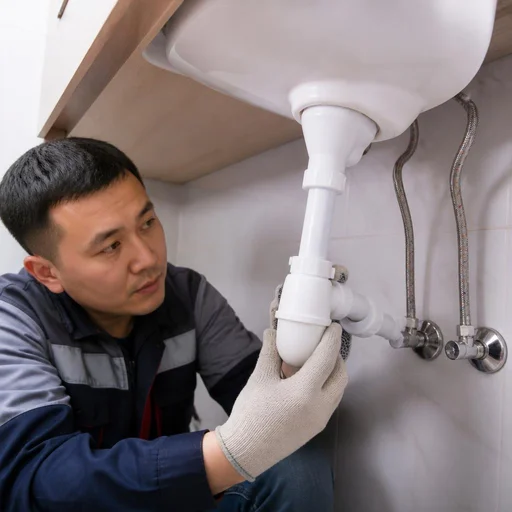
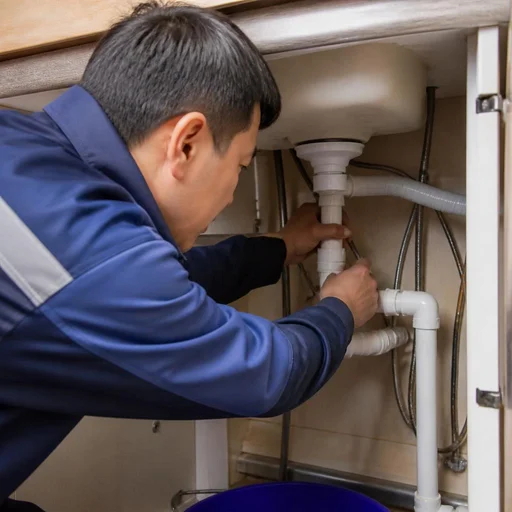
We clear clogs in sinks, bathtubs, shower trays, and toilets with a plumbing auger — this is a fast way to break through a blockage of hair, soap, and paper within an apartment. Clearing a sink clog takes 20-40 minutes: the technician disassembles the siphon, runs the auger through the bends, and flushes the section with hot water. Clearing a toilet clog is more difficult — a dense blockage requires an auger with a plunger attachment so as not to scratch the ceramic and not tear the gasket. The auger is effective on short sections up to 3-5 meters and on small-diameter pipes; in a kitchen riser and horizontal branch it is often useless — those require hydro-jetting or a CCTV inspection.
Hydro-Jetting: When the Auger Is Powerless
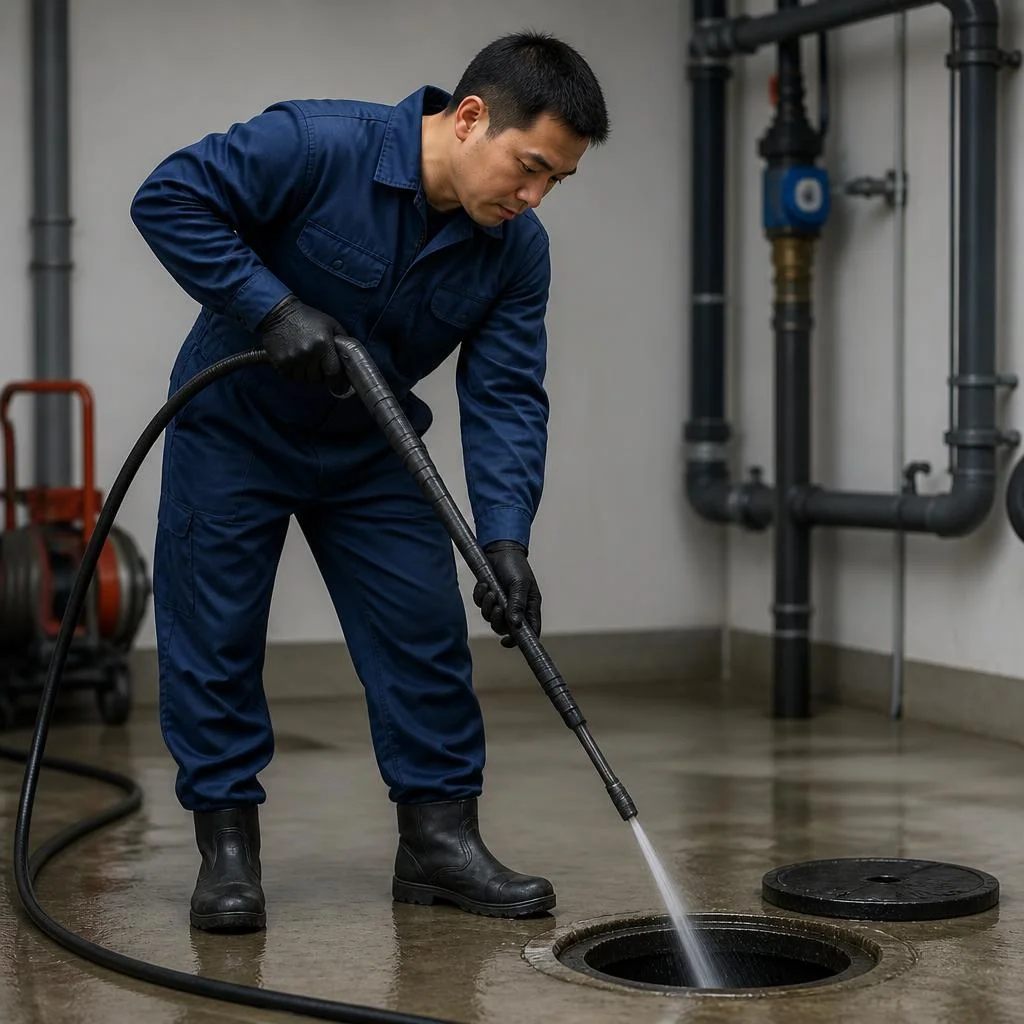
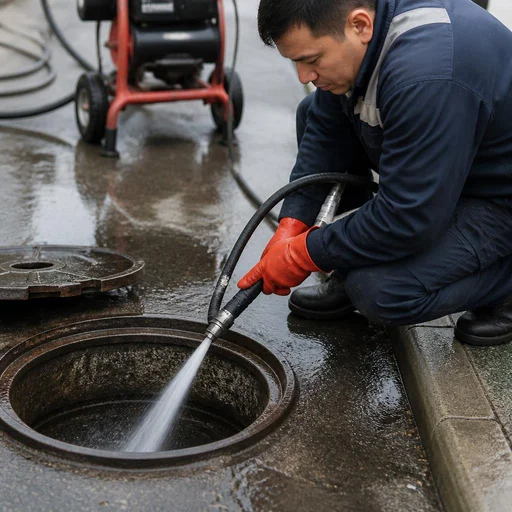
We use hydro-jetting of the pipe for kitchen risers, horizontal branches, and sections with grease deposits: a pressurized water jet washes away the buildup around the entire circumference of the pipe. A hydro-jetting machine supplies water at pressures up to 150-200 bar through a hose with a backward-facing nozzle — thanks to reactive thrust, it propels itself along the pipe and removes grease, soap stone, and silt from the walls. A kitchen riser in a panel building takes 1-2 hours, a horizontal branch — up to 3 hours with mandatory flushing of the two or three nearest manholes. Hydro-jetting restores the original diameter of the pipe rather than simply punching a hole in the blockage — after it, the clog does not return in 2-3 weeks, as it does after an auger. When a clog goes beyond the house, clients search for "outdoor sewer" — and end up here: on outdoor sections from the manhole to the septic tank, an auger is useless, and hydro-jetting with CCTV inspection works according to the same scheme as inside a riser.
Comparison of Clog Removal Methods by Zone
| Zone | Method | When It Is Used | What It Achieves |
|---|---|---|---|
| Sink, bathtub, shower tray | Auger | Hair, soap, paper | Fast removal |
| Toilet | Auger | Dense blockage | Flow restored |
| Kitchen riser | Hydro-jetting | Grease deposits | Clean pipe around the circumference |
| Horizontal branch | Hydro-jetting + CCTV inspection | Recurring clog | Exact cause identified |
| Washing machine | Auger + flushing | Scale, lint | Clog removed |
The technician selects the method based on the pipe diameter and the length of the section: choosing the wrong tool leads to damage of the cast-iron riser and a shift from cleaning to replacing the section. Through Eco-Service, you can order a CCTV inspection before hydro-jetting — the camera will show whether there are cracks in the pipe or a displaced socket, which would only accelerate destruction under pressure flushing.
Sewer repair in an apartment: replacing fittings and pipe sections
When cleaning doesn't help, it's a matter of replacing elements. We break down which fittings are replaced in an apartment and how sewer restoration is carried out without dismantling the entire bathroom.
Replacing siphons, seals and flexible connections
- Replacing a sink siphon: a plastic bottle siphon is removed in 15-20 minutes, and the new part is installed on the same thread without reworking the drain outlet.
- Replacing a bathtub siphon: here the siphon is often combined with the overflow, so we replace the entire assembly — replacing the overflow bowl separately is not leak-tight.
- Replacing a toilet seal: the rubber ring between the bowl and the outlet is replaced without removing the bowl, if the mounting bolts are not seized to the ceramic.
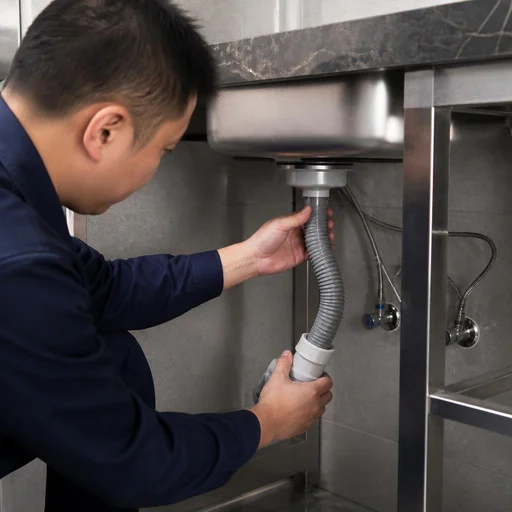
- Replacing the flexible drain connection: a reinforced hose lasts 3-5 years, after which the corrugation cracks and leaks at the joint with the pipe.
Replacing a bend, tee and pipe section
We replace a sewer tee, a sewer pipe bend and a section of cast-iron or plastic pipe — the work is performed by cutting out the damaged fragment and installing a new one. Such section replacement in a toilet takes from 2 to 4 hours: first the defective segment is cut out with an angle grinder, then the edges are cleaned and degreased, after which a new fragment is installed via a compression coupling or a socket with a sealing ring. On a cast-iron riser in Khrushchyovkas and Stalinkas in Bishkek, the diameter is usually 100 mm; in new buildings along Gogol and Kievskaya streets it's plastic 110 mm, and the adapter is selected strictly for that size. When replacing a section of cast-iron pipe with plastic, it's important to correctly select the adapter for the socket: the wrong size causes a leak at the joint a few months after the work.
Eliminating leaks and replacing the cleanout on the riser
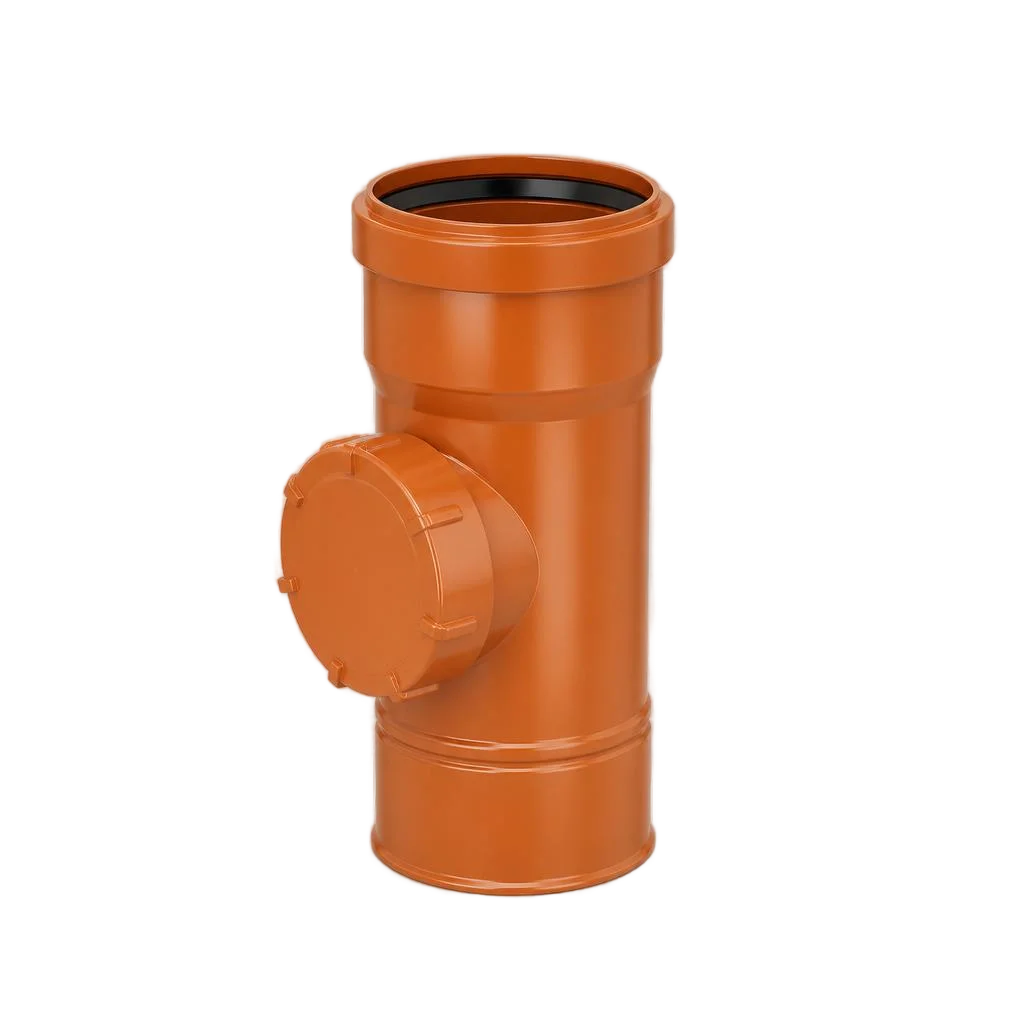
We eliminate sewer pipe leaks and replace the cleanout on the riser — the cleanout hatch is needed for access to the riser during cleaning and diagnostics. A leak on the riser often comes not from a crack but from depressurization of the cleanout: if it is replaced and tightened correctly, the problem goes away without replacing the entire riser. On old cast-iron risers in buildings along Chuy Prospekt and Zhibek-Zholu, the cleanout is fastened with four bolts, and the gasket under the cover hardens within 4-6 years — then water seeps along the thread, leaving rusty streaks on the ceiling of the neighbors below. We check the joint by tension and a test flush of 10-15 liters of water to make sure it is leak-tight before closing the hatch. If the cleanout thread is stripped, welding in a new coupling is cheaper than replacing the entire riser section. Clients often state the task briefly — sewer pipe repair — and the technician on site clarifies exactly which fitting has failed.
What is included in sewer pipe repair in an apartment
- Diagnostics: the technician inspects the fitting, and for a questionable section runs a CCTV inspection to precisely determine the boundaries of the damage.
- Cutting out the section: the defective fragment is removed with an angle grinder with a margin of 5-10 cm on each side of the crack or pinhole.
- Installing the new fragment: the plastic or cast-iron insert is connected via a coupling or a socket with a seal.
- Checking the joints: each seam is coated with sealant and checked by tension dry before water is supplied.
- Test flush: 15-20 liters of water are run through the new section, and the slope is checked with a level — the norm is 2 cm per meter for pipes with a diameter of 50 mm.
Sewer repair in an apartment building: stack, basement, horizontal run
In an apartment building, sewer restoration is divided by areas of responsibility: the apartment belongs to the resident, the stack and basement belong to the management company. We break down where the boundary lies and how the work is structured in each section.
Area of responsibility: what the resident fixes and what the management company fixes
The resident is responsible for the pipes up to the first joint with the stack, the management company is responsible for the stack, the horizontal run and the basement distribution; in the event of an emergency on the stack, the call goes to the management company. The boundary runs at the tee: everything above and beyond the branch into the apartment is common property of the building, and it is serviced by the management company under the management contract. Common property includes the stacks up to the first shut-off device, the horizontal runs in the basement, the outlets up to the first manhole and the cleanouts. Replacing the siphon, the toilet seal or the flexible drain connection is the resident's area, and this work is done at their own expense. In our practice, in Bishkek five-story buildings on Chuy Avenue and Toktogul Street, the management company has not replaced the cast-iron horizontal runs for years, and water escapes through gaps in the floor slabs. In practice, the management company often delays work on the stack — if this floods an apartment, document the damage with a report together with the neighbors and a management company representative; this is grounds for compensation.
Sewer repair in the basement of an apartment building
We perform sewer restoration in the basement of an apartment building: we eliminate leaks on the basement distribution, replace sections of cast-iron pipes and clean the horizontal run with hydrojetting. The basement distribution collects wastewater from all the stacks of the entrance, so an emergency here stops drainage for an entire section — requests about such leaks come in batches from apartments on different floors. Hydrodynamic flushing at pressures up to 150 bar removes grease and mineral deposits from the walls of the horizontal run, and CCTV inspection shows in advance where the pipe has rusted through. We offer manhole restoration as a separate service — this is how residents of the private sector and chairpersons of cooperatives whose outlets end in an inspection manhole in the yard formulate their request. The work is coordinated with the management company: during the opening and repair, the basement remains under its control. In the basements of Bishkek five-story buildings, cast-iron horizontal runs are laid without a slope or with a reverse slope — simple cleaning does not help, the section needs to be relaid with the correct slope set.
Sewer repair in an apartment building: stack and horizontal run
We repair stacks and horizontal runs in apartment buildings: we cut out damaged sections of cast-iron pipes, install plastic inserts and restore the tightness of the joints. The stack is replaced in sections from cleanout to cleanout so as not to open up the floor slabs through the entire height: a plastic pipe with a diameter of 110 mm fits into the cast-iron socket through an adapter and lasts longer than the original metal. The horizontal run in the basement is relaid with a slope of 2 cm per linear meter — with such a slope the flow washes away solid particles by itself and blockages form less often. The joints are checked for tightness by pouring water under pressure before the stack is put into operation. Replacing a section of the stack requires coordination with the neighbors in the entrance and the management company: during the work the water in the stack is shut off, so the work is scheduled for a short interval.
Major sewer repair in an apartment building
Major sewer repair in an apartment building is needed when more than half of the stacks and horizontal runs are worn out: spot replacements no longer give results, a complete relaying is required. During major repair, the stacks are replaced through the entire height of the section, the horizontal runs in the basement and the outlets up to the first manhole, and the cast iron is replaced with plastic with diameters calculated for the current number of bathrooms. The work is carried out in stages, one stack at a time, so that residents are not left without a sewer for the entire duration: one stack in a five-story building is replaced in a single shift. Coordination with the management company and the owners takes more time than the installation itself — the design and estimate are prepared in advance. A sign that it is time for major repair is repeated blockages and leaks in different apartments of the same stack within a year: this means that the pipe is worn out along its entire length, and not at a single point.
Outdoor sewerage, wells and repair without excavation
Outdoor networks begin at the outlet from the house and end at a well or storm drain. We explain how underground pipes are restored without excavating the entire yard and when restoration of sewer wells is required.
Restoration of outdoor sewerage and sewer wells
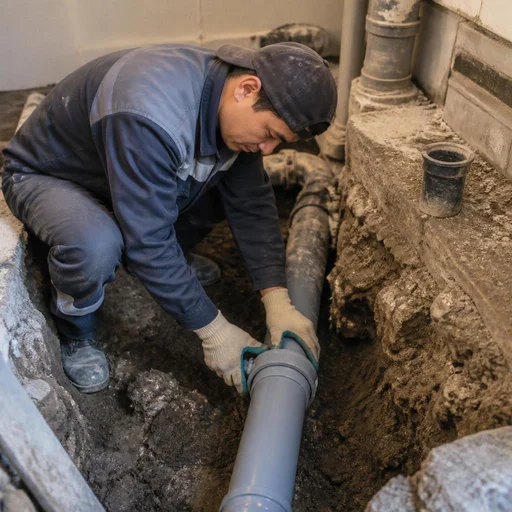
We perform restoration of outdoor sewerage and sewer wells: we restore the tightness of the walls, replace destroyed channels, and eliminate soil subsidence above the pipe. Work begins with a CCTV inspection — the camera shows the condition of the joints, cracks in the concrete and the level of deposits on the channel. Soil subsidence above a well is the first sign of depressurization: if the channel is not restored, sewage seeps into the ground and erodes the base under a road or foundation. At Bishkek sites where wells stand under the roadway, we restore the channel and walls from the inside without breaking up the road surface. In the early stage, sealing and channel replacement are enough; in an advanced case, the well is rebuilt completely with excavation of a pit.
Restoration of storm sewerage
We perform restoration of storm sewerage: we clean clogged storm inlets, renew damaged pipe sections, and eliminate water stagnation after rain. Storm drains clog with sand, leaves and gravel faster than a domestic network, and in spring and autumn the load on storm inlets is at its maximum — if water stands in the yard for days after rain, what is needed is not cleaning of one inlet but hydrodynamic flushing of the entire branch. Clients often phrase the request as storm sewer repair — and in that case it involves a full cycle: from flushing the collector to sealing the sockets and replacing destroyed sections. We replace damaged pipe sections locally and seal cracks in the sockets. Before starting work we carry out a CCTV inspection: it shows where sand has accumulated and whether there is a void under the pipe.
Trenchless sewer restoration: without opening up or excavation
We perform trenchless sewer restoration: renewing the pipe from the inside without opening up the ground or dismantling the surface — the method is used for underground sections under roads, yards and lawns. The technology works on pipes with a diameter of 100 to 600 mm: a flexible liner or polymer shell is inserted inside, which after curing forms a new wall with the same internal passage. Clients often phrase the request as sewer repair without opening up — and this is exactly the technology where the yard and asphalt remain untouched. The savings on earthworks and on restoring the landscaping are significant: after excavating a yard, tiles or asphalt must be laid again, whereas here the surface remains intact. The trenchless method is not suitable if the pipe has collapsed or has a displacement of more than two diameters — then local excavation is needed.
Restoration of sewer pipes underground: methods and limitations
We perform restoration of sewer pipes underground using trenchless renewal methods and local excavation — the choice depends on the depth of burial, the material and the nature of the damage. At a depth of up to 1.5 metres, local excavation is more often used: the ground is opened up only above the damaged section, the fragment is replaced and backfilled. At a depth of 2 metres and under permanent surfaces, trenchless restoration is more advantageous — it does not require earthworks along the entire length of the route. Cast-iron pipes of the old stock usually have corrosion pinholes along their entire length, and local replacement here gives only a temporary effect. Restoration of sewer pipes without excavation on such sections extends the life of the line for years, but before choosing a method a CCTV inspection is mandatory: it shows whether the pipe is damaged at one point or worn along its entire length.
Comparison of outdoor restoration methods
| Method | When it is used | Ground excavation | Surface restoration |
|---|---|---|---|
| Spot excavation | Local damage | Over one section | Required |
| Trenchless rehabilitation | Wear along the length | Not required | Not required |
| Flushing + CCTV inspection | Blockage without destruction | Not required | Not required |
| Section replacement | Pipe destruction | Over the damage | Required |
Before choosing a method, a CCTV inspection is mandatory: without it, you cannot tell whether the pipe is damaged at a single point or worn along its entire length. This determines both the method and the scope of work — for a local defect, spot excavation is sufficient, while for wear along the length of the line, trenchless rehabilitation costs less than sequentially replacing several sections.
Sewer repair in a private house and water supply: what to consider
In the private sector, the sewer system is autonomous — a septic tank, a cesspit, or local treatment facilities. We break down how work in a private house differs and why sewer and water supply tasks often appear in the same estimate.
Autonomous systems: what to consider
We perform system rehabilitation in a private house: we clear blockages in the outlet, replace damaged sections of the outdoor pipe, and restore the tightness of the septic tank or cesspit. In the private sector of Bishkek — from Alamudun to Oktyabrsky district — the outlet most often runs through a plastic pipe with a diameter of 110 mm at a depth of 0.8-1.2 m, and in areas with old asbestos cement, the joints separate after every winter ground movement. A two- or three-chamber septic tank is serviced once every 1-2 years, a cesspit — as it fills up, and if pumping does not help, then the problem is not the volume but silting of the bottom or a crack in the tank body. A common cause of blockages in the private sector is tree roots that have grown into the joints of the outdoor pipe: they are removed mechanically, and the joint is sealed, otherwise the roots will return within a season.
Water supply repair in Bishkek: the connection to sewerage
We repair water supply lines: we replace damaged pipe sections, eliminate leaks, and restore water supply — often this work is done together with sewer line maintenance. In a private house, the water inlet and the sewer outlet usually lie in the same trench at a depth below the freezing point (for Bishkek — about 1.2-1.5 m), so a single ground subsidence hits both lines at once: a 25-32 mm polypropylene water pipe cracks along the seam, and the sewer branch loses its slope. A sign of a common cause is a simultaneous drop in pressure and a smell from the inspection port; then the trench is opened once and both sections are replaced. If a house simultaneously smells of sewage and the water pressure drops, the cause may be common — ground subsidence under the foundation has damaged both pipes; in this case, the work is done as a comprehensive job.
Major sewer repair: when spot work is not enough
Major rehabilitation is needed when the pipe is worn along its entire length: spot replacements give a temporary effect, and a year later the problem returns at a new section. A cast-iron outlet older than 30 years, asbestos cement with visible pitting, plastic with cracks after several seasons — all of these are reasons not to patch a joint but to replace the line entirely while maintaining a slope of 2 cm per meter for a 110 mm pipe. In the private sector, relaying is done by the open-cut method along the existing trench, less often — by pulling a new pipe inside the old one, if the diameter allows. Clients often describe the task in their own words — pipes underground — and from such a request we immediately understand: this is about an outdoor line, not indoor plumbing. The decision on major repair is made after a CCTV inspection of the entire line: if the camera shows cracks and pitting in several sections, it is cheaper to relay the line entirely than to patch it piece by piece.
Warranty, timelines and how to order sewer repair
We explain how the ordering process works, how long the work takes and what the 2-year warranty on completed work gives you. Separately — about round-the-clock dispatch, our own service center and where to find customer reviews.
2-year warranty on all types of work
Eco-Service gives a 2-year warranty on all types of sewer restoration work — from cleaning to replacing a section of pipe and trenchless restoration. The two-year term covers mechanical cable cleaning, hydrodynamic flushing, and replacement of a branch, tee or inspection fitting on the riser: a warranty certificate is issued for every visit, not just for major work. For trenchless restoration of the pipe from the inside, the condition is the same — 2 years, because we work with certified materials and are responsible for the method itself, not just for the fact that the emergency was fixed. The warranty is valid subject to compliance with operating conditions: if construction waste or rags get into the pipe after the work, the case is considered non-warranty — that is why the technician warns about this on site.
Work timelines and round-the-clock dispatch
We respond to emergency blockages around the clock, and we carry out scheduled tasks within 1-2 days depending on the scope. A night call-out in Bishkek and the suburbs does not differ in cost from a daytime one — the dispatcher takes the request at any time, and the technician sets off within 40-60 minutes after the call. For scheduled work — replacing a riser, an inspection fitting or a section of cast-iron pipe — we agree on a time in advance so as not to shut off the neighbors' water during peak hours. Clients often phrase the request as pipes without excavation — and this is exactly the scenario where we work using the trenchless method, without digging up the yard or the paving tiles. Most blockages are cleared in a single visit: the technician arrives with a cable and hydrodynamic unit, so there is no need to wait for a separate visit for cleaning and diagnostics.
Our own service center and reviews in Bishkek
- Taking requests: the Eco-Service service center in Bishkek takes calls around the clock and distributes call-outs among the crews.
- Coordination: the dispatcher records the address and the nature of the blockage and passes the data to the technician before the visit — this saves time on site.
- Warranty documents: the 2-year certificate is stored in the center's archive; if the problem recurs, there is no need to look for the paperwork.
- Reviews: clients leave ratings on 2GIS and Google Maps — there you can see real addresses and dates of completed work.
Conclusion
We have gathered the main things that determine the outcome of water disposal restoration work: from distinguishing between a blockage and damage to the warranty documents.
Key takeaways
- A blockage and damage are different problems: cleaning removes the plug, while a crack, a displaced joint or a sagging section require replacing a fragment of the pipe.
- A CCTV inspection before serious intervention is essential: the camera shows the exact location and depth of the defect, so excavation is done in a targeted way, not along the entire length of the line.
- In an apartment building, the area of responsibility is divided: in-unit fixtures and piping are the resident's responsibility, while the riser, the horizontal run and the basement are the management company's.
- Outdoor networks are repaired according to the condition of the pipe: when there is wear along the length, the trenchless method is suitable; for local damage, targeted excavation is cheaper.
- The warranty is documented: a two-year term is sufficient for hidden defects in joints and soil settlement around the pipe to show up.
- Prevention is cheaper than an emergency: check the inspection fittings and slopes once every 2-3 years, especially in old housing stock with cast-iron risers.