
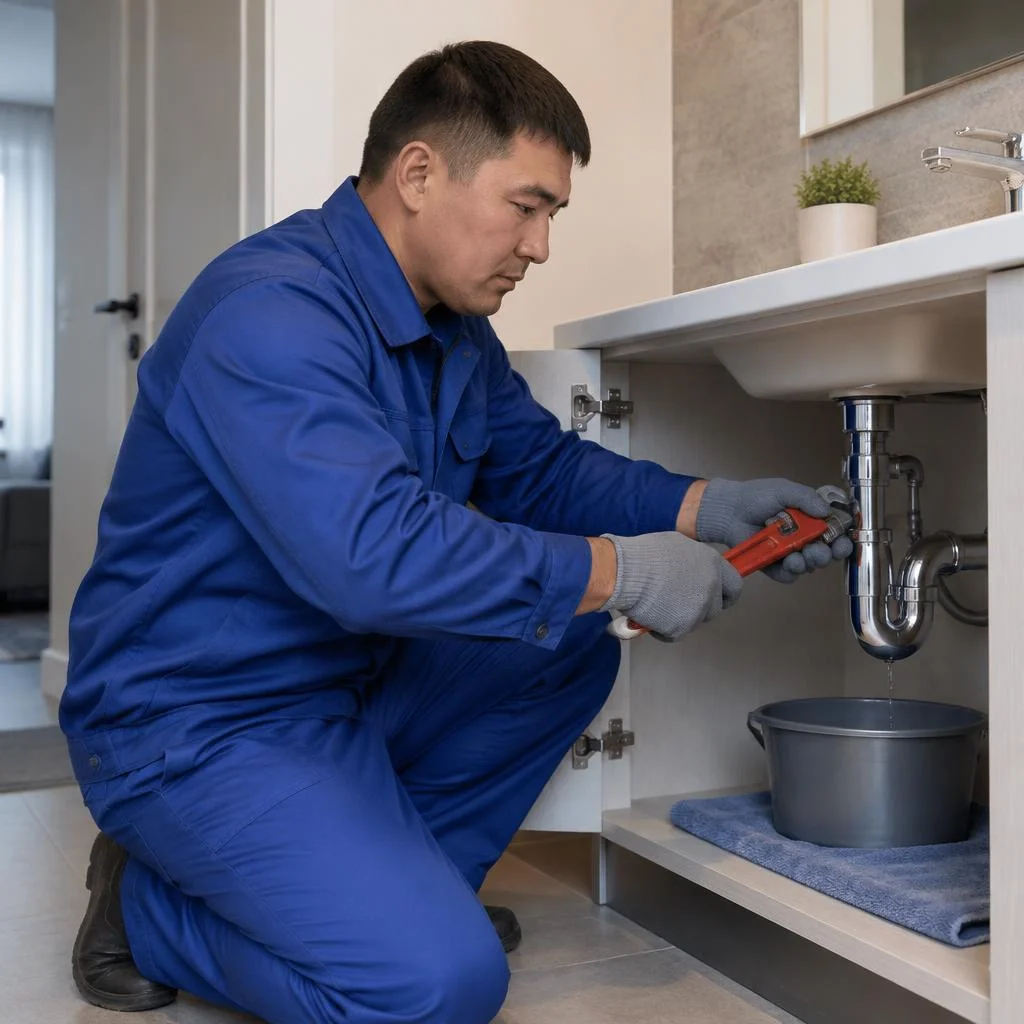
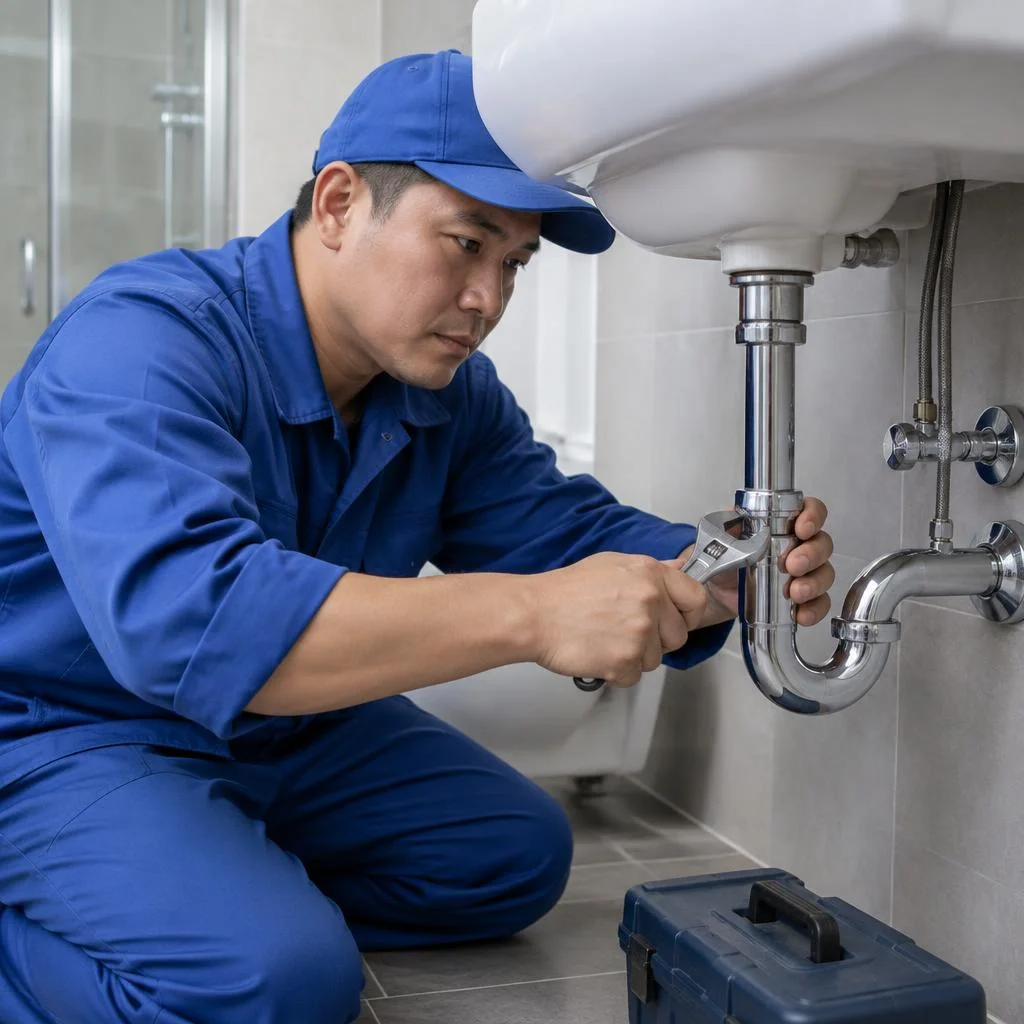
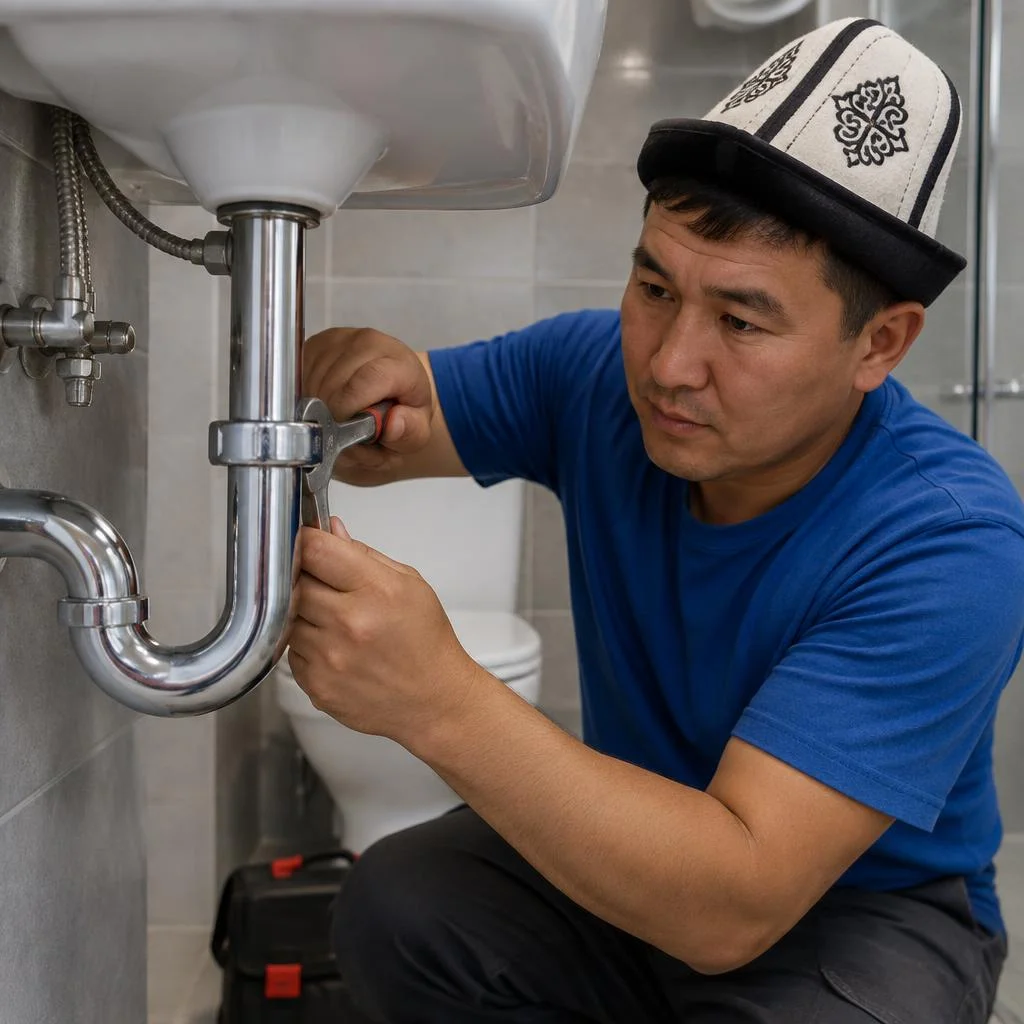
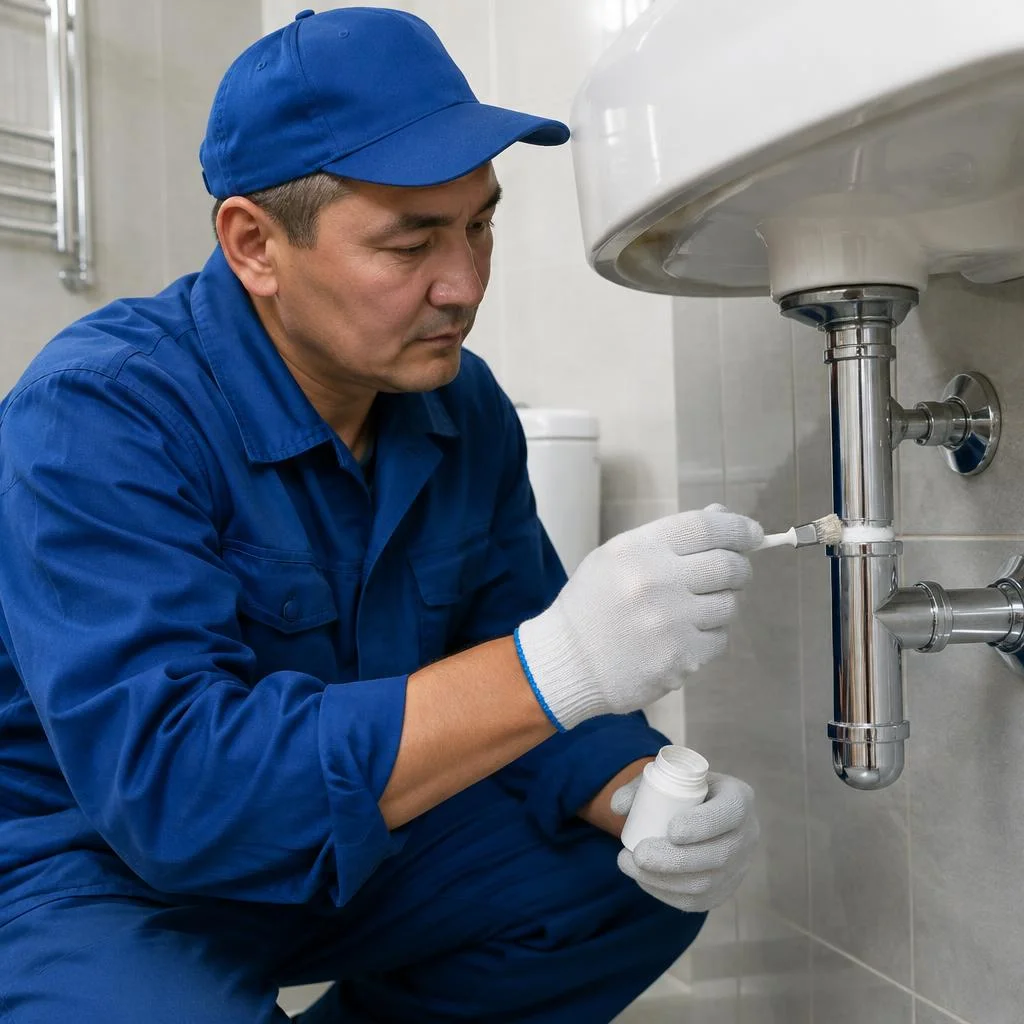








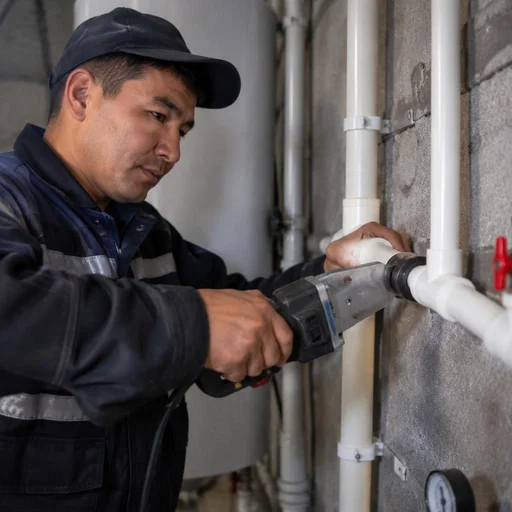
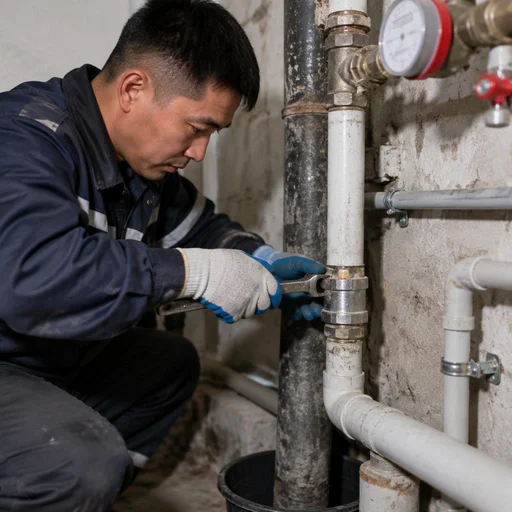
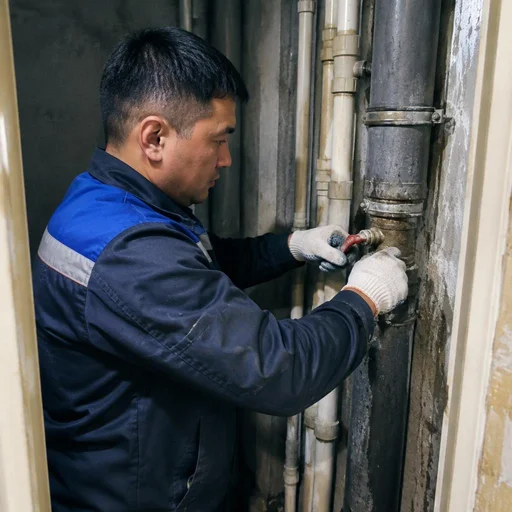
Why pipes leak: causes of leaks and first actions in an emergency
A leak rarely happens "suddenly" — there is always a cause, and the first ten minutes determine the scale of the damage. Let's look at where a leak comes from and what to do before the technician arrives.
What to do in the first minutes if a pipe bursts
- Shut off the water: turn the main inlet valve or the valve on the riser — emergency shut-off of the riser stops the flow in 10-20 seconds.
- Cut the power to the area: switch off the breaker in the panel for the room where the leak is — water and electricity together are dangerous.
- Place a container underneath: a basin or bucket under the stream, rags around the perimeter, so the water doesn't reach the neighbors below.
- Warn the neighbors: knock on the doors of those below — flooding is recorded in an official report, and it's better if they see the first traces.
- Note the time: write down when you shut off the water — this figure will be needed for the flooding report and the discussion with the insurance company.
Typical causes of leaks in Bishkek apartments and houses
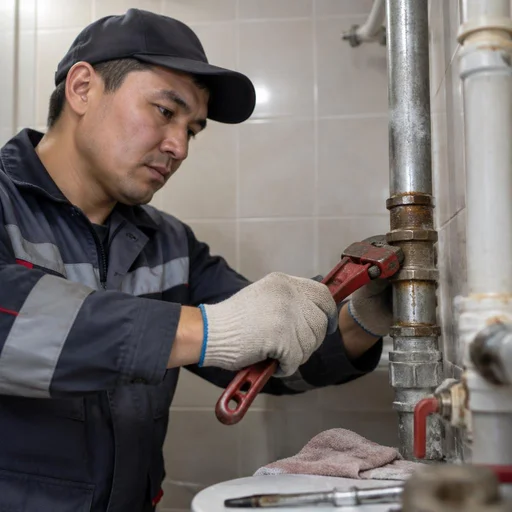
- Threaded connection on steel: pipe nipples and locknuts on old risers lose their seal first — repairing a threaded connection is the most frequent call-out here.
- Pinhole on a steel pipe: pinpoint corrosion eats through the wall from the inside, and a thin stream breaks through to the outside.
- Polypropylene solder joint: an underheated or overheated seam cracks after a pressure surge in the network.
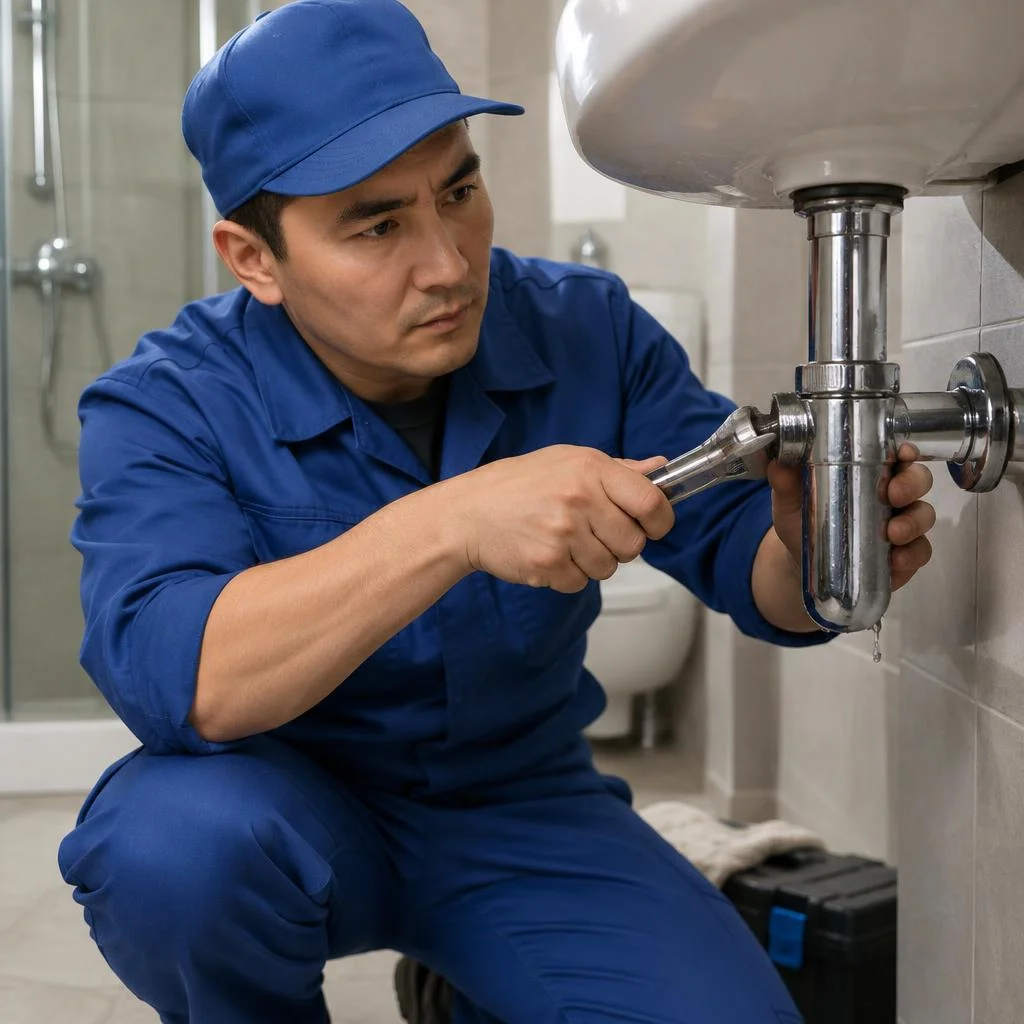
- Compression fitting on metal-plastic: at the bend the ring loosens, and the pipe starts to sweat, then leak.
- Seasonal factor: autumn-spring pressure fluctuations in the city network cause a peak in calls about pinholes and thread seal failures.
How leaks in steel, polypropylene and metal-plastic differ
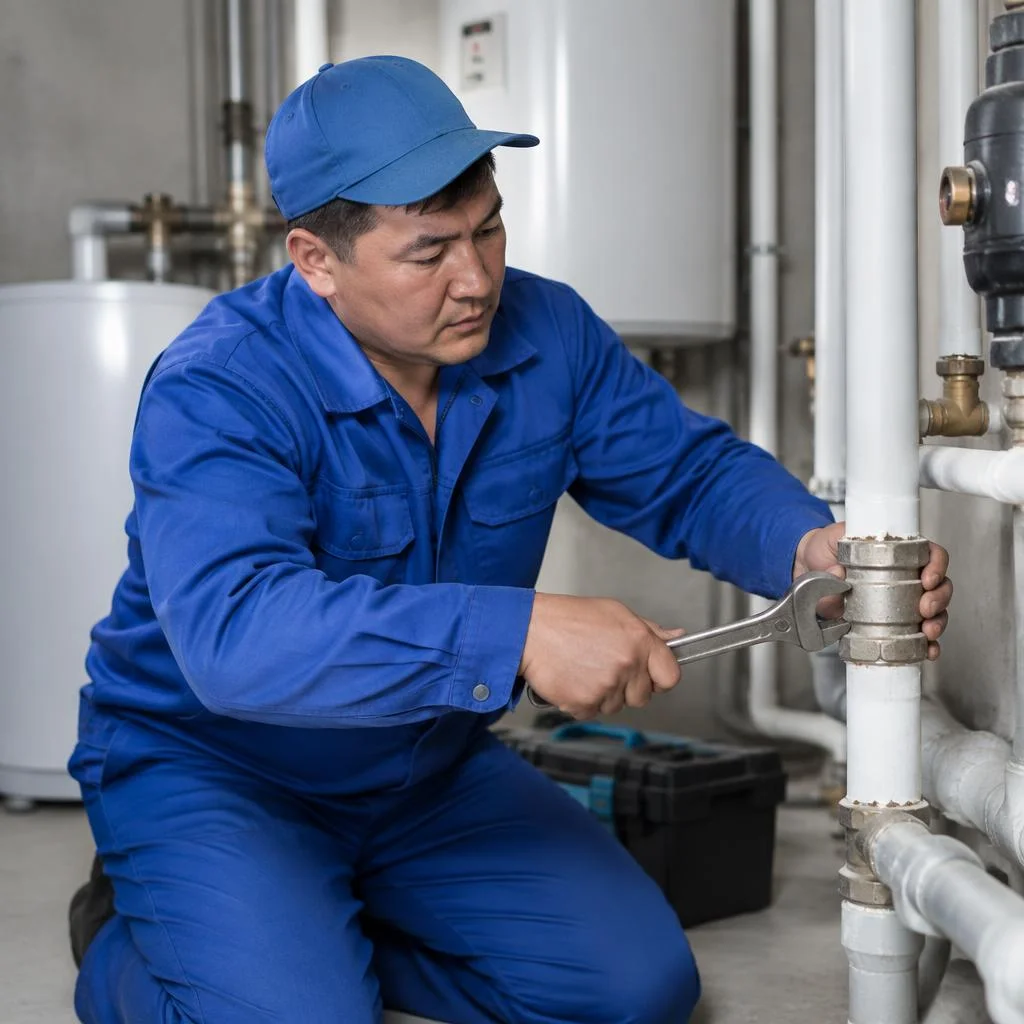
The pipe material determines the repair method: where steel can still be sealed with a clamp, polypropylene requires soldering, and metal-plastic requires replacing the fitting. Fixing pipe leaks at an early stage costs less than replacing a section, so don't put off diagnosing the joint until the point leak turns into a rupture. In our practice, on Bishkek risers we most often have to open up the steel nipple: rust goes 2-3 mm deep, and the clamp only holds for a few weeks. On polypropylene runs, the problem is almost always in a single seam — it can be seen as a thin crack spreading from the coupling. Metal-plastic gives itself away by sweating at the nut of the compression fitting long before the first drop. If a leak appears on a thread, first release the pressure in the riser and only then take the connection apart — otherwise a stripped locknut will add work for the neighbors below.
How Eco-Service finds and fixes a pipe leak: diagnostics and methods
The repair method depends on exactly where it's leaking and whether the spot can be reached without opening up the wall. Here's how we find the leak and which methods we use.
Finding a hidden leak without destroying the wall
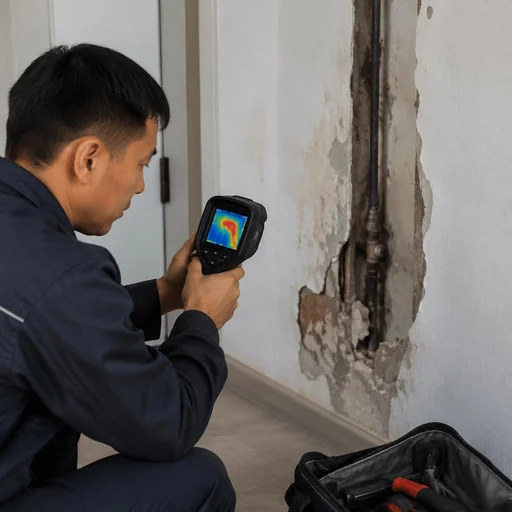
We find a hidden leak without opening up the wall: the technician locates the spot by moisture zones and traces at the joints, then confirms the area with a targeted opening. Searching for a hidden leak in a panel building on Toktogul Street or in a khrushchyovka in Jalal microdistrict follows the same algorithm: we check the wall's moisture, inspect the riser passages, listen for noise in the pipe and compare it with the meter readings when it spins with the taps closed. Our plumber works with a thermal imager and a moisture meter — the devices show the zone of increased moisture in 10-15 minutes, without tearing out the tiles in the bathroom. An early sign of a hidden leak is not a puddle, but a constantly damp corner, bubbling paint or a musty smell: if you notice this, don't wait for visible water, diagnostics will cost less than repairing the wall.
Fixing a pipe leak without replacement: sealing, clamp, cold welding
- Sealing the joint: an anaerobic compound or flax with paste on a threaded connection holds pressure up to 10 bar if the thread is in good condition.
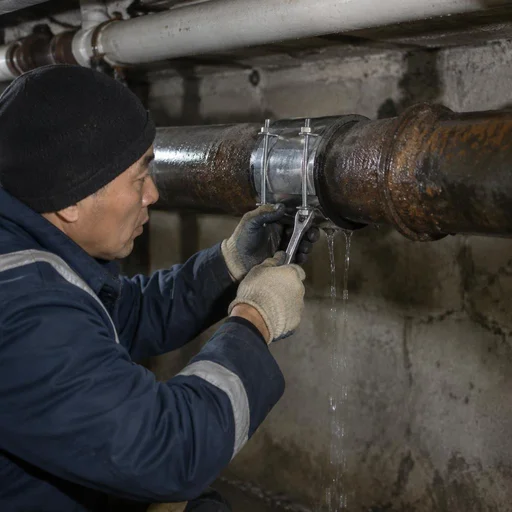
- Repair clamp: a rubber gasket with a metal body fits over the pinhole from the outside, works as a temporary measure on steel and cast iron.
- Cold welding: epoxy resin hardens in 15-20 minutes and covers pinpoint defects on polypropylene and metal-plastic.
- Replacing the locknut and nipple: rebuilding the threaded assembly without replacing the section, when it's the connection that's leaking, not the pipe body.
- Repairing the pipe without replacing the section: suitable only for local defects — if the metal is corroded along a stretch, the clamp gives a temporary effect and the leak will return elsewhere.
Fixing a leak on steel: pinhole, thread, section replacement
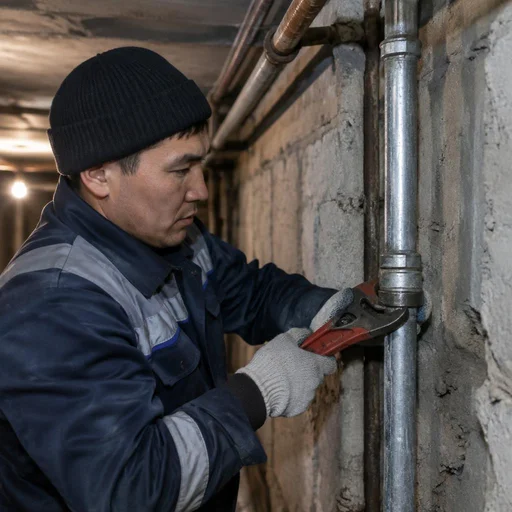
On a steel pipe we fight a leak in three ways: we weld or seal the pinhole, rebuild the threaded connection, replace the section in case of through corrosion. A pinhole on galvanized steel in Bishkek buildings of Soviet construction is a common story: the thin wall rots from the inside, and water starts to seep drop by drop. The technician cuts out the defective stretch with a grinder, welds in a new one via a nipple and locknut, or installs a threaded repair coupling if the pipe still holds pressure. We do a pinpoint patch with a clamp only as an emergency measure for the night or the weekend. A pinhole on steel is almost always a signal that the pipe is worn from the inside: a pinpoint patch will save you for months, but you should plan to replace the section right away.
Repairing polypropylene and metal-plastic: soldering and replacing fittings
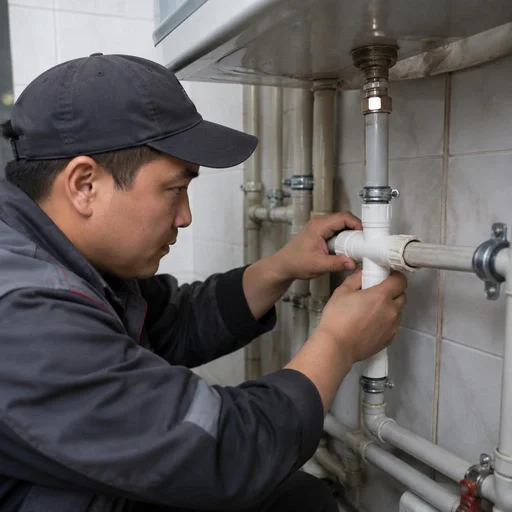
We repair polypropylene by soldering, metal-plastic by replacing compression and press fittings: couplings, elbows, tees. A polypropylene pipe on a hot water riser in new buildings in Jalal microdistrict or in Asanbay holds 95 °C, but a joint welded with overheating cracks along the seam after 2-3 years — then the technician cuts out the assembly and welds in a new one. On metal-plastic, a compression fitting more often leaks due to a loosened nut: tightening helps for a week, the right solution is to replace the fitting with a press version with a crimp sleeve. Polypropylene cannot be sealed with external compounds — the joint only holds with re-soldering, so the technician always cuts out the defective assembly and welds in a new one.
What tools and spare parts the technician brings along
- Press tongs: for press fittings on metal-plastic and PEX, crimp the sleeve in one motion.
- Polypropylene soldering iron: with 20-32 mm attachments, welds in a coupling or tee right on site.
- Adjustable and gas wrench: for threaded connections on steel and cast iron, including riser nipples.
- Repair clamps: rubber-metal, sizes 15-110 mm, for emergency stopping of a leak.
- Spare parts in the vehicle: couplings, nipples, locknuts, tees, bends, flax, paste, cold welding.
- Moisture meter and thermal imager: for finding a hidden leak without opening up — standard fittings and clamps are on hand, so most leaks are fixed in a single visit.
Emergency pipe leak repair: how urgent call-out works
An emergency request differs from scheduled repairs: first the water is shut off, then the cause is fixed. Here's how an urgent call-out works.
Emergency riser shutoff and leak containment
In an emergency, the first thing we do is perform an emergency riser shutoff and contain the leak to stop flooding of neighbours. In Bishkek's khrushchyovkas and 5-9 storey panel buildings, the main valve is most often located in the basement or on the technical floor, less often in the stairwell vestibule; our emergency crew knows the typical building systems in the Asanbay, Alamedin-1, Dzhal and Vostok-2 microdistricts and reaches the shutoff valves within minutes. Shutting off the riser affects the entire entrance — warn your neighbours and the management company in advance so as not to provoke a conflict and to gain access to the shared valve. If the valve is seized and doesn't close fully, residual pressure will still cause a leak — in that case we shut off the inlet into the apartment and install a repair clamp as a temporary measure.
Urgent call-out of a technician and emergency crew in Bishkek
The Eco-Service emergency crew accepts urgent requests and travels to the address to stop the leak and carry out a temporary repair. The shift is staffed by plumbers with a pressure-testing pump, a set of clamps for diameters 15-50 mm, press tongs for metal-plastic and a welding machine for polypropylene — on site the crew seals a pinhole leak, replaces a section or installs a plug until the welder arrives. Until the crew arrives, keep the inlet valve closed — if you open the water "to check", the pressure will blow out the temporary plug and the flooding will happen again. The dispatcher accepts requests around the clock, including weekends and holidays, so work is not postponed until Monday morning.
Who is responsible for a riser leak in an apartment building
The riser and common property are the responsibility of the management company or the homeowners' association (TSZh), while the branches and in-apartment piping after the first valve are the owner's responsibility. The boundary of responsibility runs at the first shutoff valve: everything before it is the management company's area, everything after it is yours, and this determines who pays for the repair. If neighbours below are flooded, call a representative of the management company and draw up a flooding report with photographic evidence before work begins — without this document, the insurer or court will not accept a claim. If the riser is leaking, the repair is at the management company's expense; if a flexible hose under the sink or a polypropylene elbow in the piping has burst, that is the owner's area, and the work is carried out at their expense. The report is drawn up in two copies, one of which stays with you.
What pipe leak repair includes and how the repair is carried out
Leak repair is not just about sealing a hole: it is important to restore the tightness of the assembly and make sure there is no leak under operating pressure. Let's break down the stages, types of work and what the service includes.
Stages of work: from diagnostics to pressure testing of the pipeline
- Diagnostics: the technician inspects the assembly, checks the wall moisture with a moisture meter and identifies the source — a pinhole leak, a threaded connection, a fitting.
- Shutting off the water: we close the valve on the supply line or the riser; if the shut-off valve is corroded, we install a temporary plug until it is replaced.
- Repairing the assembly: sealing the joint, installing a repair clamp or replacing a section of pipe — the choice depends on the material and the extent of the damage.
- Pressure testing of the pipeline: we apply pressure above the operating pressure and hold it under a pressure gauge — the device will show whether the connection holds after the repair.
- Follow-up inspection: we check that the joint and adjacent fittings are dry, and record the pressure gauge readings in the work completion report.
What work is performed during leak repair: table of repair types
| Type of work | Material | When it is used |
|---|---|---|
| Sealing the joint | steel, cast iron | micro-leak on a thread, loosened joint |
| Installing a repair clamp | steel | pinhole leak up to 10 mm, emergency shutdown |
| Replacing a coupling | steel | crack or pinhole leak on a coupling |
| Replacing a pipe nipple | steel | wear of the threaded connection |
| Replacing a tee | steel, polypropylene | crack in the tee, branch |
| Replacing an elbow | steel, polypropylene | deformation of the angle, pinhole leak |
| Replacing a locknut | steel | stripped thread, dripping |
| Replacing a compression fitting | metal-plastic | leak along the crimp ring |
| Replacing a press fitting | PEX, metal-plastic | depressurization of the sleeve |
| Polypropylene soldering | polypropylene | crack on the welded seam |
Replacing a fitting is often more cost-effective than sealing: if the thread or coupling is worn, sealing the joint will give only a temporary result.
What the service includes and what the technician does on site
- Visit and diagnostics: the technician arrives with tools, finds the source of the leak and assesses the scope of work on site.
- Leak repair: sealing the joint, installing a repair clamp, replacing a coupling or pipe nipple — based on the inspection results.
- Consumables: couplings, pipe nipples, clamps, locknuts, sealants and gaskets are brought by the technician.
- Pressure testing: pressure testing of the assembly with a pressure gauge, checking that the joint and adjacent connections are dry after the repair.
- Documents: a work completion report stating the assembly, type of repair and pressure test result.
2-Year Warranty, Payment, and the Eco-Service Service Center in Bishkek
After a repair, it's important to understand what to do if the leak comes back and where to turn. We break down the warranty obligations, payment methods, and how our service center operates.
2-Year Warranty on Leak Repair
Eco-Service provides a 2-year warranty on leak repair: if the leak returns at the repaired unit, the technician will come again. The warranty covers the work and the installed parts: threaded connections, pipe nipples, couplings, clamps, polypropylene soldering, pipe section replacement, and pipeline pressure testing. The plumber records the unit, repair method, and date in the work order — this document is used to arrange a repeat visit without any dispute over the cause. The warranty is valid as long as access to the unit is maintained: if after the repair the unit is walled in or covered with tile without an inspection opening, a repeat visit becomes more complicated — the finish will have to be opened up, and that is a separate job. Leave an inspection hatch or removable panel at every connection — that way the technician can reach the unit in minutes, not hours.
Payment via MBANK, O!Dengi, and Optima Bank
- MBANK: transfer by phone number or via QR code — the payment arrives within a minute.
- O!Dengi: payment from wallet or card, the receipt is saved in the app.
- Optima Bank: bank transfer from an account, suitable for commercial properties.
- Demir Bank and Bakai Bank: payment by card or transfer, the work order is issued on site.
- Cash: the technician accepts payment after the work is completed and the work order is signed.
Eco-Service Service Center and Reviews on 2GIS
Eco-Service's own service center operates here: you can visit in person, and reviews of the work are collected on 2GIS. The center accepts requests for emergency visits, scheduled repairs, and pressure testing, and keeps a history of requests by address — if a leak recurs, the technician can see what was repaired and when. Residents of the capital leave reviews after each visit: they show how many hours it took the crew to arrive, how the repair ended, and how disputed cases were resolved. Before calling a technician, check the reviews on 2GIS for the specific address and date — recent reviews show how the service operates now, not a year ago. Requests are also accepted via Telegram and by phone — if the leak is severe, specify the floor and pipe type in your request right away so the crew brings the right fittings.
Leak prevention: how to avoid a repeat leak
Most repeat leaks can be prevented: it is enough to monitor pressure, the condition of connections, and to replace worn components in time. To eliminate a pipe leak at an early stage, regular inspection of connections is enough — it is cheaper than emergency repairs. Below — what to check yourself and when spot repairs no longer help.
What to check regularly so the pipe doesn't burst
- Threaded connections: inspect the joints on the riser and supply lines once every six months — drips, white deposits and rusty droplets give away a developing leak.
- Valves and taps: check the smooth operation of the shut-off valves; if the stem jams or has play, the unit needs servicing.
- Damp spots: moisture at the base of the riser, on the ceiling of the neighbors below or in the bathroom signals a hidden leak long before a rupture.
- System pressure: surges above 6-7 bar tear connections apart; a pressure gauge at the inlet will show the actual background level in the building.
- Flexible supply lines: replace them every 5-7 years — rubber hoses to mixers and toilet tanks crack from the inside and burst without warning.
When it's time to replace pipes rather than repair them
It's time to replace pipes if pinholes and leaks recur in the same section more than once a year, or if the pipe is affected by corrosion along its entire length. On a steel riser in an old building, a spot weld on a pinhole holds for months, then bursts nearby — the metal has thinned, and each repair only postpones the accident by a couple of weeks. Polypropylene and metal-plastic behave differently: here the cause is more often the fitting or the soldering, so replacing a section of pipe solves the problem rather than postponing it. In Bishkek's Khrushchyovkas and panel buildings, unprotected metal rarely lasts more than 20-25 years, while polypropylene's service life reaches 50. The guideline is simple: if the pipe is older than its service life and pinholes run along its entire length, plan to replace the section, not another clamp.
Conclusion
We've gathered the main things worth keeping in mind during an emergency and after a repair — a short set of rules that saves time and money. The main rule is to eliminate a pipe leak before it washes away the finish and reaches the neighbors.
Key takeaways
- Shut off the water first: in an emergency, immediately close the valve and cut power to the wet area; look for the cause afterwards.
- The repair method depends on the material: steel — a clamp and section replacement, polypropylene — soldering, metal-plastic — fitting replacement.
- Spot sealing is for local defects: if corrosion runs along the entire length of the pipe, the section needs replacing, not a patch.
- Pressure testing is mandatory after repair: it confirms tightness under working pressure, not just visually.
- Prevention is cheaper than an emergency: timely replacement of worn pipes and regular inspections reduce the risk of a repeat leak.