

















When the sewer system needs replacement: diagnostics and signs
Sewer replacement usually becomes necessary unnoticed: corrosion, deposits and cracks accumulate over the years. Let's look at how to distinguish a temporary clog from wear and why the scope of work is determined before dismantling, not after.
Signs that the sewer system has outlived its usefulness
- Constant smell from the sewer: if it does not go away after cleaning and disinfection, it means there are pinholes and microcracks under the joints or in the body of the pipe.
- Rusty streaks and pinholes on cast iron: brown marks along the riser, drops on the clamps and a characteristic coating indicate that the pipe wall has thinned to a critical value.
- Repeated clogs in the same section: if a blockage occurs two or more times per season in the same place, the bore is narrowed by corrosion and deposits.
- Clog after replacement: when a section has already been replaced, but water again drains slowly, the cause is an unreplaced neighboring segment or an incorrect slope.
- Slow drainage in all fixtures at once: simultaneous slowdown in the toilet, bathtub and sink points to a problem with the common riser, not an individual trap.
Diagnostics before replacement: what the technician checks
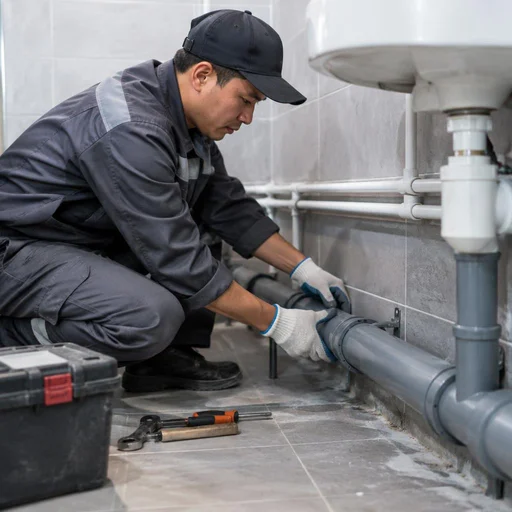
Before preparing an estimate, our technician inspects the riser, the horizontal distribution, the horizontal run in the basement and the outlet from the house — this makes it possible to determine precisely which sections to replace and which can still serve. The work begins with exactly such an inspection: the specialist checks the joints and inspection openings, measures the slope with a level or laser level, assesses the condition of the sockets and fittings, and on problem sections runs an inspection camera. In panel buildings in Bishkek (series 1-464, II-49, the Kyrgyz series), the riser is more often replaced entirely from floor to floor, while the horizontal run in the basement often remains serviceable for several more years. Clients often phrase the request as: sewer pipe replacement in a private house price — and from that it is immediately clear that the person needs both the scope of work and the calculation procedure. In my opinion, the camera pays for itself precisely on old cast-iron horizontal runs: it shows where the wall still holds and where it is already crumbly. Diagnostics before dismantling saves money: often it is enough to update the riser and distribution, and leave the horizontal run — but this can only be seen on site, not over the phone.
Replacing cast iron sewer pipes with plastic: materials and technology
Sewer replacement in Bishkek most often involves cast iron pipes: the metal corrodes, becomes overgrown on the inside, and cracks at the joints. Below — which polymers are replacing it, which diameter to use where, and how to assemble the system without welding.
Why cast iron is replaced with plastic: service life and properties
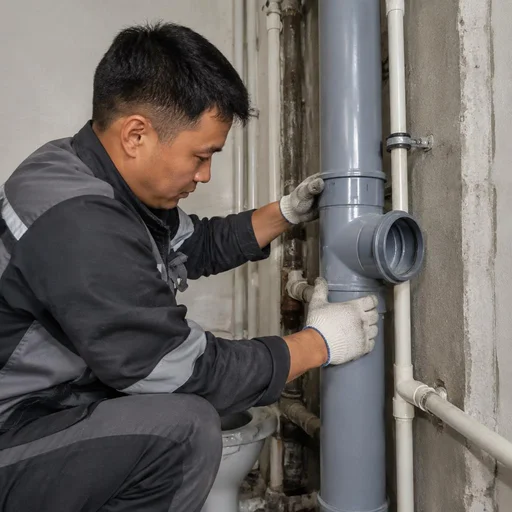
Plastic sewer systems last 50 years or more, do not corrode, do not become overgrown on the inside, and cost less than cast iron — which is why switching to polymers has become the standard for major renovations. Polypropylene and PVC pipes do not oxidize from moisture and cleaning agents, whereas cast iron over 25-30 years of use loses up to a third of its bore due to rust and grease deposits. A cast iron pipe weighs 4-5 times more than a polymer one of the same diameter, which complicates installation on upper floors and requires a helper. In requests, clients often write briefly: replacement of a sewer tee — and from that single line it is clear that the person has already disassembled the assembly and hit a stuck cast iron branch. The main gain is not in the price of the pipe, but in the smooth inner wall: plastic hardly accumulates grease and deposits, so clogs after such work occur far less often than with cast iron.
PP or PVC: what to choose for the riser and the distribution lines
| Section | Material | Diameter | Feature |
|---|---|---|---|
| Riser | PP | 110 mm | vertical, shared across floors |
| Basement horizontal run | PP | 110 mm | horizontal, with a slope |
| Distribution to fixtures | PP | 50 mm | to the sink, bathtub, toilet |
| Outlet from the house | PP / PVC | 110 mm | outlet to the manhole or septic tank |
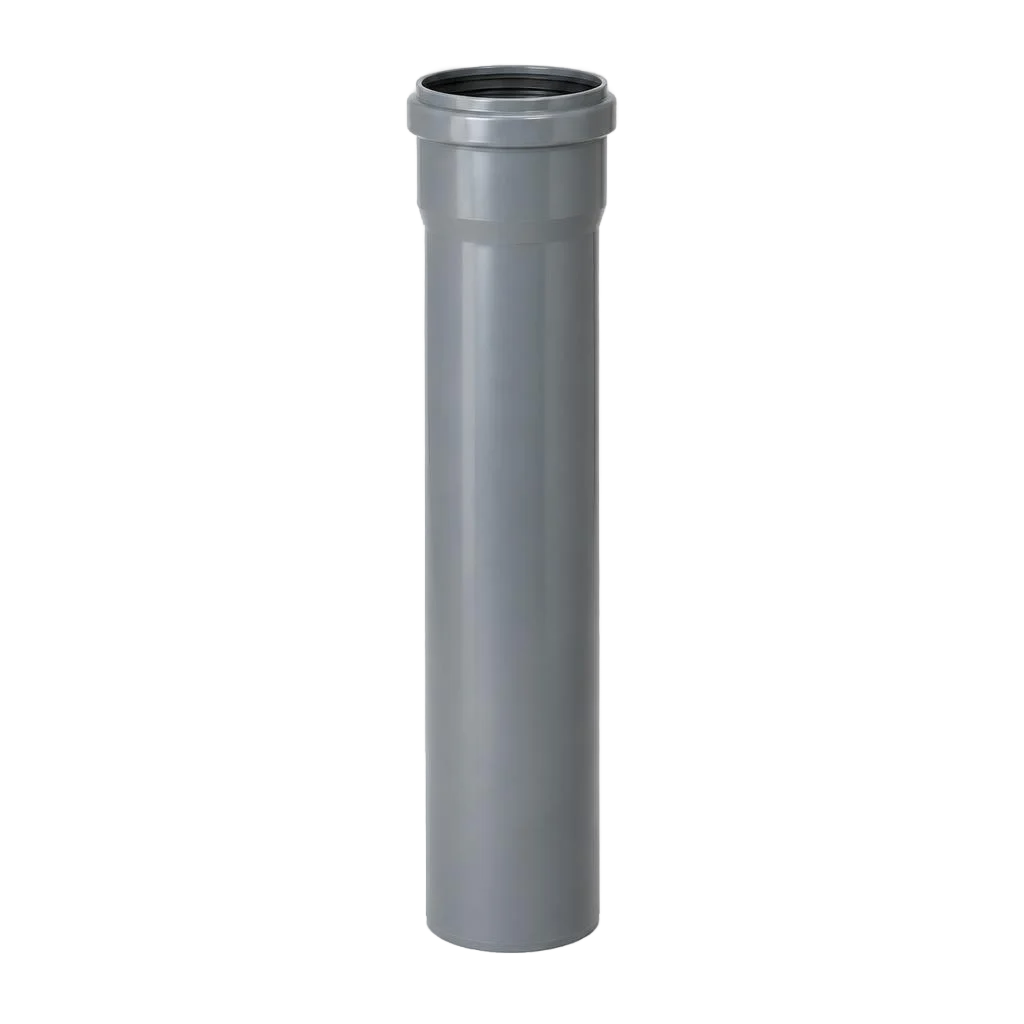
For the riser and horizontal run, Eco-Service installs PP with a diameter of 110 mm, for distribution to plumbing fixtures — 50 mm; we use PVC where increased resistance to household chemicals is needed. The diameter must not be reduced "to save money": on a riser, 110 mm is not a margin but a requirement, otherwise when several floors drain simultaneously, the water goes down with noise and flooding.
Installation without welding: the socket method and fittings
- Socket connection: the pipe enters the socket through a rubber seal — the work is done without welding and open flame in the apartment.
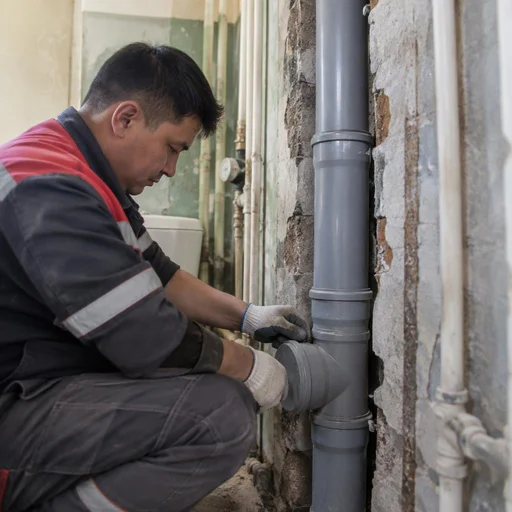
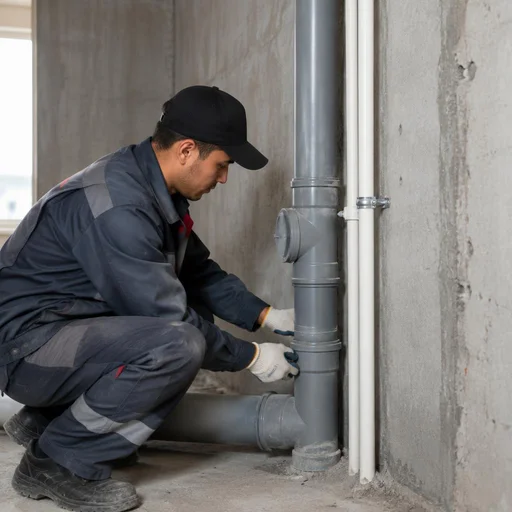
- Tee: splits the flow across floors and branches, installed on the riser and on horizontal sections.
- Bend: changes the direction of the route by 45 or 90 degrees, installed at turns in the distribution lines.
- Cross piece and adapter: the cross piece joins two branches at one point, the adapter connects plastic to the cast iron outlet.
- Cleanout and expansion joint: the cleanout provides access for cleaning, the expansion joint absorbs the thermal elongation of the pipe.
- Assembling the unit: installing a sewer tee or cleanout takes 20-40 minutes — the unit is disassembled by hand, without cutting or an angle grinder.
Replacing the sewer system in an apartment: the riser, the pipe layout, a Khrushchevka
Replacing the sewer system in an apartment works differently than in a private house: the riser runs through all the floors and does not belong to just one family. We break down how to plan the work, when approval is needed, and what changes in a Khrushchevka.
The sewer riser: a shared matter with the neighbors
The riser is a shared pipe for the entire building entrance, so before starting work Eco-Service coordinates it with the neighbors on the riser and the management company, so as not to leave the floors without drainage. In practice, the technician goes around the apartments from top to bottom, records the condition of the cast-iron bell-and-spigot joints, checks who already has plastic installed and on which floors there are cleanouts. Replacing a cast-iron riser affects all the apartments in the entrance at once, while replacing a plastic one goes faster — the old clamps are removed without cutting, if the pipe is not deformed. Approval from the management company in Bishkek takes from a few days to two weeks — it depends on the schedule for access to the basement and the technical floor. The optimal moment for replacing the riser is when the neighbors above and below are also ready to replace theirs: then the work proceeds in one go, rather than dragging on for months with temporary clamps.
Sewer pipes in the apartment: the pipe layout and spot work
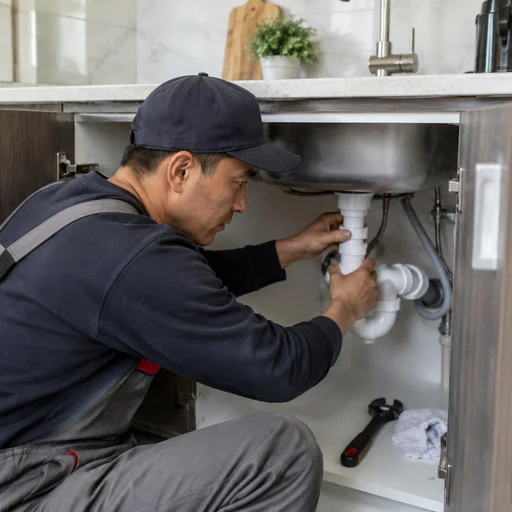
Replacing the sewer pipes in an apartment does not always mean a full teardown: the horizontal pipe layout is replaced, along with the sections under the sink, the bathtub and the toilet, as well as individual fittings. A full teardown of the riser is not needed in this case — most often what is involved is local sections, not the entire system as a whole. The horizontal pipe layout from the riser to the plumbing fixtures is replaced entirely if the slope is off or there are cracks in the pipe. The section under the sink with the trap and the branch into the riser is completed in a single technician visit. The section under the bathtub requires access to the floor slab and is often combined with replacing the floor drain and the water seal. The outlet under the toilet includes a tee and an adapter for the new model, and the slope is set for the specific fixture. The tee, the bend and the cleanout are replaced as spot work if the body is intact and wear is noticeable only on the seals and the threads.
Sewer system in a Khrushchevka: what to take into account
Work in a Khrushchevka is complicated by cramped bathrooms, cast-iron horizontal runs in the basement and thin walls — we select fittings and slopes so as to fit within the dimensions without redevelopment. A combined bathroom in a panel Khrushchevka is 2.5-3 square meters, where the horizontal pipe layout runs along the wall rather than in the floor screed. The slope of 50 mm pipes is kept within 2-3 cm per meter: less — silting, more — the water seals of the neighbors below get siphoned out. The cast-iron horizontal run in the basement is replaced together with the riser or separately, if the building's outlet is still functional. In Khrushchevkas it is often impossible to run the pipe layout into the screed because of its thickness — in that case the pipes are run along the wall with a decorative box, and this must be planned for before the work begins, not after. Clients often phrase their request in their own words — cramped bathroom, cast-iron horizontal run, pipe layout along the wall — and from that description the technician immediately understands the scope of work.
Replacing the sewer system in a private house: the main drain line, the outlet, and storm drainage
Replacing the sewer system in a private house is arranged differently than in an apartment: its own piping layout under the bathroom and kitchen, an outlet into a manhole or septic tank, and a separate storm drainage loop. Let's break down where to start when replacing each section.
Replacing sewer pipes in a private house: piping layout and outlet
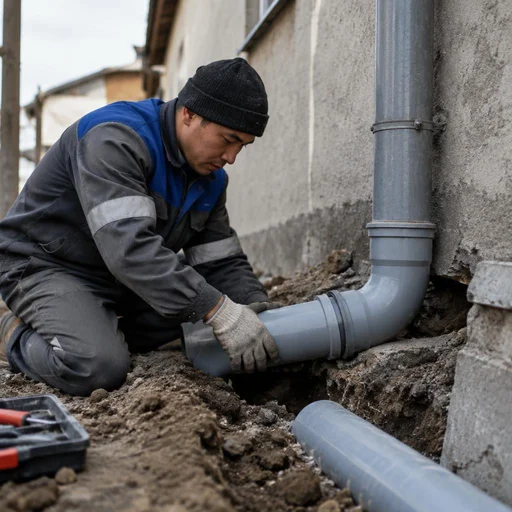
Replacing sewer pipes in a private house covers the entire system: from the piping layout under the bathroom and kitchen to the outlet from the house into a manhole or septic tank. Clients often write in their request about a comprehensive upgrade of the utility networks — and the technician immediately understands the scope. At sites in the suburbs of Bishkek — Kok-Zhar, Mayevka, Lebedinovka — we open up the floors in the bathroom, dismantle the old cast iron or rusty steel, lay PP or PVC with a slope of 2-3 cm per meter, and run a new outlet into the existing manhole. We assemble the horizontal piping layout using socket joints with rubber seals, without welding. The outlet from the house is the most vulnerable spot: it is precisely there that the soil most often subsides and ruptures the pipe, so during work it is checked even if the rest of the system is in order.
Replacing sewer pipes in the basement: the main drain line and cleanouts
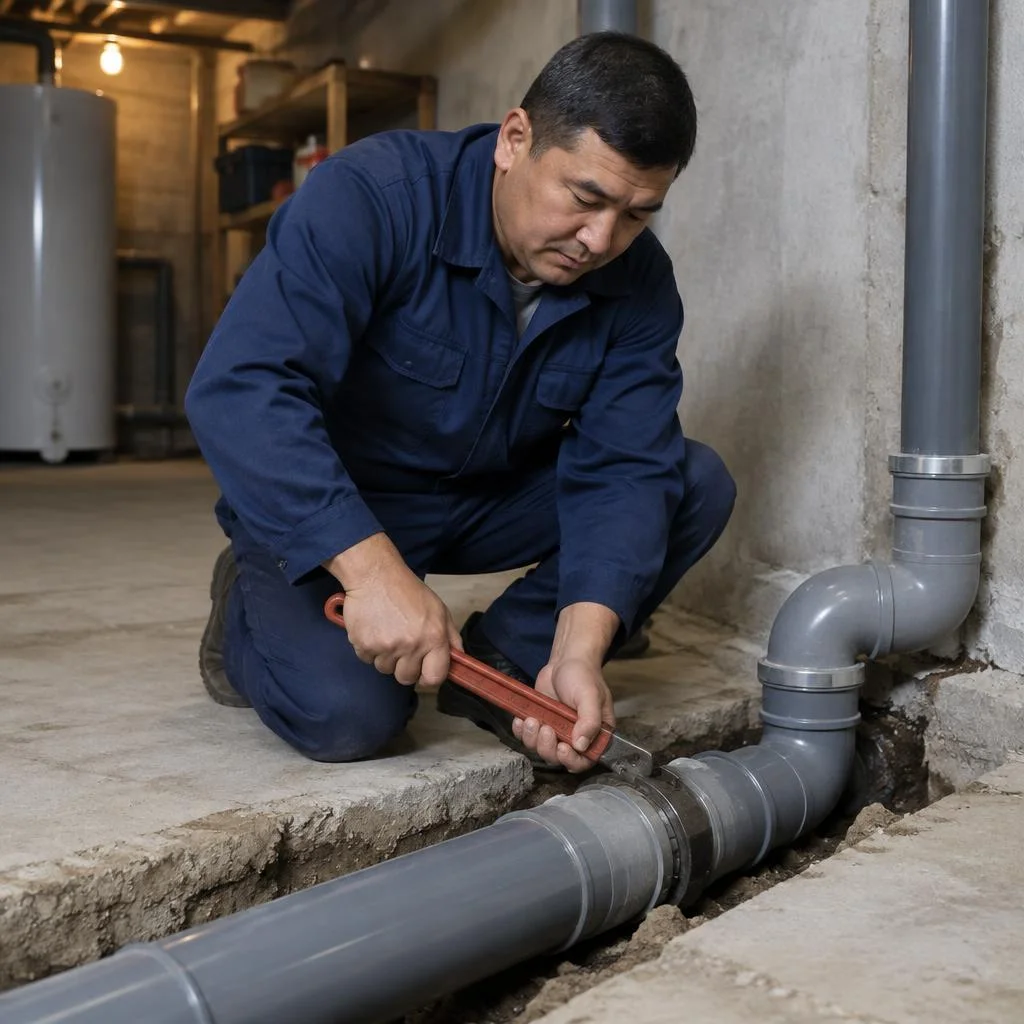
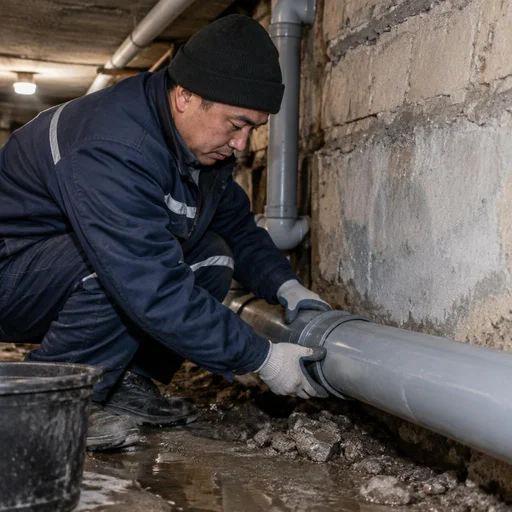
- Main drain line in the basement: we replace the horizontal section under the house either entirely or section by section, maintaining the design slope toward the outlet.
- Cleanouts: we install them at turns and on straight sections longer than 8-10 meters — through them the system is cleaned without opening up the floor.
- Expansion joints: on long main drain lines we install them to absorb temperature deformations, otherwise the joints work loose within a couple of seasons.
- Fastenings: we secure with clamps every 1-1.5 meters so the pipe does not sag under its own weight and the weight of the wastewater.
- Slope: we maintain 2 cm per meter for a diameter of 110 mm — less causes clogs, more accelerates wear on the joints.
Replacing storm drainage: a separate loop
Storm drainage is a separate task: it is an outdoor loop for rainwater and meltwater, which is replaced independently of the domestic system, taking into account the freezing depth of the soil. In Bishkek, storm drainage is laid below the freezing depth or with insulation — otherwise in spring the pipe overflows with meltwater and bursts at the joints. Winter installation is carried out only in prepared trenches with insulated backfill, while in summer during laying they monitor a slope of 1-2 cm per meter toward the stormwater inlet or drainage manhole. When calculating how much it will cost to upgrade sewer pipes in a private house, the price depends on the length of the loop, the number of manholes, and the depth of the trenches — the technician measures these parameters on site before preparing the estimate. Install the storm drainage intake grate 2-3 cm above the level of the lawn — then meltwater goes into the pipe instead of standing in a puddle by the foundation.
Replacing the sewer system in the toilet and connecting plumbing fixtures
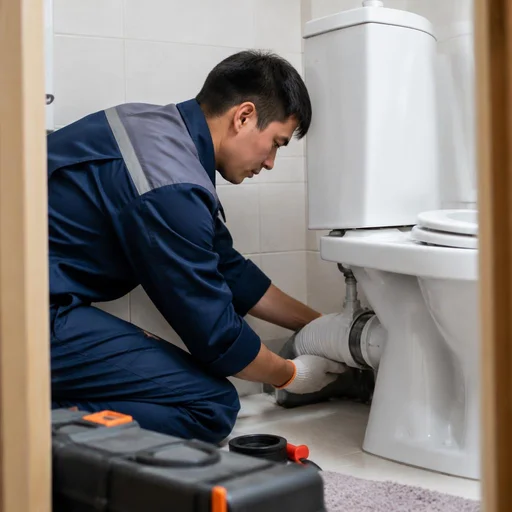
Replacing the sewer system in a toilet often goes hand in hand with connecting the toilet — that way the technician completes the whole assembly in a single visit. Updating the riser in a bathroom is not just the pipe in the wall, but also the toilet connections: the cistern, the siphon, the floor drain, and the flexible supply line. Let's break down which jobs go together and why the connections should not be left old.
Work in the toilet: toilet, cistern, siphon
- Toilet: removing the old bowl, checking the outlet, and installing a new model with horizontal and vertical alignment taken into account.
- Cistern: replacing the flush mechanism and gaskets — a worn valve leaks and creates constant moisture at the base of the bowl.
- Siphon: switching to a new model with a smooth outlet instead of a corrugated hose, where scale and fibers accumulate.
- Sealing the joint: the gasket between the bowl outlet and the pipe socket — without it, odors from the riser return into the room.
- Checking the slope: after assembly, the technician runs water through and makes sure the flow drains without delay.
- Eco-Service: replaces the toilet, cistern, and siphon with a single crew so that the connections and the new pipe line up to a single geometry.
Floor drain, flexible supply line, and final connections
The floor drain in the shower area and the flexible supply lines to the fixtures are the final points where tightness is checked after updating the sewer system: this is where leaks most often show up, because the connections operate under constant pressure and temperature fluctuations. A floor drain with a dry trap holds back odors even when the bathroom is not in use, while a water trap requires regular flushing. The flexible supply line to the mixer and cistern is subjected to water supply pressure — during surges up to 6-8 bar, the old braiding bursts at the threaded fitting. After assembly, our technician runs water through all the points, checks the joints for dryness, and leaves access to the inspection port for future maintenance. The flexible supply line is replaced together with the pipe, even if the old one looks intact: the rubber ages from the inside, and a year later it bursts right after a fresh repair.
Estimate, timeline and 2-year warranty for sewer replacement
Sewer replacement involves an estimate, a timeline and warranty obligations — three questions the customer asks before dismantling begins. Let's break down how the scope of work is formed, how long each section takes, and what the warranty covers.
Estimate before work begins: how the scope is formed
Eco-Service prepares an estimate before work begins: the technician records the list of sections and fittings, and the final sum does not change during the process unless the scope grows at the customer's initiative. The calculation includes replacement of the cast-iron riser, horizontal distribution, the basement main line, the house outlet, as well as tees, bends, crosses and inspection fittings — each item is listed on a separate line. Sewer diagnostics before the estimate takes about an hour: the technician checks the slopes, the condition of the joints and the sections under concrete, so as not to include unnecessary dismantling in the plan. A frequent request on first contact is the cost of sewer replacement in an apartment, and the exact figure is given after an inspection, not over the phone. A transparent estimate protects both sides: the customer sees what they are paying for, and the technician does not encounter "and let's also do this" in the middle of dismantling, when the riser has already been taken apart.
Replacement timeline: riser, distribution, main line
| Type of work | Timeline | What affects it |
|---|---|---|
| Riser replacement | 1 day | access, coordination with neighbors |
| Horizontal distribution | from several hours | number of fixtures |
| Basement main line | up to 2 days | condition of the basement |
| House outlet | up to 2 days | excavation of soil |
The timeline depends not on the length of the pipe, but on access: if the riser is boxed in or the main line is encased in concrete, dismantling takes more time than the installation itself. Sewer pipe replacement price and timeline are directly linked: the more difficult the opening up, the higher the labor costs, so the technician gives a time range already during diagnostics. Replacing cast-iron sewer pipes with plastic — the price accounts for the additional difficulty of dismantling cast iron: it is heavier and requires cutting, not disassembly at threaded joints.
2-year warranty and service center in Bishkek
Eco-Service provides a 2-year warranty for sewer replacement, and the work is performed by its own service center in Bishkek — not an outside contractor, so the same technician responds under warranty. Sewer replacement price is made up of the scope, but warranty obligations are the same for all work — from replacing a pipe under the sink to replacing the house outlet. Round-the-clock dispatch also works for warranty calls: if a joint bursts at night, the technician arrives within a few hours. Reviews on 2GIS and Google Reviews help assess quality before contacting. The warranty covers connections and slopes, not blockages from foreign objects: if after sewer replacement something leaks at a joint — that is a warranty case; if it is clogged with a rag — it is not. Sewer replacement in an apartment — the price in this case is discussed separately, as cleaning, not as a warranty redo.
Conclusion
Work where the cost of an error is measured in flooded ceilings and re-opening walls. We have gathered five conclusions that will save time, money and nerves when planning such work.
Main conclusions
- Diagnostics before dismantling determines the real scope: often the riser and distribution are enough, and the main line is still serviceable.
- Plastic instead of cast iron lasts 50 years or more, does not overgrow inside and reduces the frequency of blockages.
- The riser is a shared resource: work is coordinated with neighbors, optimally — when all floors are replaced at once.
- A private house requires separate attention to the outlet and storm drainage, which freeze and subside.
- The estimate and warranty are fixed before work begins: this protects both the customer and the contractor.