








When it's time to replace a water meter: timelines, verification, and the first signs
The decision to replace is made based on two criteria: the next verification deadline has arrived, or the device is already malfunctioning. Below we'll cover both — the regulatory intervals, signs of wear, and the choice between verification and a new installation.
Verification interval and meter service life
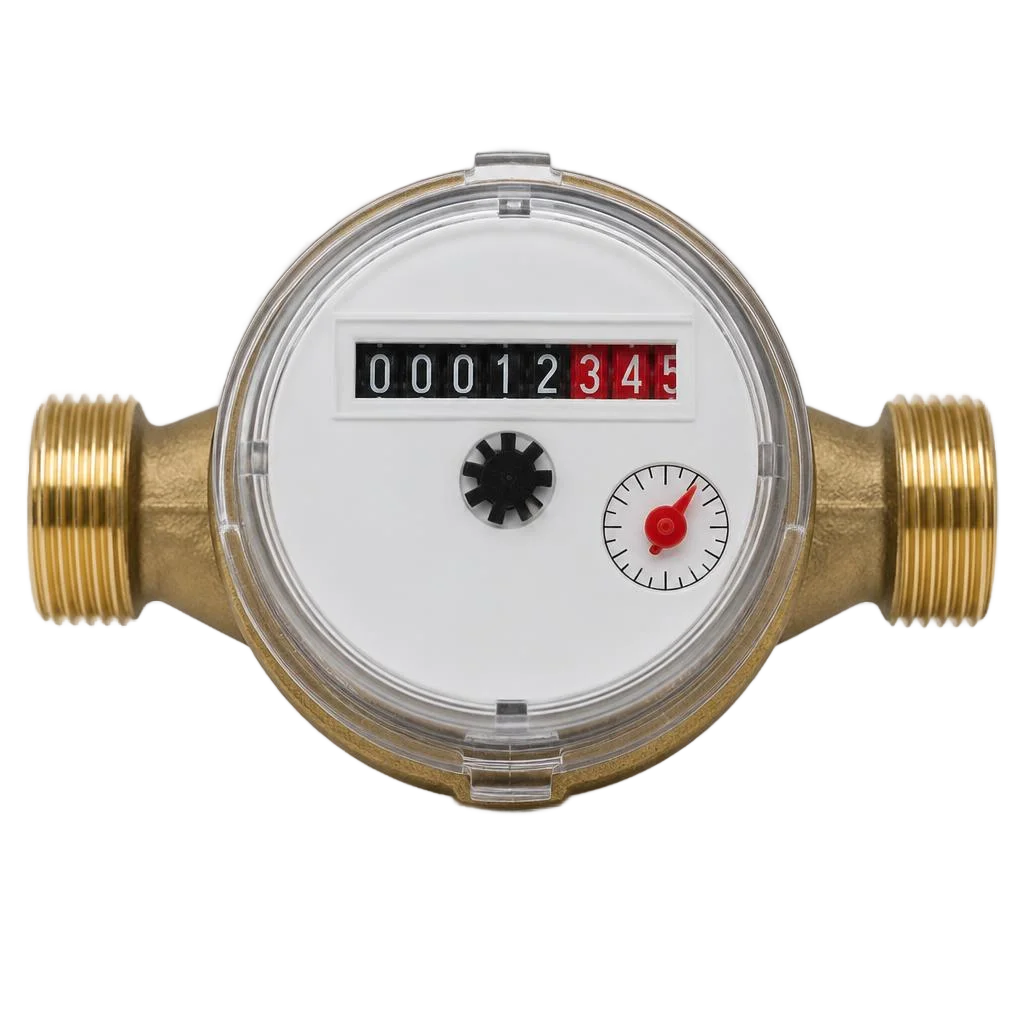
For cold water, the verification interval is usually 6 years, for hot water — 4 years, and the average service life of the device is 12 years. Vane-type cold water supply (CWS) models are marked in the passport as "6 years VPI" (verification interval), hot water supply (HWS) devices — "4 years VPI," and the countdown starts not from the purchase date, but from the date of commissioning with the water utility's seal. In the private sector of Bishkek, where water from a well comes with sand and iron inclusions, the real lifespan of the vane is reduced to 5-7 years. If the meter is installed on hard water without a coarse filter, the mechanism wears out faster — the vane gets clogged with scale, and the device begins to understate or overstate consumption. Clients often search for "water meter replacement price" and land here, not yet knowing whether they're even due for a new device based on its age. In my opinion, it's cheaper to install a coarse filter in front of the device right away than to replace the meter twice as often.
Verification or a new device: what to choose in a specific situation
Verification is cheaper, but if the device is over 12 years old, is installed on hard water, or has already malfunctioned — installing a new one is more reliable than repeat verification. For an apartment CWS meter in a new building with a coarse filter at the inlet, verification is reasonable: the mechanism barely wears out over 6 years, and the technician simply confirms the accuracy class on the test bench. A different picture exists in old housing stock on the outskirts of Bishkek — there the pipes are rusty, the water comes with impurities, and repeat verification on a worn vane gives a "pass" result, but after a season the device starts giving false readings. The query "hot water meter replacement price" usually comes from those who have already been through this cycle and don't want to repeat it again. After verification, the device continues to operate with the same worn mechanism, so in 1-2 years the issue returns — and removal and reinstallation cost more than simply installing a new meter right away. Clients type "water meter replacement price" and land here, already understanding that repeat verification on a worn mechanism doesn't solve the problem. In our practice, at sites with hard water, we advise not waiting until the scheduled verification, but replacing the device with a margin.
Signs that it's time to replace the meter
- Discrepancy in readings: compare the meter against a control flow — if when drawing 10 liters the device shows 8 or 13, the mechanism is giving false readings.
- Rusty water from the tap: a reddish tint after stagnation indicates corrosion inside the housing and deterioration of the vane.
- Seepage under the device: moisture on the threads or housing is a signal of depressurization; the device no longer accounts for consumption correctly.
- Cracks and scale traces: visual damage to the glass, housing, or salt deposits on the fitting — a direct sign of wear.
- Spikes in the bill: if consumption has sharply increased without any change in habits, and how often water meters are replaced — the question is no longer about the interval, but about the specific device.
What to do if the meter fails verification
When the test bench shows a deviation beyond the accuracy class, the owner has two options: file a non-conformity report and install a new device, or contest the result at another accredited laboratory. In practice, the second option almost never helps — if the vane is worn, a repeat measurement on another bench will give the same error. After receiving the report, the water utility charges consumption based on the per-person norm rather than readings, and the amount on the monthly bill grows noticeably. In search, such owners most often type "cold water meter replacement price" and "water meter replacement cost" — they need not an analysis of causes, but a clear next step. Installing a new meter in such a situation is not a formality, but a way to return to paying by actual usage: a new seal and the device's passport close the issue for the entire next verification interval. In our experience, it's not worth delaying this — the norm over a couple of months outweighs the difference between verification and a new device.
Water meter replacement in Bishkek: how an Eco-Service technician's visit works
A single technician visit covers the entire process: dismantling the old device, installing a new one, checking for leaks, and sealing. Below is how each stage works and what determines the total duration of the work.
Dismantling the old meter and preparing the assembly
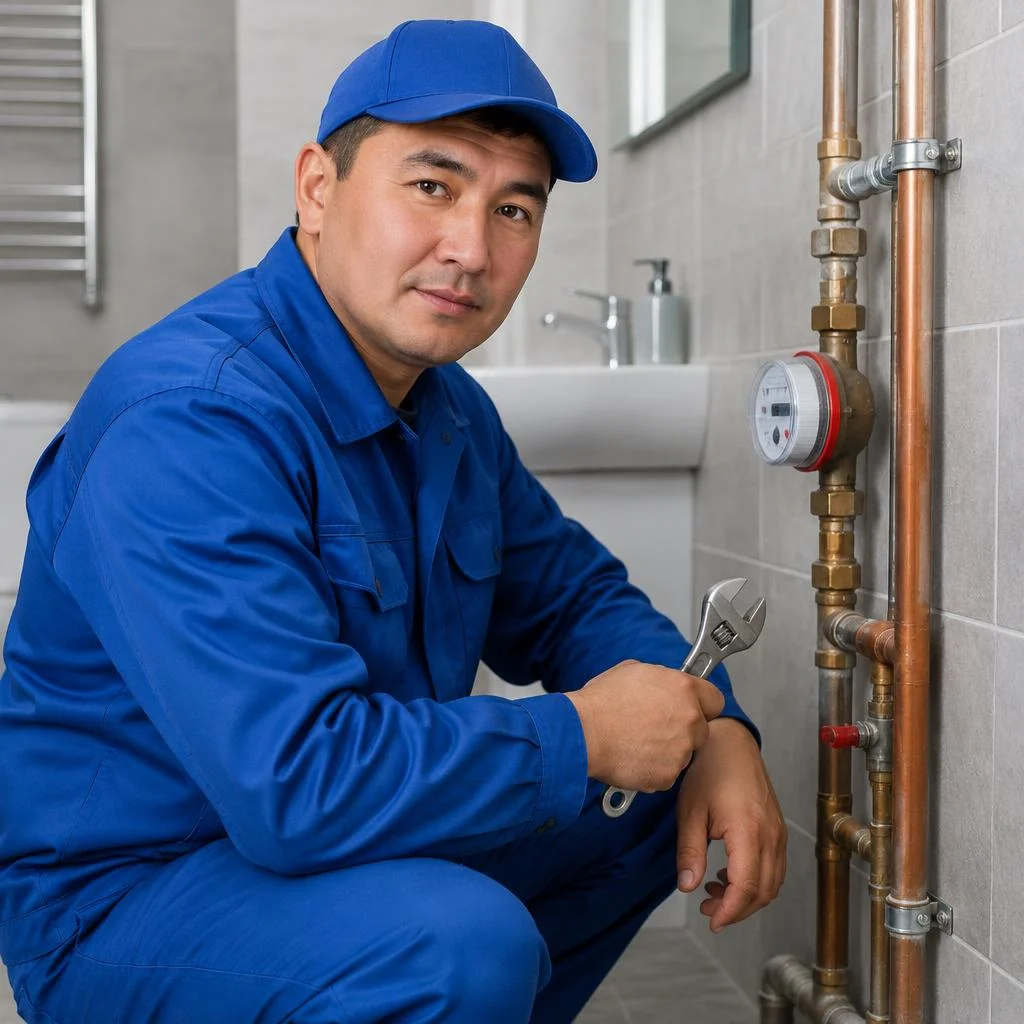
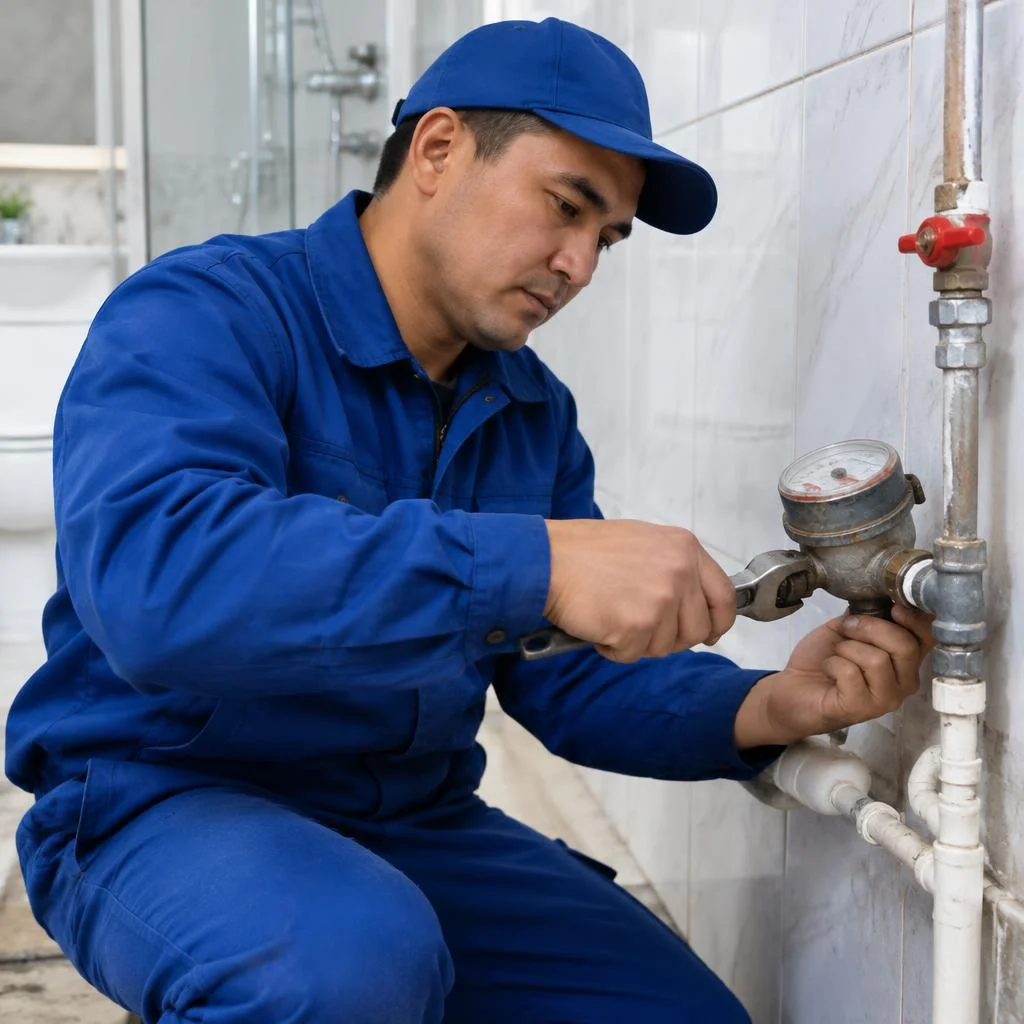
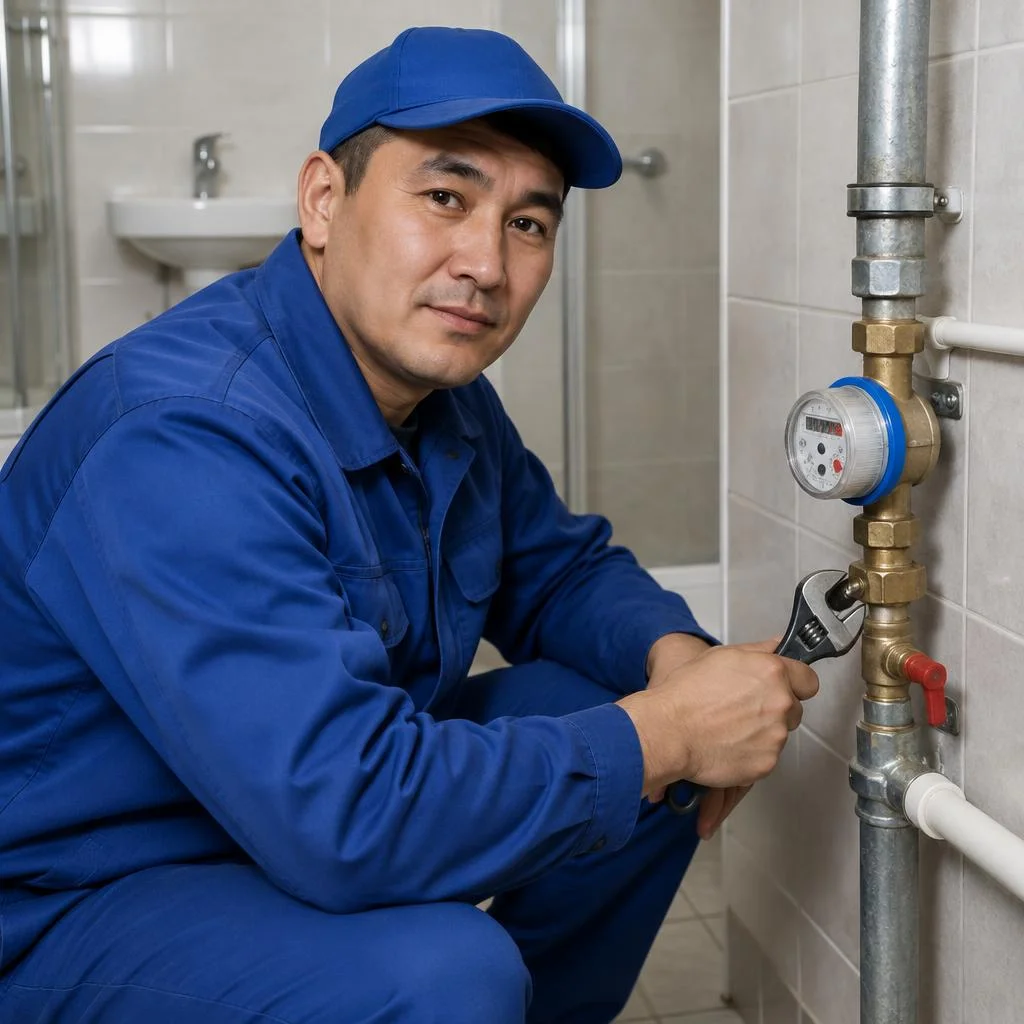
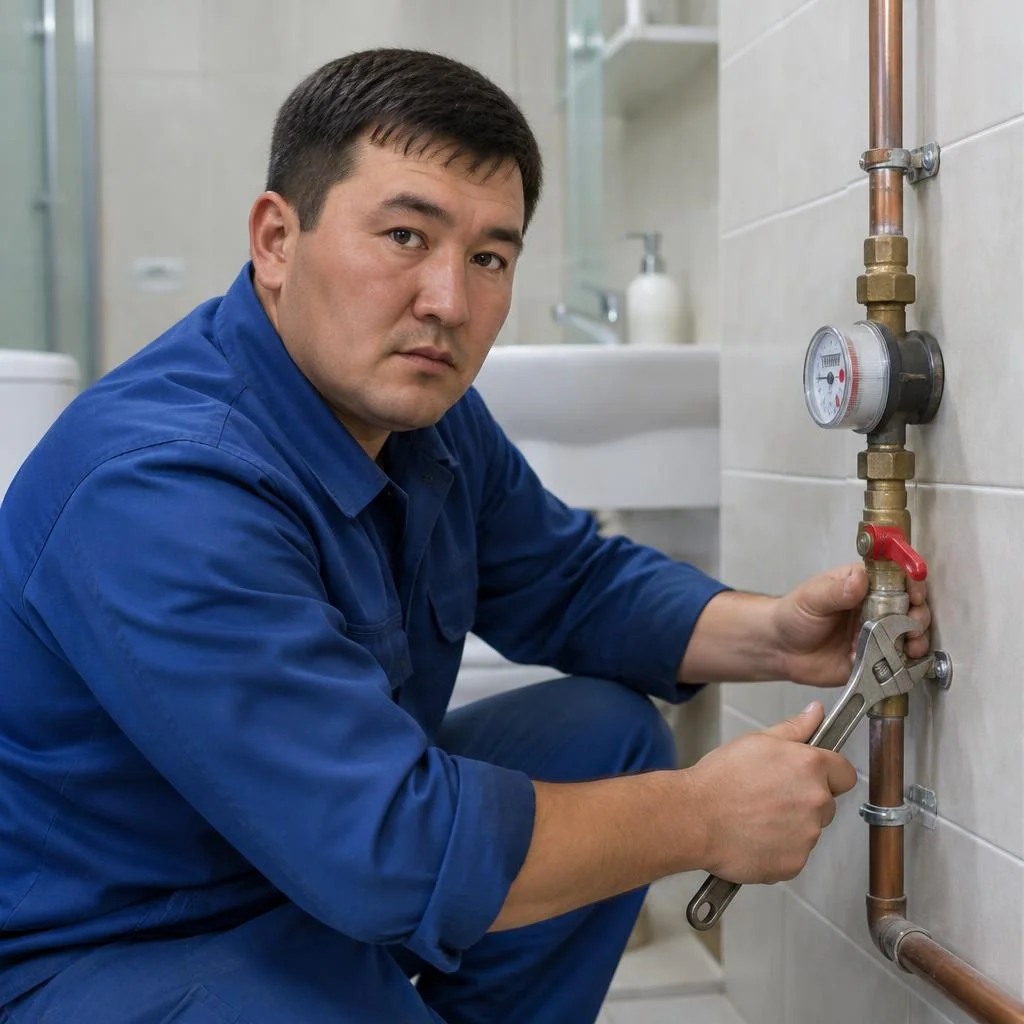
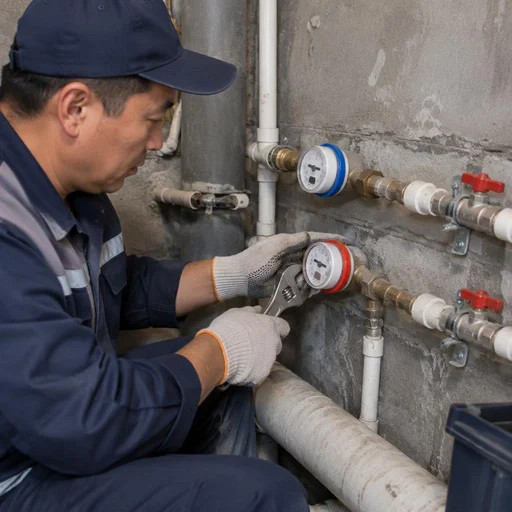
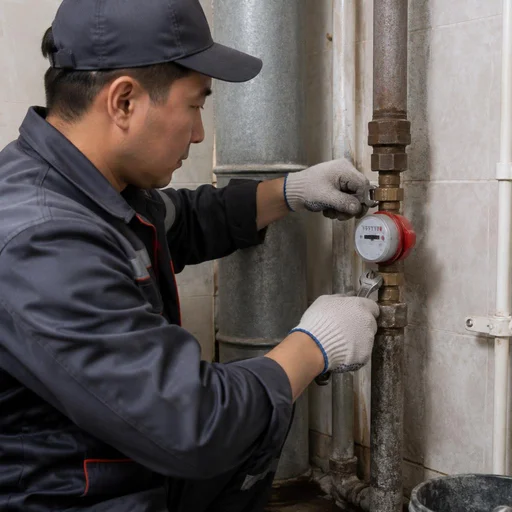
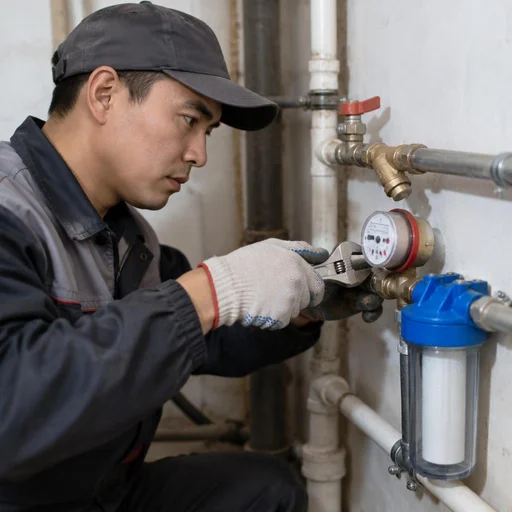
An Eco-Service technician shuts off the water, drains the remaining water from the assembly, and removes the old device along with the flexible supply line if it is worn out. Before removal, the readings are recorded: the last digits are entered into the report, and the assembly itself is inspected for seized threads, cracks on the filter housing, and traces of leaks on the shut-off valve. On a metal pipe, the threaded connection often has to be heated — without this, it is impossible to break loose the old meter during dismantling without damaging the pipe. Clients often look for water meter replacement and verification in a single request — and that makes sense: the technician on site assesses whether it is more advantageous to install a new device or send the existing one for verification. Before dismantling, the technician photographs the last readings — this protects the client from disputed charges if the water utility requests confirmation of consumption for the last period.
Installing the new meter and checking for leaks
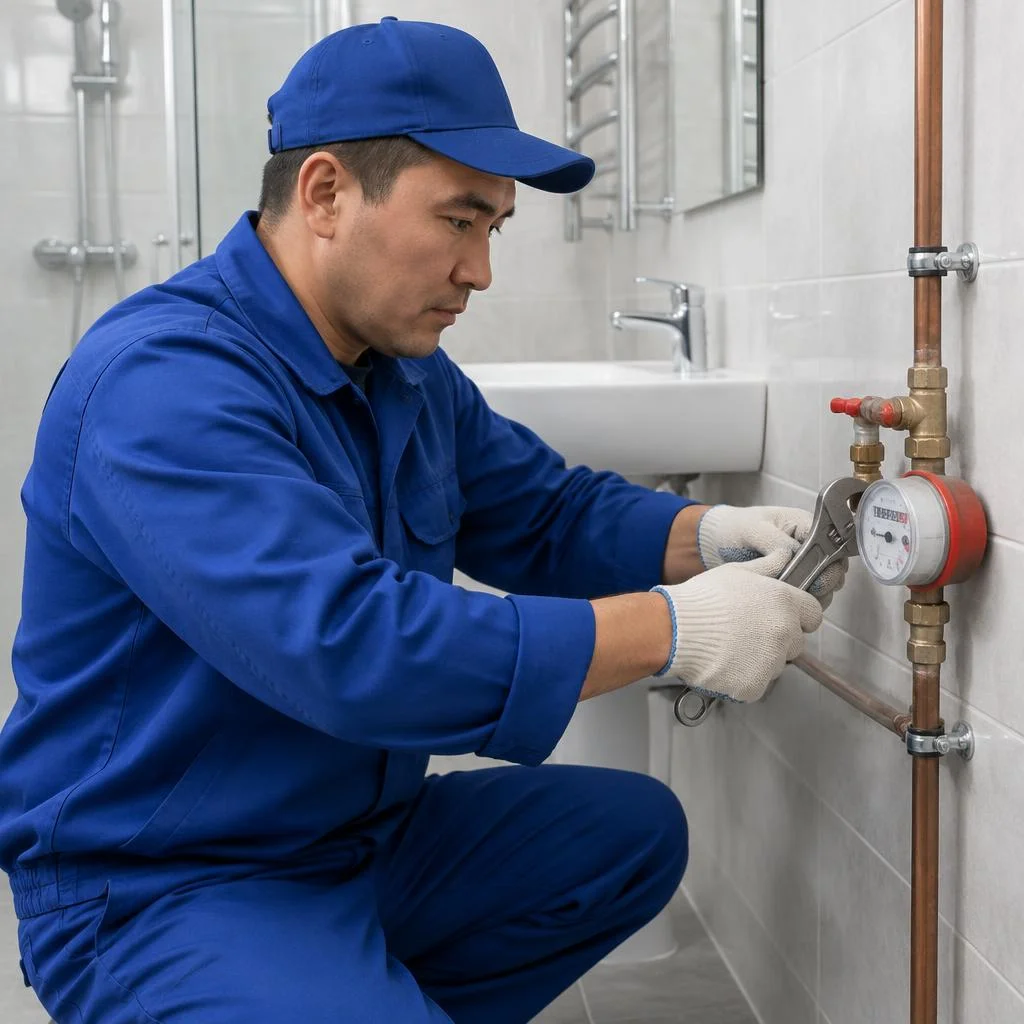
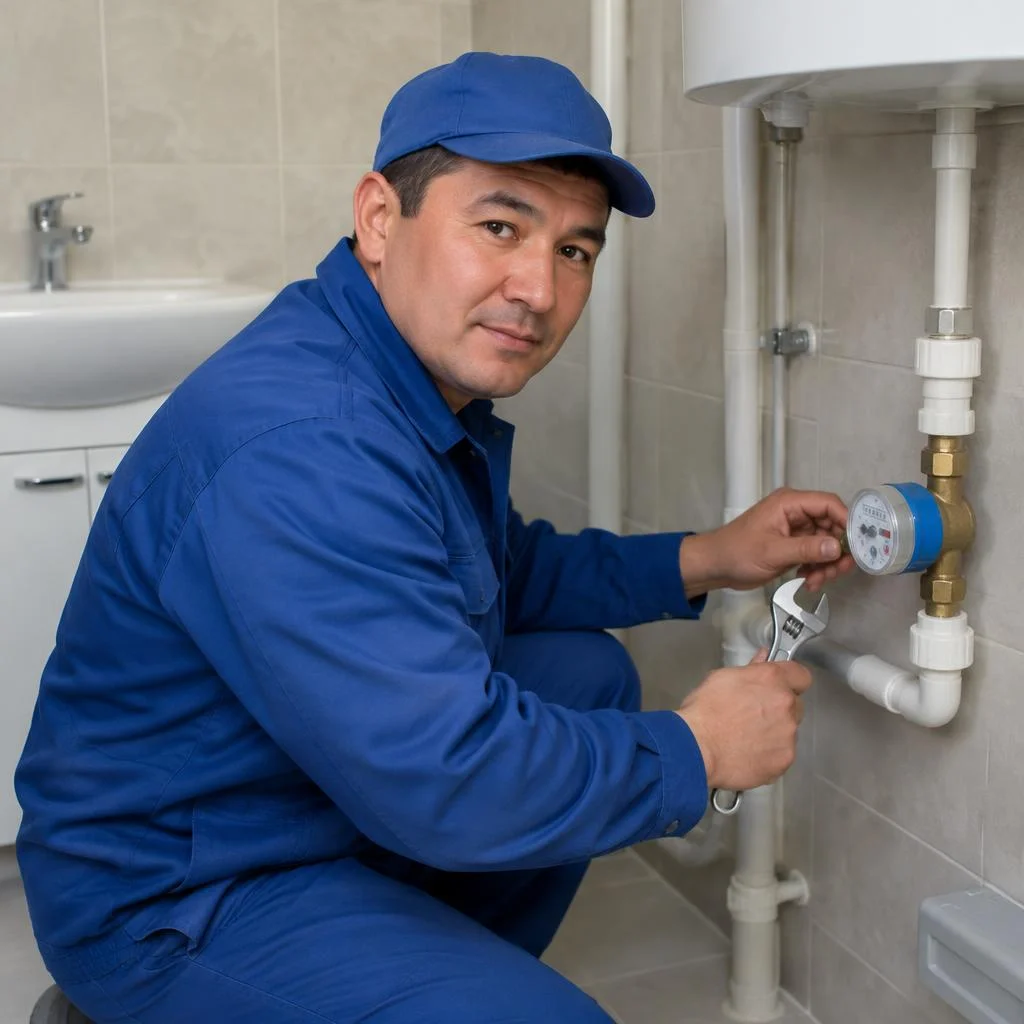
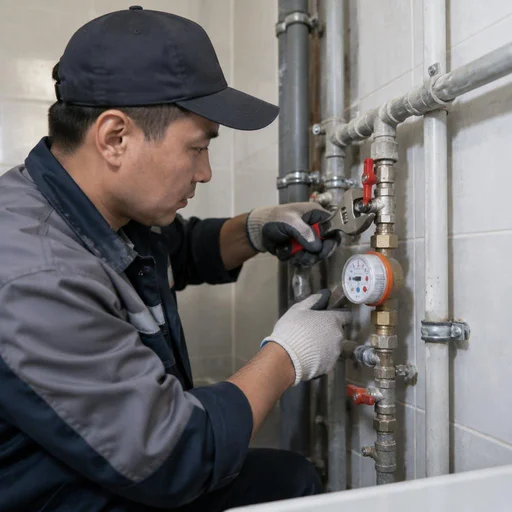
The new meter is installed with a seal and a check valve, after which the assembly is pressure-tested for leaks. First, the seal is wound onto the thread — flax with paste or anaerobic sealant — then the device body is aligned strictly according to the flow direction indicated by the arrow on the dial. The check valve is installed before the meter, and the coarse filter — before the valve, so that shavings and scale do not get into the measuring mechanism. After assembly, the technician opens the valve and holds the assembly under working pressure for several minutes, checking the joints for drips. In searches, people often type water meter replacement price — but the final amount depends on the configuration of the assembly, the condition of the pipe, and the number of devices, so the technician provides an exact calculation after inspection. Clients often phrase the request as water meter replacement cost — and that is understandable: a person wants to know the order of magnitude of the sums in advance, rather than finding out everything after the fact. A check valve is mandatory if pressure fluctuations are possible in the building — without it, water from the riser can flow backward and "spin up" the readings on the meter.
Sealing the meter and documents for the water utility
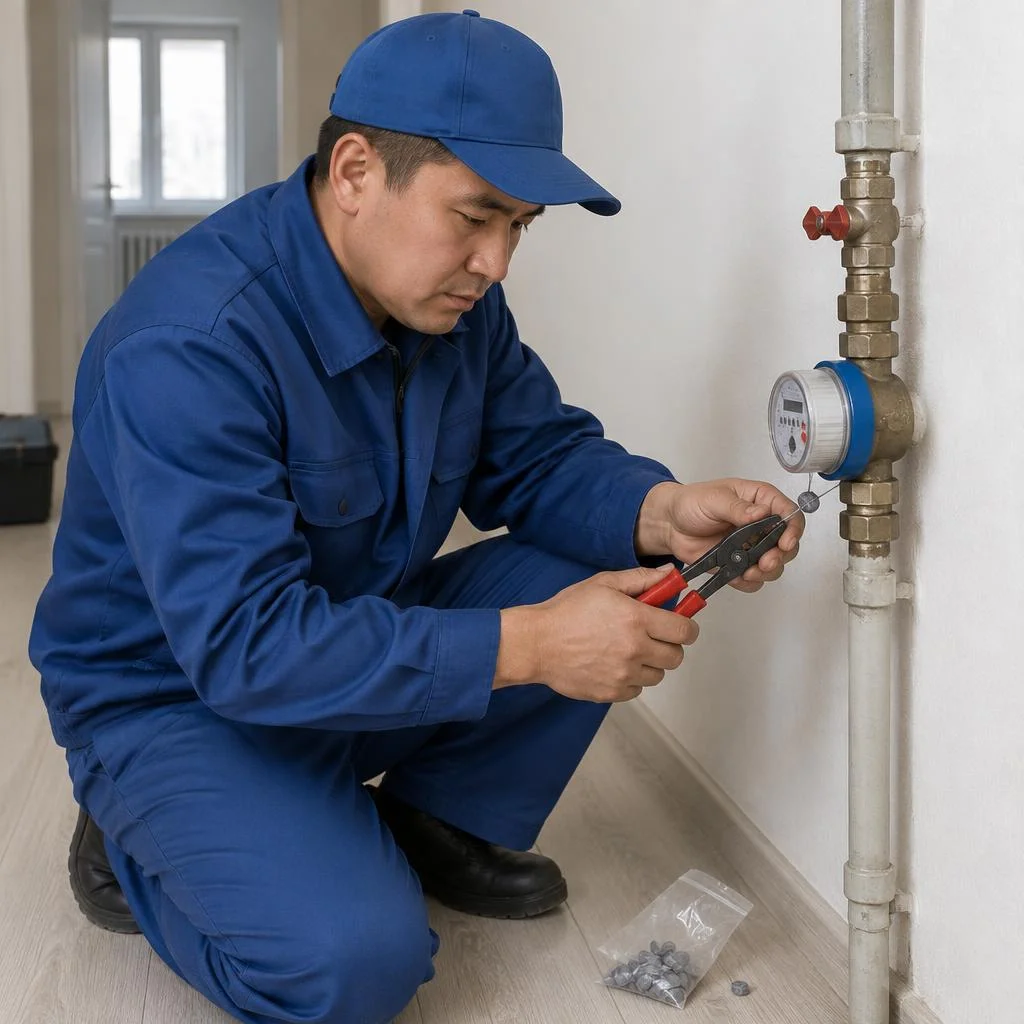
After installation, the technician seals the meter and draws up a commissioning report — the client submits this package of documents to the water utility to register the new device. The report specifies the device's serial number, installation date, initial readings, and seal data; a copy of the meter's passport and an application for registration are attached to it. The package is accepted at the water utility's subscriber department at the location where the property is registered — at the address linked to the account. Until the meter is registered with the water utility, charges are based on the norm rather than on readings — so the documents should be submitted within a few days after replacement, without delay.
How long replacement takes and what the timeframe depends on
- Standard scenario: water meter replacement on a single device takes 40–60 minutes, including dismantling, installation, and sealing.
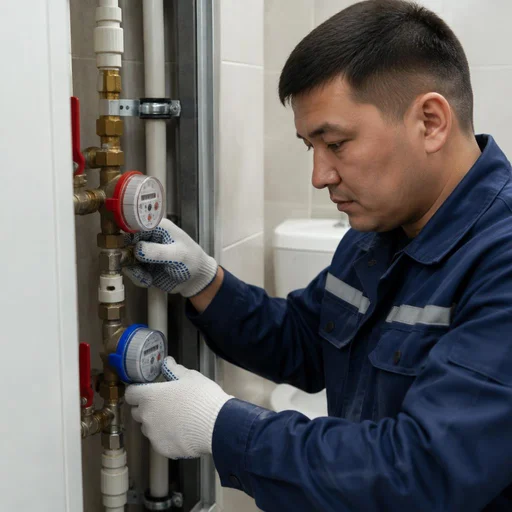
- Two devices (cold and hot water): about 1.5 hours if both assemblies are in the same plumbing layout and access to them is unobstructed.
- Metal pipe with seized threads: plus 30–40 minutes for heating the connection and replacing a section of pipe.
- Limited access: an assembly in a basement or boiler room without lighting adds time for preparing the workspace.
What affects the timeframe and how the technician works with a metal pipe
Replacing a water meter in a private house with long pipe runs can take more than an hour even on a single fixture — this is worth clarifying when submitting a request. If the pipe is metal and the threads are seized, the technician needs extra time to replace a section of pipe — it's best to warn about this in advance so the visit doesn't stretch into half a day. Replacement and installation of water meters on two risers proceed in parallel: while the sealant sets on one unit, the technician prepares the second. The question "how often should water meters be replaced" is asked by clients on almost every visit: the verification interval for household meters is usually several years, and after it expires the meter is either verified or replaced with a new one. A visit within Bishkek city limits usually fits into a single appointment, while properties in remote residential areas like Ak-Ordo or Kalys-Ordo require separate scheduling arrangements.
Cold and hot water meters: what's the difference
Metering devices for cold and hot water supply differ in impeller design, operating temperature, and scale-protection requirements. Let's break down how this affects installation and why there's no universal meter for both pipes.
Installing a cold water meter: installation specifics
Installation on cold water supply relies on simple physics: the device is rated for temperatures up to +30 °C and is installed with a coarse filter so that sand and rust from the riser don't clog the impeller. At the apartment inlet, the body is mounted after the shut-off valve, with the filter placed before it: in Bishkek's older housing stock, scale is often found in the water, which without protection will ruin the mechanism within a couple of seasons. A brass body, ½ or ¾ inch threaded connection, pressure testing after installation — through Eco-Service such work is completed in a single visit. Clients search for "cold water meter replacement" — and land on this page, though essentially it's the same unit. Another phrasing also appears in searches — water meter replacement, when the person hasn't yet figured out which pipe the device is on. On cold water, condensation on the body is normal, but if it appears regularly, the seal should be checked: constant moisture accelerates corrosion of the threaded connection.
Hot water meter: what to consider
A hot water supply meter must withstand up to +90 °C — it has a different impeller design, and a cold water model on a hot pipe will quickly fail. Inside are heat-resistant seals and materials resistant to constant heating; on the riser, thermal expansion compensation is taken into account, otherwise the connection loses its seal. Installation with Bishkek's water is complicated by scale: the mechanism fouls faster than on a cold inlet, and the technician checks the temperature-class marking against the riser parameters before installation. In searches this is most often phrased as hot water meter replacement — and the technician immediately understands which unit is meant. The verification interval for hot water is shorter — 4 years versus 6 for cold water, because hot water and scale wear out the mechanism faster.
Comparison of cold and hot water meter parameters
| Parameter | Cold water meter | Hot water meter |
|---|---|---|
| Operating temperature | up to +30 °C | up to +90 °C |
| Verification interval | 6 years | 4 years |
| Scale protection | coarse filter | filter + heat-resistant seal |
| Typical location | apartment inlet | hot water riser |
| Seal material | standard rubber | heat-resistant polymer |
The key differences are operating temperature, verification interval, and scale-protection requirements. When installing both meters at once, the technician checks the condition of the shared unit: replacement and sealing of water meters in a single visit costs less than two separate call-outs, and replacing a water meter with a simultaneous inspection of the shut-off valves reduces the risk of leaks.
Replacing water meters in apartments, private houses and non-standard locations
The replacement technology depends on the type of housing and the location where the metering unit is installed. Let's go over the main scenarios — from a standard apartment to a basement and a boiler room.
Replacing water meters in an apartment: the standard scenario
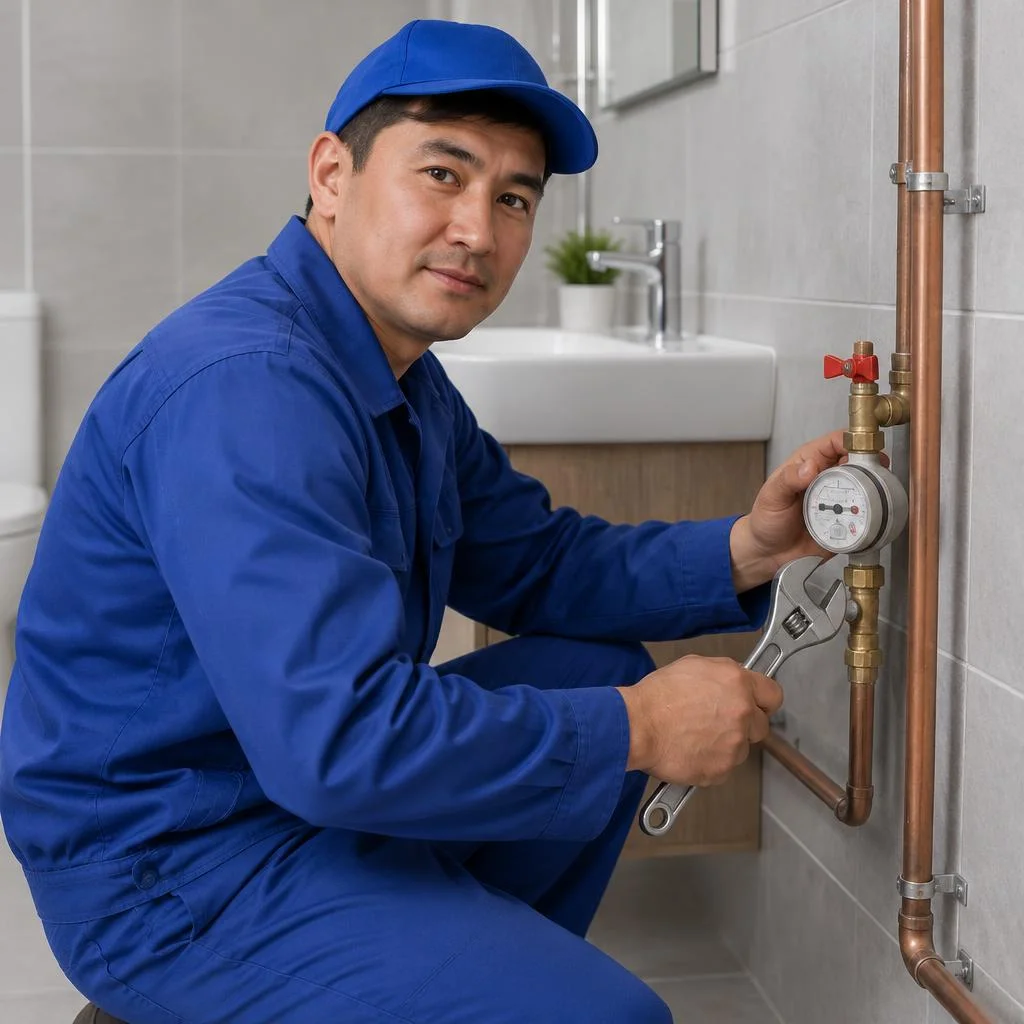
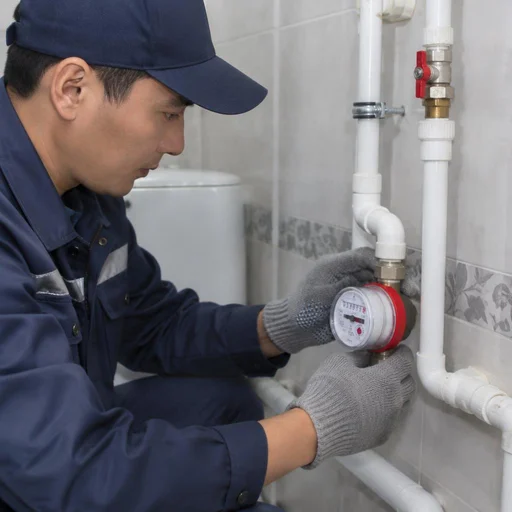
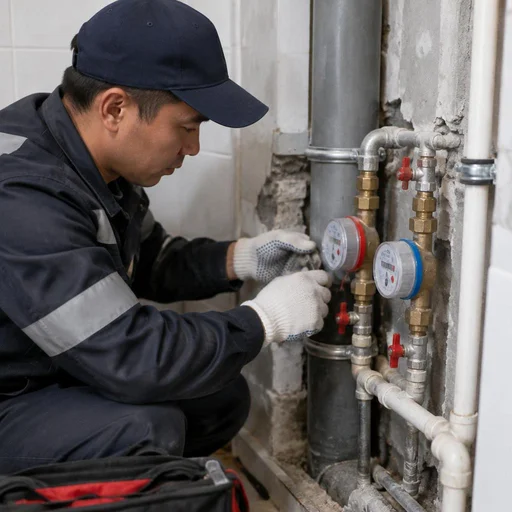
Replacing a water meter in an apartment usually takes a single visit by a technician with a full set of documents, because the device is installed at the inlet to the bathroom or in the kitchen. In most Bishkek apartments these are a couple of compact units with flexible connections and a shut-off valve, and through Eco-Service such work is completed in one visit. If the plumbing is a manifold system, water flows from a single manifold to several points — in that case the technician needs to shut off the entire riser rather than a single valve. With panel building layouts, access to the manifold is sometimes only through an inspection hatch, and it should be cleared of items before the specialist arrives. Clients often write in their request "replacement or verification of water meters" — and from that wording the technician immediately understands that a visit with diagnostics and a spare model is needed. Before the visit, arrange with your neighbors for a short water shutoff — otherwise the coordination will shut off the entire riser for an indefinite period and derail the work.
Replacing a meter in a private house: what's different
Replacing a water meter in a private house often takes place in a basement or a pit, and the pipe is sometimes metal — this increases the scope of work and requires extra time. At the street inlet, the pipe diameter is larger than in an apartment, and there is often a check valve and a coarse filter, which are also checked for wear. If the inlet comes from the street, before replacement you should locate the shut-off valve: sometimes it is placed outside the house, in a well on the property. Without access to it, the technician cannot shut off the water, and the visit will have to be rescheduled. In our practice, at private properties we more often replace a section of pipe — metal becomes encrusted over time, and the threads do not always come out without damage. A separate story is replacing hot water meters: in hot water supply, metal expands more, and the threaded connection holds worse than on a cold line.
Replacing a meter in a new building and old housing stock
Replacing water meters in an apartment in a new building is more often done on plastic pipes, while in old housing stock it is done on metal pipes, which affects the technology and the set of related work. In new buildings, the units are assembled on polypropylene or metal-plastic with press fittings, and the work takes less time thanks to clean threads. In buildings of Soviet construction, the threads on the pipes are often seized, and the metal itself is thinned — the technician may need to replace a section of pipe, not just the device. Clients often phrase their request briefly: water meter replacement cost — and from such a request the technician immediately understands that a visit with an inspection of the unit and a preliminary estimate is needed. Therefore, when placing your request, specify the year the building was constructed and the material of the plumbing: this determines which spare parts to bring along. At old housing stock properties, we deliberately allow extra time in the visit precisely because of the condition of the threads. If you need water meter replacement with registration, the documents are prepared right at the site — the act and the device passport are handed to the owner the same day.
Replacing a meter in a basement and boiler room
Replacing water meters in a basement and boiler room is done on shared units, and the work requires coordination with the management company or the homeowners' association. Here the device meters consumption for the entire building or for the heating circuit, so access to the unit is arranged in advance, and sometimes the work is carried out in the presence of a management company representative. In a boiler room, the device operates at high temperature and under constant vibration from the pumps — for such conditions, a model with a reinforced body and a heat-resistant mechanism is selected. If an ordinary apartment meter is installed, it will fail before the verification interval, and the replacement will have to be repeated. Check with the management company on the access regulations for the basement: in some buildings, keys are only issued during working hours.
Water meter replacement and sealing: documents and registration with the water utility
A new device without registration with the water utility does not work for you: charges continue to be calculated according to the norm rather than by readings. Let's break down which papers the technician prepares and how to submit them to the water utility.
Which documents the technician prepares after replacement
An Eco-Service technician prepares a commissioning certificate, records the serial number of the new meter and gives the client a package for submission to the water utility. The standard set includes the certificate itself with a signature and stamp, the device passport with a note of the installation date, and a photograph of the sealed unit. The seal is placed on the device body and on the shut-off valves, and its number is entered in the certificate on a separate line. Installation and sealing of water meters without these papers has no legal force — the water utility simply will not see that the unit has been updated. Clients often search for water meter replacement price, but in fact the papers matter more first: the serial number and installation date should be kept separately, as this data will be needed at the next verification or installation to confirm the age of the device. Keep the documents in one folder with your receipts — in a disputed billing situation, the certificate is the first thing requested.
How to register a new meter with the water utility
The client submits an application to the water utility with a copy of the commissioning certificate, after which the device is registered and charges begin to be calculated by readings. The application is accompanied by the device passport, a copy of the ownership document or lease agreement, and the readings at the time of sealing. Registration usually takes from three working days to two weeks, depending on the workload of the subscriber department. Before registration, the readings of the new meter are not taken into account — if you delay submitting the documents, the difference between the norm and actual consumption will have to be disputed separately. In search queries this procedure is described as water meter replacement water utility, and the essence is correct: submit the papers within a week after installation, as it is easier to prove that consumption during the transition period was based on actual usage rather than the norm.
Water meter replacement and verification: how to combine with a scheduled inspection
If the verification deadline is approaching and the device is already old, it makes more sense to replace it right away — this saves you from a repeat dismantling in 1–2 years. Installation and verification of water meters rarely coincide favorably in terms of timing: verification costs money and time, and extends the life of the device by only a few years. During a scheduled verification, the water utility may send its own specialist — check in advance whether they accept a certificate from a third-party organization, so as not to pay for the inspection twice. When less than two years remain until the next verification, installing water meters with registration is more sensible than investing in checking an old mechanism. Subscribers often phrase their question briefly — meter replacement price — although the final estimate consists of dismantling, the device itself, sealing and processing the certificate, not just the cost of the body. In search, many type water meter replacement and verification — and land on this page, although in essence these are two different procedures with different costs and timelines.
What to do if the water utility does not accept the documents
The water utility sometimes processes the installation of a water meter with a delay due to discrepancies in the data: the seal number in the certificate does not match the database, the device type is not specified, or the installation date is missing. In such cases, the subscriber department issues a written refusal with a specific reason — not verbal, but on paper, so that there is something to work with going forward. Most often it is enough to correct one line in the certificate and submit the application again, but sometimes a repeat visit by the technician is required to clarify the unit's data. In a service request this usually sounds like water meter replacement price, and from this wording the technician immediately understands that both installation and a full package of documents are needed. If refused, request a written justification and clarify the list of missing documents — this way the repeat submission goes through on the first try.
Related works and a 2-year warranty from Eco-Service
During meter installation, the technician often sees worn components of the assembly — the valve, the check valve, the supply line. Replacing them during the same visit is cheaper than calling the team out again, and all completed work is covered by a two-year warranty.
Which related works are worth doing right away
When installing the device, an Eco-Service technician checks the shut-off valve, check valve, flexible supply line and coarse filter — worn components are replaced during the same visit. The shut-off valve at the inlet lasts 8-12 years, after which it lets water through even in the closed position: the gaskets inside dry out from hot water and chlorine. The check valve prevents the cold and hot water flows from mixing, while the coarse filter traps sand and rust that clog the impeller of the new device. A flexible stainless steel supply line loses strength after 5-7 years of use — with Bishkek's water and its increased hardness, this period is shortened. A shut-off valve that doesn't hold water devalues the meter replacement — the next time there's a leak, there will be nothing to shut off the assembly with, and water will flow into the apartment. In search, clients often type water meter replacement — and via this phrase they land on our page.
2-year warranty: what it covers
Eco-Service provides a 2-year warranty on meter replacement work — it covers the tightness of connections, correct installation and the operation of the shut-off valves. If six months after installation a drip appears at a threaded connection or the valve stops shutting off the water, the technician will come and fix the cause at no additional cost. A warranty case is processed based on the work completion certificate and the receipt: the document states the date, address, list of replaced components and the serial number of the device. If the assembly is put together on a metal pipe with an old nipple, the technician records the condition of the thread in the certificate — this protects both parties in disputed situations. The warranty does not cover the device itself if it has failed due to hard water — in this case the meter is replaced under the manufacturer's warranty, and the work is performed separately. In search, clients often enter water meter replacement how much it costs — that's how they land on our page describing the installation. And some type in water meter replacement price — and also end up here, already ready to book a technician's visit.
Comparison of replacement options: basic, turnkey, with related works
| Format | What's included | When it's suitable |
|---|---|---|
| Basic | removal, installation, sealing | new assembly, serviceable valves |
| Turnkey | basic + assembly check + documents | standard apartment |
| With related works | turnkey + replacement of valve, check valve, supply line | old housing stock, metal pipes |
Conclusion
We've gathered the main things worth keeping in mind before replacing water meters: timelines, signs of wear and the procedure to follow after installation. Below are brief takeaways without repeating the previous sections.
Main takeaways
- The timeline is dictated by the verification interval: for cold water it is 6 years, for hot water — 4 years, and the count starts from the device's manufacture date, not the installation day.
- Verification or replacement: if the device is older than 12 years or operates on hard water, repeat verification is not economically justified — it's more reliable to install a new one right away.
- Duration of work: a standard replacement takes 40–60 minutes and includes removal, installation of the new device and sealing, but on metal piping the time stretches due to threaded connections.
- Documents determine the charges: after installation, the certificate and the device's passport must be submitted to the water utility — until registration, the fee is charged according to the norm, not actual consumption.
- Check the entire assembly: a worn shut-off valve, check valve or coarse filter devalues the new installation, so their condition is assessed before work begins.