








Which toilets Eco-Service replaces: types, models and outlets
Floor-standing, wall-hung, close-coupled, corner and children's models, as well as bowls with an angled or straight outlet — the type of fixture determines both the dismantling and the installation. Let's break down exactly what the technician works with and how this affects the set of works.
Floor-standing, wall-hung, close-coupled, corner, children's — what we install
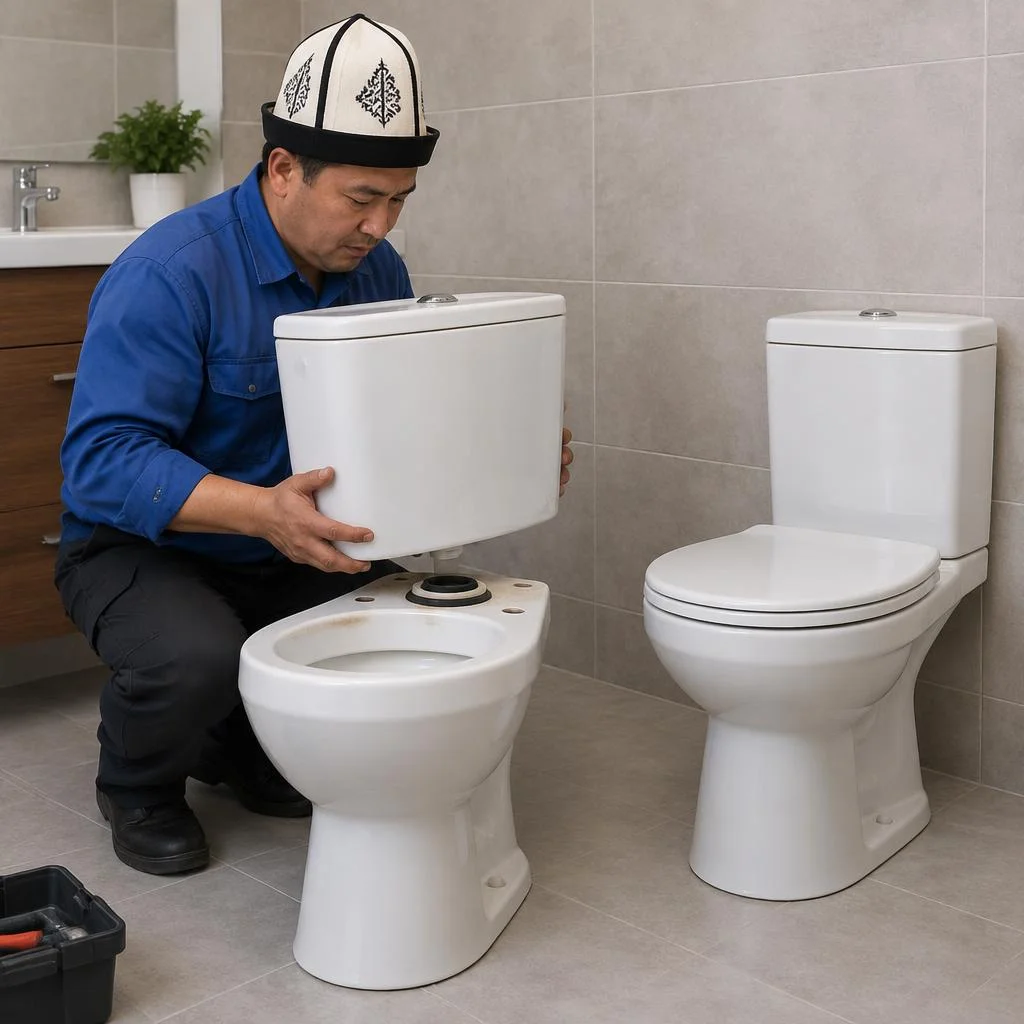
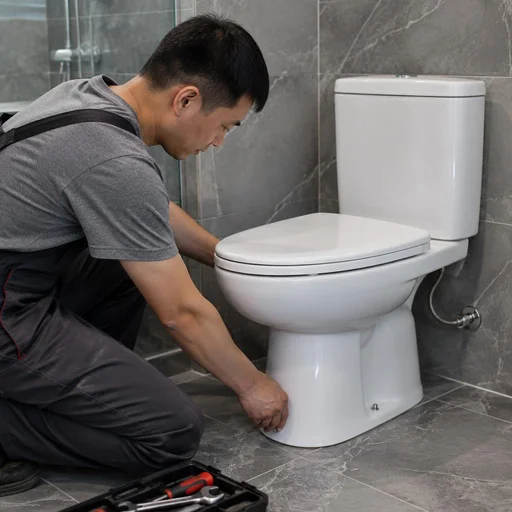
- Floor-standing toilet: a classic model, fixed to the floor, no installation frame needed, suitable for replacement in old housing stock without reworking the wall.
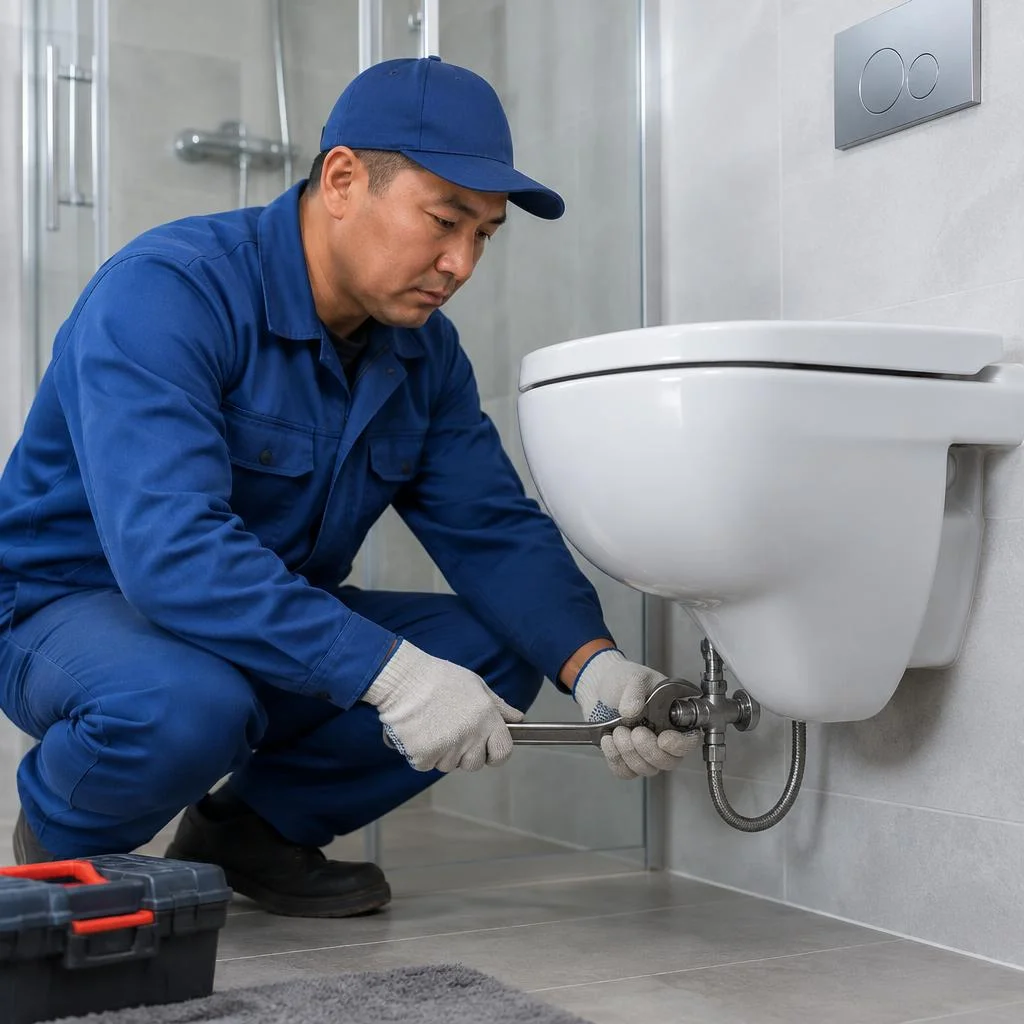
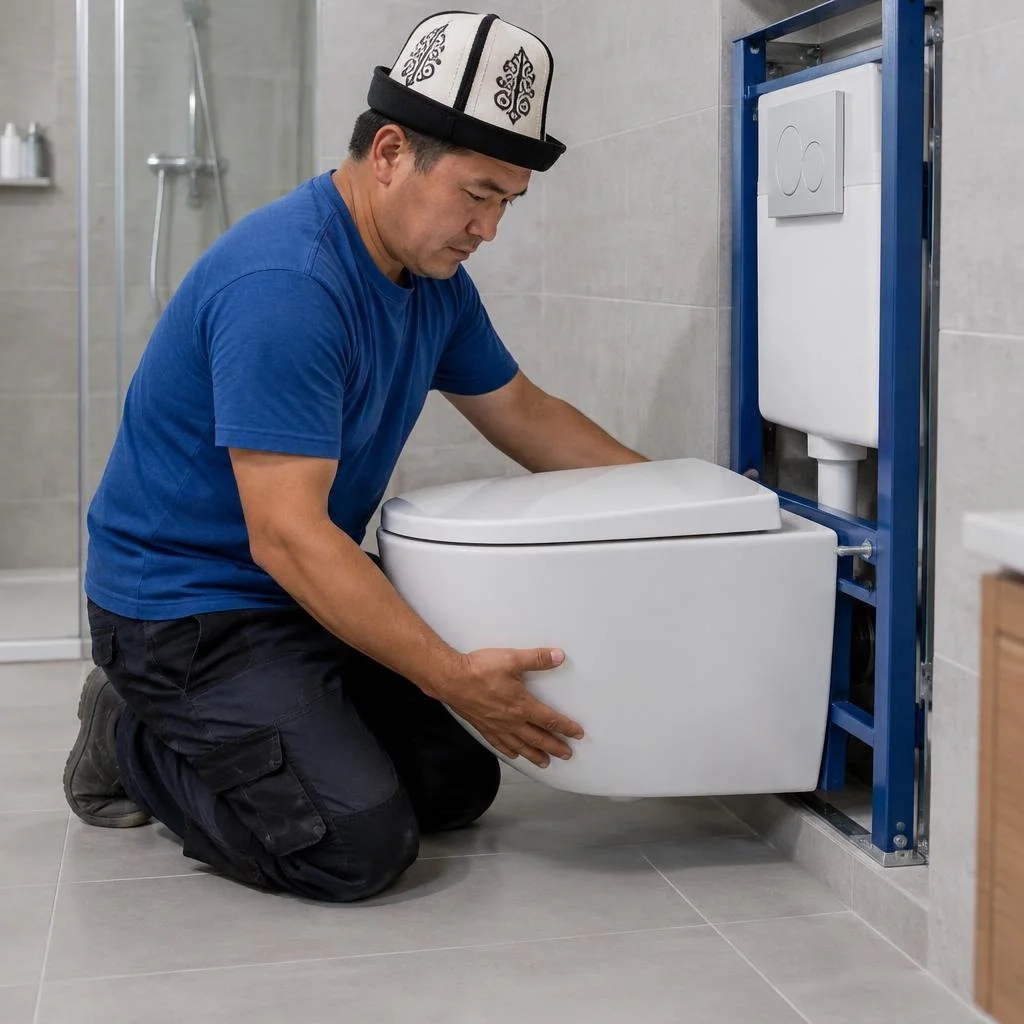
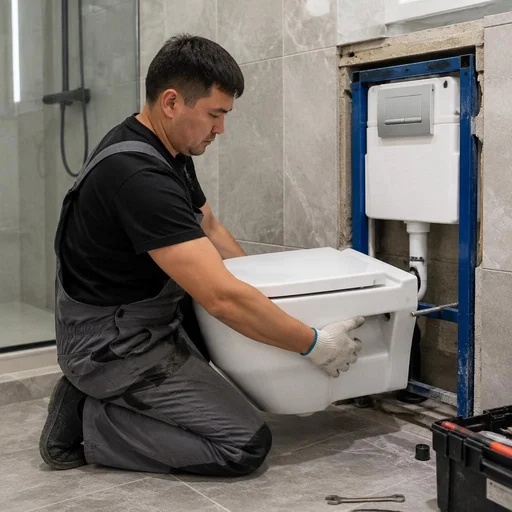
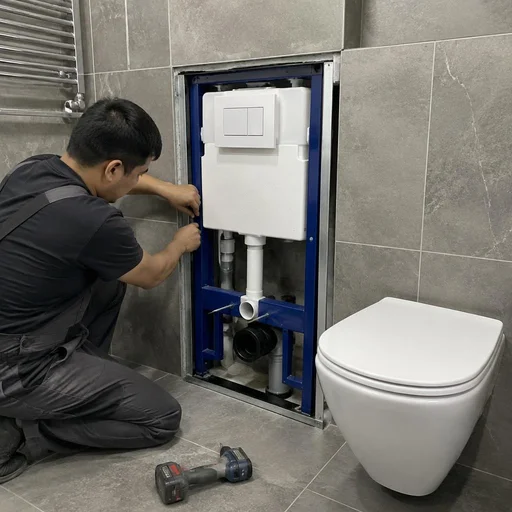
- Wall-hung toilet: mounted on an installation frame in the wall or a box, frees up the floor, requires opening up the cladding during replacement.
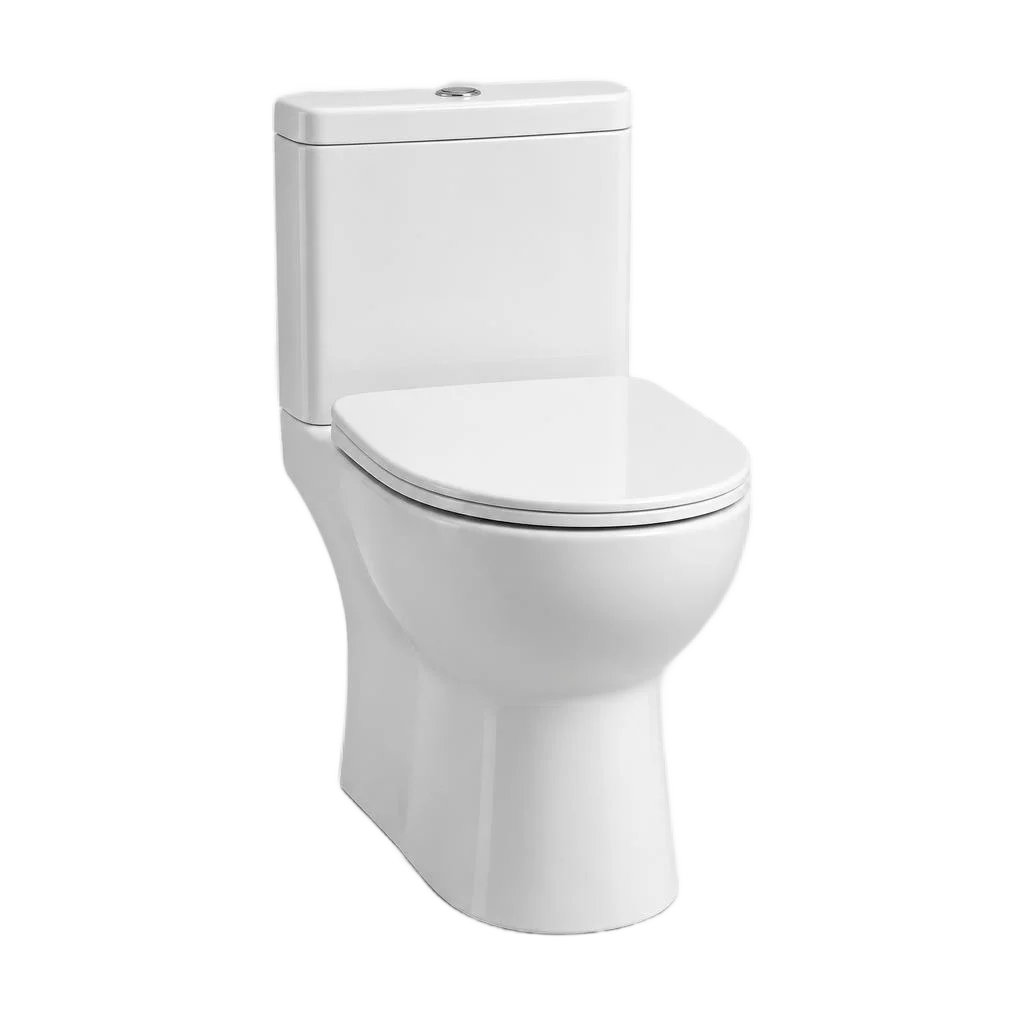
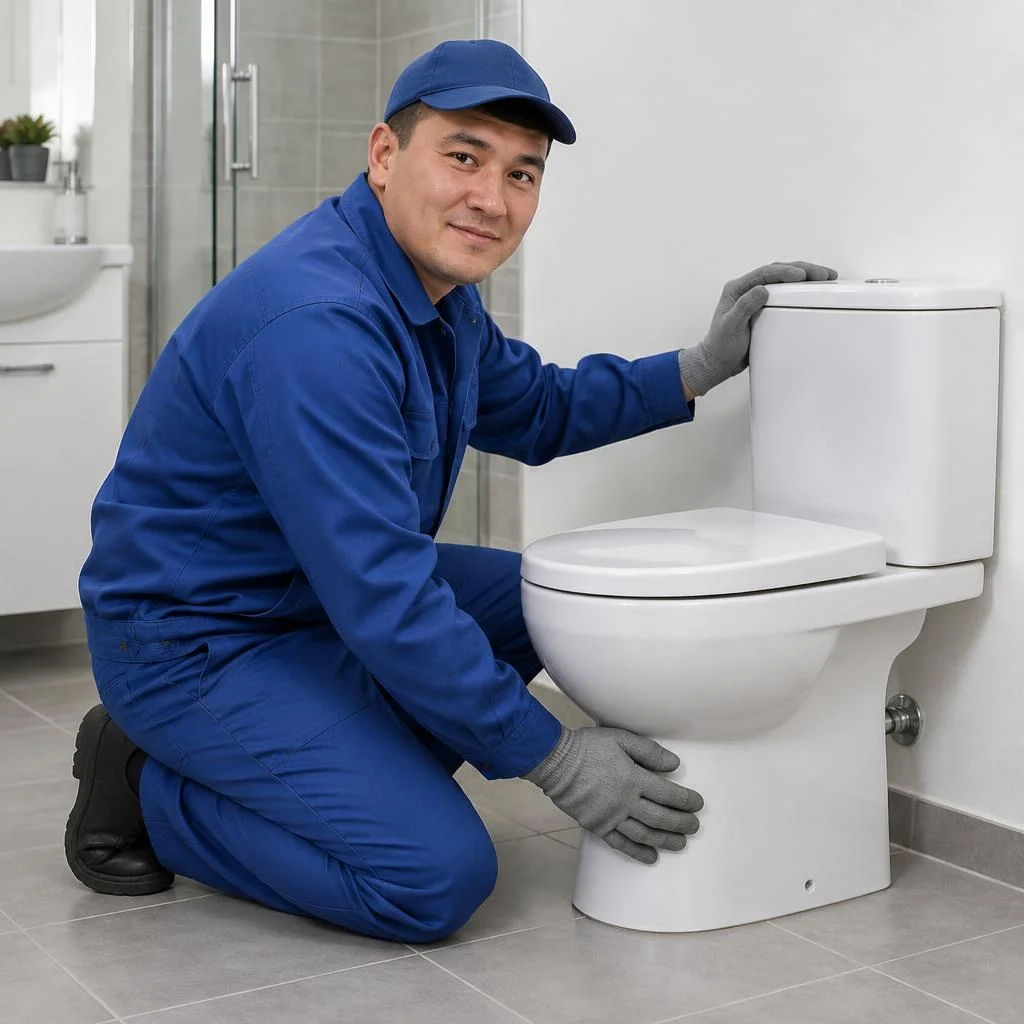
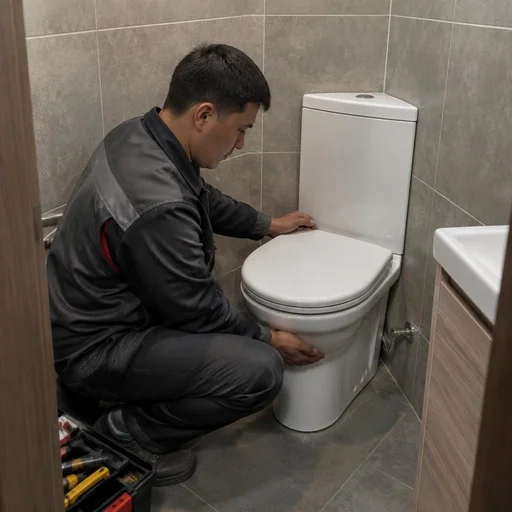
- Close-coupled toilet: the cistern is in a single body with the bowl, the most common type for apartments, installed on a floor outlet.
- Corner toilet: the bowl is turned at 45 degrees, saves space in narrow bathrooms and combined bathrooms.
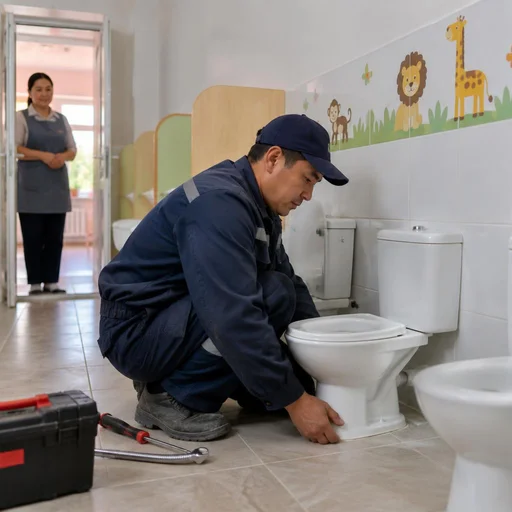
- Children's toilet: reduced height and cistern, installed in kindergartens, schools and apartments with small children.
Angled and straight outlet: how the outlet type affects installation
A toilet with an angled outlet is connected to the sewer at an angle, with a straight one — horizontally, and Eco-Service works with both types. The angled outlet is more common in Bishkek's old housing stock: there the socket is brought out at a slant, and the bowl sits flush against the wall without an adapter. The straight outlet is typical of new buildings and most modern models — the branch pipe comes out horizontally and joins the socket via a seal. The distance from the wall to the outlet axis differs by 10-30 mm between manufacturers, and the socket height from the floor varies from 150 to 220 mm. If the outlet does not match the sewer socket, the technician selects an adapter or changes the connection scheme — this can only be seen on site, which is why the model is not agreed from a photo. In search, clients often type "toilet replacement price" — and for such a query the technician first checks the slope of the socket and the condition of the cast-iron pipe, because in panel buildings of the old series the outlet is almost always angled, and the final estimate depends on the scope of dismantling. Another frequent query is toilet replacement Bishkek: it shows that the person needs not advice but a technician visit, and on site it is decided whether the standard seal is enough or an adapter is needed for the specific slope of the socket.
Comparison of toilet types by installation and connection
| Toilet type | Mounting | Installation frame needed | Installation feature |
|---|---|---|---|
| Floor-standing | to the floor | no | standard installation on the outlet |
| Wall-hung | to the installation frame | yes | installation into the wall or a box |
| Close-coupled | to the floor | no | cistern in a single body |
| Corner | to the floor | no | saves space in the bathroom |
| Children's | to the floor | no | reduced height and cistern |
For small bathrooms, a corner or wall-hung toilet frees up to 30 cm of usable floor area — enough to place a washing machine or a cabinet next to the bowl.
How a toilet replacement is done: stages from dismantling to connection
The order of work is structured as follows: shutting off the water, dismantling the old fixture, installing the new one, connecting the supply line, sealing the joint, and checking the flush. Below is what happens at each stage and how long it takes.
Shutting off the water supply and dismantling the old toilet
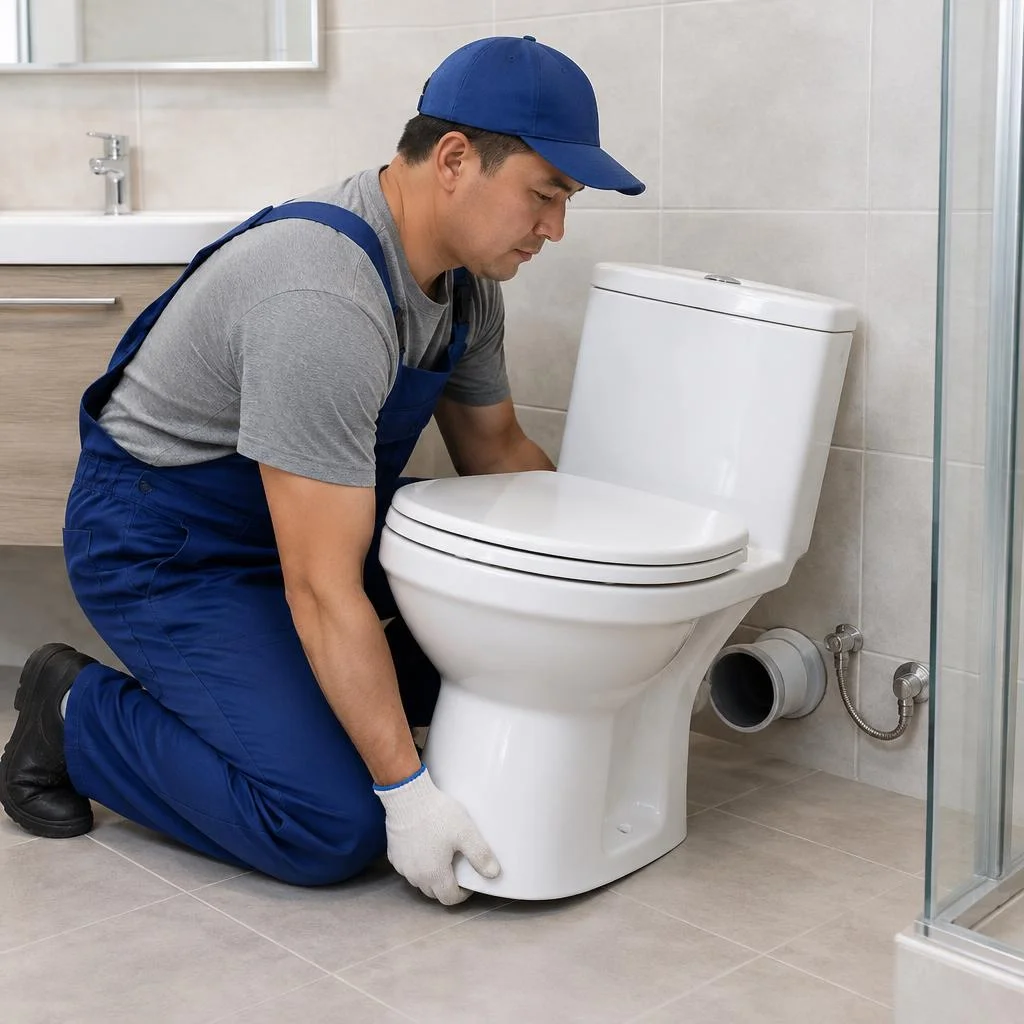
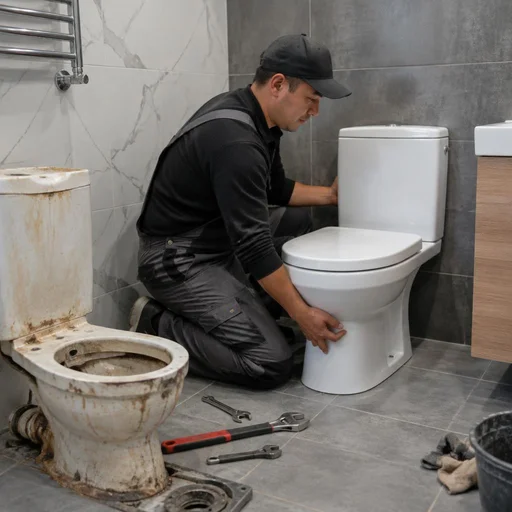
Eco-Service begins by shutting off the water supply and dismantling the old fixture — this takes up the bulk of the preparatory work. First, the technician closes the valve on the supply line and drains the remaining water from the tank, then disconnects the flexible hose, removes the fasteners from the floor, or dismantles the wall-hung bowl from the installation frame. The tank is removed separately if it gets in the way during removal. Dismantling a floor-standing model takes 20-30 minutes, a wall-hung one — up to 40 minutes due to the concealed fasteners in the frame. If the valve on the supply line doesn't hold, the technician shuts off the water at the riser — otherwise the work will lead to a leak into the neighbors' unit.
Installing the new toilet and connecting the flexible supply line
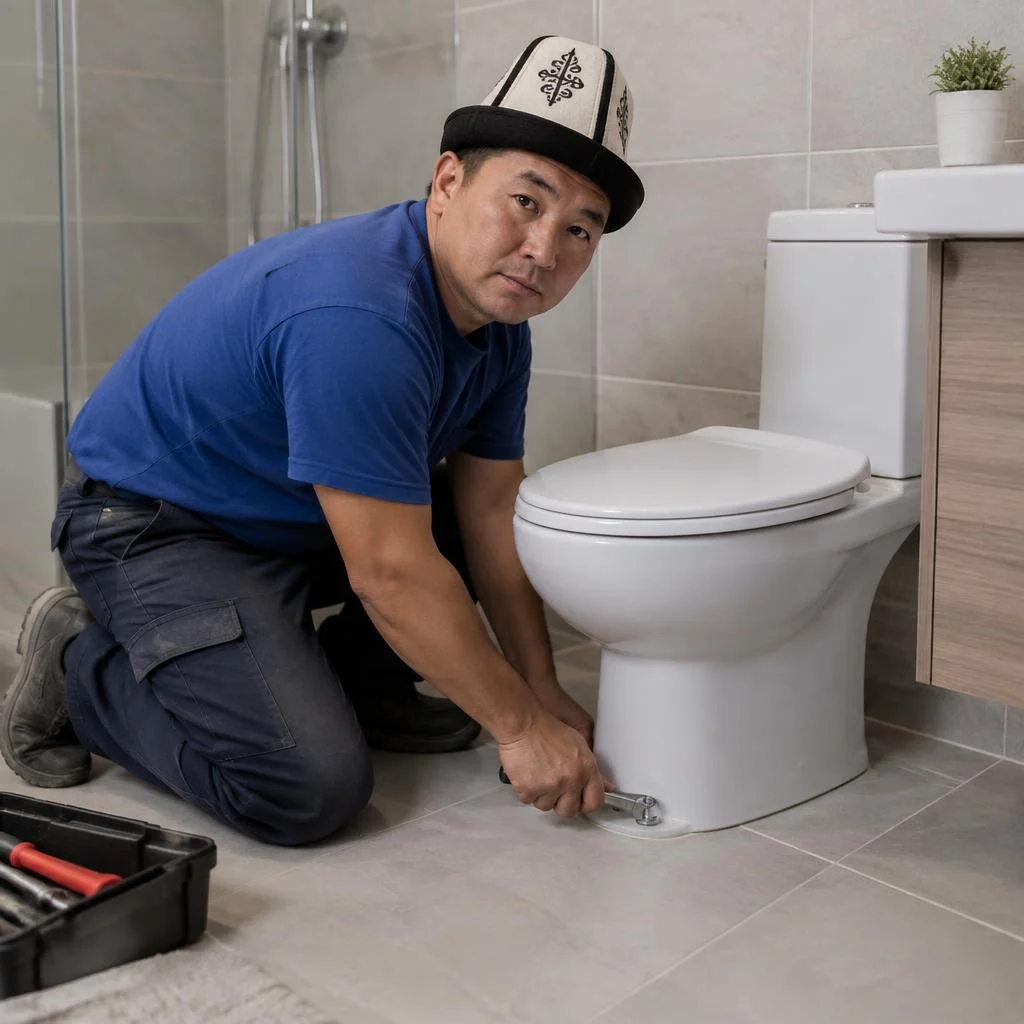
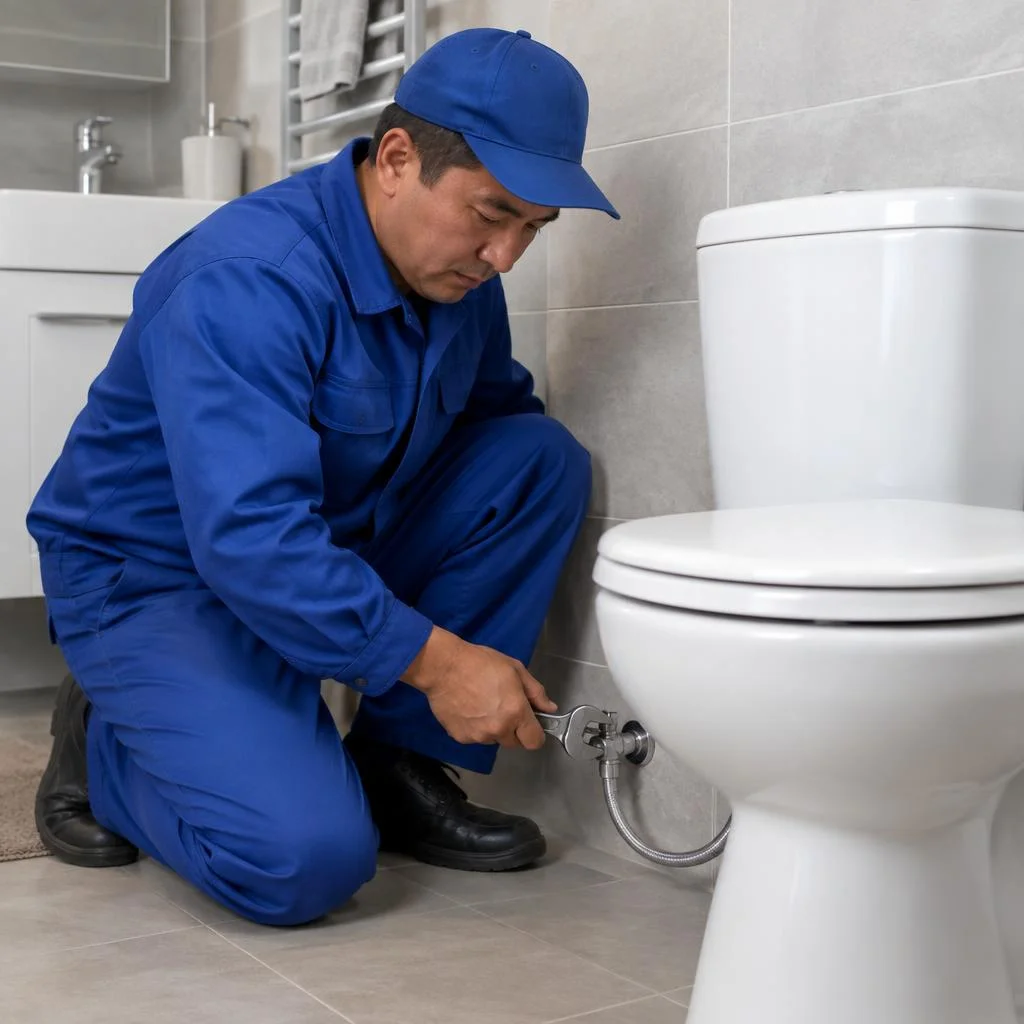
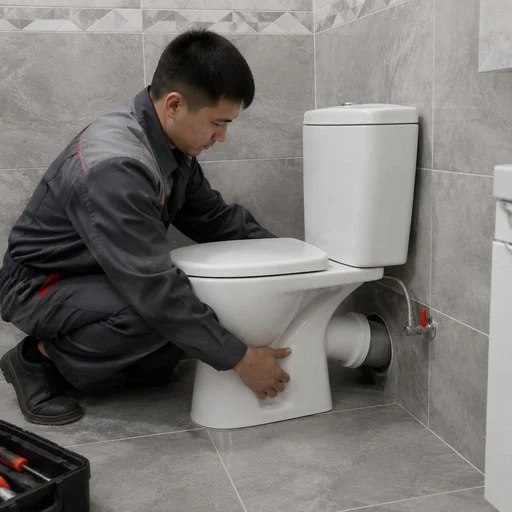
After dismantling, Eco-Service installs the new fixture and connects the flexible supply line to the tank, checking the tightness of all connections. The floor-standing model is leveled, the holes for the dowels are marked, and the bowl is fixed to the floor; the wall-hung one is hung on the installation frame's studs with height adjustment. The flexible supply line is attached to the tank's inlet valve and to the tee on the pipe, tightening the union nut without cross-threading. The gasket inside the nut is replaced with a new one; the old one is not reused. Requests to the service are often brief: replace the toilet — and the technician immediately understands the task, although in fact both the supply line and the gaskets are replaced. A flexible supply line lasts 3-5 years — if it's old, it is replaced together with the fixture, otherwise a leak will happen before the new one wears out.
Sealing the joint with the sewer and removing the old toilet
- Preparing the outlet: the bowl is removed from the socket, the chamfer is cleaned of old sealant and deposits, and the integrity of the rubber gasket is checked.
- Installing the gasket: a corrugated or conical gasket is fitted onto the outlet and lubricated with silicone for a tight fit into the sewer socket.
- Sealing the joint: plumbing sealant is applied around the entire perimeter of the outlet, not just the front — an unsealed joint lets sewer odors into the bathroom even when the flush works properly.
- Removing the old toilet: the removed bowl and tank are packed, taken out of the apartment, and disposed of — the customer doesn't need to handle disposal on their own.
How long a toilet replacement takes
A standard toilet replacement at Eco-Service takes 2-4 hours, and installation with an installation frame — up to one working day. The fastest is installing a new fixture of the same configuration: if the outlet and the fastener markings match, the technician finishes within two hours. We offer same-day emergency visits for Bishkek — requests received before noon are completed the same day, evening ones are moved to the morning. A separate case is replacing a toilet in a Khrushchevka: an old cast-iron socket, a narrow bathroom, and an offset outlet add work. Requests to the service are often brief: toilet replacement in a Khrushchevka — and the technician immediately understands what he'll be dealing with on site. If the fixture is to be replaced with the outlet relocated, the timeframe increases — the technician gives the actual time after an inspection.
Replacing a wall-hung toilet and installing the carrier frame
A wall-hung toilet is not supported by the floor but by a concealed load-bearing frame — inside the wall or in a boxed enclosure. Here everything depends on the quality of the carrier frame installation and the correct adjustment of the flush button.
Installing the carrier frame in a wall and in a boxed enclosure
Eco-Service installs carrier frames in two ways — into a wall with chasing, and into a boxed enclosure built on top of the wall. When installing into a wall, a niche is cut into the structural masonry or a drywall partition, the frame is set deep inside and plastered flush, and the bowl then hangs with no visible gap. Installing the carrier frame in a boxed enclosure does not require chasing: the frame is clad with moisture-resistant drywall and tiles, producing a neat protrusion. In Khrushchyovka and panel buildings in Bishkek, load-bearing walls often cannot be touched, so a boxed enclosure is the only lawful option. A boxed enclosure is simpler and cheaper in labour costs, but it "eats up" 15-20 cm of bathroom space — for small rooms this is noticeable.
Installing and adjusting the flush button on the carrier frame
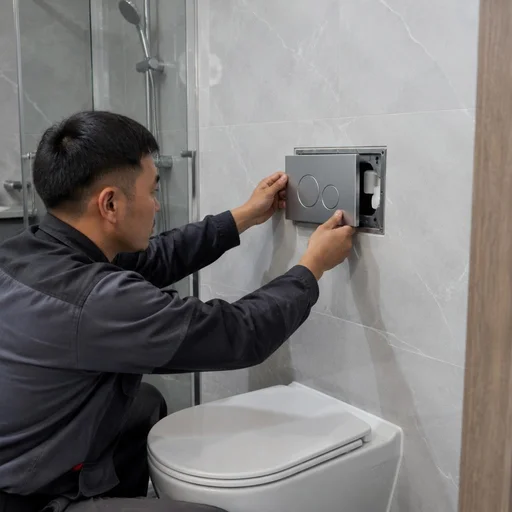
- Mounting the push plate: we fit the push plate into the carrier frame's frame and set the rods to the right length so that both halves actuate without sinking.
- Adjusting the force: after assembly we adjust the rods so that the small and large push plates are pressed with the same travel and do not stick.
- Replacing the button separately: if the mechanism has cracked or jammed, we replace only the push plate with its frame — there is no need to remove the bowl and open up the wall.
- Checking the flush: after adjustment we run the water twice — a short and a full flush — and check that the cistern fills without noise or overflow.
How replacing a wall-hung toilet differs from a floor-standing one
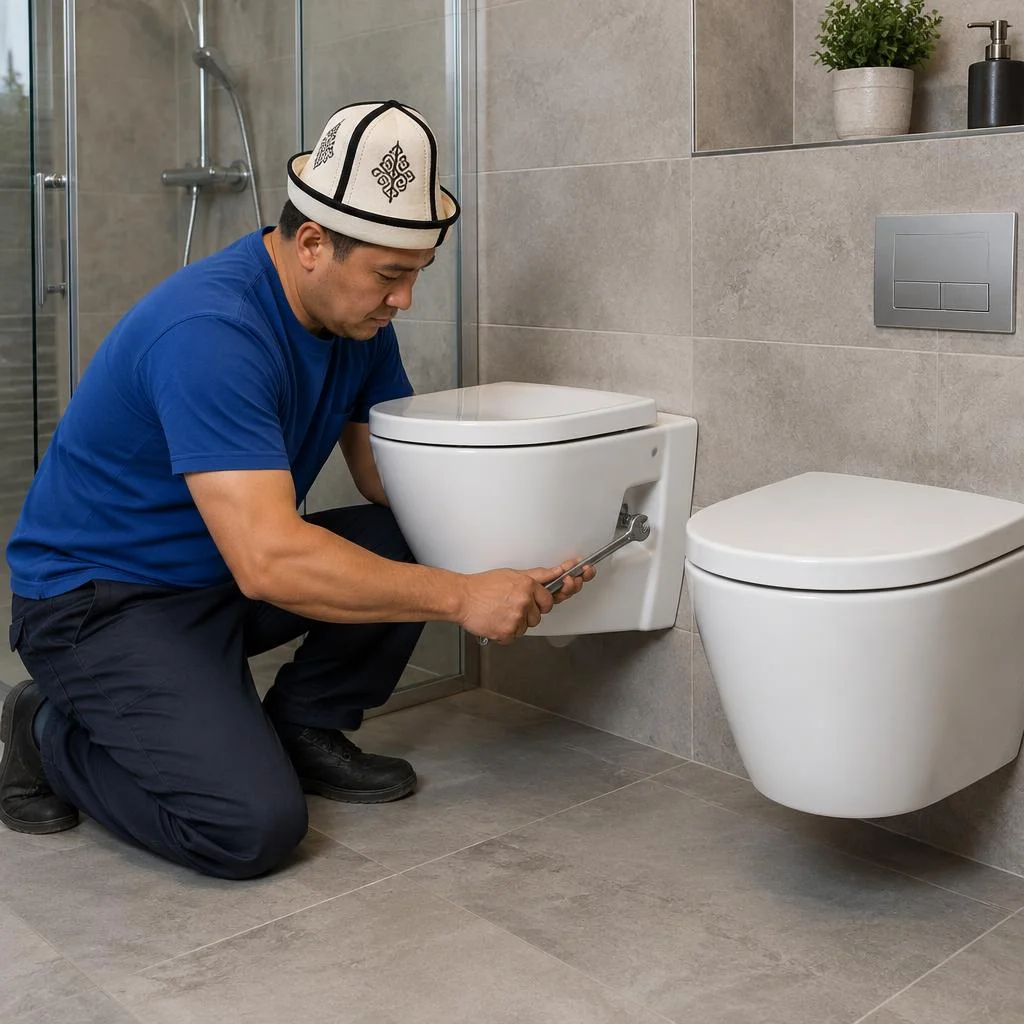
Replacing a wall-hung toilet is more complicated than a floor-standing one: first the carrier frame is dismantled, then a new load-bearing system is installed, and only then is the bowl hung. While with a floor-standing fixture it is enough to disconnect the outlet and the supply line, here you have to open up the cladding, remove the old frame and level the mounting point for the new one. Clients often describe the task in their own words: replacing an old toilet with a new one — and from that phrase the technician immediately understands the scope of work. Eco-Service installs wall-hung toilets with the load-bearing frame checked for anchor bolts and the bowl height adjusted to the residents' height. When the carrier frame is installed correctly, a wall-hung toilet can withstand up to 400 kg — the myth of its fragility is linked to fastening errors, not to the design. Installing this type costs more than a floor-standing one precisely because of the work on the frame and cladding, not because of the cost of the bowl itself.
What the standard replacement scenario includes
- Dismantling the bowl: we remove the seat and unscrew the bolts fastening it to the frame, taking care not to damage the porcelain stoneware on the wall and floor.
- Inspecting the carrier frame: we check the anchors, the condition of the frame and the integrity of the supply line — replacing the fasteners with new ones if necessary.
- Installing the new bowl: we hang the fixture on the frame's studs, level it and tighten the fasteners evenly, without skewing.
- Connecting and sealing: we connect the flexible supply line, seal the joint with the sewer and check the flush under pressure.
- Cleaning up and removal: we clear away construction dust, take out the old fixture and packaging, and leave the bathroom ready for use.
How long the work takes
Replacing a wall-hung toilet takes on average an hour to an hour and a half longer than a floor-standing one because of the work on the frame and cladding. In requests this service is often described briefly: toilet replacement — and the dispatcher only clarifies the type of bowl and the address. We schedule the technician's visit with time to spare: dismantling the old bowl and frame — about an hour, installing the new carrier frame and hanging the fixture — another two to three hours, connecting and checking the flush — 30-40 minutes. If the wall is load-bearing and chasing is prohibited, the boxed enclosure adds another hour for cladding and tiling. Installation with an offset outlet is faster in this case — the connector is fitted without re-soldering the sewer branch.
Toilet replacement in an apartment and Khrushchevka: nuances of old housing stock
A bathroom in an older apartment building differs from a new build: cast-iron pipes, non-standard outlet positioning, valves that don't hold water. Let's break down what changes in the technician's work.
Toilet replacement in an apartment: what to consider in a multi-apartment building
Toilet replacement in an apartment does not require approvals if the riser is not being relocated — such work in Bishkek apartment buildings is performed daily. Approval is only needed when interfering with the building-wide system: relocating the riser, changing the sewage configuration, combining the bathroom with relocation of the wet zone. In panel series, which make up the majority in Bishkek (105, 106, 1-464), the riser runs right against the wall behind the tank, and the outlet is brought out at a height of 180-220 mm from the floor. When installing a wall-hung frame, the technician checks the pipe positioning along the entire depth of the chase so as not to hit the riser when removing concrete. Before starting work, check with the upstairs neighbors whether they have changed the riser — someone else's modifications sometimes shift the branch, and then the new toilet won't sit in its former place without an adapter.
Toilet replacement in a Khrushchevka: old pipes and non-standard outlets
- Cast-iron outlet: becomes overgrown inside within 20-30 years, so before installation it is cleaned with a cable or the section up to the riser is replaced.
- Shutting off the water supply: the old valve on the supply line often doesn't hold — the water is shut off at the riser or a new ball valve is installed.
- Outlet height: in Khrushchevkas the branch is often brought out at 150-170 mm; a toilet with an angled outlet is selected for it.
- Fastening to the floor: in old floor slabs drilling is difficult, anchors are chosen shorter so as not to pierce through the slab.
Water quality in Bishkek and choosing a toilet model
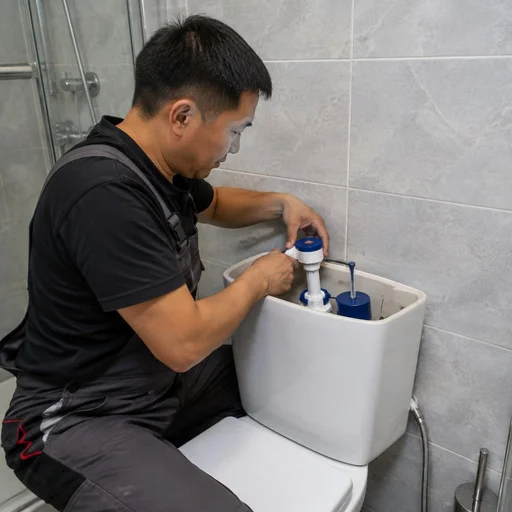
Hard water in Bishkek forms scale on the tank valve more quickly, so models with an accessible valve for cleaning are easier to service. Hardness salts settle on rubber membranes, the valve seat and the flush button: with concealed fittings, the valve can only be reached through the installation hatch, while with a classic close-coupled toilet — after removing the tank lid. Clients often phrase their request briefly — toilet replacement cost — and the technician immediately understands that the person needs not only installation but also a clear estimate by component. Replacing a toilet in an apartment with hard water more often requires not repair but cleaning — once every 6-12 months the valve is removed and soaked in a citric acid solution. Floor-standing toilets with exposed fittings are more convenient in this sense: access to the mechanism does not require dismantling. If the tank valve has become overgrown with scale, the flush weakens — a simple cleaning of the valve restores the pressure without replacing the component.
What is included in the turnkey service and how we calculate the scope of work
"Turnkey" means that the customer does not participate in the process: the technician shuts off the water, removes the old fixture, installs the new one and cleans up the debris. Let's break down the composition of the work and what its scope depends on.
What is included in a turnkey toilet replacement
- Shutting off the water supply: we close the valve or the riser, and drain the remaining water from the tank before dismantling.
- Dismantling the old toilet: we remove the fixture from its fasteners and disconnect the outlet from the sewer socket.
- Installing the floor-mounted toilet: we level it, secure it to the floor, and connect the flexible supply line to the tank.
- Sealing the joint: a gasket or silicone at the connection to the sewer — no odors and no leaks.
- Removing the old toilet: we pack up and carry out the fixture so the bathroom stays clean.
How the technician determines the scope of work on site
The technician determines the scope of work after an inspection: the type of toilet, the condition of the pipes, the connection method and whether a concealed cistern installation is needed. The cost of the service depends on the outlet — an angled one requires fitting the socket, a straight one is installed without rework. The price increases if the old fasteners have seized to the floor or the porcelain tiles: removal takes twice as long. The height allowance of the supply line is also taken into account — if the hose is too short, it is replaced together with the tank fittings. The final amount is based on the number of operations, not on the model of the fixture. When searching, customers often type in "toilet replacement price" — and land on our page describing the composition of the work. Eco-Service separately performs flush button replacement and flush button adjustment — the technician checks these works after installation, before leaving. Some people simply search for "toilet replacement price" — and from such a query the technician immediately sees that both installation and an estimate based on an on-site inspection are needed.
Turnkey toilet replacement: what to clarify before the technician's visit
Turnkey work begins with one question: does the customer buy the fixture, or does the technician bring a model from the warehouse. If the toilet is purchased independently, the completeness of the kit is checked before installation — missing fasteners, gaskets or a seal are discovered on site and resolved before work begins. In this case the price does not change, but the timeline shifts: someone will have to go to the store to buy the missing parts. When the technician brings the fixture, the selection is made to match the outlet and the dimensions of the bathroom, and all consumables are already included. Many phrase their request as "replace toilet price" — from such a query the technician immediately understands that both installation and an estimate based on an on-site inspection are needed.
2-year warranty, timelines and Eco-Service support
Warranty obligations, response speed and who exactly performs the work — these are the three questions a customer asks before installation begins. Let's break down how the service support of a direct provider is structured and how it differs from an intermediary scheme.
2-year warranty on toilet replacement work
Eco-Service provides a 2-year warranty on all toilet replacement work — from dismantling the old unit to connecting the flexible supply line and installing the concealed cistern frame. The term is the same for floor-mounted, wall-hung and corner models, for close-coupled units with an angled or straight outlet, for children's toilets and for installing a concealed frame in a wall or a box. The coverage extends to the tightness of the connection to the sewer, the operation of the flush button, and the reliability of the bowl's attachment to the floor or to the installation frame. If a leak appears at the connection point or the flush weakens, the technician will come under warranty and eliminate the cause. In our practice, most warranty claims are related not to installation but to the wear of old cistern fittings — in this case the technician diagnoses it on site and explains exactly what has failed. Customers often search for "toilet replacement price" in the search bar, although what they essentially need is the same installation with a warranty.
Own service center in Bishkek and direct provider
Eco-Service is a direct provider of the service with its own service center in Bishkek: the work is performed by in-house technicians, not by contractors from aggregator platforms. The customer knows in advance exactly who will arrive and does not encounter a situation where different contractors with different quality levels show up at the same address. An in-house technician follows a single procedure: shutting off the water supply, dismantling the old unit, carrying it out, installing the new one, connecting the flexible supply line, sealing the connection, adjusting the flush button. If you are comparing how much installation costs from different contractors, consider not only the rate but also who bears responsibility for the connection a month after installation. Through the service center it is easier to file a warranty claim: the request goes to the same provider who performed the work, not to an intermediary. Most often the query is "how much does toilet replacement cost" — and the answer depends on the condition of the outlet and pipes, not on who will arrive.
Same-day emergency response and service area
Eco-Service responds to emergency toilet replacement on the day of request across Bishkek, and schedules planned work at a convenient time. If the flush does not work at all or water leaks from the connection, the technician arrives with a spare flexible supply line and sealant — so the work does not have to be postponed to a second visit. The service area covers all districts of Bishkek, including remote residential areas. The technician quotes the toilet replacement cost after inspection: it is affected by the condition of the outlet and pipes, not by the urgency of the visit. Clients often ask how much a plumber charges for urgent toilet replacement — in the estimate this is reflected only in the arrival time, not in the list of operations. Many ask for the cost to replace a toilet even before diagnostics, although a non-standard outlet in older housing stock sometimes requires an additional part.
Conclusion
We have gathered the main factors that affect the result and timelines: from the type of unit to the condition of the old pipes. Below are brief conclusions that will help you plan the work and choose a contractor.
Key takeaways
- Type of unit: a floor-mounted, wall-hung, close-coupled, corner or children's toilet determines the mounting method and whether a concealed frame is needed.
- Full cycle: the work includes shutting off the water, dismantling, installation, connecting the supply line, sealing the connection and carrying out the old unit.
- Older housing stock: in a Khrushchevka building there are additional nuances — cast-iron pipes, non-standard outlets, faulty valves.
- Concealed frame: a wall-hung model requires mounting the frame in a wall or a box, which increases the scope and duration of the work.
- Contractor: a warranty on the work and having its own service center are the key selection criteria.